New Suntory Commercial in Japan Featuring Engaged Dads Draws Praise

Much like Uniqlo’s commercial featuring an LGBTBQ+ couple a couple years back, Suntory’s advertisement for their Premium Malt’s drink is creating a buzz not so much over the actual product, but for the story it tells. Titled “Silent Fathers” (無言の父たち; Mugon no chichitachi), the CM shines a spotlight on the dads raising their kids while balancing work, and the interesting camaraderie, or lack thereof, between fellow dads.

No Title

No Description

The Suntory CM stars Abareru-kun and YouTuber Hiroaki, who runs the popular family channel おうちごっこ (O-uchi gokko) with over 848,000 subscribers.

The humorous commercial follows the daily life of a working father, portrayed by comedian Abareru-kun (あばれるくん). He drops his kid off at school, bikes to work on a mamachari, falls asleep in a department store, and plays at the park.

None of the other fathers portrayed talk to each other. But the looks exchanged between them, wavering between understanding and bashfulness speaks volumes – raising a kid isn’t a walk in the park, but it’s worth it. This lack of outspoken unity among them is best juxtaposed by the group of mothers chatting happily away while the dads walk off in different directions.

The commercial ends with the couple cracking open cans of Suntory Premium Malt after the father successfully puts their child to sleep [1].

All Too Relatable

The commercial drew positive responses on X (formerly Twitter), with the company’s tweet garnering over 62,000 likes and numerous comments like “I can totally relate.” One comment read, “I teared up a bit at the last scene.”

Others were quick to dismiss the notion that there’s no camaraderie between dads. “I take fellow preschool dads out to go drinking, and have them over to my house for barbecues,” one user wrote [1].

Users were also surprised the CM never once showed a child, despite the focus on fatherhood and child-rearing. Turns out there’s a good reason for that. Japan’s Alcoholic Beverage Advertisement Screening Committee (酒類の広告審査委員会) has a rule prohibiting minors under 20 years of age from appearing in advertisements promoting anything booze-related [2].

Abareru-kun, himself a real-life father, found himself relating to each and every scene. “The department store scene in particular, where I appear to nod off, was something I’ve experienced before, so I totally got it,” he said [1].

A Suntory spokesperson spoke to Netorabu about focusing on fathers for this project:

We have both mothers and fathers on our team, and over the course of numerous discussions with them, learned about the characteristic awkwardness in how fathers approach child care, or when they’re with other fathers. Even after listening to opinions from mothers, we thought this would be something that not only fathers, but also the mothers who encounter this, could sympathize with [2].

Yuka, who not only plays the main wife in the commercial but is also Abareru-kun’s real-life wife, commented, “I had to laugh because the emotional and physical distance between the dads sending their kids off to kindergarten is so accurate. I chat with the other moms, but not so much with the dads. Yet there’s a sense of shared understanding when we do say a few words to each other.”

More of This, Please
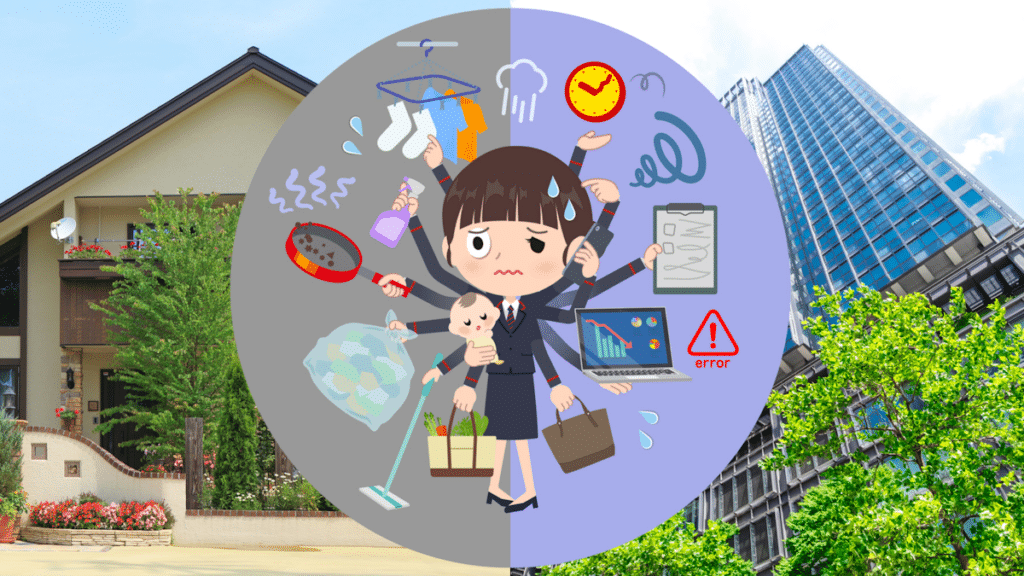
Woman stressed out from balancing work/life
Picture: とよとよ / PIXTA(ピクスタ)

The commercial is undoubtedly a reality more mothers would love to see from their husbands. A new survey on housework reported only 9.4% of men surveyed helped with child-rearing. A controversial pamphlet aimed at new mothers shows that some dads still expect their wives to do the brunt of the work raising children while still meeting their (often selfish) needs. And for the fathers who do take time off work to be with their kids, they may find themselves subject to paternity harassment in the form of a job transfer.

The emotional and physical distance seen between dads in the CM also touches upon another reality: making dad friends isn’t as easy as it seems. In a 2021 survey by Papa Shirube, 56.1% of respondents agreed with the importance of having fellow dad friends, but over 52.6% said they didn’t have many, with 14% not having any friends at all [3]. For those with dad friends, 30.7% met at their kids’ schools.

Clearly, there’s a need and drive for tight-knit dad groups. But how to foster more of that when the government already has a dismal track record of encouraging couples to even have kids?

Certainly, as the CM shows, raising kids isn’t easy. But Japan could do a lot more to make it easier for all parents.

What to read next

Survey: Japanese Women (Still) Do All the Housework

Sources

[1] 「最後のシーン泣ける」「わかりみが深い」。あばれる君が演じる「パパ同士の絶妙な距離感」を描いたウェブCMが話題に. HuffPost Japan.

[2] よく見ると子どもが1人も映ってない……! あばれる君の“プレモル”新CMが話題、なぜこうなったのか聞いてみた. Netoraba.

[3] パパ友は9割が必要と回答!パパ友の作り方やメリットはどんなところ?. Papa Shirube.

These Uncommon Kanji May Surprise You!

The Japanese government sets policy for what kanji are jōyō– in standard use. These have evolved over the past century, starting from the institution of tōyō kanji and shinjitai (new character form) in 1946, and continue to evolve over time.

But there are many more hyōgai kanji— that is, kanji outside the list. What is the history of this? And what are some interesting and salient examples of hyōgai kanji?

Historical evolution

Dai Kan-Wa Jiten
The Dai Kan-Wa Jiten – Great Dictionary of Sino-Japanese Characters – in all its glory. (Picture: Amazon.jp)

In order to understand hyōgai kanji, we need to back up and understand the origins of modern jōyō kanji.

Shinjitai, the simplified modern form of kanji, dates to 1946, by authority of the Japanese Ministry of Education on 16 November 1946. Then Minister of Education Abe Yoshishige oversaw the promulgation of the 1946 era Tōyō kanji— Kanji in Current Use. This was the origin of what grew into the current list of jōyō kanji.

From a starting count of 1850 kanji as of 1946, the number grew to 1945 kanji in 1981. As of 30 November 2010, the Ministry of Education, Culture, Sports, Science, and Technology (MEXT) revised the list again, to 2136 kanji, with 196 new jōyō kanji added and the removal of 5.

Whatever isn’t jōyō kanji is considered hyōgai kanji— that is, kanji outside the listing. This is a very broad category, so there isn’t a complete listing of them. Some are jinmeiyō (name usage) kanji, though there are many Japanese names that one can spell with jōyō kanji alone. Some are also historical kanji, yes, but many more are obscure and mostly unused characters.

Niigata native Morohashi Tetsuji’s epic, multivolume opus Dai Kan-Wa Jiten is one of the preeminent resources cataloging characters of all kinds. It was a decades-long labor that was waylaid by partial destruction during the World War II bombings of Tokyo, though it finally saw publication starting in 1955.

Dai Kan-Wa Jiten was an endeavor so monumental that Morohashi was decorated by the Japanese government with the Order of the Chrysanthemum in 1957 and the Order of Culture in 1965. It has entries for over 50,000 characters.

But what are some noteworthy examples of hyōgai kanji that you might already be familiar with? Here are a few for your consideration.

Some examples

Moe/anime-style in a red and white dress sitting and holding her hands  character
Picture: ビショップサクライ / PIXTA(ピクスタ)

Arguably the best-known hyōgai kanji in modern pop culture is 萌. This is moe, the ubiquitous anime concept of cuteness or crushing on a character. Interestingly, it’s also the verb for “to sprout.” Those familiar with kanji will perhaps be less surprised by this– it has the grass radical 艹 on the top.

Taka 鷹 is one I know because of its historical usage. One of the common pastimes of daimyo in the Edo period was falconry, whose Japanese name– takagari 鷹狩– uses this kanji. Today, however, this kanji is perhaps best known for the toponym Mitaka 三鷹, one of the cities in the Tokyo metropolis. It shares its name with Mitaka Station, a JR East rail station in the city.

Ame 飴 is a kanji you might know from Japanese confectionery. At a glance, it might be easily confused with 餅、the kanji for “mochi.” Ame roughly corresponds to candy, rather than baked goods. A famous example is that of 金太郎飴、candy whose cross-section depicts the folk hero Kintarō. But be careful not to be called Kintarō-ame like, as that’s equivalent to calling someone a cookie-cutter rendition or a carbon copy.

喋 is shaberu– something that’s common in spoken Japanese, as it means “to chat.” In written form, one often encounters it rendered in hiragana, but yes, it does indeed have a kanji form. Be careful you don’t write this in katakana, though, as that’s the transliteration of “shovel.”

絆 is another one that is a familiar enough term in spoken Japanese, but perhaps a bit less commonly known in its kanji form. Kizuna is the term– connecting bonds, the ties between people. The radical to the left– “thread” 糸– is a clue for how to recognize it. 

Finally, fascinatingly, is the kanji 嘘. The word is simple enough, and common enough– “uso,” meaning “lie.” But ordinarily, one encounters it in hiragana rather than kanji form. Still, it does have a kanji form– and that, you can rest assured, is no lie.

Conclusion

What is and isn’t jōyō kanji is constantly evolving. It will continue to evolve, as the Japanese language itself evolves and changes. But jōyō kanji are ultimately decreed by the government. And as these hyōgai kanji show us, there’s no shortage of other kanji that remain regularly used.

Sources