Why Japan Forbids Bus Drivers From Greeting Each Other

People in Japan were surprised recently to find a rule that many didn’t know existed: a restriction around bus drivers greeting one another as they pass by. As it turns out, however, this rule is just as often broken as it is followed.

Keep your eyes on the road, buddy

Hand pointing to a warning sign
Picture: 78create / PIXTA(ピクスタ)

Japan has a reputation for rules and regulations. Often, people in charge enforce these without exception or flexibility. We’ve written in detail how schools tend to enforce regulations such as restrictions on sunscreen even during the hottest days of the year. Schools have also been subject to online backlash in recent years for outdated rules around hair color.

Now, local media is reporting on a rule involving bus drivers that many never knew existed. Most companies forbid bus drivers of all stripes from greeting one another as they pass by on the road.

The site Kuruma no News (Car News) explains why this rule exists. The head of the Nihon Bus Association (NBA) tells the site that it stems from a recommendation in the national guidelines set by Japan’s Ministry of Transportation.

The Ministry saddled the tome of recommendations with the weighty title 自動車運送事業者が事業用自動車の運転者に対して行う一般的な指導及び監督の実施マニュアル (roughly: Manual for the Standard Guidance and Conducting Supervision for Drivers of Vehicles for Transportation Companies). In the manual, it states:

すれ違う同社の運転者にあいさつ(挙手挨拶)されるなど、運転に集中できない状況も生じます。乗客の安全を確保するためには、走行中は運転に集中させましょう。

Driver’s attention can become diverted when two passing operators greet one another (raising hands in greeting). Operators should focus on driving when in motion in order to guarantee the safety of passengers.

If you know Japanese and have trouble sleeping one night, you can download the full PDF here. Tantalizing stuff.

Does the rule save lives?

This isn’t a new rule. The manual dates back to 2001 (Imperial Year Heisei 13), which means this has been on the books for over 20 years. It’s just that, until recently, few people who weren’t bus drivers knew about it.

Many on social media were shocked to learn this rule even exists, with some asking “is this necessary?” and “what harm can a little greeting cause?”

Of course, not all rules are purposeless. We all live by many rules that save countless lives every day. And some would argue that this is one of them. In 2003, a bus driver greeting another bus driver failed to notice a pedestrian, striking and killing them. So, arguably, this is one rule that should stay on the books.

Breaking the rules…with KINDNESS

Bus driving through two huge snow piles that dwarf it by close to three times the height of the bus
Picture: kazz zzak / PIXTA(ピクスタ)

As it turns out, a study released in early August shows that not every driver is on board with the rule. The Ministry of Transportation’s Committee Investigating Commercial Driving Accidents says it’s discovered that half of all drivers flout the rules and give each other a little wave or a nod as they pass by.

Sakai Hirokazu, head of the Committee, told TBS news that drivers probably “think this is an extremely light means of telling each other, ‘good work.’ But it can lead to blind spots when it comes to safety.”

Sakai said the Committee wants to educate drivers better on the possible dangers of greeting each other. Supervisors in the industry interviewed by Kuruma no News also agreed, saying bus companies should work to ensure bus drivers realize how a little wave can turn quickly into a deadly situation.

What to read next

School Segregates Black Japanese Student at Graduation Over Hair

Sources

バス運転手の「すれ違いの挨拶」禁止の理由は. Kuruma no News

事故に繋がる“危険行為” バス運転中の“挨拶”依然横行 覆面調査で半数確認 都営バスでは20年ほど前から“挨拶”を禁止. TBS News Dig
Japan Women’s Org Colabo Scores a Court Victory Against Harassment

A few months ago, we reported on the vicious harassment campaign against the women’s support organization Colabo and its founder Nito Yumeno. The main instigator is YouTuber and ex-game developer Himasora Akane, who continues to accuse Colabo of misusing public funds.

Fortunately, there’s now more public awareness of and support for Colabo’s plight. Colabo finally achieved a minor victory when the court threw out a rather nonsensical lawsuit filed by Himasora last year that all began with a YouTube copyright claim [1].

A Rather Ridiculous Lawsuit

Scales of justice - Colabo lawsuit follow-up
Picture: bee / PIXTA(ピクスタ)

The defendant in the lawsuit actually wasn’t Colabo, but the anti-discrimination group called Norikoe Net (のりこえねっと). They’re also no stranger to court.

In 2018, co-chair Shin Sugok sued DHC Television for defamation over a 2017 “News Girls” program segment. The segment covered Okinawa’s anti-air base movement. It unfairly labeled activists “terrorists” and “extremists” and painted Shin as the “mastermind inciting a radical opposition movement.” The ensuing harassment spurred Shin to sue, and she finally won her case this May [2].

So how did Norikoe Net get caught up in Himasora’s rampage against Colabo? According to the 4-page court decision, Himasora used portrait photographs of Nito in two YouTube videos he uploaded on December 13th, 2022. Norikoe Net hired a photographer to take the photos in 2020 and ostensibly owned the copyright. On the 19th, Norikoe Net filed a copyright claim through YouTube, which took down the videos.

Himasora took the reactionary route and filed a lawsuit against Norikoe on the 23rd, a mere five days after the video takedown, claiming spiritual distress. Bizarrely, he tried to claim the video takedown was illegal because no copyright was ever infringed upon in the first place.

Himasora argued that Nito must own the copyright since she provided the photos to Asahi Shinbun for an article. However, Nito confirmed she obtained permission from Norikoe Net to use the photos, voiding Himasora’s allegations [3].

Purposely Wasting Time and Resources?

Aside from the initial complaint, Himasora’s team submitted no evidence or rebuttals. They didn’t even bother showing up to the courthouse. Norikoe Net and Nito went through the trouble of hiring lawyers and submitting proof of copyright ownership, even bringing in the photographer.

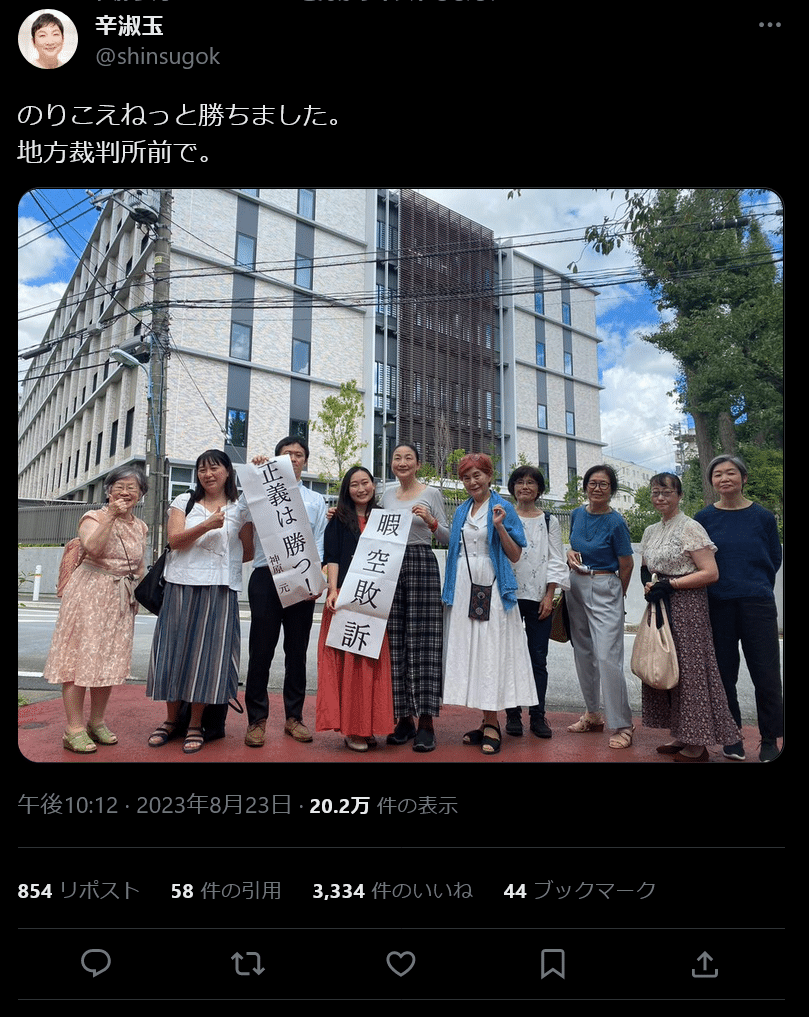
Finally, on August 24th, the court confirmed Norikoe Net as the copyright owner and dismissed Himasora’s inflammatory lawsuit.

Nito poses with Norikoe Net and lawyers following the court’s dismissal of the lawsuit (Source: X (formerly Twitter))

The case frustrated everyone involved, especially Norikoe Net’s defense team. Right from the start, it seems Himsora didn’t take the lawsuit seriously and even purposefully obfuscated progress. Mr. Kanbara, one of Norikoe Net’s lawyers, said Himasora failed to send a revised official complaint to the court until two months after the initial claim.

Himasora also claimed online that he mailed an official complaint to Norikoe’s office, but they never received it. Instead, out of the twenty or so board members, he sent it to Ueno Chizuko. Yes, that Ueno Chizuko.

More lawsuits coming

If Himasora’s goal was to waste everyone’s time and resources, then he certainly achieved that. “The trial itself has turned into a game,” stated Kanbara. “The reason why we’re able to do this [fight back] is through crowd-funding. But no matter how much he loses in the trial, Himasora himself won’t be harmed.”

“What is certain is that he used Norikoe Net to strike out at Colabo,” Shin stated. Because of the situation, Shin stated that they’ll sue Himasora for other copyright infringements.

“Himasora says if he has to appear for questioning, he wants a partition screen because he feels he’s in danger,” Nito said. “Yet we are the ones who’ve suffered from his harassment through rumors, death and rape threats, and strange men showing up at our homes. We intend to fight him head-on” [4].

Colabo helps young girls on the streets with nowhere else to turn, providing them basic necessities and resources to rebuild their lives. Learn more about them (English) and how you can support their mission.

What to read next

Colabo, Other Japan Women’s Groups Enduring Targeted Harassment

Sources

[1] 暇空茜さんの訴えが棄却される → 提訴時はめちゃくちゃ盛り上がっていたのに……. Yahoo! News Japan.

[2] 「『ニュース女子』は虚偽」、辛淑玉さんの勝訴確定. Yahoo! News Japan.

[3] のりこえねっとがYoutuber暇空茜氏に勝訴した事件の判決. Musashikosugi Godo Law Office.

[4] 『緊急報告 暇空裁判 判決』 2023年8月24日 14:30〜. YouTube.