Japan’s Police Get With The Times By Getting Rid of Skirts
Japanese society has grown more attentive to women’s rights in recent years. However, institutions can be slow to catch up. Mimicking decisions made by local police forces, Japan’s National Police Agency is taking a leap forward by updating its fashions for female police officers.
As covered by FNN, Japan’s National Police Agency, which sets guidelines and regulations for the country’s 47 prefectures, is updating uniform guidelines for the first time in 31 years. The move includes retiring the use of skirts for female officers. The move will go into effect in April 2025 and apply to the 260,000 uniformed offers across the country, of which around 10% – 20,645 – are women.
The move follows a similar one by Kanagawa Prefecture in February of this year. The prefecture updated its own uniform guidelines to stop issuing skirts after a survey showed that most female officers found them too impractical for chasing down suspects.
Skirts for female officers is an artifact of an era where women officers were considered at best eye candy or at worst amusement for male officers, a view that kept most of them sidelined in traffic control jobs. Up until 1994, female officers could only wear slacks during the winter. The NPA says it’s received regular feedback from both male and female officers wondering why uniforms are still gendered.
The NPA guidelines will also update other aspects of the uniforms to make them align between genders. For example, rank insignia on lapels and the police symbol on hats are currently smaller on women’s uniforms. The new regulations will make them the same size regardless of gender.
There’s something for the men in the NPA’s updated guidelines as well. As part of the change, the new guidelines will issue polyester polo shirts that officers can wear in the summer. Caps will also be outfitted with mesh on top. Caps and badges will also now be washable.
Comments on Yahoo! News JP seem mostly in favor of the change, with many agreeing that it makes sense for officers – all officers – to have clothing that fits the job. With women in Japan still facing harassment in the workplace and even during job interviews, it’s nice to see most people agree that this is a positive change.
Survey: 52% of Young Japanese Don’t Want Kids
Japan is struggling to counteract a rapidly declining and aging population. A new survey shows that, if trends continue, the country won’t be able to depend on its youth to rescue it – at least unless both economic and working conditions improve.
A cash-strapped youth that doesn’t want kids
The survey, run by a research team led by Nihon University’s Suetomi Kaori, collected responses from 4,000 young people online across the country, with all respondents being between ages 15 and 39. The team conducted the survey from February 13th to the 27th. Suetomi recently released the results via ResearchMap.
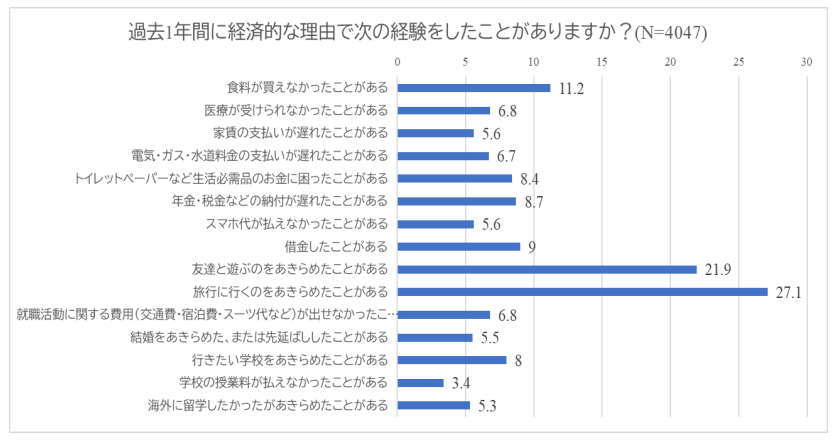
The survey wasn’t just about children. Titled “What Privations and Challenges Does The Young Generation Between 15 and 39 Face – And What Are Their Policy Needs?”, it asks various questions, such as what economic difficulties young Japanese have faced in the past year. 27.1% reported not being able to go on a trip they wanted to go on, while 21.9% said they had to give up on plans with friends. Depressingly, 11.2% reported there were times they couldn’t afford food.
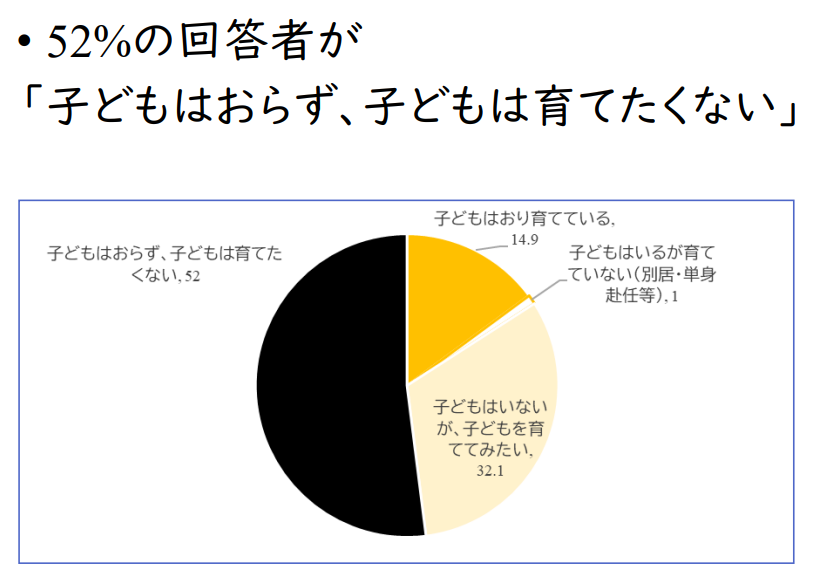
But the stat drawing the most headlines in Japan right now relates to kids. 14.9% of respondents said they have kids, while 32.1% said they didn’t have kids but wanted them. However, a full 52% said they didn’t have ’em and didn’t want ’em.
Of those who answered they didn’t want kids, the percentage where the respondent made under 2.99 million yen (USD $20,020) a year and the household made less than 3.99 million yen ($26,716) was 60%. Interestingly, however, that number drops to a little under 40% for women between the 30-34 and 35-39 age brackets.
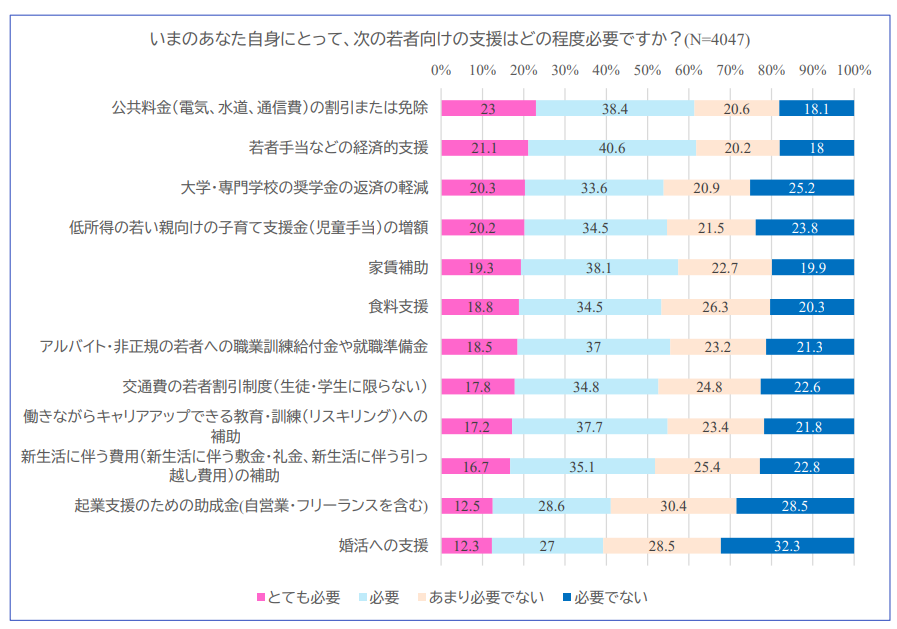
The survey also asked young people what they thought they needed in terms of government strategy. The top answer was a financial stipend for youth (61.7%; 21.1% replying “very necessary,” 40.6% replying “necessary”). The next top results were a discount or exemptions from paying public utility fees (61.4%; 23/38.4), rent subsidies (57.4%; 19.3/38.1), and subsidies to part-time and contract workers for job training and job prep (55.5%; 18.5/37).
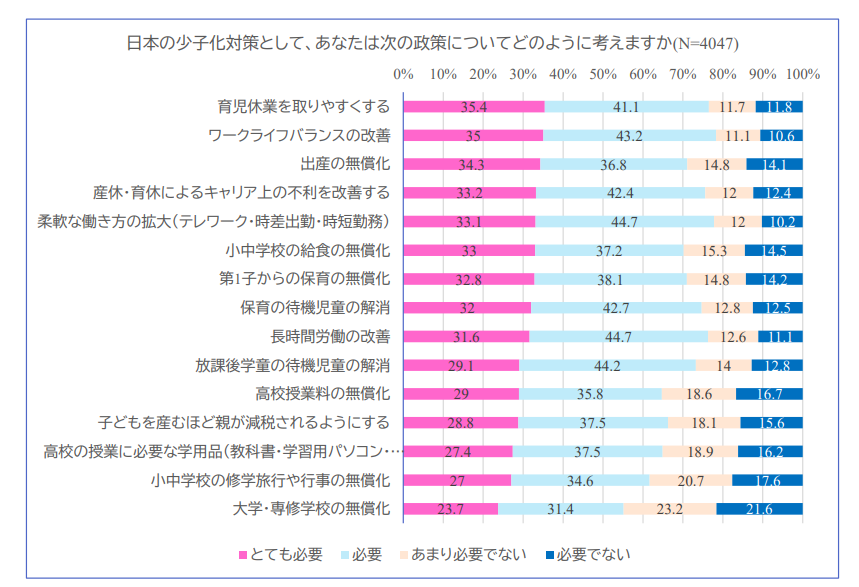
What do young people think the country should do to encourage people to have more children? The answers here were very enlightening, as they weren’t directly economic. 78.2% want better work-life balance (35/43.2). Meanwhile, 77.8% want better flexible working options, like remote work (33.1/44.7), and 76.5% said it should be easier to take parental leave (35.4/41.1).
Additionally, overwork in general is a chronic issue, to the point where death by overwork (過労死; karoushi) is an official cause of death entitling a victim’s family to compensation.
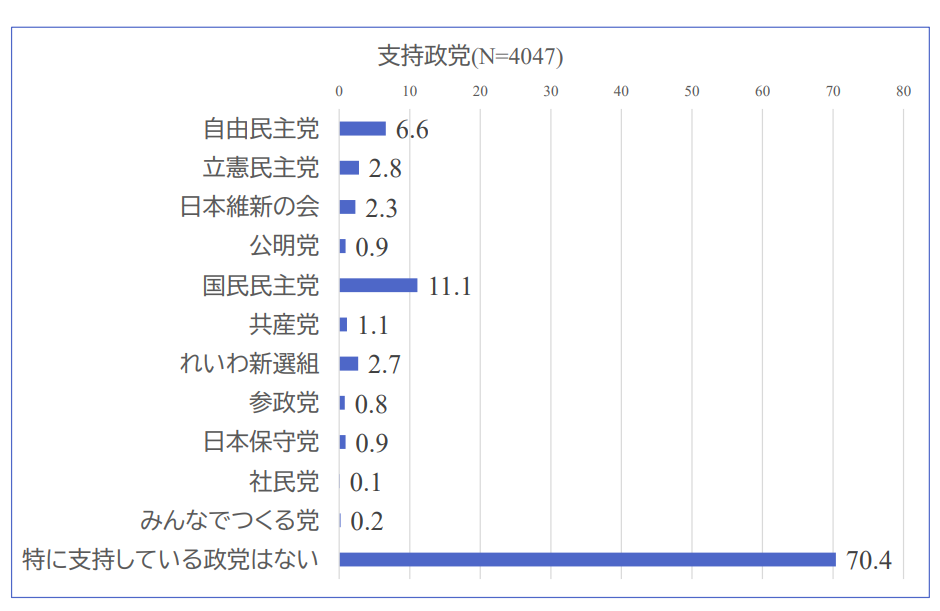
However, the report shows that young people don’t have confidence in Japan’s political parties to deliver on these strategies. Of those surveyed, 11.1% said they supported the rising Democratic Party for the People (DFPF). 6.6% support the majority and conservative-leaning Liberal Democratic Party (6.6%), while only 2.8% support the largest opposition party, the Constitutional Democratic Party (CDP). A whopping 70.4%, however, said they don’t support any party.
The childless don’t want to spend money on kids
I’ve written before how the trend towards singles culture in Japan – and towards people deciding to remain childless – could potentially become a vicious cycle. I.e., as more people are choosing not to have children, Japanese society shows signs of becoming more hostile to child-rearing.
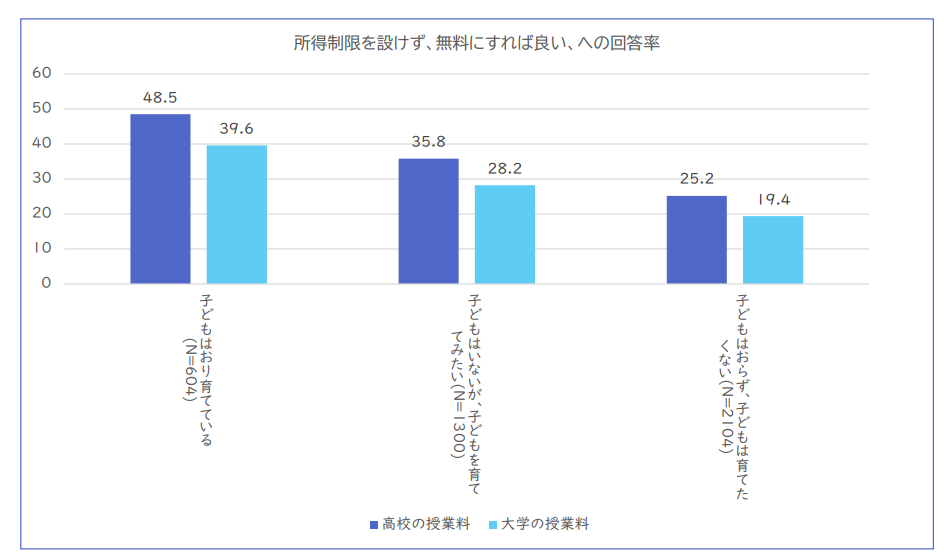
This survey shows signs of the same phenomenon. In general, people who didn’t want kids were less enthusiastic overall about strategies for reversing Japan’s falling birth rate. When asked specifically about plans to make high school and college free for anyone regardless of income level, 48.% percent of people with kids approved of free high school for all, while only 39.6% approved of it for college. But among those without kids, the numbers were almost half – 25.2% and 19.4%, respectively.
Japan reacts
The report has sparked a raging debate on social media and forums such as Yahoo! News JP. The top user comment on Yahoo! News, where one news report on the survey is approaching 6,000 comments, laid the blame on Japan’s economy – particularly on the country’s lack of wage growth and the increase in irregular employment.
“If it’s difficult to buy a car and live by yourself, then getting married and having kids will feel impossible,” one user wrote.
Another commenter, posting from a “women’s standpoint,” said that adding kids to a full-time job puts additional burdens on parents’ time, such as attending PTA meetings and participating in kids’ organizations. “That burden’s increasing with the rise of the nuclear family,” the commenter lamented.