
Many of my Insider stories are, frankly, depressing. I often focus on headline-making issues that highlight some emerging or long-simmering social issue in Japan.
Today’s story is a refreshing change. It’s about how far Japan has come in accepting women in the workplace.
That doesn’t mean discrimination is solved and Japan is living in a DEI utopia. But it’s instructive to look back and see just how bad things used to be, and how attitudes that dominated business in the century prior are ridiculed today.
An example recently surfaced on Japanese social media involving the bookstore chain Kinokuniya. Today, the company, like most Japanese businesses, goes out of its way to enforce equality in hiring. But that wasn’t the case in the 1980s, when its own union revealed a secret list of do’s and don’ts for hiring female employees.
Few people rushed to the store’s defense. In fact, the memo was so appalling it helped push Japan toward its first equal-employment law.
“The ugly document”
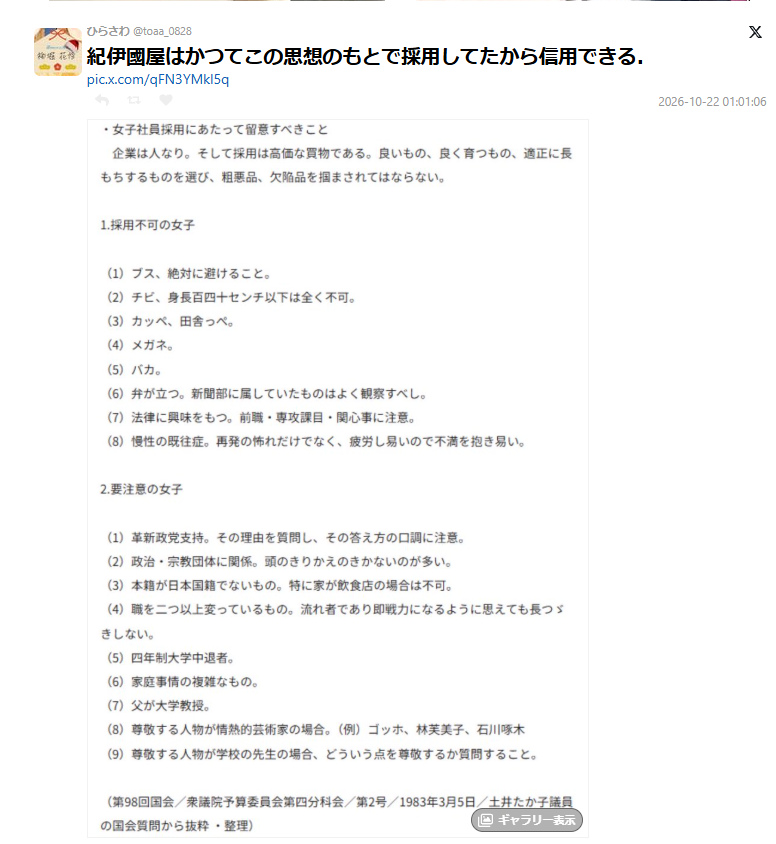
We know about Kinokuniya’s list not only thanks to the company’s union, but to female lawmaker Doi Takako (土井たか子). The union took the memo to the Labor Ministry, and on March 5, 1983, Doi read the text into the official record to raise awareness around it. The eight-point memo reads like the unbridled id of the world’s biggest misogynistic prick.
The list of women the memo recommended the company avoid hiring included: