
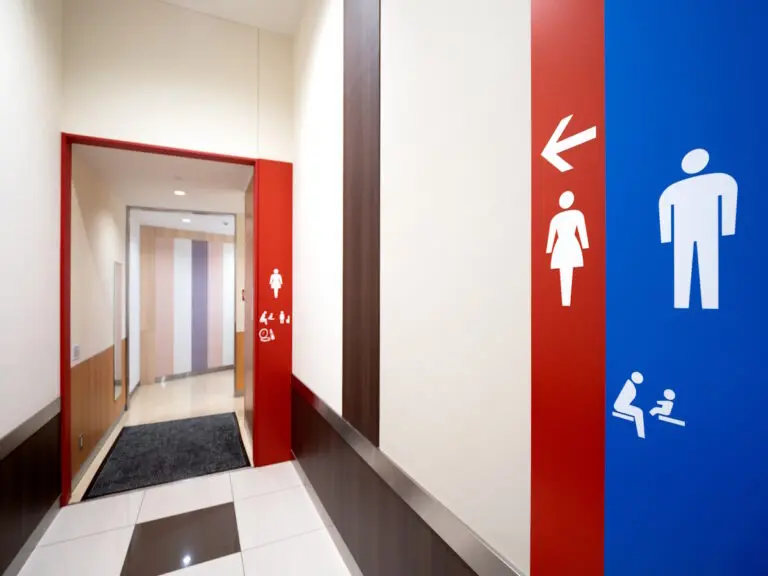
Life can be hard as a woman in Japan. On top of sexual harassment, political underrepresentation, and shouldering an unfair share of housework, women in the country suffer another indignity: long toilet lines.
The lack of sufficient public women’s toilets has frequently made headlines in Japan over the past year. In response, Japan’s government recently issued new guidelines for toilet construction. The backlash online has been as predictable as it is ridiculous.
Making women’s toilets a priority
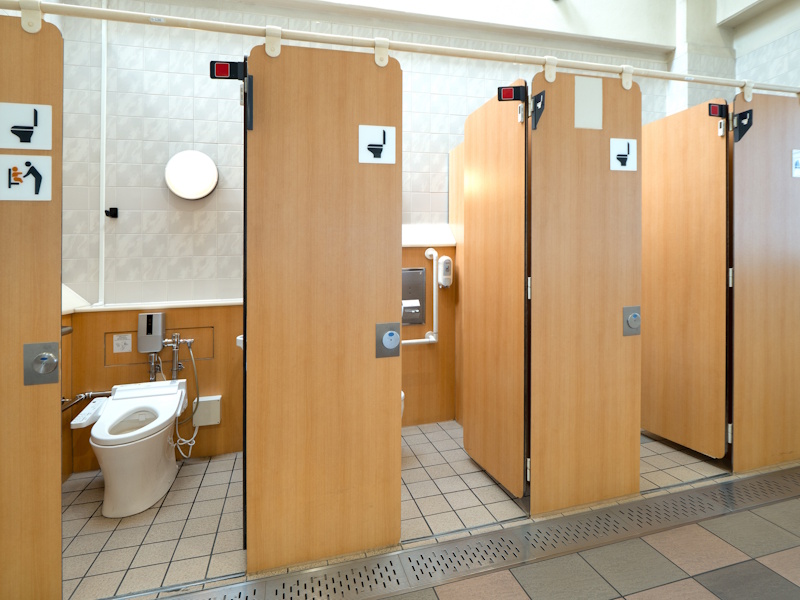
The dearth of public women’s toilets became news last year after 60-year-old paralegal Momose Manami made headlines for her research on the issue. Her survey found that public restrooms (in train stations, etc.) had 1.8 times as many facilities for men as for women.
Critics pounced on Momose’s study. Men, in particular, were faux-outraged, arguing that it’s only natural since men’s restrooms can have space-saving urinals. By this line of thinking, if women want equal treatment, then…well, they should have been born men, I guess?
The issue, however, didn’t go away. (As you’d expect when half of your country is routinely inconvenienced.) It popped back into the national spotlight after 2025’s cherry blossom season, when many women reported waiting 45 minutes or longer to access a toilet at Tokyo’s Yoyogi Park.
In response, Japan’s government has swung into action. The country’s Ministry of Land, Infrastructure, Transport and Tourism (MLIT) is compiling new guidelines that recommend businesses and facilities administrators construct more women’s toilets than men’s. For example, if a facility has 16 total toilets and urinals, there should be six for men and 10 for women.
MLIT will also issue concrete guidelines on space restrictions. For example, if a facility can’t increase the space it dedicates to restrooms, MLIT will recommend making existing stalls smaller or, during busy times of the day, using removable partitions to convert men’s toilets to women’s toilets.
Japan’s first female PM agrees
The government itself will also address toilet inequity in its own buildings.
A non-partisan group of female lawmakers in Japan’s House of Representatives has submitted a proposal to increase the number of women’s toilets in the National Diet Building. The lawmakers complain that the waits have become intolerable after a record number of female lawmakers were elected to the Lower House in the last election.
The National Diet Building was constructed in 1936, when women were barred from serving in political office. There are now 12 bathrooms for men and nine for women. However, there are only 22 toilets for women, while there are a whopping 67 toilets and urinals for men.
Around 80% of the women in the Diet agree that there needs to be more women’s facilities. Among them? Takaichi Sanae, Japan’s current Prime Minister and the country’s first female PM.
Question: do you like UJ's independent coverage of Japan? Our writers are supported by our members. Join Unseen Japan Insider to get bonus content every week, an ad-free website, and access to our large and growing Insider archive.If you love UJ's independent coverage of Japan, join Unseen Japan Insider to get content every week, an ad-free website, and access to our large and growing Insider archive.
Men are angry (as usual) about doing anything good for women
Sadly, some men – being the overly emotional creatures we are – are hopping mad about the change.
The issue has trended on X, the third-largest social media platform in Japan. As Shūkan Josei Prime notes, some are fear-mongering that men’s restrooms will be whittled down to make more space for women’s facilities. Others complain that it’s unfair to count urinals among the facilities provided to men, as the exposed devices don’t provide the same privacy and convenience as private stalls. Still others argue that women should stop using the restroom for activities such as touching up makeup if they want to decrease wait times.
The thing is that MLIT’s proposal isn’t even that radical. Most international standards regulate a 1:3 ratio of men’s facilities to women’s facilities or even greater. Taiwan has a 1:3 standard for businesses and a 1:5 rule for public facilities, such as train station bathrooms.
A solution: The women’s urinal?!
In an attempt to broker peace between the two sides, one user on X put out a radical solution: the women’s urinal. User @siriusfantasy suggested installing standing women’s urinals in an equal number to men’s urinals and keeping both bathroom spaces of equal area.
Most women weren’t impressed by this suggestion.
“That’s the first time I’ve seen this”
“How the hell do you use it?”
You may wonder if the picture above is AI. According to Josei Prime, though, it’s a real, Made in Japan product. Sanistand (サニスタンド), made by washlet maker Toto in 1951, was used at the 1964 Tokyo Olympics and sold in the United States by American Standard. Women were instructed to use the device by standing over the seat with their backs to the wall.
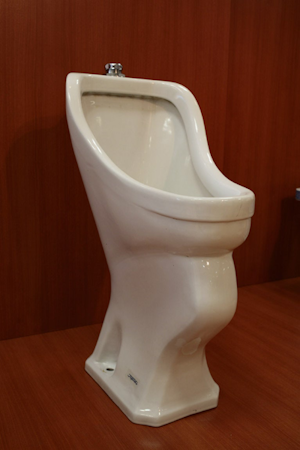
The idea, however, proved as unpopular back then as it seems now. Toto discontinued the manufacture of the Sanistand in 1971.
At any rate, it doesn’t appear like MLIT’s plans will be foiled by the eruption of incel anger. The Ministry plans to finalize the new guidelines by March 2026. If all goes well, maybe in a few years, long lines snaking out from women’s public restrooms will be, if not extinct, then at least perhaps a touch shorter.
Keep reading



Sources
女性トイレを男性以上に、国交省 駅や映画館、待ち時間短縮. Kyodo
女性トイレ「男性以上の便器数に」国交省案に批判噴出の一方「最適解やろ」注目が集まった“女性用小便器”. Shūkan Josei Prime
衆院の女性トイレ増設、超党派の女性議員有志が求める…男性用便器67個に対し女性用22個. Yomiuri Shimbun
女性用の小便器はあるのか?建築資材・設備機器販売「株式会社 大萬」代表取締役社長ブログ
.