
Japan’s feminist movement is embroiled in a redux of the Feminist Sex Wars of the 1970s.
Some people who know nothing about Japan beyond what they glean from Naruto sometimes assert there’s no feminist movement in Japan. That’s not true, as we’ve painfully documented. What is true is that a lot of Japanese feminism tends to cling to some of the worst aspects of second-wave feminism – i.e., highly TERF-y and clearly anti-sex work.
We can clearly see this in the latest public debate over revising Japan’s prostitution laws. There’s a clear push for the so-called Nordic model – arresting the buyers of prostitution as opposed to the workers. Its most vocal feminist proponents are getting mainstream press coverage.
Meanwhile, advocates for decriminalization are finding themselves shut out of the conversation. As happened in the debates around Japan’s Adult Video Law, the country is debating a stigmatized profession without bothering to include the people who do the work.
Why the Nordic model is suddenly popular

The Nordic model is preferred by prominent feminists such as Nitō Yumeno (仁藤夢乃). Nitō is the head of Colabo, an organization that helps runaway girls on the streets of Tokyo by giving them food, guidance, and purpose. In other words, she’s seen firsthand the damage that sex work can do, especially to vulnerable minors.
“Victims of prostitution as young as 12 are by no means rare,” Nitō has stated.
The Nordic model has gained attention in Japan in the past year in the wake of an increase in street prostitution. Ostensibly non-penetrative sexual services, such as soaplands and oppai bars, have long been legal in Japan. (I say “ostensibly” because soaplands and other businesses often operate in a grey zone that permits intercourse as a “private” arrangement between workers and customers.)
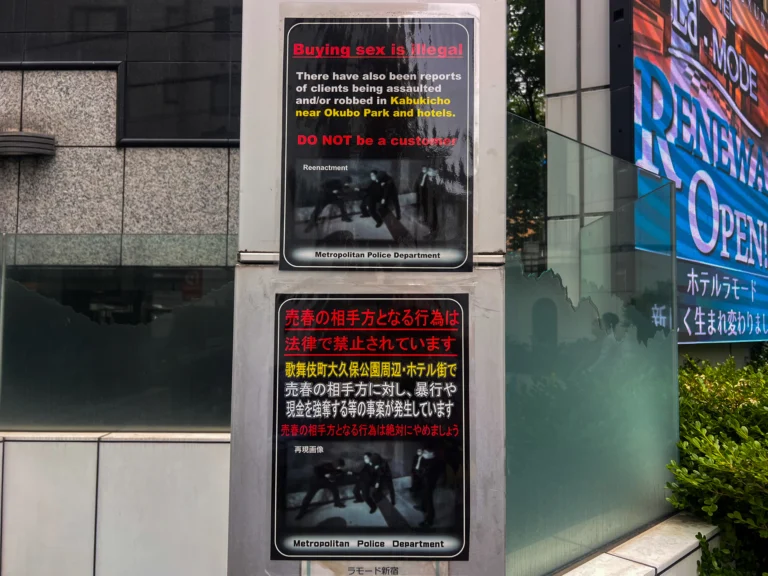
By contrast, full-on prostitution has been and remains illegal. Illegal street prostitution has spiked in recent years, particularly in the area around Tokyo’s Ōkubo Park, driven by the economy and by women racking up debt at host clubs.
Initially, police responded by cracking down…but only on those selling services. Current Japanese law criminalizes profiting from prostitution, not soliciting. Men are let off with a slap on the wrist, while workers (many of them cis and trans women) are hauled off to jail.
This approach resulted in a public backlash last year when Tokyo cops arrested four women in Ōkubo Park and some media outlets subsequently published their names. Critics demanded to know why the women deserved to have their lives ruined while the men who solicited them got off scot-free. That backlash has led to today’s public re-examination of the prostitution law.
As part of her own support of the Nordic model, Nitō champions no longer “making women the target of punishments.” If selling isn’t decriminalized, she argues, women “can’t even ask for help.” Last year, Nitō’s group brought former French MP Maude Olivier, an architect of France’s 2016 buyer-punishment law, to argue this case further.
In her talks in Japan, Olivier cited statistics such as the increased rate of self-harm amongst sex workers. She also cited how 90% of workers in France are foreign, indicating some or many have fallen prey to sex trafficking.
The voices in Japan opposing the Nordic model

Nitō isn’t the only one pushing the Nordic model. The Japanese government under Prime Minister Takaichi Sanae is investigating the practicalities of changing the country’s prostitution law to punish buyers instead of sellers.
However, a smaller contingent is speaking out against the Nordic model. Sex worker and other public policy advocates are arguing that criminalizing anyone – buyers or sellers – not only fails to address the root of the issue; it makes workers unsafe.