
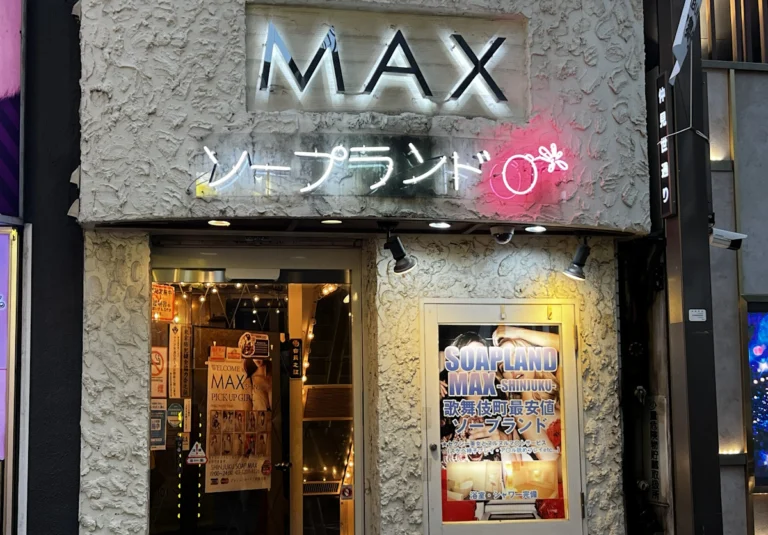
Japan’s nightlife scene is full of various euphemisms for sexual services. For example, “fashion health” for erotic massage and “delivery health” for hotel room visits. Soaplands fall into this category. While they’re Japan’s most well-known sexual service abroad, they’re still surrounded by misunderstanding and misconceptions.
In this article, I’ll break down what soaplands are, how they got started, and why they’re so popular. I’ll cover how they’re allowed to survive, along with guidelines for anyone who might think about visiting one.
What is a soapland?
A soapland is a type of 性風俗 (seifūzoku), or sexual entertainment business, in Japan. Participants pay for time in a private room with a female worker, euphemistically called a “bubble princess” (泡姫; awa-hime), who provides body washing services, usually with some sort of “happy ending.”
Legally, soaplands are classified as “special bathhouses” (特殊浴場; tokushu yokujō). Sexual services are implied as part of the service, but not sold or advertised directly.
Some sexual businesses in Japan stay within the law by employing rules that prevent penetrative sex from occurring. At an oppai bar, for example, you’re allowed to kiss and play with the female workers from the waist up. By contrast, full penetrative sex often occurs at soaplands, either with protection (ゴムあり; gomu ari) or without protection (ゴムなし; gomu nashi). How far an evening goes, however, is up to each individual worker.
Pricing for soaplands split into a bath fee (入浴料, nyūyokuryō) paid to the shop, and a service fee (サービス料) paid to the worker, with the service fee typically 1.5 to 2 times the bath fee. The average price is around ¥30,000 (~$184) for a 70-minute session. However, prices can range up to ¥85,000 (~$521) or even ¥120,000 (~$735) for 120 minutes at some luxury locations. As with many sexual services in Japan, you’re likely to be presented with many “options” when entering a soapland that make the real total higher than the advertised price.
There are around 1,200 soaplands in Japan. In the past decade, the number of in-store sexual entertainment businesses has dwindled, while off-premise or “store-less” (無店舗; mutenpo) businesses like delivery health and webcam businesses have exploded. Despite some shocking closures recently, soaplands are one of the few brick-and-mortar sexual businesses still holding their ground.
A short history of the soapland
How did soaplands get to be called “soaplands”? That’s an interesting tale, actually.
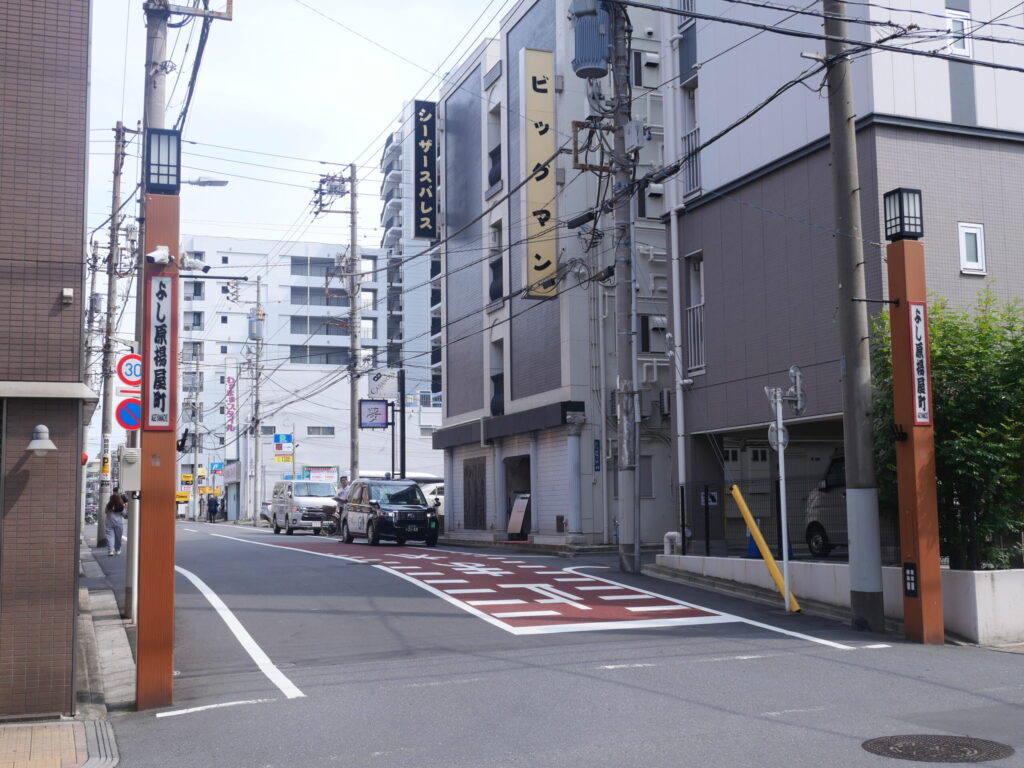
For centuries, the only place in Tokyo where prostitution was strictly legal was the gated pleasure center of Yoshiwara. Originally located in present-day Nihonbashi, it moved to Asakusa after the 1657 Meireki fire.
The 1957 Anti-Prostitution Law shuttered Yoshiwara for good. Around 1951, however, a Ginza bathhouse called Tokyo Onsen premiered a new service under the name “Turkish baths” (トルコ風呂; toruko furo). The trend caught on, and many businesses in Yoshiwara shifted to this model.
The name “Turkish bath,” however, didn’t go over well with some people. Namely, people from Türkiye. In 1984, a Turkish exchange student at the University of Tokyo, Nusret Sancaklı, petitioned Health Minister Watanabe Kōzō to drop the slur on his country. The Turkish Embassy also officially complained to the Japanese government after a Shinjuku sex shop was listed as the “Turkish Embassy” in a phone book.
In 1984, the Tokyo Special Bathhouse Association succumbed to public pressure and ran a public naming contest. “Soapland” beat out runners-up such as “Roman Buro” and “Ukiyo Buro” to become the service’s new official name.
To this day, Yoshiwara has the highest concentration of soaplands of any area in Japan, around 10% of the country’s total. Kawasaki’s Horinouchi/Minami-chō and Kobe’s Fukuhara are tied for second after Yoshiwara at around 60 shops apiece. You’ll also find a scattering throughout Tokyo as well as concentrated in other nightlife districts around the country.
By the way, a certain Tokyo reporter helped publicize the campaign to rename soaplands. Her name? Koike Yuriko, whom many people now know thanks to her new job as the popular governor of Tokyo.
Are soaplands in Japan legal?
Which raises the question: How is this legal? After all, prostitution is illegal in Japan. How is this an exception?
Soaplands, like many legal sexual services in the country, survive by operating in a tolerated gray zone. The Anti-Prostitution Law, Article 11, prohibits “providing a place for prostitution.” But soaplands operate under the legal fiction of “free love” (自由恋愛; jiyū renai). In this narrative, a soapland worker isn’t paid to have sex; she chooses, of her own free will, to do so. She just, you know…happens to choose it every time, with every customer.
Sex shops in Japan, including soaplands, do get busted for “crossing the line.” Authorities can press charges if they believe a store is expressly facilitating prostitution. In 2026, authorities busted Louvre in Yoshiwara, charging that two female employees provided sex to several guests with the owners’ knowledge. The arrest came after a former worker lodged a police complaint because she said she’d been fired for calling in sick.
In 2025, authorities shut down another type of sex business, a men’s esthe, for explicitly selling sex to foreign tourists.
Can foreigners visit a soapland?
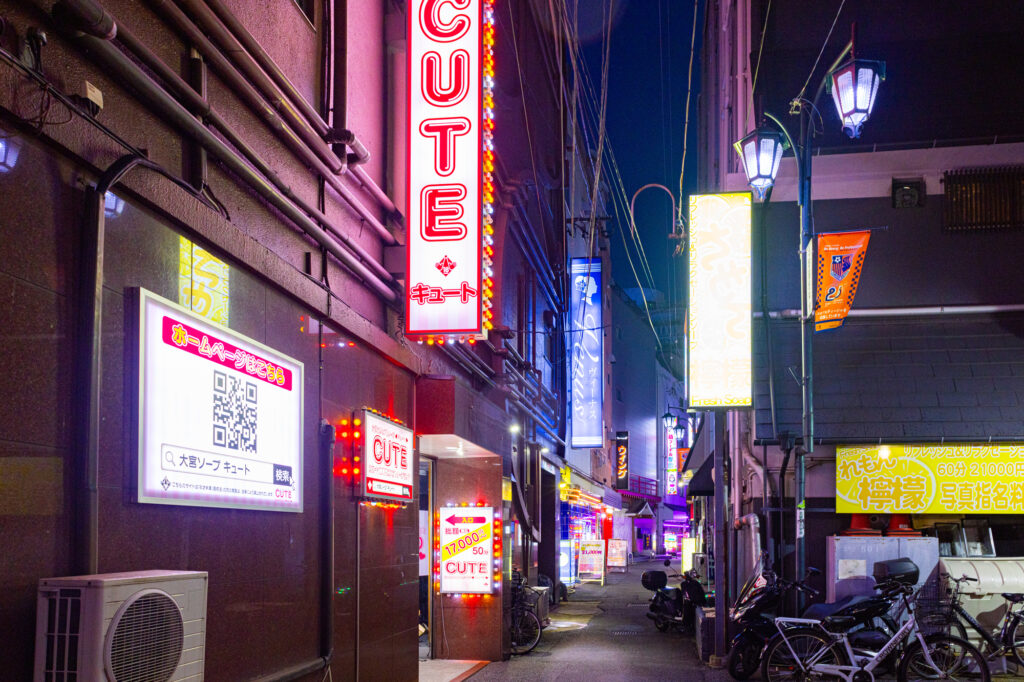
Japan’s sexual businesses have a reputation for being exclusive. Many explicitly exclude foreigners on the grounds that they won’t understand Japan’s nuanced laws; sometimes, however, the motive is just pure xenophobia. (The ex-worker who reported Louvre to the police said staff would frequently associate Chinese customers with sexually transmitted diseases.) Other shops allow foreigners, but only if they can speak Japanese.
Currently, foreigners can visit some soaplands. Not every soapland allows non-Japanese guests. Some may allow non-Japanese to enter, in which case this will usually be advertised on the sign outside, along with which languages the staff speaks (usually English and Chinese). My nightlife guide lists several of the more popular soaplands among foreign visitors.
Things to consider before visiting a soapland
Thinking about trying a soapland? Here’s what to know before you go.
You’ll usually pay a “foreigner tax”
Soaplands that allow foreigners in often upcharge for the privilege. Often, this is a nominal fee (around 3,100 yen, or $19.60). However, some stores may pile on additional charges because they assume foreigners are tourists who won’t know how to complain to the cops.
I’ve identified some soaplands that are priced reasonably. You can find them in my nightlife guide, along with guidelines on how to shop around places like Yoshiwara and generally protect both your wallet and your body on Tokyo’s nightlife scene.
The risk of a bust is small but non-zero
Louvre wasn’t the only soapland busted. Kameari Kadoebi in Katsushika Ward and Grand Opera in Fukuoka’s Nakasu are two of the other five soapland shops taken down in recent years.
The reasons for the busts vary. You won’t be shocked to learn that sex businesses are frequently intertwined with organized crime; authorities sometimes bust businesses they deem are money laundering fronts. Others get busted for facilitating sex, usually due to an official report. Police arrested officials at Grand Opera after a worker’s family member filed a complaint.
Mind you, these arrests span 14 years. Five busts out of 1,200+ soaplands and over a decade of operation is hardly a crime wave. But there’s always an off chance you could find yourself answering some uncomfortable questions at a Japanese police station.
Beware STIs
At many shops that allow foreigners, workers will demand condom use from the beginning. If a shop doesn’t, be wary.
Sexually transmitted infections (STIs) tend to be rampant in Japan. I wrote last year about the spike in syphilis in Tokyo, which has seen infection numbers climb for the fourth year running. In other words, be smart and stay safe – use protection.
Some workers might be working under pressure
I’m not saying that soaplands are unscrupulous and blackmailing their workers. The danger here is that some workers might be working, not because they chose the lifestyle, but because they feel pressured after racking up debt at host clubs.
Some hosts are notorious for lulling their female customers into racking up debts they know they can’t pay, and then pressuring them into sex work at soaplands or even illegal street prostitution. While Japan has made that illegal, hosts have found various ways around the new restrictions passed in 2025.
Statistics from other countries show that the majority of workers in sex trades are there of their own free will. A study by researcher Niina Vuolajärvi found, for example, that only a minority (around 6 percent) were trafficked. But there’s a difference between trafficking, which involves overt violence, and pressure.
This is a moral question to consider whenever paying for sex, and isn’t specific to soaplands. If you’d rather stick to meeting people who are simply looking to have fun, a happening bar may be a better choice. You can also book a nightlife tour with us, and we’ll show you other sexy but strictly legal entertainment options around Tokyo.
Keep reading
Sources
ソープランド Wikipedia(日本語版)
トルコ風呂 (性風俗) Wikipedia(日本語版)
売春防止法 Wikipedia(日本語版)
吉原遊廓 Wikipedia(日本語版)
昔は「トルコ風呂」と呼んでいた。「ソープランド」への名称変更の裏にはあわや国際問題!の危機が? Japaaan(エキサイトニュース)
風俗での本番行為は違法?成立しうる犯罪や刑罰、対処法をわかりやすく解説 ベンナビ刑事事件
ソープランドの総額料金(相場)と男子スタッフの給与について 俺風チャンネル
吉原の歴史 吉原防犯安全協力会
Prostitution in Japan: Soaplands & the Law Offbeat Japan
How Japan’s Secretive ‘Soapland’ Brothels Operate VICE
ソープランドの摘発・逮捕と売春防止法!客やキャストも逮捕される? グラディアトル法律事務所
売春防止法とは。性行為を伴う風俗店は全て違法なのか。 ダーウィン法律事務所