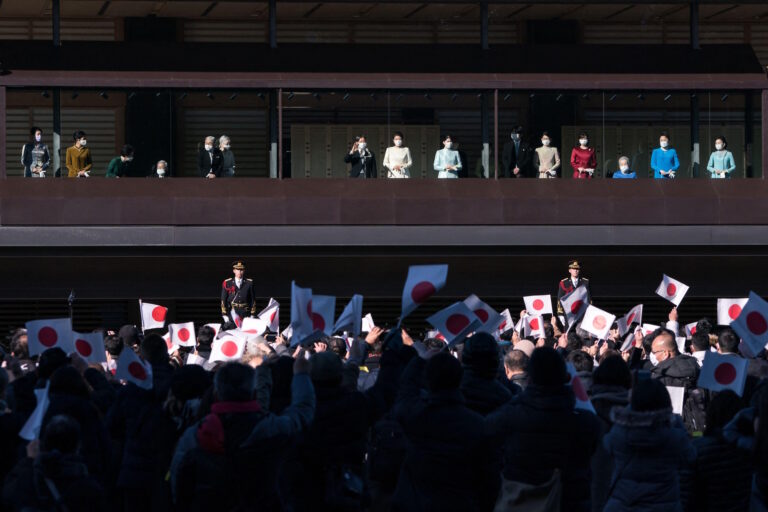
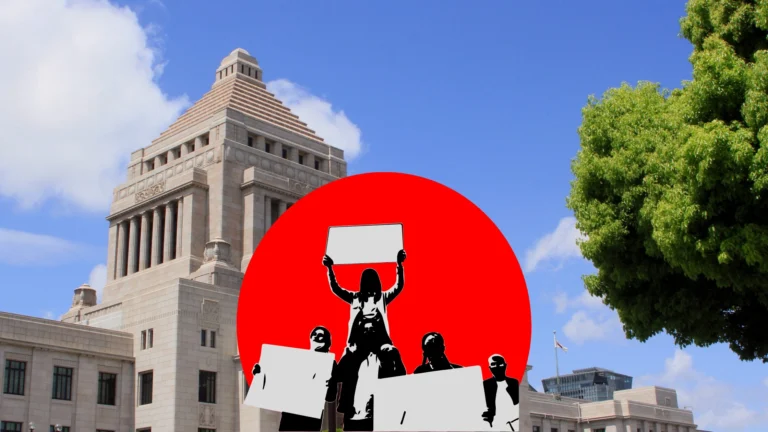
Silhouetted protesters holding blank placards over a red circle, before Japan's National Diet building.
Picture: リュウタ / PIXTA(ピクスタ)
Insider

Takaichi Wants Japan to “Coexist” With Foreigners. Japan’s Hard Right HATES Her for It

This article is for members of our Insider program. Read the preview below. To read the rest, become a member today. · Log in

This week, Japan’s government announced that the country’s Japanese population had fallen below 120 million for the first time in over four decades. It marks the 17th straight year of decline, and the steepest drop on record, in both raw numbers and as a rate. The only reason Japan’s overall population isn’t shrinking even faster is the very foreign residents the right wants gone.

At the same time, Japan’s foreign population rose above 4 million for the first time ever. That’s not a coincidence. As the country’s population both shrinks and ages, industries such as transportation and care are becoming essential components of Japan’s economy. In some cities, foreign students working part-time comprise over 50 percent of convenience store staff.

This might seem like a strange time to demonize the foreign laborers your country needs to keep its economy moving. But, hey, no one ever said racists were smart.

We’ve documented how Prime Minister Takaichi Sanae’s government continues to crack down on law-abiding foreigners for no good reason whatsoever. The latest proposed change would set income requirements for permanent residency higher than the average Japanese salary.

Despite these moves, however, Takaichi’s government insists it’s still seeking “coexistence” (共生; kyōsei) with foreigners. It’s a line she’s touted since arriving in office.

And it has Japan’s online far right fuming.

This is nothing new in Japan. The country’s far right has often gone past the limits of even the most extreme imperialistic policies of the ruling power. The difference is that today’s far right could eventually get its way. And if it does, it’ll doom the country’s economy.

Did Takaichi betray her “zero base”?

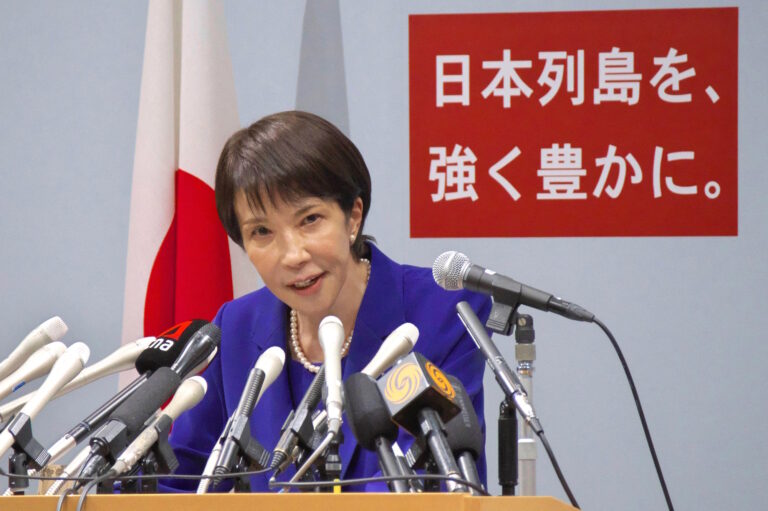
A recent X post by Sankei Shimbun, a major right-leaning newspaper, shows what Japan’s first female prime minister is up against. The story quoted Takaichi as saying, despite the recent visa and PR changes, she doesn’t want Japan to look “unfriendly to foreigners.”
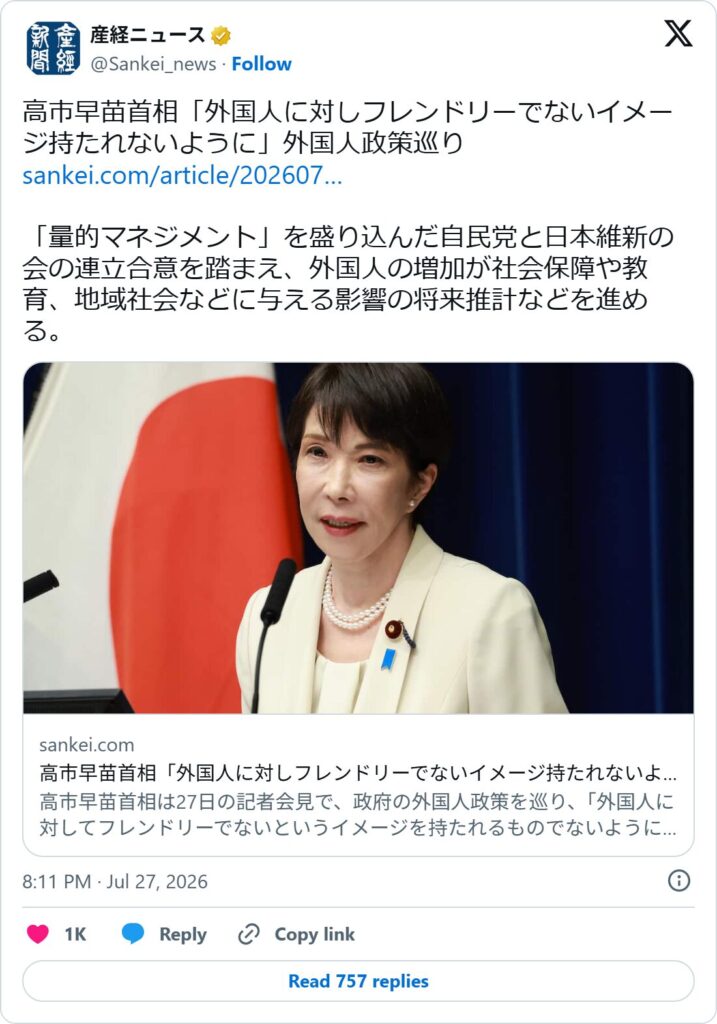
@Sankei_news post: Takaichi says Japan shouldn't look "unfriendly to foreigners," shown at a press conference.

Right-wingers instantly lit into her. They said that Takaichi was betraying her promise to re-examine policies towards foreigners “from zero base” (ゼロベース), meaning that every law and provision would be revisited.

Even though she’s since gone on to enact most of her promises, her one-time supporters aren’t happy about all this “coexistence” nonsense. They expected a halt and a reduction, not the continuation of the status quo that her words imply.

But this wasn’t the first time Takaichi drew the xenophobic right’s ire.

On November 4th, 2025, the Prime Minister’s Office’s official X account posted about the Ministerial Meeting on the Acceptance of Foreigners and the Realization of an Orderly Coexistence Society. Posting as Takaichi, the account said it instructed ministers to look at sharpening compliance with existing rules, while at the same time “drawing  a clear line against exclusionism.”

@kantei post (Nov 4, 2025) on "orderly coexistence" with foreigners, showing Takaichi at a ministerial meeting.

The reaction to her government’s coexistence posts was overwhelmingly negative. The largest share, 31.1%, coalesced around a theme that Japan “never consented to coexistence.” Echoing Western racist talking points, many pointed to Europe as some sort of unique hellscape where the unwashed masses (read: non-white people) have overwhelmed local populations. Other responses echoed common right-wing fictions about foreigners leeching off the public welfare system.

Bar chart of quote-tweet themes by engagement share: "never consented to coexistence" 31.1%, betrayed zero-base pledge 17.8%, cut the numbers 14.3%, "Japanese are the victims" 10.1%, welfare free-riding 8.9%, "don't call us xenophobes" 5.2%.

Another 17.8% invoked Takaichi’s zero-base pledge, showing that anger around her “departure” from her campaign promise is long and sustained. A full 14.3% urged Takaichi to cut the existing number of foreigners or even slam the door closed entirely, returning the nation to sakoku.

Another post on January 28th, 2026 featured video of Minister Onoda Kimi explaining the “comprehensive measures” Japan would take to ensure “orderly co-existence” with foreigners. The top response to that post, which received over 13K likes, proclaimed, “I keep telling you, the public does not want ‘coexistence.'”

@kantei post (Jan 28, 2026): Minister Onoda Kimi's video on "orderly coexistence" with foreigners.

The public doesn’t care about immigration

Immigration banner in Shinagawa
“Please comply with proper hiring of foreigners”: A banner at Shinagawa Station. Every immigrant who files for a visa at the Shinagawa immigration office passes under this banner. (Picture: Jake Adelstein)

It’s good to keep this rhetoric in perspective. This is X. It’s a self-selected sample of political extremists, not necessarily representative of the population. It’s worth putting their actual power in perspective.

I’m not saying the online world doesn’t matter. This rhetoric has swayed popular opinion before: last year, a survey showed that a majority of Japanese believed online lies about foreigners getting preferential treatment from Japan’s government.

But that doesn’t mean immigration is on top of everyone’s minds. Polls show that Takaichi isn’t losing ground because she isn’t hard enough on immigration; she’s losing ground because the economy sucks.

In the recent round of public opinion polling, 71% of those polled by Yomiuri Shimbun said they disapproved of the government’s response to inflation. 57% of Asahi poll responders had a poor opinion of Takaichi’s response to rising prices.

Instead of spending the special Diet session on these bread-and-butter issues, Takaichi spent it focused on revising the Imperial succession law and ramming through a national flag-desecration bill. (And, dare I say it, on immigration.) In other words, she hyper-focused on pet issues disconnected from people’s daily lives.

Takaichi is now in a mad panic to reverse course by focusing on cost-of-living issues. The government just announced it’ll seek to reduce the consumption tax on groceries from 8% to 1% for two years starting in April 2027. And Japan apparently just intervened in financial markets to shore up the weak yen, which is now running at around 160 yen to the US dollar. The US Treasury even joined in, a coordinated intervention Washington has joined only twice before: during the 1998 financial crisis and after the 2011 earthquake.

Takaichi is still plenty popular. She has time to respond to the public’s concerns and shore up her numbers. If she does that, no one will give a damn about her immigration policies.

The far right’s cycle of doom

Banner for Sanseitō reading "Japanese First"
Picture: Sanseitō YouTube channel

There’s also no one on the far right (yet) who would magically swoop in and take charge if Takaichi falters.

At the marginal end is the Japan Conservative Party. Leader Hyakuta Naoki opened his 2026 campaign by proclaiming, “We don’t need any more immigrants.” He’s derided the idea of multicultural coexistence as unnecessary. However, his party has little direct power; it holds a mere two out of the national Diet’s 713 seats.

Of much greater concern is Sanseitō. The far-right party led by Kamiya Sōhei stunned the political world by nabbing 14 seats in the 2025 Upper House election. Kamiya is a charismatic figure with a loyal following. It’s conceivable that, at some point, his party could gain enough ground to become a kingmaker of sorts in selecting a new prime minister.

Sanseitō has particularly gone hard against refugees, building on the hatred manufactured by Japan’s online right against the Kurdish population in Saitama Prefecture. He’s also railed against “fake refugees” and rallied for Japan to change its laws to deport anyone after a single failed application.

This makes it sound like Japan is flooded with refugees seeking asylum. In fact, the country only approves around 300 refugee applications a year, historically as little as 0.7% of applicants.

This situation threatens to suck Japan into a cycle of doom. Voters want politicians to fix the economy. When they don’t, they swing further toward far-right demagogues who promise to “make Japan great again.” Except these demagogues also aren’t focused on improving the economy. Instead, they build and retain support by scapegoating foreigners and intimidating critics into silence.

Japan needs a competent leader who can directly address popular concerns around affordability. If it doesn’t get one soon, it could find itself in a very dangerous place.

Sources

外国人の受入れ・秩序ある共生社会実現に関する関係閣僚会議(令和7年11月4日) 首相官邸

高市早苗首相「外国人に対しフレンドリーでないイメージ持たれないように」外国人政策巡り 産経新聞

〈縮むニッポン〉日本人1億2000万人割れ、過去最大91万人減少―人口動態調査:外国人は400万人突破 nippon.com

住民基本台帳に基づく人口、人口動態及び世帯数(令和8年1月1日現在) 総務省

令和7年(2025)人口動態統計月報年計(概数)の概況 厚生労働省

移民問題、抜本的に見直す 日本保守党・百田尚樹代表―党首第一声【26衆院選】 時事通信

日本保守党の重点政策項目 日本保守党

参政党の政策カタログ 参政党