

A cropped T-shirt and gray sweatpants, inspired by K-pop’s rehearsal wear, may be popular among Japanese women not only for their comfortable, cute appeal, but also because the outfit can offer a practical defense against one of Japan’s most common forms of sexual harassment: upskirting.
Discussion about the outfit’s popularity gained traction after a recent post on X, which included a reply suggesting that some women wear the look to deter upskirting. That reply, and the account behind it, have since been deleted. The following article draws on replies to the discussion collected by Togetter.
Why are Japanese women wearing K-pop “rehearsal wear”?
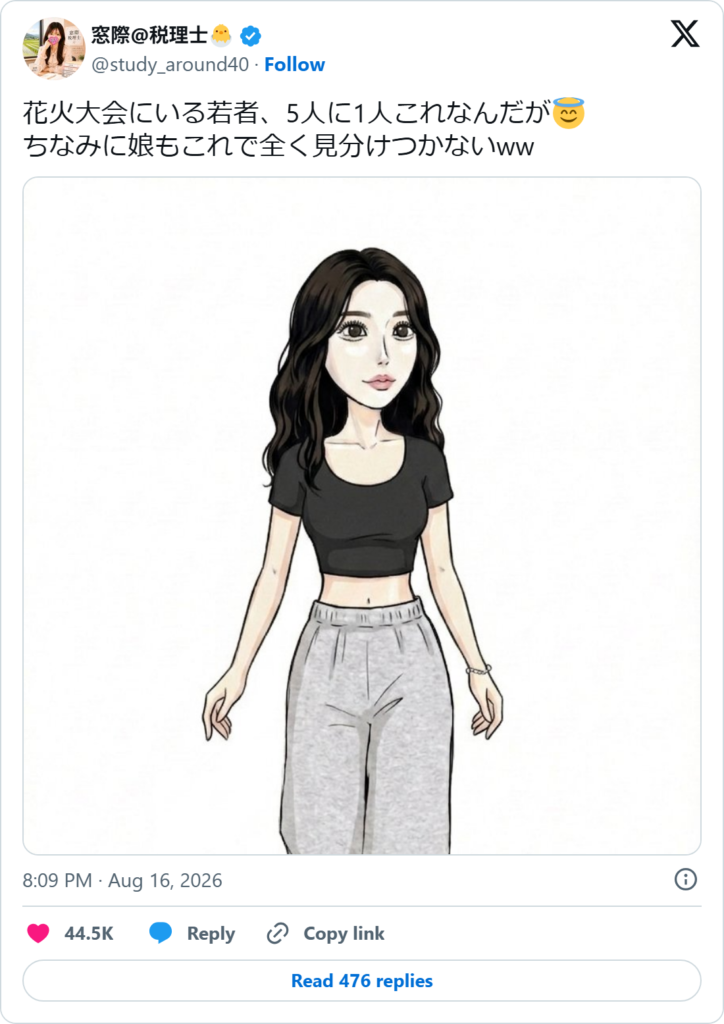
On Aug. 16, an X account under the handle @study_around40 posted an illustration of a young woman wearing a cropped T-shirt and gray sweatpants, along with the comment: “One in five young people at the fireworks festival are wearing this. My own daughter is dressed this way too, and I genuinely couldn’t pick her out, lol.” In a follow-up post, the user added: “They’re all in sneakers.”
The post, which shared an observation rather than verified data, received 44,500 likes.
The following day, the X account @selfcomestomine (EvoPsy) replied that Gen Z has been conditioned to associate K-pop dance rehearsal wear, known in Japanese as rihagi (リハ着), with cute young women, helping drive the style’s popularity even among young women who don’t dance.
That reply received 13,245 likes and 3.77 million views, several times the engagement of the original post, and linked to the writer’s essay on note.com.
But not everyone agreed that K-pop idols were the main reason for the trend.
One woman, posting under the X account “@momo_monpesca36,” argued that women aren’t necessarily making an aesthetic choice, but one based on comfort and safety.
“I think it’s simply that it’s comfortable. No wondering whether your panty lines are showing, whether your underwear is showing through, or whether you’re going to get photographed up-skirt,” the user wrote.
For context, festivals are a known setting for such offenses, and police treat them accordingly.
On July 6, 2026, Aichi police arrested a high school teacher in his 50s from Shizuoka on suspicion of violating the Photographing Offenses Act after allegedly using a smartphone to photograph the underwear of multiple girls at the Atsuta Matsuri in Atsuta Ward, Nagoya, in June.
The case illustrates why summer festivals can be a particular concern for women and girls. Large festivals and fireworks displays bring dense crowds together in predictable locations, creating opportunities for offenders to target people in crowded conditions.
A similar dynamic is seen on public transportation during Japan’s university entrance-exam season in January. On Japanese social media, some men have infamously referred to the period as a “molester festival” (chikan matsuri, 痴漢祭り), exploiting the fact that entrance exams put large numbers of students on the same trains at predictable times.
For a student on the way to an exam, reporting an incident can also mean losing precious time, an imbalance that can make victims reluctant to act in the moment.
Returning to the X posts’ thread, another woman made a similar argument from a different angle. The X account “@GUEEE_Y_IKITERU” warned against associating rehearsal wear too closely with cuteness.
“If rehearsal wear gets tied to cuteness (可愛い; kawaii), there’s a disaster-level problem: clothing worn to avoid being hit on stops working as avoidance wear,” she wrote.
Others likewise pushed back against the idea that women are deliberately styling themselves in rehearsal wear for purely aesthetic reasons.
The X account “@paq_gaat,” for example, questioned whether young women even consciously identify the style as “rehearsal wear.”
“Nobody even says ‘rehearsal wear.’ I would get it if you’d say we’re influenced by K-pop idols’ airport look,” the user wrote.
Other replies made a similar distinction: while the cropped T-shirt and gray sweatpants combination may have been influenced by K-pop idols, women in Japan may now be choosing the look primarily because it’s comfortable and practical, or because it fits into the broader minimalist trend, including styles such as normcore.
A short history of “airport fashion”
The connection to K-pop becomes more interesting when considering the history of airport fashion (空港コーデ; kūkō kōde), a genre with a well-documented and heavily photographed origin.
In a 2025 Yahoo! News Expert column, Korea specialist and translator Nishijima Hiromi traced the genre back to the late 2000s, when TVXQ (東方神起; Tōhō Shinki) frequently traveled between Japan and South Korea. Superfans equipped with high-end cameras photographed the group in airport terminals, and the images were subsequently circulated through fan blogs. The term “airport fashion” became mainstream around 2010.
Nishijima also noted that agencies and brands now treat airports as advertising venues, with idols often wearing items supplied by sponsors.
“In fact, many of the items idols wear are provided by sponsoring brands, and behind the transformation of airports from places of transit into advertising spaces lies a sophisticated marketing strategy,” Nishijima said.
And that creates an intriguing irony.
The aesthetic Japanese women may now be adopting was, in part, shaped by K-pop idols being photographed by fans without their permission. Yet some Japanese women are embracing a similar look for almost the opposite reason: to make themselves less vulnerable to being photographed without their consent.
In that sense, what began as an image-driven fashion phenomenon surrounding K-pop idols may have evolved into something more practical: a comfortable, minimalist style that some women also see as a way to protect their privacy and personal safety.
Japan’s plague of upskirt photography
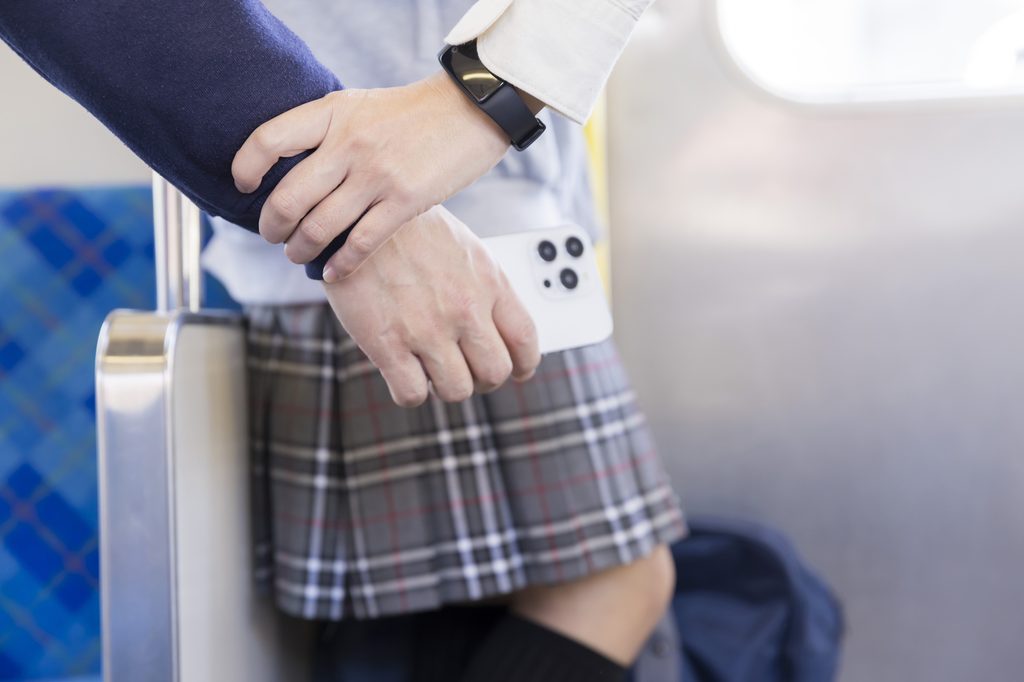
Japan’s legal framework for criminalizing upskirting is based on the Act on Punishment of Photographing Sexual Body Positions (性的姿態撮影等処罰法; seiteki-shitai-satsuei-tō-shobatsu-hō). The Act, which took effect in 2023, covers the unauthorized photographing of sexual body parts, as well as worn underwear covering those body parts, the provision that encompasses the archetypal upskirting offense.
Penalties include up to three years in prison or a fine of up to ¥3 million (300万円; approximately $18,900) for photographing sexual body positions.
Retaining such images can carry a penalty of up to two years in prison or a ¥2 million fine (200万円; approximately $12,600), while transmitting them to an unspecified or large group can result in up to five years in prison or a ¥5 million fine (500万円; approximately $31,400).
Installing a camera for the purpose of committing the offense can also be punishable as an attempted offense, even if no image is ultimately recorded.
According to a May 2025 survey by Japan’s National Police Agency (NPA), more than 6,300 secret-filming cases were cleared under the new Photographing Offenses Act in 2024, along with 2,013 cases handled under prefectural nuisance ordinances. In total, more than 8,300 cases were cleared across the two frameworks.
More than 80% of cleared cases under the Photographing Offenses Act involved an ordinary mobile phone, while about 15% involved a concealed camera. Commercial facilities accounted for 36% of cases, followed by stations at 21%. Within the station cases, many occurred on stairs and escalators.
Across cases covered by both the new law and prefectural ordinances, roughly 1,750 cases in a single year involved stairs or escalators, precisely the kind of setting in which a skirt can create an opportunity for an offender that sweatpants don’t.
The NPA’s February 2025 crime report also recorded approximately 8,400 recognized cases under the Photographing Offenses Act in 2024, an increase of 232% year on year, while around 640 juveniles were arrested under the law, up 474%.
However, those early figures should be interpreted with caution. The sharp increases may reflect the transition to a new legal framework and changes in how offenses are classified and recorded, as well as changes in offending behavior.
They’re even using infrared photography
The same underlying behavior has also targeted clothed bodies through other means.
NHK reported that in January 2025, Hyogo police arrested a 53-year-old man from Minami-Awaji on child-pornography charges after he attended swimming events in several cities between July 2023 and 2024 and photographed eight female swimmers, one of them 11 years old. Police said he used an infrared filter and techniques intended to produce see-through images through tight clothing.
A seized SD card reportedly contained approximately 26,000 images.
The possibility of photographing through clothing became widely known after Sony’s NightShot camcorder function was found in 1998 to produce see-through effects under certain conditions. Sony subsequently halted shipments until the function could be disabled in daylight.
Japanese sportswear maker Mizuno now develops fabric specifically designed to thwart such imaging technology.
The contrast is telling. The K-pop-inspired sweat set is an accidental countermeasure that women have discovered for themselves; Mizuno’s fabric is a deliberate one engineered by the industry. Both exist because the possibility of being photographed without consent has come to be treated, to some extent, as a fact of everyday life rather than simply a behavior to be stopped.
Companies are moving away from skirts

Major Japanese companies have also begun responding to concerns about upskirting and other forms of discomfort reported by female employees by offering or switching to trouser-based uniforms.
JR East abolished skirts from its uniforms in May 2020, putting station staff, conductors, and drivers in the same basic uniform. A company spokesperson said there had been widespread internal demand to eliminate skirts, largely because they restricted movement.
Japan Airlines introduced its first trouser option for cabin crew in April 2020.
Both changes followed years of complaints documented by Business Insider Japan. In one case, a department-store receptionist recalled being warned by a supervisor: “You can get photographed from behind when you bow, so be careful.”
Her response was blunt: “I can’t ‘be careful’ about that.”
A 2019 survey of more than 1,600 cabin crew members by Japan’s aviation-workers’ labor federation found that more than 60% said they had been photographed or filmed without their consent, or suspected that they had been.
Taken together, these examples suggest that the issue extends beyond the criminal act itself. Clothing, workplace uniforms, and even sportswear are being designed or chosen with the possibility of nonconsensual photography in mind.
That may be the most striking irony of the trend: when clothing is modified because people expect that someone might violate their privacy, the burden of prevention has quietly shifted from the person holding the camera to the person being photographed.
Keep reading



Sources
花火大会にいる若者、5人に1人これなんだが→Z世代は「リハ着=かわいい子」と条件付けされている、という説→いや「空港コーデ」では?などの指摘も Togetter
「リハ着」から「ダル着」へ──流行とは脳の「=」の書き換えである note
なぜ空港で着飾るの?K-POPアイドルの「空港ファッション」|個性的な「スカーフ巻き」もチェック Yahoo!ニュース エキスパート
性犯罪関係の法改正等 Q&A 法務省
性的な姿態を撮影する行為等の処罰及び押収物に記録された性的な姿態の影像に係る電磁的記録の消去等に関する法律 令和5年6月23日法律第67号 日本法令索引(国立国会図書館)
令和6年中の痴漢・盗撮事犯に係る検挙状況の調査結果 警察庁生活安全局生活安全企画課
盗撮事犯に係る防犯対策 施設管理を行うにあたって 警察庁生活安全局
令和6年の犯罪情勢 警察庁長官官房
祭りで複数の少女の下着を盗撮した疑い 静岡の50代高校教員の男を逮捕 名古屋「熱田まつり」 他にも各地の祭りに出向き盗撮繰り返したか【独自】 CBCテレビ/ライブドアニュース (archived)
祭りで女子高校生盗撮疑い 静岡の教諭逮捕、愛知県警 神戸新聞NEXT(共同通信)
花火大会でスカートの中を盗撮か 自称住職を逮捕 カナロコ by 神奈川新聞
靴に小型カメラ仕込みスカート内を盗撮未遂疑い 各務原の商業施設で男逮捕 岐阜新聞デジタル
「痴漢被害は制服に原因」「女性はTwitterで被害」ハラスメント実態調査 Business Insider Japan
盗撮、セクハラ…スカート制服に悩む女性たち。JR東日本はスカートを廃止 Business Insider Japan
10代後半女性の6割が「この夏、浴衣を着たい」2023年若年女性の浴衣事情 ガールズ総合研究所(フリュー)
特殊フィルターで水着透かし選手盗撮か 容疑者逮捕 兵庫県警 NHK 兵庫県のニュース (archived)