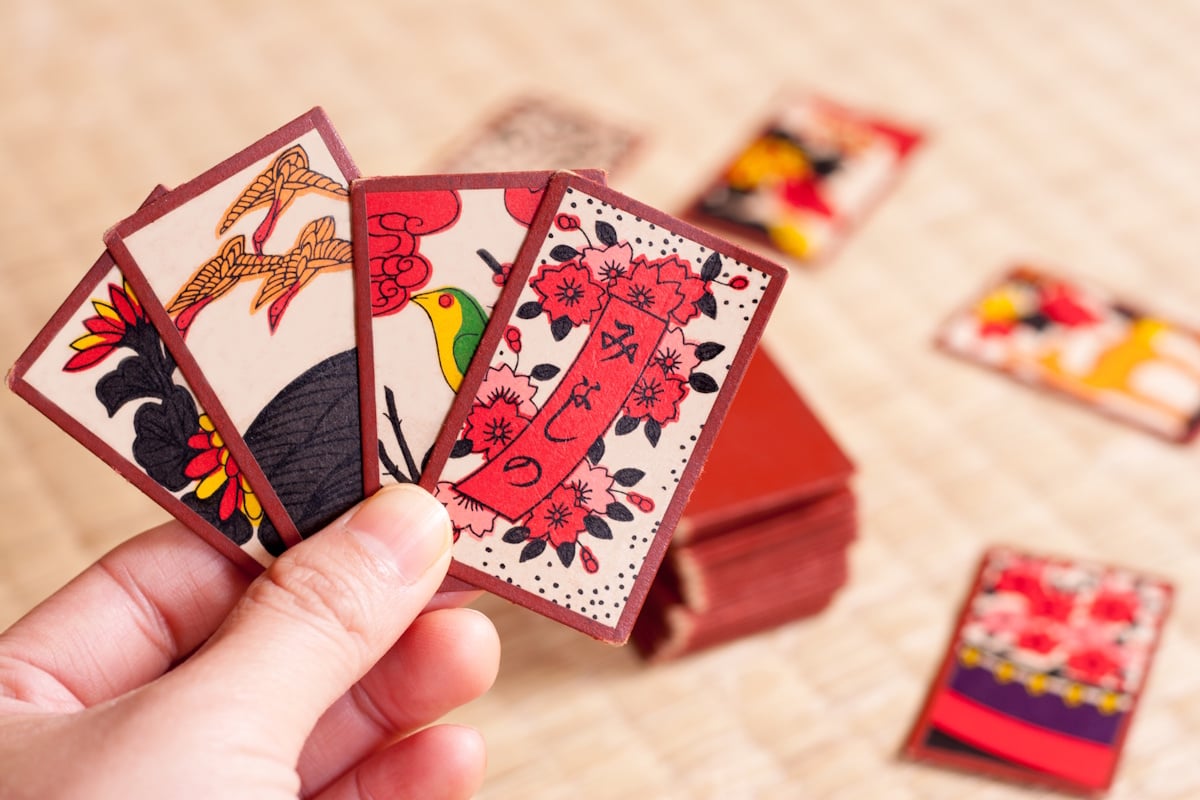


Long before Mario jumped his first barrel, and a century before Pokémon fit in a pocket, Nintendo was already a household name in Japan. But let’s be clear: their customers weren’t kids, and they weren’t playing video games. They were yakuza gangsters sitting in smoke-filled rooms, and their game of choice was a deck of cards called hanafuda.
Today, we think of Nintendo as the ultimate family-friendly brand. But the company’s foundation is built on a deck of “Flower Cards” that started life as illegal contraband.
Hanafuda isn’t just a retro game. It is the story of a 400-year-old battle of wits between gamblers and the Shogun that accidentally gave rise to the modern gaming industry. It’s a story of secret codes, subversive art, and how the Japanese underworld kept a tradition alive by pretending it was nothing more than poetry.
Editor’s Note: This article is an unpaid collaboration between Unseen Japan and Hanafuda Legends.
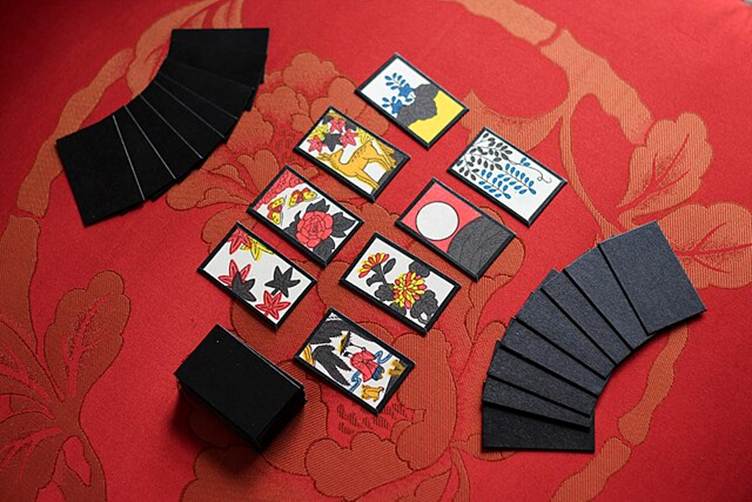
Hanafuda card playing field / wikimedia
1543: The shipwreck that changed everything
It all started with a typhoon. In the autumn of 1543, three Portuguese merchants were blown off course and crashed onto the shores of Tanegashima. They brought two things that would change Japan forever: the matchlock musket and a deck of 48 playing cards called cartas (Yamaguchi, 1961).
The Japanese were instantly obsessed. They reverse-engineered the decks, calling them Tensho Karuta (a Japanese pronunciation of “carta”). These were essentially bootleg copies of the European originals.
They kept the 48-card structure and the four Latin suits: Cups, Coins, Clubs, and Swords. The designs were so faithful that the Ace of Coins often featured a dragon, a direct mimicry of the Portuguese style. This 48-card “DNA” became the mathematical backbone of Japanese gaming, surviving long after the Europeans left.
But the ruling Tokugawa Shogunate wasn’t having it. They saw these foreign symbols as a gateway to social decay and – more importantly – illegal gambling. By the mid-1600s, the government laid down the ban hammer.
The public refused to quit. It turned into a centuries-long game of cat-and-mouse. Every time the government banned a deck, the people invented a new version with different pictures to hide the numbers (Ebashi, 2012). Finally, they created hanafuda – the ultimate “visual camouflage.”
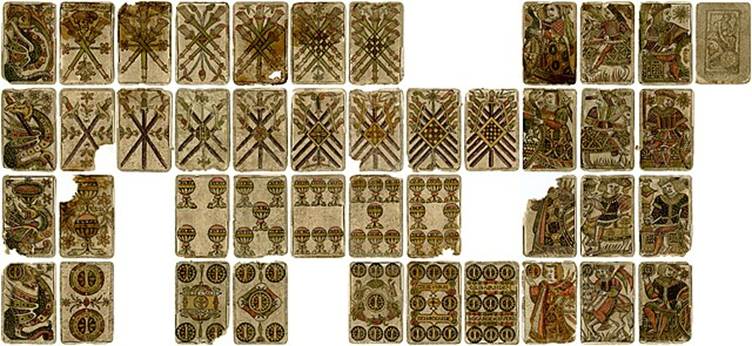
Portuguese “Cartas” / wikimedia
See a side of Tokyo that other tourists can't. Book a tour with Unseen Japan Tours - we'll tailor your trip to your interests and guide you through experiences usually closed off to non-Japanese speakers.

The 12-month structural revolution
To truly fool the police, the cards needed to lose their Western logic. As researcher Yamaguchi Kichirobei explains, the creators pulled off a fundamental structural shift. Western decks were organized by Suits (4 suits of 13 cards). That was too easy for the police to spot (Yamaguchi, 1961).
Hanafuda flipped the script. Instead of organizing by suit, the creators organized the deck by Time. They kept the total of 48 cards but reorganized them into 12 suits of 4 cards, each representing a month of the lunar calendar.
By mapping the cards to the seasons – Pine for January, Plum for February, Cherry for March – the game could be passed off as a calendar or an educational tool. It was a brilliant pivot: the mathematical probability required for gambling remained, but the interface became entirely Japanese (Ebashi, 2005).
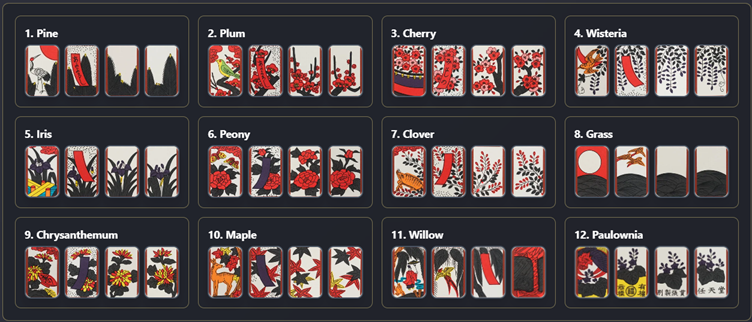
12 suits of 4 cards organized by months of the year / Hanafuda Legends
The 8-9-3: The birth of the yakuza
Because hanafuda existed in this legal gray zone, it became the tool of choice for the Japanese underworld. In fact, you can’t separate the cards from the crime – the connection is baked into the very name of the Japanese mafia.
The word yakuza comes directly from a hanafuda-based gambling game called Oicho-Kabu. In this game, the goal is to reach 9. If you are dealt an 8 (Ya), a 9 (Ku), and a 3 (Za), your total is 20. In Oicho-Kabu, only the last digit counts—meaning your score is 0. An “8-9-3” hand is literally “worthless” (Ebashi, 2005).
Originally, the term yakuza was used by card sharks to describe themselves as the “worthless” outcasts of society. The cards themselves were designed for this rough environment. Unlike thin, flexible Western cards, hanafuda are small and stiff, made by pasting multiple layers of paper and clay together.
This thickness served a purpose. It made the cards durable enough to be slammed onto a tatami mat with a loud, intimidating “clack”—a sound that became the heartbeat of the Edo gambling den (Yamaguchi, 1961).
The hierarchy of nature: Okawa’s “portable poetry”
Here is the irony: while the underworld used them for gambling, the cards themselves remained a masterpiece of high art. Researcher Okawa Gohei argues that hanafuda is actually a “portable poetry” gallery, deeply rooted in the Heian-period aesthetics of Waka poetry (Okawa, 2008).
Okawa identifies a strict Visual Hierarchy hidden within the images. Unlike Western cards where a “7” is printed on the face, hanafuda value is determined by the complexity of the image.
- Brights (Hikari) – 20 Points: There are only five. These feature grand symbols (The Sun, The Moon, The Rain Man, The Phoenix, The Cherry Curtain).
- Animals (Tane) – 10 Points: Cards featuring a creature (Boar, Deer, Butterfly) or a significant object like the Sake Cup.
- Ribbons (Tanzaku) – 5 Points: These feature thin strips of paper used for writing poetry.
- Chaff (Kasu) – 1 Point: The “junk” cards, featuring only flowers or vegetation.
This system allowed for complex games like Hachi-Hachi (88), a game of immense strategic depth favored in geisha houses, and Koi-Koi (Come-Come), the tense 1-on-1 match that remains the most popular way to play today.
See a side of Tokyo that other tourists can't. Book a tour with Unseen Japan Tours - we'll tailor your trip to your interests and guide you through experiences usually closed off to non-Japanese speakers.
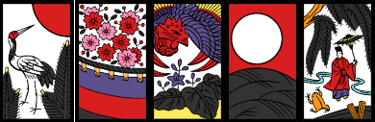
Hikari (The Sun, The Cherry Curtain, The Phoenix, The Moon, The Rain Man) / wikimedia
How “flat” art created the anime look
Perhaps the most “unseen” influence of hanafuda is how it shaped the way Japan draws. Because the cards had to be recognizable in dim light and easy to print with woodblocks, they used a very specific style: bold black outlines, flat colors, and no shading (Okawa, 2008).
This wasn’t just an artistic choice; it was a technical necessity. However, this high-contrast look became the visual DNA of Japan. In the early 20th century, as manga and eventually anime began to develop, artists looked to this tradition of bold, iconic imagery. When you look at the clean lines of a modern anime character, you are seeing a style that was perfected on the backs of gambling cards centuries ago.
The Nintendo legacy
Hanafuda’s transition into the modern world was secured in 1889, when a craftsman named Yamauchi Fusajiro opened a small shop in Kyoto called Nintendo Koppai. At the time, the Meiji government was finally relaxing its stance on card games, and Yamauchi saw an opportunity to bring the forbidden game into the light (Naganuma, 1907).
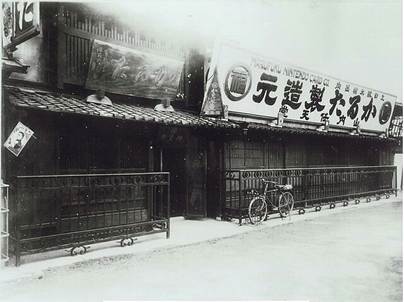
Nintendo’s first headquarters in Kyoto, 1889. Note the sign advertising “Karuta” (Playing Cards) / wikimedia
But hanafuda was still expensive to produce. To dominate the market, Yamauchi looked to the West. He began producing the “Daitoryo” (President) deck—a set of high-quality cards featuring the face of Napoleon on the box. It became the symbol of modern hanafuda, blending Western mass-production quality with the Japanese soul.
To sell these cards, Nintendo made a brilliant move: they partnered with the government’s Japan Tobacco and Salt Public Corporation (specifically the Monopoly Bureau). At the time, tobacco shops were the social hubs for men across the country. By placing “Daitoryo” decks on tobacco counters, Nintendo turned every corner store into a gaming shop. This partnership was so successful that it provided the financial bedrock for Nintendo to survive for nearly 100 years before it ever touched a computer chip.
The digital bloom
From the sharp clack of thick paper in a smoky Edo backroom to the digital light of a Switch screen, hanafuda has traveled a long road. It is proof that you can’t easily stamp out culture. This is a game that outsmarted the police, preserved ancient poetry in the middle of crime dens, and gave birth to one of the biggest video game companies on earth.
Hanafuda is more than just a deck of cards. It is a history book you can play. It reminds us that sometimes, the most beautiful stories come from the most forbidden places.
Enter the game: Where to play Koi-Koi (most popular hanafuda game)
Reading about hanafuda is one thing. But the only way to truly understand the tension of the game is to play it. The most popular variant today is Koi-Koi—a competitive match where you try to form “yaku” (sets) before your opponent stops the round.
If you want to try your hand at the game that started it all, you don’t need to find a backroom in Kyoto. You can play online at Hanafuda Legends.
- Play Online: Hanafuda Legends
- Learn the Rules: How to Play Koi-Koi
- Interactive Guide: Practical Tutorial
Japan’s most ruthless and efficient ruler believed a good diet was the key to success. Here’s how he kept his edge, according to historians.

The company took pains to reassure its Japanese customer base that information about their masturbatory habits was safe.
How Kabukicho, Japan’s biggest red light district, arose from the ashes of post-war Japan.
Sources
- Ebashi, T. (2005). Hanafuda: The Flower Cards of Japan. Dai-Nippon Playing Card Museum.
- Original: 江橋 崇『花札』(大牟田市立三池カルタ・歴史資料館)
- Ebashi, T. (2012). Visual Camouflage: The Evolution of Gambling in the Edo Period. Journal of Japanese Ludology.
- Original: 江橋 崇「視覚的偽装:江戸時代における賭博の進化」『日本遊戯史学会』
- Naganuma, K. (1907). The Rise of Nintendo Koppai: Business Records of the Meiji Era. Kyoto Commercial Archives.
- Original: 長沼 健『任天堂骨牌の興隆:明治期営業録』(京都商業文書館)
- Okawa, G. (2008). Portable Poetry: The Visual Hierarchy of Japanese Gaming. University of Tokyo Press.
- Original: 大川 五兵衛『掌の詩:日本の遊戯の視覚的階層』(東京大学出版会)
- Yamaguchi, K. (1961). Unsun Karuta and the History of Japanese Playing Cards. Hoikusha.
- Original: 山口 吉郎兵衛『ウンスンカルタ』(保育社)
