


Shinjuku started as a mere post town on the road from the countryside to the samurai capital of Edo. Quickly gaining a reputation for licentiousness, the samurai government dismantled the post town after a mere few decades of operation.
By the late 18th century, however, the government reinstated the town. After the fall of the samurai government, a small train station in the area slowly became a new focal point for all of Tokyo. Shinjuku was on the rise – right up until the cataclysm of World War II.
Learn more in part 1 of this two-part series, or read on, below!
The destruction of Shinjuku
In July of 1944, the onslaught began.
In that month, the American military retook the Japanese-occupied island of Saipan in the Northern Marianas, using the island to launch a mass firebombing campaign against the Japanese mainland. The campaign meted out wholesale destruction to much of the urban space throughout Japan, with the capital of Tokyo seeing an especially stark level of death. Twenty years earlier, Shinjuku was spared the devastation of the Great Kanto Earthquake. This time, the district would not be so lucky.
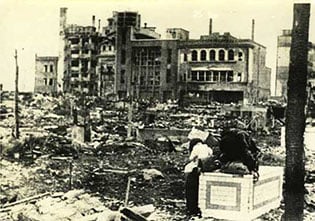
The worst came on April 13th and May 24th-25th, 1945, when B29 bombers filled the skies above Shinjuku. Approximately 55,000 homes in the area were reduced to ashes by their fiery payloads. Fires enveloped the streets of the entertainment district, reducing 80% of what would become the whole of Shinjuku Ward to a field of smoldering debris.
On March 10th, 1945, the Tokyo Great Air Raid resulted in the death of over 100,000 people across Tokyo in a single bombing raid. In Shinjuku, most children had been evacuated to the countryside; nonetheless, countless people were killed. [5] When those who had evacuated or fled finally made their way back to wartorn Tokyo, the district was an unrecognizable expanse of debris and gutted-out buildings.
Some large concrete edifices remained amidst the rubble: the Mitsukoshi, the Isetan, and a few others. Surprisingly, the Shinjuku Gyoen gardens had been spared and offered a green respite in the midst of the ruins.
In darkest night: The black markets of Shinjuku
On August 15th, 1945, nine days after the atomic bombing of Hiroshima and seven days after Nagasaki suffered the same fate, Emperor Hirohito made his historic radio broadcast announcing the surrender of Japan. The vast majority of Shinjuku lay in ruins. On the 20th, five days after the stunning end of the war, a hum of activity was already underway amidst the debris. The Shinjuku Black Market was open for business.
The first of the great black markets of Occupation-era Japan, the Shinjuku yami-ichi (新宿闇市) was the brainchild of Ozu Kinosuke, boss of the Ozu gang, a local yakuza organization. With advertisements placed in major newspapers, Ozu had recruited small-time factory owners (whose contracts had been with the now-defeated imperial military) and other entrepreneurs with something to sell.
Their makeshift stalls, tightly controlled by the yakuza, became a lifeline to the desperate people of Tokyo. Within only a few weeks, the market even had its own twinkling, startlingly optimistic billboard, reading “Light from Shinjuku.”(「光は新宿より」.) Surely this was a strange sight amidst the utter devastation.
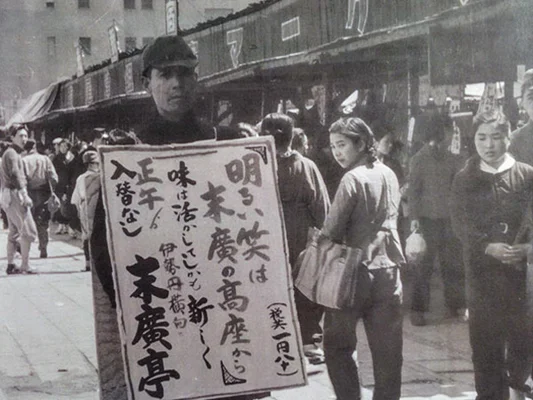
Shinjuku was an ideal location for such a huge postwar market. Much as with the Great Kanto Earthquake, the vast conflagration of the Allied firebombing had driven Tokyoites from central Tokyo into the western suburbs. As it had for centuries, Shinjuku stood as a junction between the population of the west and the capital proper. For those still living in the ruin of central Tokyo, and families living with relatives in the relatively untouched west, the black markets of Shinjuku lay amidst the convenient hub of Shinjuku Station. (A hub that became all the more convenient as the train, bus, and trolley lines stuttered back to life.)
The Ozu gang ran the huge black market next to the Shinjuku east exit; this was called the “Shinjuku Market” (新宿マーケット), and played host to over 70,000 shopkeepers and peddlers. Still, the Shinjuku Station area was vast enough, and the demand in poverty-stricken Tokyo great enough, that each major exit had its own black market lorded over by a different yakuza gang. The west exit had the “people’s market” (民衆マーケット) run by the Yasuda gang; the southeast exit area had the Wada Market, named after its own yakuza operators. Soon, over three hundred black markets had blossomed across the blighted Tokyo landscape; similar sights could be seen in cities around the country. [13.]
The black markets live on: Shinjuku’s Yokocho
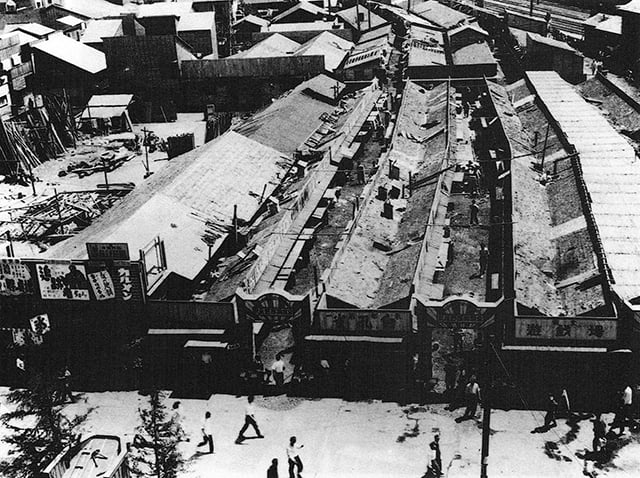
In 1949, the black markets were finally dismantled by order of the Occupation forces. At this point, various of the original yakuza market ringleaders were in jail, and the hundreds of black market stalls were shifting from hawking fenced necessities to selling booze and noodles. As noted in Emergent Tokyo, however, “…these measures did not treat black market merchants as a criminal element to be pushed out of a society, but rather as a group worthy of reasonable accommodation that could be integrated into plans for the next stage of postwar development.”
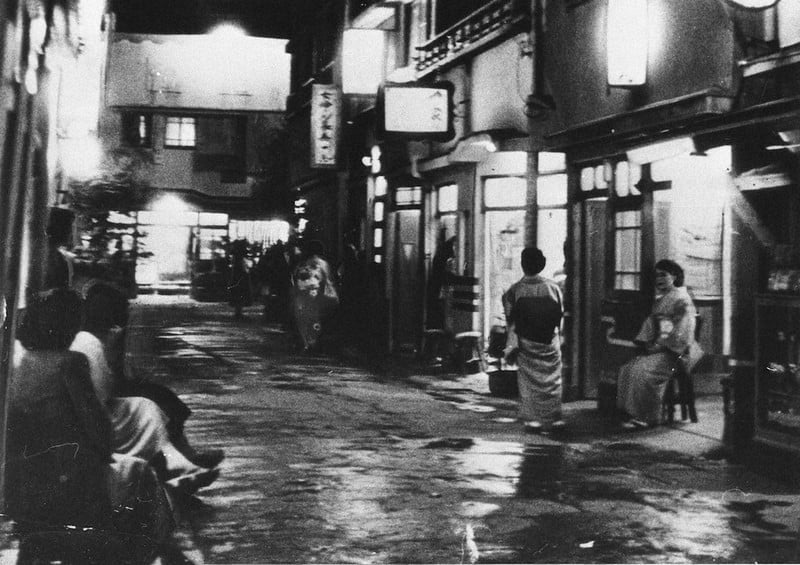
The east exit Shinjuku Market businesses were moved into a series of row houses half a kilometer from the station; this is the now-famous Golden Gai, home to nearly 300 tiny drinking establishments. (Originally, many of these were brothels – but the 1956 banning of prostitution put the kibosh on that business structure.) From the 1960s until the mid-1980s, the narrow bars of Golden Gai were a beloved haunt for artists, actors, and activists.
Omoide Yokocho, the station area’s other famous yokocho space, similarly emerged from the west exit black market. This was first known as “Lucky Street,” featuring a series of tiny outdoor stalls separated by sliding door frames. (It would later take on the less appealing sobriquet of shonben yokocho – “piss alley,” thanks to the main drag’s sole bathroom space. Omoide Yokocho, “Side Street of Memories,” is a more recent naming attempt to spruce up the neighborhood’s image.)
The Lucky Street black market stalls sold the only meat they could get their hands on during the controlled economy under the Occupation – entrails and offal, unwanted cuts from the cows and pigs used to feed the Occupation troops. Even today, half of the izakaya that make up Omoide Yokocho sell yakitori and motsu nabe – offal hot pot.
The Shinjuku black market was a place of strange tensions; it provided an invaluable source of everyday goods for a devastated populace, but often did so at prices that gouged that same populace. It was a site where violence often erupted between competing gangs, but also one where Japanese and non-Japanese former imperial subjects worked alongside each other in relative harmony. It served an important purpose, but became a feared symbol for the breakdown of law and order and, in particular, the rising threat of foreign criminals.
In some ways, little has changed.
Emerging from Occupation: The birth of Kabukicho
In the early years of the post-war Occupation, a major change occurred to the breakdown of wards and towns within Tokyo. During the war, Tokyo City itself had ceased to exist in 1943, replaced by 35 wards within its old borders. By the war’s end, the area that’s now Shinjuku was split between three wards: Ushigome and Yotsuya to the east, within the borders of old Edo, and Yodobashi Ward to the west. In 1947, the 35 Tokyo wards were reorganized into the 23 we know today; Ushigome, Yotsuya, and Yodobashi at last agglomerated into our modern Shinjuku Ward.
Not that this municipal reorganization initially had much impact on the ground, where the black markets were in full swing and abject poverty still reigned. Much of the new Shinjuku Ward consisted of hovels and makeshift communities near Quonset huts. The civilian government sought to change this. Disempowered on a national level by the ever-watchful Allied Occupation, the local governments turned their focus towards domestic uplift. From 1945, Tokyo’s revitalization policy was led by urban planner Ishikawa Hideaki. He was soon approached by Suzuki Kihei of the Shinjuku Revitalization Land Readjustment Union with an intriguing plan: turning the devastated Tsunohazu neighborhood east of Shinjuku Station into a major entertainment district, with a kabuki theater at its heart.
This was the birth of Shinjuku’s modern lynchpin, the ever-popular, ever-infamous Kabukicho. Tsunohazu had been a marshy village that hosted a samurai lord’s mansion in the old days; pre-war, it featured a girls’ school and mixed residential and shopfronts. A firebombing raid on April 13th, 1945, had destroyed all that. Now, Ishikawa, Suzuki, and landowner Mineshima Mohei envisioned a grand, 1850-seat kabuki theater, christened the Kiku-za, as the centerpiece of a massive entertainment district to rival the old Naito Shinjuku. To help gin up excitement for the new development, they petitioned the city government to officially change Tsunohazu Town’s name to Kabukicho: “Kabuki Town.” Ironically, the building of the Kiku-za theater faltered as funds ran out. So, Kabukicho famously lacks the building that was to be its namesake. Nonetheless, the entertainment district would eventually eclipse anything Ishikawa and Suzuki had envisioned. [1]
The Red Light District to end all Red Light Districts
Kabukicho’s early days met with some setbacks; in 1950, a major cultural products expo set in the new Kabukicho, the Shinjuku Gyoen, and Nishi Shinjuku Square failed to generate much revenue. The expo sites were sold off piecemeal. However, the land divisions set up for the expo in Kabukichi became the basis for the outline of the entertainment district we still know today. In the expo pavilions’ place emerged cinemas, batting centers, bowling lanes, and theaters. In 1956, the Shinjuku Koma Theater came into being at the end of the wide avenue. The 2088-seat theater became a major landmark, and operated until 2009 — its location is now the Shinjuku Toho Building, atop which the Hotel Gracery and giant Godzilla head soar.
See a side of Tokyo that other tourists can't. Book a tour with Unseen Japan Tours - we'll tailor your trip to your interests and guide you through experiences usually closed off to non-Japanese speakers.

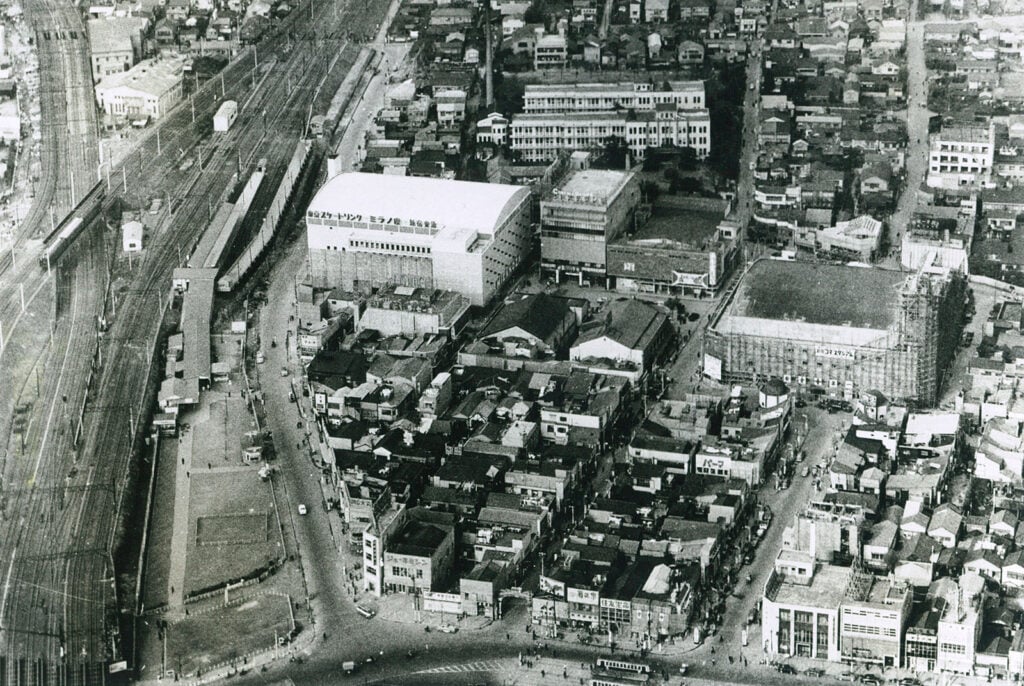
Alongside these were venues that harkened back to the old industries of nearby Naito Shinjuku: love hotels and “Turkish Baths,” now called Soaplands. (In the 1980s, the name of these businesses was changed when the Turkish Embassy complained of the derogatory association.) In 1956, the government banned prostitution, greatly altering the economic basis of the sex industry in Shinjuku. However, with the law only affecting direct penetrative acts, this had the unique result of propagating a wide range of new sex-adjacent businesses only barely skirting this red line. Kabukicho became one of the major sites for the development of this expansive new industry, and by the 1970s had emerged as the biggest red light district in all Japan. As might be expected, much of this grey-area commerce happened under the aegis of various yakuza groups vying for Kabukicho turf, with businesses paying protection money.
(“Red light district” tends to inspire foreign visitors to imagine the open windows and literal red lights of Amsterdam. Japanese law, however, states that these businesses must not have windows that reveal shop interiors, and keep advertising to a minimum. This means that the streets of Kabukicho conceal much more of this industry than foreign visitors expect from one of Asia’s largest such districts; those expecting a more titillating streetside experience may find things surprisingly tame. In Kabukicho, it all happens behind closed doors. [15])
Skyscrapers soar and drinks flow
The Occupation ended in 1952, and Japan was again suzerain over its own territory. The Japanese economy began climbing out of post-war impoverishment, and by the 1960s had entered a period of high growth and increased urbanisation. The 1964 Tokyo Olympics served as the country’s de facto coming out as a returned member of the brotherhood of nations; many of the events were held just south of Shinjuku. By now, the black markets were long-gone. Kabukicho was beginning to take a form very similar to what we know now. The Olympics served as an excuse to greatly expand the Shinjuku Station west terminal.
The west station area, still a wide aquifer, was about to evolve into a more familiar form. The Yodobashi Water Purification Plant had been hit by the 1945 firebombings, but had been spared complete destruction. By 1960, however, plans were underway to shift the plant’s operations further west to a new facility in the prefectural suburb of Higashiyamamura City. Staff and operational capabilities moved there piecemeal until the Yodobashi plant essentially shut down in 1965. In 1971, the area played host to the first true high-rise in Shinjuku: The 200-meter tall, 47-floor Keio Plaza Hotel. (1971 is also the year that Kabukicho’s Club Ai, one of Shinjuku’s very first host clubs, opened to the east of the station.)
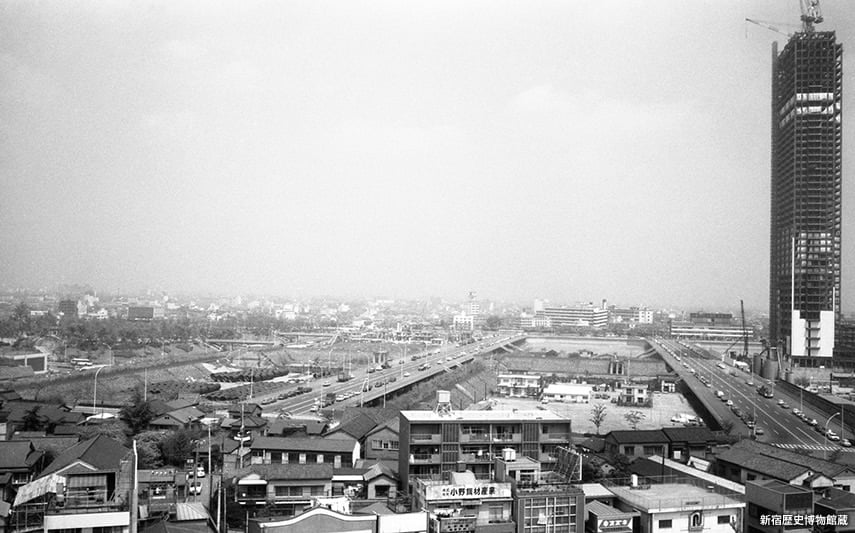
Once the Keio Plaza had arisen, it was followed by a vertical forest of ferrococrete and glass towers. The massive conglomerates of Sumitomo, Mitsui, and KDDI all completed even taller skyscrapers in 1974; the easily identifiable sloping facade of the Sompo Japan Building appeared in 1976. At least one new megatall would grace the Nishi Shinjuku skyline almost every year well into the early 2000s. With the birth of the West Shinjuku skyscraper cluster upon the dried bones of the purification plant, Shinjuku was entering into a new era: one where the district was not only the heart of Tokyo transit, shopping, nightlife, and vice, but also home to the great business giants of Japan.
Bright lights of Yasukuni
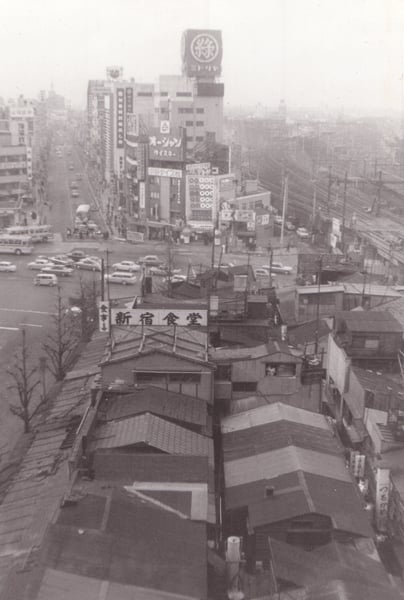
The local tram line, a nostalgic sight for those who knew the Shinjuku of the earlier part of the 20th century, shut down in 1970. The green line that runs from Yasukuni Avenue beside Golden Gai is a remnant of the tram line’s once-busy track. But another now-familiar Shinjuku sight was coming into being in the 1970s; the bright, advertisement-strewn exteriors of the multi-tenant Yasukuni Avenue midrises. These had originally been low-rise single-business eateries and offices along a recently widened avenue fronting the newly named Kabukicho district. In the early 70s, developers swooped up these plots and replaced the low-rises with a row of much taller, 8-10 floor buildings. While relatively high, these buildings occupied the same small plots as their predecessors, giving them their iconic, thin-and-tall look. [14]
These are the famed zakkyo-style buildings of Shinjuku, recognizable the world over. Each floor generally hosts a separate business, with small elevators accessible from street level taking the customer directly to their destination. In the 1970s, many of these businesses were offices, banks, or restaurants; as consumer trends shifted and Kabukicho grew, the tenants became ever more varied. Izakaya, shot bars, karaoke joints, pachinko, majong, manga cafes, retail shops, game centers, darts bars: the Yasukuni Avenue zakkyo buildings are a shining microcosm of the endless variety of offerings to be had throughout the warrens of Shinjuku. Their illuminated vertical signage signals the mass of possibilities awaiting the millions who venture into the district each day.

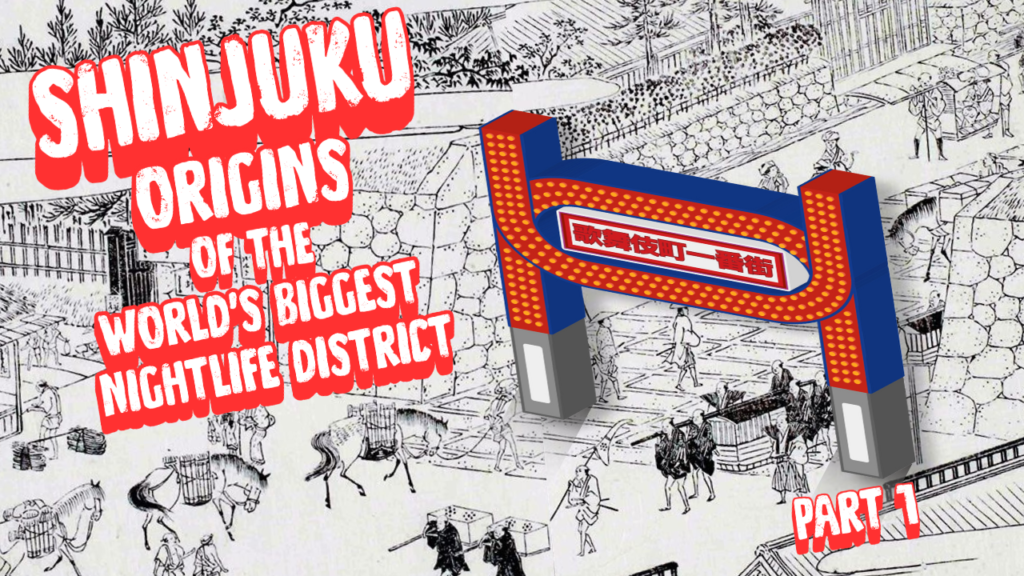
Near the western terminus of the zakkyo cluster emerged another iconic, illuminated symbol: the Kabukicho Ichibangai Arch. The now-famed red curves and twinkling lights of the arch embody “Kabukicho” more than any other single symbol. The original form of the arch appeared in 1956, just as the district was starting to gain popularity. This was a simple, wide arch with “Kabukicho” written out in English lettering. In 1969, a stockier version of the arch went up, this time featuring the now-iconic “Kabukicho Ichibangai” signage. During the 1970s, the modern design finally appeared, with two red inverse curves topping each other, strewn with flashing lightbulbs. The design has been maintained ever since (including in the popular Sega video game series “Yakuza/Like a Dragon”), although the lightbulbs were swapped for LEDs starting in 2013. [16]
In other words, midway through the 1970s, the frontage to Kabukicho had taken on much the same form as we know today. In part, this is due to the flexibility of the zakkyo-style buildings. From Emergent Tokyo: “Zakkyo buildings – with their capacity to grow, change their function over time, and reinvent themselves – offer a more robust infrastructure for urban self-regeneration.” Around half of the Yasukuni Avenue buildings still date back to the 1970s.

The protest movement explodes in Shinjuku
Shinjuku was now the core of modern, economically vital Japanese capitalism. In the 1970s, this was occurring under the watchful eye of Tokyo’s smiling governor, the self-declarative “Utopian Marxist” Minobe Ryokichi. In 1971, Shinjuku instituted one of his pet policies, a “pedestrian heaven” pedestrianized street. The car-less free-for-all still occurs ever sunday on Shinjuku’s own scramble intersection, a smaller version of the famed Shibuya Scramble right next to the Shinjuku East Exit that opened in 1971.
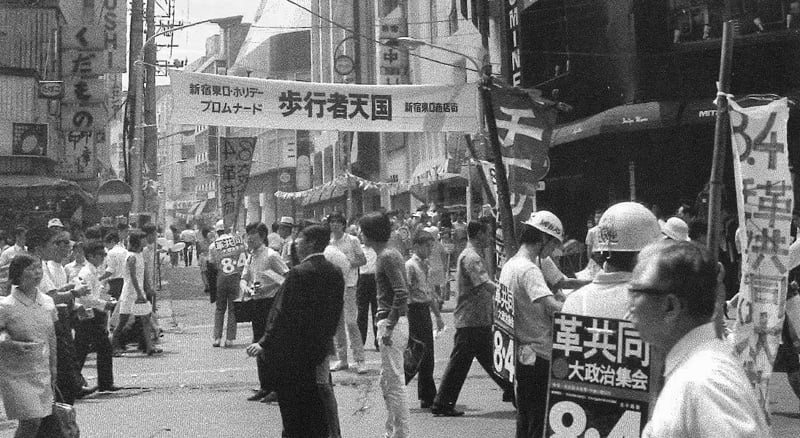
Shinjuku, and the country as a whole, was rushing towards an even more consumer-oriented national culture. At the same time, the late 1960s and early 70s was a time of burgeoning youth radicalism, and Shinjuku was no exception. On October 21st, 1968, the station area played host to one of the seminal moments of radical protest in the history of the Japanese New Left. 2000 members and hangers-on of some of the radical sects of the day – the still-extant Chuukakuha, the Marx-Lenin Faction, and the 4th International — amassed at the East Exit square. Their goal: the storming of Shinjuku Station.
The demonstration was part of a mass national day of protest against Japan’s support for the Vietnam War. Moreover, it directly targeted Shinjuku Station because of the transit system’s involvement with the shipping of US war material. Indeed, a large explosion had erupted at the station a year earlier, caused by the collision of an American military tanker car.
The radicals, armed with staves and wearing their usual hardhats with individual sect logos, engaged thousands of riot cops in hand-to-hand battle. Meanwhile, numerous radicals broke into the station, ripping seats from trains and setting them alight at the South Exit. 20,000 onlookers swelled the rioters’ ranks, and Shinjuku Station shut down entirely as the police’s tear gas pervaded the air. A train stoppage was in effect until the next morning, by which time 743 individuals were under arrest. Undeterred, hundreds of New Left demonstrators would again invade Shinjuku Station on the same date the following year.

High times in Bubble-era Shinjuku
By the 1980s, the radical Shinjuku of the previous decade was a near-forgotten memory. In its place was the partying, all-consuming nexus of a society that had just entered the economic stratosphere: the bubble era. In spite of various police campaigns to get hostess club touts off the streets, and a string of love hotel murders and Taiwanese gang wars leading to an even more negative perception of the district, the Kabukicho of the 80s was a raucous place. Money flowed into ever-gaudier hostess clubs and cabarets.
The bubble era resulted in massively inflated land prices; Kabukicho, home to thousands of small-scale bars, clubs, and businesses of ill repute became a major focus for redevelopment. Golden Gai, with its 300 tiny, aging bars, was an especially tempting target. Bar owners, many of whom ran their businesses for the sake of the vibrant communities they fostered more than mere profit motive, had to actively resist motivated developers. When they refused land buy-outs, the developers would often send in the yakuza to partake in jiage: “land raising.” Threats of violence and the occasional arson drove some Golden Gai bar owners to sell, but most managed to hold on through the turbulence of the asset price bubble era.
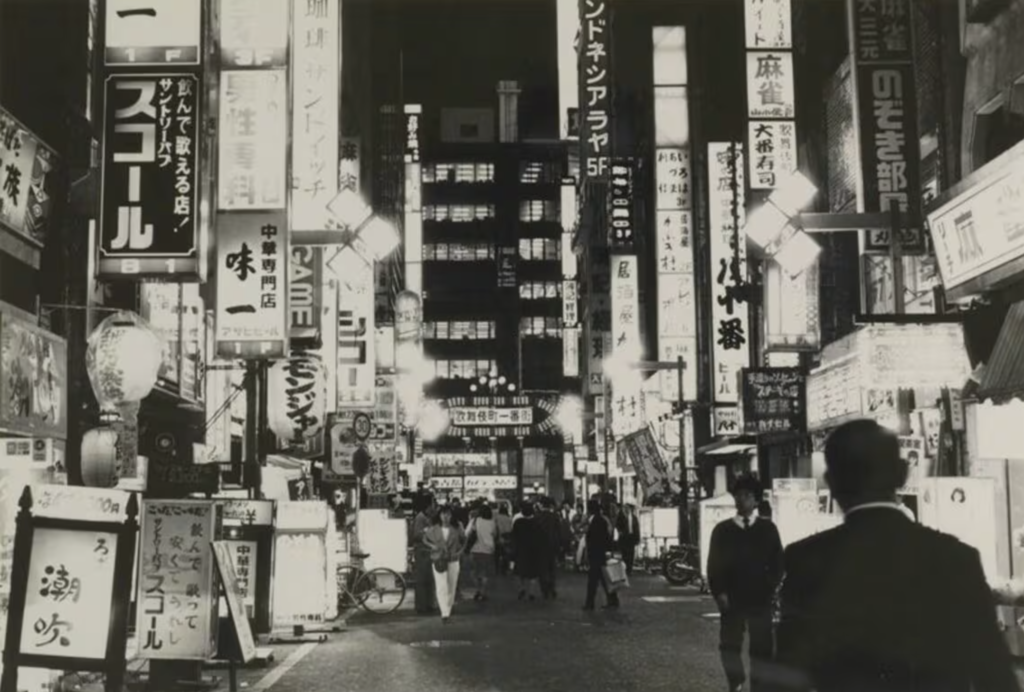
The bubble finally popped in early 1992, and with it went the will for mass redevelopment. With a population less inclined to spend extraneous money on frivolity, some businesses shuttered, and the hostess and host club industry contracted. Kabukicho and Shinjuku were somewhat diminished.
But nonetheless, a new structure in West Shinjuku proved the district’s final ascendance as the core of Tokyo: the Tokyo Metropolitan Building, the seat of the Tokyo Prefectural Government. The tallest city hall in the world, the two-pronged, 48-story structure opened in 1991, and cemented the move from the old eastern center of Edo to the newfangled western population centers of modern Tokyo. Shinjuku was here to stay.
A separate Shinjuku: Ni-chōme, Asia’s largest LGBTQ district
While the 90s saw the collapse of the bubble-era high life, East Shinjuku was experiencing a new boom: an expanding and vibrant gay party scene. Shinjuku Ni-chōme, the second district, had emerged as home to the world’s highest concentrated area of LGBTQ bars.
Shinjuku Ni-chōme, a square district of three blocks surrounded by major roads on three sides, sits just north of the Shinjuku Gyoen gardens. In other words, it’s located in the area of the old Naito Shinjuku post town. Accordingly, the frontage areas of Ni-chōme and neighboring San-chōme to the west were sites where the legacy of the prostitution of the samurai era continued well into the 1940s. With the illegalization of this industry in 1956, the old houses of ill repute dwindled. In the mid-1960s, gay bars started to move into the vacant buildings of Ni-chōme. The local gay scene, previously a scattering of establishments around Shinjuku, started to coalesce. Soon, Ni-chōme overtook Ueno as the center of gay life in Tokyo.
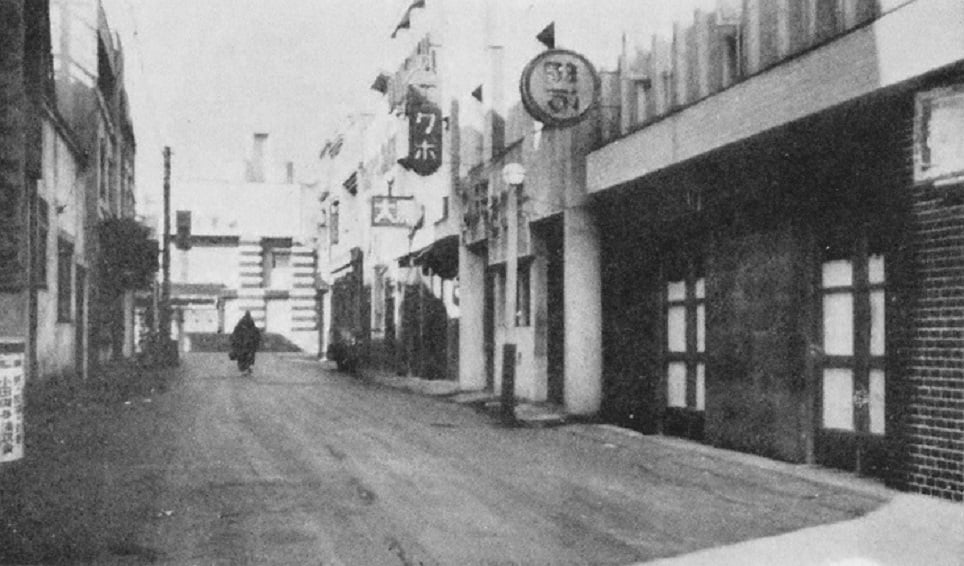
Ni-chōme grew not just via the Tokyo gay community, but with successive Japanese media “booms” focused on queer identities. 1965 saw a “sex change boom,” and the 80s had a major “new half” (a vague, potentially derogatory term for cross-dressers and trans women) boom. In the 90s, the biggest and longest-lasting boom of all, the “gay boom”, lasted from 1991 to ’94, and saw gay men represented positively in Japanese TV, magazines, manga, and more. The public knew of Shinjuku Ni-chōme as the site to engage with these depicted communities.
These days, Ni-chōme is home to over 300 gay bars, nightclubs, host/hostess clubs, pride boutiques, and more, offering both open establishments that welcome all, to bars and clubs specifically for those of specific orientations or identities. While the area is described at times as conversely warm and gentrified, and has lost some ground via increased land prices following the opening of the Fukutoshin Line at San-Chome Station, it remains a major lynchpin in the Japanese LGBT scene.
The foreign element of Shinjuku
Subaltern groups play a major role throughout Shinjuku. Indeed, since 1987, Shinjuku Ward has hosted the highest foreign population of any of the 23 wards of central Tokyo. As of 2024, this constituted 43,897 people, or about 14.5% of the ward’s total population of 305,329. (Visits to Kabukicho in the evenings might give an impression of any even higher percentage, given the sheer number of foreign visitors at any time.)
Just north of Kabukicho is the appealing Shin-Okubo neighborhood, Tokyo’s very own Koreatown, and now home to many of South and Southeast Asian descent. Kabukicho itself, while still a Japanese-facing district in many ways, has since the early 2000s been more and more internationalized. This includes on the criminal front, with Chinese tongs and triads joining the Yakuza (both ethnic Japanese and Korean) in taking advantage of the inherent profitability of the red light district. Nigerian touts were omnipresent until recent years, and still operate out of Kabukicho despite police crackdowns limiting their previously more obvious operations.
Planning a trip to Japan? Get an authentic, interpreted experience from Unseen Japan Tours and see a side of the country others miss!

Kabukicho has often stood in as a totem for grime and crime throughout Japan; powerful Prime Ministers like Koizumi Junichiro (in office 2001-2006) and Abe Shinzo (2006-2007, 2012-2020) spoke on the need to “purify” the area, and toured Kabukicho to help grasp its urban reality. Perhaps surprisingly, both had the tact to not specify foreign criminal elements as the target of this purification in comparison to the homegrown yakuza – although the noted ultranationalist Tokyo governor Ishihara Shintaro (in office: 1999-2012) was another matter. [4]
Land of tensions
Within Shinjuku, Kabukicho remains a place of strange tensions. The district is frequented by thousands and thousands of people, yet home to very few; the land and buildings are generally owned by absentee landlords. These landlords benefit from both the drinking and shopping industries, but also profit from the grey-zone sex industry. At the same time, they’ve often stood in opposition to the illegal touts and roaming street advertisers who used to so aggressively woo potential customers or new recruits to their seedy industries. [15]
Meanwhile, the new Kabukicho is a place where one sees almost as many foreign tourists as local revelers. This is a major change from the Shinjuku of even fifteen years ago; until the coming of the massive inbound tourism boom starting in 2016, the vast majority of those visiting and consuming in Shinjuku were Japanese.
Some of these overseas visitors are part of a new breed of sex tourists, and a new section of the Kabukicho industry is trying to appeal to them. For the most part, though, foreign tourists in Kabukicho are only vaguely aware of the realities of the huge red light industry there — one can see families with young children walking the streets hoping to visit Donkihote or see the giant head of Godzilla looming above the Toho Building. The government, interested in tourist dollars, has actively pushed illegal touts and recruiters off the street, making the average visitor’s experience more comfortable. And yet, this can hardly change the reality lurking in the peripherals of an expansive neighborhood still firmly grounded in hundreds of businesses providing paid intimacy.
Shinjuku, however, is more than the sum of its parts. Kabukicho attracts and repels, playing its role as Tokyo’s great seedy underbelly. But for the millions who make their way through Shinjuku every day, the district has much more to offer. In fact, offering whatever the passerby or commuter might need or want is exactly what Shinjuku does. Shopping, eating, drinking, entertainment, nature, housing, municipal services, education, museums, religion, art, transit on the grandest scale; Shinjuku is everything to everyone. At any given moment, more people than you can imagine are engaged in more activity than the human mind can comprehend. That’s Shinjuku.
From humble beginnings as a rural road to a feudal metropolis, to one of earth’s greatest centers of frenzied activity, Shinjuku has earned its reputation as the new core of the world’s most populated urban expanse. Whether it’s your exact cup of metropolitan tea or not, in Tokyo, you’ll inexorably be drawn into its endless, labyrinthian embrace.

Tokugawa Ieyasu: Japan’s Most Cutthroat Health Nut?
Japan’s most ruthless and efficient ruler believed a good diet was the key to success. Here’s how he kept his edge, according to historians.
Hanafuda: How a Banned Card Game Defined the Pre-Pokémon Era
Before Mario, Nintendo sold hanafuda cards to the yakuza. Read the 400-year forbidden history of the flower cards that tricked the Shogun.
Shinjuku: The History and Origins of the World’s Biggest Nightlife District
The world’s largest nightlife district, Shinjuku is nearly synonymous with Tokyo itself – yet wasn’t even part of old Tokyo. Where do Shinjuku’s origins lay?
Sources:
[1] 新潮社. (1994). 「江戸東京物語 山の手篇 」. 新潮社.
[2] 小林明. (2025). 「山手線「駅名」の謎」. 株式会社鉄人社.
[3] 鈴木理生. (1999).「読む・知る・愉しむ:東京の地理がわかる事典」.日本実業出版社.
[4] “このまちアーカイブス | 東京都 新宿 3:鉄道の発達と繁華街の賑わい”. 三井住友トラスト不動産.
[5] 常設展示開設シート, 1-11. 新宿歴史博物館.
[6] (2017.07.18). 新宿街史/The History of Shinjuku. 歌舞伎町文化新聞.
[7] 新宿西口 思い出横丁の歴史. Shinjuku-omoide.com.
[8] (2025). 太平洋戦争から戦後へ. SHINJUKU OHDOORI SYOUTENGAI SHINKOU KUMIAI.
[9] 戦時下および統制下におけるビール. 酒・飲料の歴史. Kirin Museum and History.
[10] Vaporis, C. N. (1986). Post Station and Assisting Villages. Corvέe Labor and Peasant Contention. Monumenta Nipponica, 41(4), 377–414.
[11] Yun Hui Tsu, Timothy. (2011). “Black Market, Chinatown, and Kabukicho: Postwar Japanese Constructs of ‘Overseas Chinese'”. Duke University Press.
[12] Seidensticker, Edward. (1983). Low city, high city: Tokyo from Edo to the earthquake. New York: Knopf
[13] Dower, John W. Embracing Defeat: Japan in the Aftermath of World War II. Penguin Books, 1999. Print.
[14] Almazán, Jorge, et al., authors. Emergent Tokyo: Designing the Spontaneous City. ORO Editions, 2022.
[15] Takeoka, Toru. (08/2015.) Sexworkers, Regulation, and “Right to the City”: The Streets in a Red Light District of Tokyo. Conference At: Urbino.
[16] (2021.01.22). 歌舞伎町の入り口で人々を迎える街のシンボル「歌舞伎町一番街アーチ」. 歌舞伎町文化新聞.
