
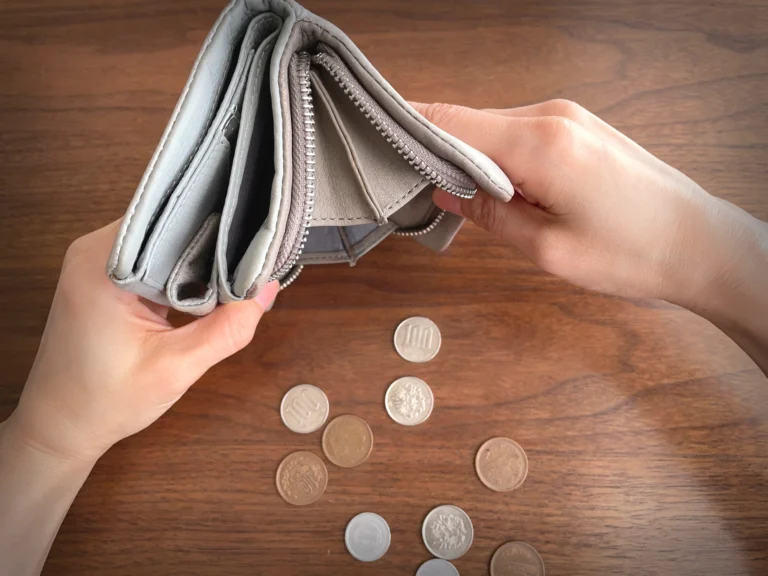
In March 2026, Japan’s Ministry of Economy, Trade and Industry (METI) announced that 58% of the country’s consumer spending was now cashless. That’s good news for anyone who doesn’t want to walk around constantly holding a walletful of yen.
But that 42% leaves many small shops where cash is still king. Additionally, not everyone can participate in Japan’s cashless revolution: the majority of tourists are still shut out from the country’s dominant cashless payment system.
There’s another wrinkle here, too: what happens when a store’s cashless payment system goes down…and you have no cash to back you up? This isn’t a theoretical question: it happened to one poor shopper, and the store called the cops on him.
What do you do if you find yourself in a similar situation in Japan? Here’s what one Japanese legal expert said recently, along with our advice to travelers and residents.
System down, so store called the police
Three years ago, X user @M29633096 live-posted an incident at a restaurant. The poster ate a meal, intending to pay with the local cashless payment service d-barai, owned by NTT Docomo Financial Group (formerly a part of Docomo, the cellular communications company).
The problem? d-barai was down.
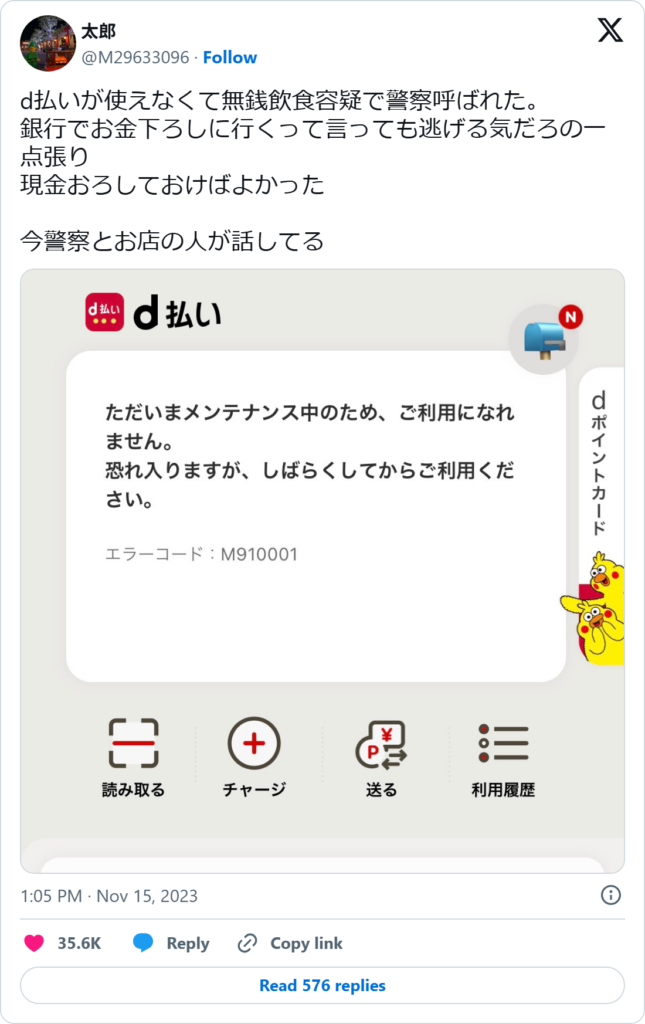
IC transportation cards, which also work as cashless payment systems, function as local wallets that work using NFC (specifically, Japan’s home-grown NFC chip implementation, FeliCa). The balance is stored on your card or phone and is synchronized with the server at regular intervals. By contrast, d-barai is a QR code/barcode payment system that requires connectivity to the server.
The user reported that they had PayPay and LINE Pay but no balance loaded, and that their credit card had failed at a previous location. Despite showing restaurant staff the app with the error code, a staff member still said they were going to call the cops. For some reason, they thought the user was running a dine-and-dash scheme.
Ultimately, an officer did come and escorted the man to an ATM where he withdrew cash. Even after paying, though, the restaurant staff member demanded that he apologize. He refused, saying a system error wasn’t his fault.
Cashless advances in Japan, but some merchants rebel
Japan has made leaps and bounds in cashless support since I started writing about the issue. Credit cards account for the majority of cashless payments at 82.7%, while electronic code payment apps like PayPay account for around 10.2%.
Officially, Japan is aiming for 80% cashless payments nationwide, with a goal of 65% by 2030. At 58% today, it’s well on the way there.
Not everyone is happy with the rush to cashless. And when I say “everyone,” I mean merchants.
According to Teikoku Databank, cashless payment fees at retailers have risen from 1.41% of sales to 2.04%, a 45% increase. Restaurants have fared even worse: they’ve seen their fees jump from 1.54% to 2.94%.
The economics of cashless don’t work for many small businesses. Take ramen shops, which operate on hideously thin margins. Kirimen, a ramen shop in Kasai, Hyogo Prefecture, would have to spend around ¥300,000 (~$1.9K) just to add cashless functions to its existing ticket machine, then hand a slice of every sale to the payment processors on top of that.
Owner Kiritani Naoyuki puts the total bite at roughly 5%. Between those fees and rising ingredient costs, he said, going cashless would mean raising every item on the menu by about ¥200 ($1.25), pushing his signature ¥750 ($4.70) bowl toward the dreaded ¥1,000 wall ($6.30).
In the end, Kirimen has decided to remain a cash-only business. Some businesses wish they could emulate. On X, one third-generation flour miller wrote, “You have no idea how painful it is to have 3% of your sales taken. Customers who pay cash start to look like gods.”
The fees are so bad that a few high-profile businesses have reverted to cash-only. GGC, a Gunma steakhouse chain, the Daiei supermarket chain, and the Sendai supermarket Seisenkan Murauchi are three examples of businesses that have abolished electronic payments.
Question: do you like UJ's independent coverage of Japan? Our writers are supported by our members. Join Unseen Japan Insider to get bonus content every week, an ad-free website, and access to our large and growing Insider archive.If you love UJ's independent coverage of Japan, join Unseen Japan Insider to get content every week, an ad-free website, and access to our large and growing Insider archive.
Many tourists still love cash
Despite this, many tourists, conditioned to regard cash as king in Japan, are still paying the old-fashioned way. The Japan Tourism Agency’s inbound consumption survey microdata for April to June 2024 found that 94.5% of respondents used cash at some point in their trip. 74.5% used credit cards; only 31% used some form of electronic money.
One factor driving cash for tourists? The lack of access to domestic cashless payment options. Many small shops support the QR code app PayPay but not credit cards, because PayPay offered them low initial transaction fees to join. PayPay can also be used with no equipment: shops looking to save money can put up a QR code placard that customers scan to make a payment.
The problem for tourists? Most can’t access PayPay, as it requires a Japanese phone number to register.
That’s changing, though. PayPay estimates that its tie-up with Alipay, the dominant form of electronic payment in Asia, means 80% of tourists can now pay at PayPay’s merchants using their own home-country payment service. The company is also in the early stages of an experiment with US credit card giant Visa in California, which could eventually lead to deeper Visa/PayPay integration in Japan.
What happens when you can’t pay?
So what happens if you find yourself in a restaurant or shop unable to pay because you have no cash?
Legally, discovering you can’t pay isn’t a crime. It’s a debt. It only becomes a crime if you lie and attempt to flee. If you say “I forgot my wallet, let me go get it,” and then don’t come back, that’s a deceptive act (欺罔; gimō) under Article 246 of Japan’s Penal Code.
Lawyer Kitamura Shinichi, a representative attorney at Makoto Law Office in Osaka, states what the law actually requires: “You ate having deceived the shop, with no intention of paying from the start.”
The best thing to do, Kitamura says, is to do what you can to assure the store you’ll come back with cash. “To put the shop at ease, the basic approach is to show ID such as a driver’s license or My Number card, and give contact details including your name, phone number, and address.” The store may also ask you to fill out a contract as a promise of payment.
Our advice? Always carry cash in Japan. That way, you always have a backup if you suddenly find yourself in a cash-only shop. The article suggests carrying at least a 1,000 yen (~$6.30) bill; my general advice to my guests is to keep 20,000 yen (~$125), two 10,000 yen bills, at all times.
Additionally, grab a coin purse to hold change. As an American, I’m used to change feeling worthless or even disposable. In Japan, it’s very common to receive 100 and 500 yen coins (~$0.63 and ~$3.13) as change, and it becomes real money pretty quickly.
Need more Japan travel tips? Sign up for our free five-day Japan trip planning guide, where we discuss more gotchas that many first-time travelers never consider before they learn the hard way.
Keep reading

Sources
d払いが使えなくて無銭飲食容疑で警察呼ばれた。銀行でお金下ろしに行くって言っても逃げる気だろの一点張り X(@M29633096)
2025年のキャッシュレス決済比率を算出しました 経済産業省
2025年のキャッシュレス決済比率は58% 新たな国内指標で80%目指す Impress Watch
小売業「支払手数料」比率調査 帝国データバンク
キャッシュレスはつらいよ 個人商店にコストの負担重く 日本経済新聞
キャッシュレス時代に逆行する飲食店たち なぜ今「現金決済に戻す」店が増えているのか Yahoo!ニュース エキスパート
物価高でキャッシュレス決済を廃止する店舗が増加…便利な一方で経営に負担となる手数料の実態とは TOKYO MX+
中小事業者におけるキャッシュレス決済導入における課題 日本政策金融公庫論集 第66号
インバウンドへの対応を拡充!訪日外国人の約8割が、自国の決済サービスを通してPayPay加盟店で決済可能に! PayPay株式会社
PayPayを利用するときに必要なものが知りたい PayPay ヘルプ
Alipay+ とは PayPay 加盟店様向けヘルプ
Alipay+、PayPayとの提携拡大により、日本全国300万以上の加盟店でEウォレットでの決済が利用可能に PR TIMES
訪日外国人旅行者の受入環境に関する調査を実施しました ~旅行中「困ったことは無かった」と回答した割合が大幅増~ 観光庁
令和6年度「訪日外国人旅行者の受入環境整備に関する調査」結果 観光庁
インバウンド需要の拡大と訪日外国人の決済動向 ~訪日外国人のニーズに則したキャッシュレス決済の推進を~ 日本総研
キャッシュレス払いの手数料は個人店にはかなり痛手で現金払いの客が神様に見えるという話「もちろん何でも嬉しいけれど…」 Togetter
個人経営のカフェ店主「当店はずっと現金支払いのみなのですが、現金だけですか?と高頻度で聞かれるようになり悩んでいます…」 Togetter
「当店、現金のみです」でも財布がない…! 飲食店での『NG行動』と正しい対処法【弁護士が解説】 grape
PayPay and Visa Enter into a Strategic Partnership Agreement to Advance Global and Domestic Payment Innovation PayPay Corporation
PayPayとVisaが戦略的提携、米国進出へ 日本でもPayPay加盟店とVisaの連携強化狙い ITmedia Mobile
食い逃げ(無銭飲食)の罪とは? 詐欺罪の成立要件 ベリーベスト法律事務所
無銭飲食・食い逃げ|1項/2項詐欺と利益窃盗 法律情報局