

Some restaurants in Japan are happy to welcome tourists. Others? Not so much. Besides language difficulties, there’s a concern that tourists taking up space in places like restaurants and public transit are crowding out locals who use the services.
This issue reared its head again recently when one shop in a major chain posted a sign asking tourists to stay away. The plea has renewed debate over how Japan can welcome travelers while preserving essential services for citizens and residents.
“We prioritize people who work or study in the area”
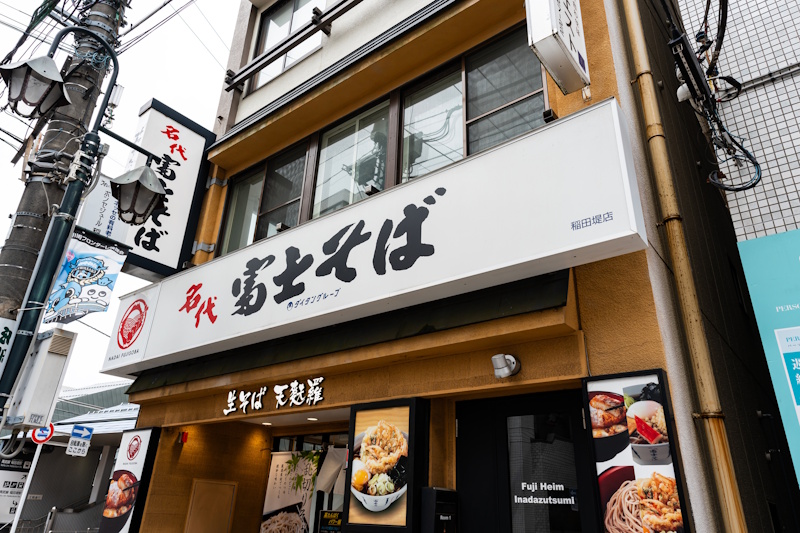
The sign appeared at a Fuji Soba store in Kamiyachō, in Tokyo’s Minato City. The chain, founded in 1985, is a “standing soba” restaurant with 100+ stores centered in Japan’s Kanto region. The store also has locations overseas in Jakarta, Taiwan, and the Philippines.
The Kamiyachō Store (so named for the historic area that Toranomon now occupies and its proximity to Kamiyachō Station) runs 23 hours a day. Traditionally, it’s served the largely business-oriented clientele in Toranomon, which is packed with large corporate skyscrapers.
However, it’s also home to a couple of hotels, including the 5-star Okura. This means that tourists are now flocking to local Japanese restaurants that feel “authentic” and local – places once mainly patronized by area workers.
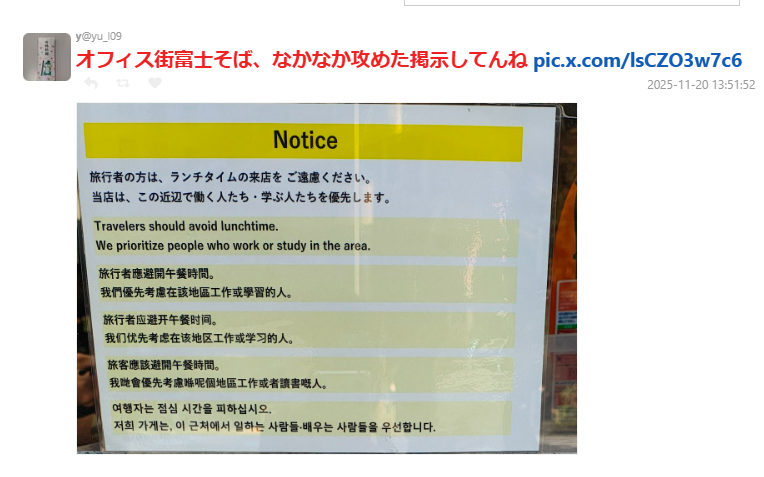
The Kamiyachō store decided it had had enough of travelers pushing out its regulars. So it put up a sign in English, Korean, Traditional Mandarin, Simplified Mandarin, and Cantonese. The English reads:
“Travelers should avoid lunchtime. We prioritize people who work or study in the area.”
Support online for local workers
X user @yu_l09 posted the sign on November 20th. It ignited a firestorm of controversy. Comments on Yahoo! News JP, one of Japan’s most popular online news sites and discussion boards, numbered nearly 5,000 posts at press time.
The top 40 most popular comments largely expressed support for this policy. They emphasized that many workers have only 10 to 15 minutes to eat and must get in and out quickly. Many respondents said they haven’t been able to get into their favorite fast-food places lately.
Some complained that tourists don’t understand the “eat and leave” culture of ramen, soba, and other Japanese fast-food shops. They said that Western tourists, in particular, are used to long, leisurely meals filled with conversation. Others complained that tourists block the aisles with their luggage and take too long figuring out how to operate the ticket machines used by many chains.
Still others argued that the business reality of Japanese restaurants demands high customer turnover. Many soba and ramen shops keep their prices below 1000 yen ($6.40) to keep fast meals affordable for locals. Banning tourists at lunch, they say, wouldn’t negatively impact store revenues. In fact, it might actually help.
Is there a better way?
The sentiment of many posters is valid. The implementation, however, leaves a lot to be desired.
For instance, how is the store determining who counts as a “local”? Tokyo’s Minato City has a heavy concentration of foreign residents. If store staff are refusing entry to people who don’t “look Japanese,” that raises issues of equality and fair treatment under Japan’s Constitution.
"Noah [at Unseen Japan] put together an itinerary that didn’t lock us in and we could travel at our own pace. In Tokyo, he guided us personally on a walking tour. Overall, he made our Japan trip an experience not to forget." - Kate and Simon S., Australia

That might explain why Daitan, the company that runs Fuji Soba, issued an apology. A representative speaking to J-Cast News said that the Kamiyachō Store put up the sign of its own initiative.
“We thought this was rude to our customers, so we ordered them to take it down. This was the result of ineffective management.”
The store took the sign down on November 21st.
While the sign might be problematic, the issues raised by Japanese users are real. Some users suggested that restaurants take a different approach – e.g., by putting up signs explaining local customs and expectations, and posting express time limits per customer.
At Unseen Japan Tours, we help our customers understand these “unseen” local customs so they can enjoy their trip without inadvertently causing trouble for citizens or residents. Contact us below to arrange your itinerary and guided tour to places that most non-Japanese speakers can’t access.
Kyoto City May Partially Ban Vacation Rentals to Give Residents Tourist Relief
The city’s mayor won’t rule out creating “zero-day vacation rental” zones in residential areas in response to chronic complaints.
Japan Sets New February Tourism Record Despite China Boycott
Travel from other countries offset a 45.2% drop from a nation that used to lead the pack in Japan tourism.
Credit Card Tap-to-Pay Comes to Many (But Not All) Tokyo Trains
Soon, you’ll be able to tap-to-pay on many trains and subways across Tokyo. But be warned: not every train company’s on board.
Sources
外国人観光客に「ランチタイム来店遠慮して」 富士そば店舗の貼り紙が波紋、運営会社は撤去指示「失礼だった」. J-Cast News (via Yahoo! News JP)
名代富士そば. Wikipedia JP
オフィス街にある富士そば、なかなか攻めた掲示をしていた「旅行者の方は、ランチタイムの来店をご遠慮ください」. Togetter
