

Japan’s Health Ministry recently announced that in households with a child under 18 and a mother present, a record 81.2% have a working mother. Japan has been trying hard to get more women into the workforce, so this may sound like a good thing on the surface.
But many online are saying this isn’t a sign of gender equality. It’s a sign of how rough the economy has gotten in recent years, and that raising a family is just too expensive to rely on only one income.
More working mothers and ever… but the type of employment matters

The figure comes from the Ministry of Health, Labour and Welfare’s 2025 Comprehensive Survey of Living Conditions (国民生活基礎調査), released on July 15 and 16, 2026. The 81.2% working mother stat is up slightly from 80.9% the previous year. It also marks the first time the figure has climbed above 81%.
Of course, the rate of working mothers has been rising steadily for the past couple of decades. It was 56.7% in 2004, climbed to 60.2% in 2010, then 67.2% in 2016, and so on as the years went by.
This also means that, just 22 years ago, almost half of these households had a stay-at-home mother. For that to be slashed to just 19% of households in so short a time is startling.
However, the headline leaves out an important detail. While more mothers are working than ever, many of these are not full-time, permanent positions you build a career around. (And even when it is a full-time career, people take issue with it.)
Though the ministry hasn’t released 2025’s detailed employment breakdown yet, a look at 2024’s shows that only 34.1% of mothers had regular full-time employment. The remaining 46.8% of working mothers had part-time or contract jobs or were self-employed.
In other words, mothers in non-regular employment outnumbered those with permanent jobs. And mind, these non-regular jobs generally pay less, offer fewer benefits, and provide less job security than regular jobs. So, despite more mothers working, for many, the positions are relatively unstable.
Cost of raising children takes toll
The survey had another record-breaking figure. For the first time since this measurement began in 1986, households raising only one child accounted for more than half of all child-rearing households, reaching 50.1%.
The ministry pointed to later marriage as one reason for the increase. But many observers saw it as another sign of the financial realities facing young families. If both parents are already working simply to maintain their household, the cost of raising a second child can seem overwhelming.
That concern fits with another major finding from the survey. Across Japan, 55.4% of all households described their financial situation as either “very difficult” or “somewhat difficult.” Among households with children, that figure rose to 61.5%. For single-mother households, it reached a staggering 82.1%.
The online response to the survey backs this up. Almost 70% of replies online said that with education, housing, and food costs, raising a second or third child is almost impossible.
Question: do you like UJ's independent coverage of Japan? Our writers are supported by our members. Join Unseen Japan Insider to get bonus content every week, an ad-free website, and access to our large and growing Insider archive.If you love UJ's independent coverage of Japan, join Unseen Japan Insider to get content every week, an ad-free website, and access to our large and growing Insider archive.
Economic hard times across the country

Ironically, household incomes have increased on paper. Back in 2023, the average income of households with children hit ¥8.205 million (USD $50,000), the highest level recorded since 1985. More than 90% of that income came from earned wages (as opposed to pensions or other income types), as would be the case in most two-income households.
However, higher incomes do not necessarily mean families feel wealthier. Like X users pointed out, higher living costs, inflation, childcare expenses, education costs, and housing all eat into household budgets. For many families, two salaries have become the minimum needed to maintain a decent standard of living. Thus, the high rate of working mothers.
In fact, so many have decided to avoid kids altogether. In 2024, only 16.6% of all households in Japan had children.
A ministry official tried to focus on the 81.2% working-mother rate as a positive. They said that it means more employment support for mothers and growing acceptance of fathers taking parental leave.
What changing trends say about Japan as a whole
In all fairness, many mothers find fulfillment in working outside the home. Some may even do so to escape motherhood. But combined with everything else, it looks more and more like a situation in which many mothers are working not because they want to, but because they have no choice.
This is only reinforced by X user Kudo20260404 who said, “I’m saying this ’cause I dunno if the government folks get it or not, but this ain’t about women advancing in society or whatever. Straight up, it’s just that ya can’t live off just the husband’s earnings anymore, so moms are reluctantly cutting back on time with the kids and going out to work, ya know.”
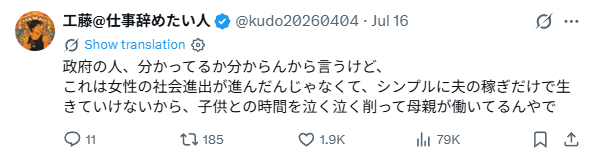
There’s no question that the record number of working mothers is a milestone. But considering shrinking family sizes, widespread financial anxiety, and the dominance of non-regular employment, many Japanese people don’t see it as a victory for women’s advancement. Instead, it’s just another sign of how difficult it has become to raise a family in modern Japan.
Keep reading




Sources
母親が働く世帯は81%超に 過去最高 NHKニュース
子育て世帯のうち「子ども1人」の割合は50.1% 初めて5割超える 晩婚化などが影響か 母親が働いている割合は81.2% Yahoo!ニュース/TBS NEWS DIG (JNN)
全世帯の半数以上が生活「苦しい」と回答 特に母子世帯で顕著 ~厚労省調査~ Yahoo!ニュース/日テレNEWS NNN
2024(令和6)年 国民生活基礎調査の概況 厚生労働省
子育て世帯「母親が仕事」8割超す 厚労省調査で過去最高 日本経済新聞
各種世帯の所得の状況(2024年国民生活基礎調査の結果から) 労働政策研究・研修機構(JILPT)
令和6年国民生活基礎調査(ファイル) e-Stat 政府統計の総合窓口