
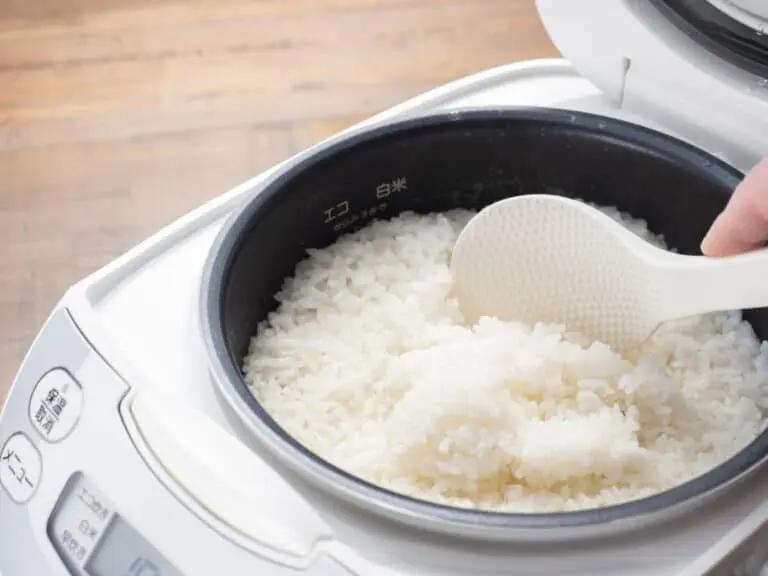
Rice has been a staple food of the Japanese diet for centuries. It remains so to this day, even if, at times, it always hasn’t been as affordable as consumers would like.
However, the Japanese rice cooker has only been around for a few decades. What led to the evolution of this indispensable kitchen appliance that we all know and love today?
The History of the Rice Cooker
Japan is famous for its wide array of unique and delicious dishes, many of which contain rice. But before the Japanese rice cooker was around to help prepare these dishes, people cooked rice on a large stove called a kamado. [1]
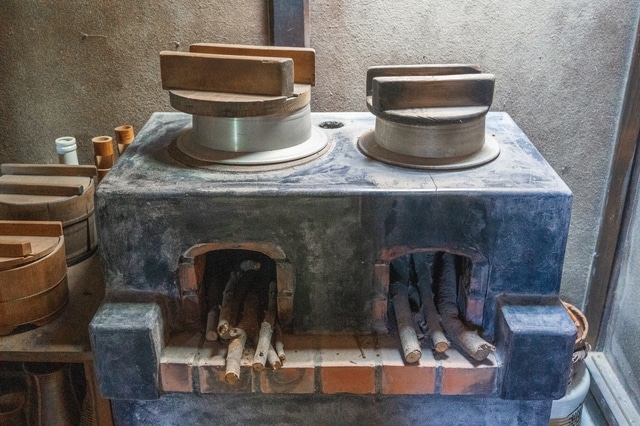
Cooking in a kamado was a long, tedious process. The taste and quality of the rice heavily depended on the strength of the heat and the amount of water, both of which required constant monitoring and manual control. It took a long time to make one pot of rice. People usually started cooking rice in the morning in order to have it ready for supper. And if it didn’t come out quite right, you were stuck with imperfect rice until the next day.
The birth of the electric Japanese rice cooker started in the year 1923. That’s when Mitsubishi Electric released its first bare-bones industrial model. About 10 years later, a similar cooker was employed on ships during the war. However, household Japanese rice cookers were still years in the making. [2]
The First Household Rice Cooker: A Failed Attempt
A number of trials and errors led to the development of the household Japanese rice cooker. Post-war Japan faced a number of struggles to rebuild its economy. Cash was scarce, and some businesses started to accept rice as payment. At this time, a radio repair company (that would later become Sony) sought to expand their business by adding a new product to their line-up – the rice cooker. [3]
In 1945, they released their first prototype, a crude wooden bucket with aluminum filaments that just could not produce a perfect bowl of rice. Eventually, they threw in the towel and went back to fixing radios without ever putting their rice cooker on the market.
Automating the Process
The first automatic Japanese rice cooker would come about a few years later as the product of another famous electronics brand, Toshiba. [4] Around that time, Toshiba salesman Shogo Yamada surveyed Japanese housewives about their most daunting household tasks while promoting their new home appliances. Surprisingly, the majority of them responded not washing clothes, not cleaning the house, but cooking rice!
The average Japanese housewife cooked rice up to three times a day, usually on a kamado. And the electric rice cookers available were not automatic and still required constant monitoring. The only real difference from using a kamado was the size. Yamada contemplated how he could solve this problem.
It was just then that an engineer (and failed water heater developer), Yoshitada Minami, came to him seeking work. Yamada entrusted the task of developing such a rice cooker to Minami. However, although he had the technical know-how (and because it was still a ‘woman’s job’ at the time), he had no idea how to cook perfect rice. So he asked his wife, Fumiko, for help. [5]
A Housewife Helps Revolutionize the Japanese Rice Cooker
In order to properly cook rice, one must control the time, temperature, and amount of water in the pot. But all these variables differed depending on season and geographical location (rice took longer to cook in a cold environment).
Fumiko’s role was to collect data by cooking rice in a variety of places and situations while measuring the water temperature with a thermometer. She cooked multiple pots of rice a day, and oftentimes throughout the night, testing prototype after prototype. She did all this while raising their six children. Eventually, Fumiko fell ill due to physical and mental distress.
The six children saw the tireless work of their parents. They became inspired and started to help with the experiments before and after school. But the research was taking a long time, and Minami had to mortgage their home while Fumiko continued her research. None of the prototypes had managed to cook a good pot of rice in the cold.
One day, they recalled a rice-cooking method from Hokkaido, the cold northern region of Japan, which involved covering the kettle with tin to retain heat. Minami wondered how they could build a pot that was similarly insulated. Meanwhile, Yamada had engineers at Toshiba investigate bimetals that they could use to create a thermo-switch.
Minami and his eldest son worked tirelessly for a whole week to develop a new prototype: a triple-structured kettle with a bimetallic strip that could turn the rice cooker on automatically once the temperature exceeded 100℃. At last, it was time to test the prototype.
Fumiko cooked one more pot of rice in a room at minus 10 degrees for 30 minutes. The result – a delicious pot of perfectly cooked rice! At last, the first automatic Japanese rice cooker was born. After a celebratory meal (cooked in the new prototype, of course), Minami took his wife’s hand and praised her. “This electric rice cooker was made possible thanks to you.” Toshiba began selling the machine in 1955.
Japanese Rice Cookers: An Evolving Technology
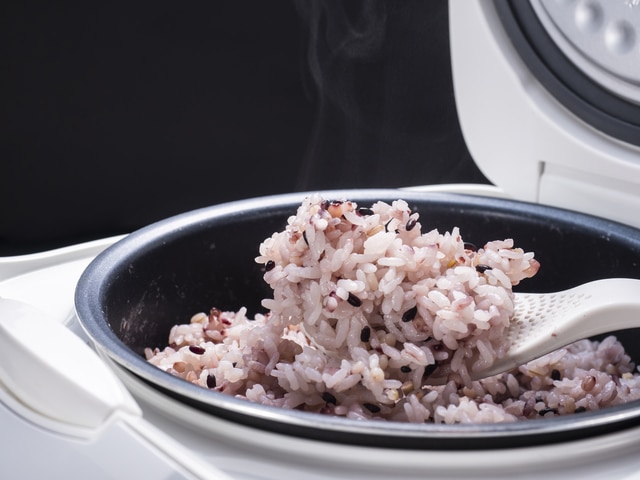
Toshiba’s success triggered a race between all other competitors to create even more innovative rice cookers. Soon, Japanese rice cookers took over the average Japanese home. By the 1960s, nearly every household had one, and they even made their way overseas. The Japanese rice cooker particularly flourished in other Asian countries, where rice was a staple of their diet. As technology advanced, companies released new models with new functions, and introduced microcomputers, fuzzy logic, and induction heating (IH). [6]
Types of Japanese Rice Cookers
All these new innovations meant new types of rice cookers. Here’s a look at some of the most common ones. [7]
Standard Rice Cooker
The standard Japanese rice cooker uses a spring and magnetic thermostat to stop cooking at the right time by reading the temperature. (However, these usually don’t shut off by themselves, and instead switch to ‘keep warm’ mode after cooking). They contain a non-stick inner pot as well as an outer pot that holds the body, heating plate, and circuitry. As the simplest of rice cookers, that is all you will be able to do.
Digital Rice Cooker
This is the most common Japanese rice cooker people use today. It includes all the basic functions of the standard, plus a timer and extra cook settings. Some digital rice cookers also have functions for preparing specific types of rice, including white, brown, and sushi rice.
Fuzzy Logic Rice Cooker
This is a fancier version of the Japanese rice cooker. They include a microcomputer that can detect temperature changes and can even compensate for incorrect water amounts, guaranteeing a perfect bowl of rice with each use. Although it is very beginner-friendly, it also tends to be more pricey for its fancy functions.
Induction Heating Cooker
This is one of the most innovative types of rice cookers. It uses magnetic field friction to heat the entire inner pot (unlike the average Japanese rice cooker, which only conducts heat from the bottom), resulting in a more evenly-cooked batch of rice.
Pressure Cookers
The pressure cooker, although not technically a rice cooker, is often used as an alternative due to its ability to cook not just rice, but a variety of other foods. It uses a combination of heat and pressure, trapping steam inside to raise the cooking temperature even higher than the average Japanese rice cooker. This also means a faster cook time. Many people opt for pressure cookers to prioritize speed and convenience. However, it may still require a little more knowledge and preparation than machines specifically for rice.
Decades of convenience
Not everything is as easy as it could be for the Japanese household in the 21st century. Even today, women still do most of the housework while their husbands find any excuse not to come home. Given space constraints, they often do so without the help of labor-saving devices such as the modern dishwasher.
On the plus side, there’s the wonder that is the Japanese rice cooker – a time-saving invention that continues to reduce the burden on families to this day.
Keep reading



Sources
[1] Rice cooker. Wikipedia
[2] Mitsubishi Electric. Wikipedia
[3] 第1章: 焼け跡からの出発. Sony
[4] 暮しに役立つ家電の学校★炊飯器. Poyoland (blog)
[5] 台所革命を起こした町工場. E-chirashi
[6] 日本で生まれた「自動炊飯器」の歴史、海外の人に説明できますか. Courrier
[7] 炊飯器の歴史. JEMA
[8] 炊飯器 人気売れ筋ランキング 2021年12月. Kakaku
[9] 《2021年》炊飯器おすすめ16選! おいしいごはんが炊けるIH炊飯器. Kakaku Magazine