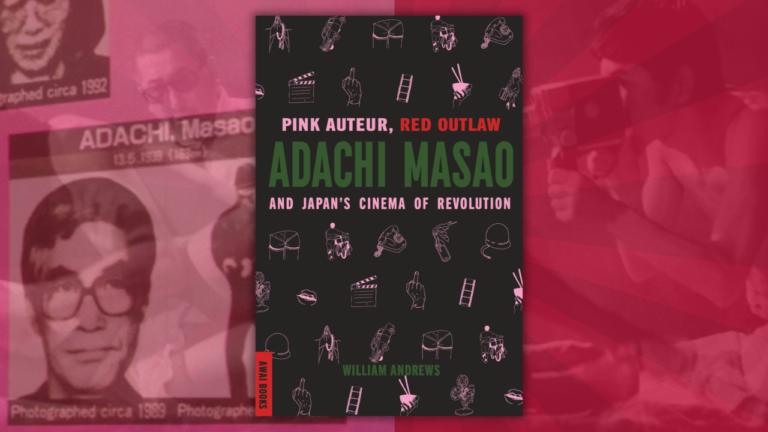
Researcher and translator William Andrews, known for his in-depth coverage of protest movements and the Left in Japan, past and present, has just published his newest English-language book: “Pink Auteur, Red Outlaw: Adachi Masao and Japan’s Cinema of Revolution.” The intriguing tome covers the career of the titular director in both the underground art scene of the 1960s and, fascinatingly, on the run in Lebanon with the notoriously militant Japanese Red Army for the final three decades of the 20th century. Read our review of “Pink Auteur” below; a brief interview with Andrews follows.
The Japan of the 1960s and early 1970s was a volatile place. Despite the general image of an ordered, homogeneous society, the country was no exception to the global mass protest movements and heady political undercurrents of the age. The promises of post-war democratization and economic uplift crashed against the realities of class inequities, military buildup, and the violence of the Vietnam War. Japanese youth, often among the first in their families to achieve higher education, came into contact with strains of Marxism, feminist thought, and theories of liberation and social revolution. From the 1950s until the early 70s, millions of Japanese people took to the streets to protest security treaties and Japanese involvement with the US war machine. Campus activists occupied and shut down dozens of universities.
In 1970, the seriousness of the domestic situation escalated. The Red Army Faction, among the most radical of the leftist youth factions, carried out the first-ever hijacking of a commercial jet in modern Japanese history. A series of bombings followed; police raided campuses and Leftist hideouts, and mass battles between riot police and protesters left many dead. For those who lived through it, the turbulent era produced any number of names of young radicals and activists replete with meaning: Shigenobu Fusako, leader of the international Japanese Red Army, which staged hijackings and politically motivated attacks from its base in the Palestinian refugee camps of Lebanon; Tomura Issaku, Christian activist and leader of the mass resistance against the building of Narita Airport; Mori Tsuneo and Nagata Hiroko, who led a horrific purge of their own radical group that resulted in 14 deaths.
For those whose interest in the era lies more in its flair for experimentation and underground art, another name has risen to prominence: Adachi Masao.
Adachi was an auteur on the fringes of a diverse range of movements, both political and cinematic. Born in 1939, most of his output as a filmmaker was in the softcore “pink film” genre. Despite the exploitative nature of this grindhouse fare, Adachi infused his work with political commentary. Highly prolific in text as well as celluloid, he helped produce film criticism, political theories, and a wealth of produced and unproduced screenplays. He moved in circles inhabited by the likes of Yoko Ono, photographer and theorist Takuma Nakahira, and militant radicals like the aforementioned Shigenobu.
In the 1970s, a developing relationship with the Palestinian liberation movement and Shigenobu’s militant Japanese Red Army forced a long filmmaking hiatus. Worried about potential legal problems back in Japan, he decamped to Lebanon – and became an important member of the JRA, seen by much of the world as a terrorist group. When he finally returned to Japan almost a quarter century later, it was as a deportee and prisoner.
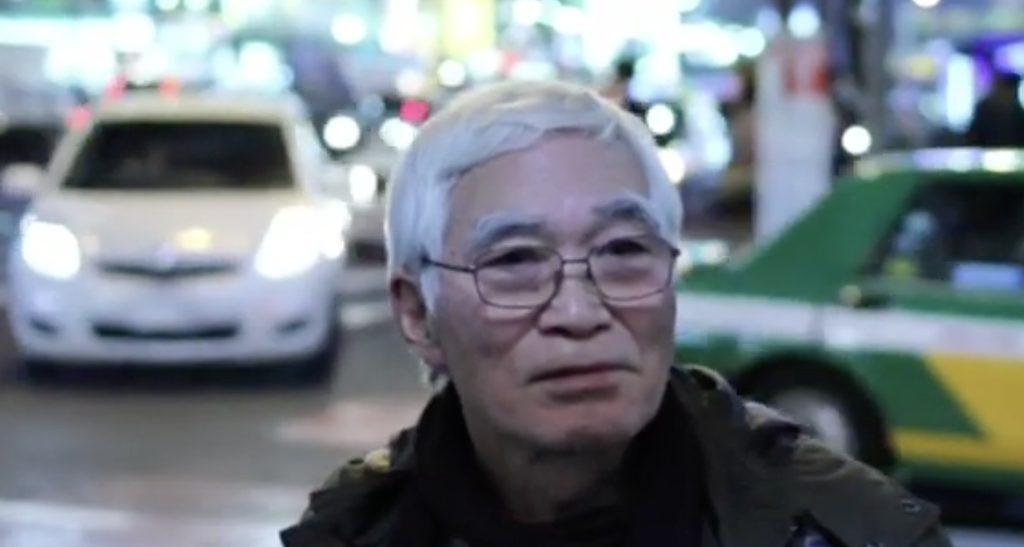
Into the Underground with Adachi and Andrews
William Andrews is an ideal person to tell Adachi’s fascinating and conflicting story. Having covered the New Left and later protest movements all the way up to those related to the 2011 Fukushima Daiichi nuclear disaster, he knows the eras involved well. Andrews also had ample time to sit down with and interview Adachi Masao himself; now 87, the director is still surprisingly active. (His most recent film, Escape, about militant bomber Kirishima Satoshi‘s 50 years spent in hiding, was released in 2025.) In “Pink Auteur,” Andrews attempts to tackle Adachi’s life, oeuvre, outlook, and actions with nuance. This is not completely without controversy, given Adachi’s long years with the Japanese Red Army.
Both an underground film retrospective and a political history, “Pink Auteur” attempts to frame Adachi within his place and time. Andrews readily admits that film is not his area of study; scholarly works on Adachi’s output and the Japanese New Wave have already been published in English and French by more authoritative figures. Andrews, however, is a major voice when it comes to the New Left and the history of protest in Japan. For those new to the period, “Pink Auteur” delves into who Adachi is and what societal forces worked upon him in the heady 60s and 70s.
Andrews goes as far as to label this a “biography of Adachi and co.,” and an “ensemble piece.” This is fitting for someone as collaborative as Adachi, who surrounded himself with such striking figures of the time. Nonetheless, a large portion of “Pink Auteur” – which comes in a beautifully designed binding by NYC/Tokyo-based publisher Awai Books, including attractive sketched illustrations – does in fact concern itself with the details of Adachi’s large catalogue of films. Those looking for cinema history and filmic breakdowns will not be disappointed.
Cinema as Activism
Adachi’s life presents some interesting challenges for a biographer. His life’s work was a cinema of politics, but his films are often purposefully ambiguous. His life story can contain similar ambiguities; with decades in relative hiding among the JRA and Palestinian refugee camps, there are gaps in what Adachi can safely reveal about his life. He also appears not to always be a reliable narrator. Andrews does a valiant job of covering all this in a digestible way, adding fact checks whenever possible. Given Adachi’s picaresque life, the book is similarly divisible into clear sections.
The first portion of ‘Pink Auteur’ details Adachi Masao’s itinerant existence across a series of avant-garde art and cinema groups populated by a veritable Who’s Who of the artistic counterculture of the 1960s. We learn of several artistic endeavours by different groups attempting to shock Japan’s emerging economic order from its growth-induced torpor. Adachi’s own works are just a small part of the overall assemblage, with his early, transgressive films (with such evocative names as “Bowl” and “Closed Vagina”) being shown at chaotic “happenings” alongside performance art and occasional theft of the film reels. Adachi feels omnipresent in this artistic milieu, popping his head up to interact with more established figures like the two famous Donalds of Japanology: film critic Richie and literaturist Keene.
Initially, his impact feels relatively small. Soon, Adachi is collaborating with directors whose output would outshine his own (at least in popular discourse); his eventual Japanese Red Army comrade Wakamatsu Koji, and the radical but comparatively mainstream Oshima Nagisa (Death by Hanging, In the Realm of the Senses, Merry Christmas, Mr. Lawrence). All three directors are now seen academically as titans of the so-called “Japanese New Wave,” but Adachi’s works remain the least accessible.
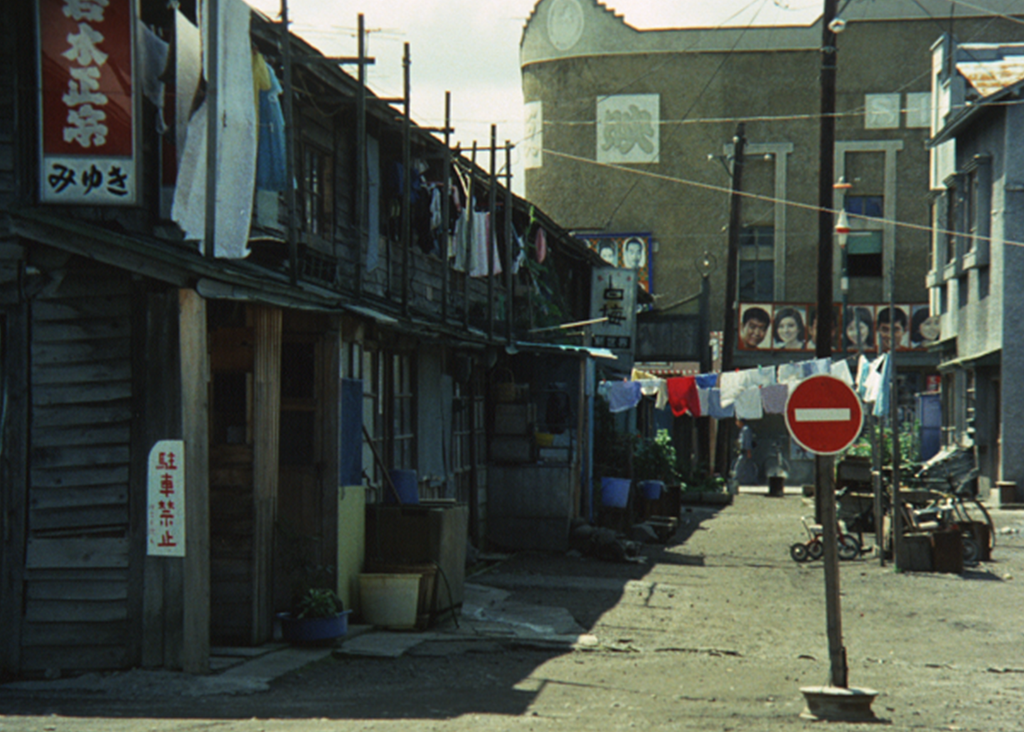
Much of this first third of the book consists of descriptions of Adachi’s consecutive projects. This is very useful for those looking to understand his output; despite Andrews’ insistence that film studies isn’t his wheelhouse, there is some fascinating theorizing about Adachi’s work, such as his landmark, near-experimental film AKA Serial Killer. Comprised of shots of the Japanese countryside and urban developments, the movie tracks the life and movements of real-life murderer Nagayama Norio. Adachi made the film only months after Nagayama’s arrest for the murder of four people. It’s a landmark for Adachi and Wakayama’s “actuality” and “landscape” theories of film; the first referring to film reflecting real-life events in the moment, and the second focused on the death of natural landscape and community under modern capitalism.
Violence On and Off Film
AKA Serial Killer does bring up a problematic that may make some readers uncomfortable with Adachi. There is a distinct element amongst his cohort that looks for heroism in what most would consider unforgivable violence. As described by Andrews, one gets the sense of how this melds precariously with the popular format Adachi and Wakamatsu used as their bread and butter: pink films. These often focused on exploitative elements of violence and sexual assault to excite their popular audiences. Adachi and Wakamatsu’s films are perhaps elevated by the political commentary they fit into this money-making genre. Still, the result often reads ambiguously.
That Adachi’s protagonists engage in violence (including sexual violence) can be waved away as metaphor; but Adachi also saw murderers like spree killer Nagayama as symbols of righteous (or at least understandable) action against the state. The issue is that Nagayama, an underprivileged illiterate roustabout, had not in fact attacked “the state.” Rather, he had murdered two security guards and taxi drivers in cold blood. Adachi and others created dense theories to lionize Nagayama; they blamed the loss of the natural environment under capitalism for his lashing out. But Nagayama’s killing fellow members of the working class hardly seems like valuable political action. Either way, Adachi’s application of imagined political theories seems a bit post hoc.
However, this callousness does dovetail with Adachi’s eventual joining and promotion of the Japanese Red Army, which believed that violence (and not just against the state) was a meaningful means of political action. While in exile in Lebanon, he even befriended (the now recently deceased) Okamoto Kozo, the only survivor of the three Japanese radicals who snuck machine guns and grenades to Lod Airport in Israel and brought about the death of 26 people, the majority of whom were Christian Puerto Rican pilgrims. The state can be oppressive, but are the maiming and killing of random people justifiable political action? Readers will have to consider this for themselves when contemplating Adachi.
(The JRA’s own narrative of the Lod attack blames Israeli soldiers for killing civilians during the firefight at the airport; but it was the Japanese militants who’d snuck submachine guns and grenades into a civilian transport hub with the intention of staging an attack. Whether the official narrative of wanton murder of civilians or the JRA narrative of civilian casualties by way of a firefight with legitimate targets is to be believed, it had a major human cost. In addition to the 26 killed, 80 people were wounded – many with parts of their bodies blown off or gaping bullet wounds. Survivors have spoken of suffering lifelong PTSD.)
Question: do you like UJ's independent coverage of Japan? Our writers are supported by our members. Join Unseen Japan Insider to get bonus content every week, an ad-free website, and access to our large and growing Insider archive.We manage to keep most of our content free thanks to the generosity of our members. Join Unseen Japan Insider and you'll get access to new, exclusive UJ member content weekly, an ad-free website, and access to our large and growing Insider archive.
Between Two Worlds
The book begins to concern the major and final years of the militantly active New Left around the 100-page mark. Discussing the late 60s/early 70s, this is a truly intriguing look at Adachi and partner Wakamatsu’s interactions with the likes of the Japanese Red Army. Andrews fulfills his promise of critical reportage by portraying the ambivalences and idiosyncrasies of these directors’ initial half-in, half-out participation in activism.
As Andrews rightfully notes, Adachi Masao was a decade older than the youthful activists and militants of the era. Some student activists saw Adachi’s filmwork as regressive, even right-wing. Adachi was appreciative of the student movement, and often interacted with them during their university occupations, but wasn’t truly of them. In fact, Adachi was, as Andrews puts it, something of a “hack.” While the students erected barricades, Adachi was pursuing filmic activism with Wakamatsu by way of ambulance chasing. Exciting outsider murders (and sexual violence) were quickly turned into commodified celluloid in their pink films. The two engaged in political commentary, but their methods could easily be seen as exploitative.
Andrews gives a great summation of Adachi’s early film activism:
“What is fascinating about Adachi and his peers was that they used cinema and the ‘obscene’ medium of pink film to respond posthaste to current events and also engage in this discourse almost by subterfuge – by inserting these themes and motifs into films intended for mass entertainment and titillation (making them, to coin a phrase, sexploitation-exploitation). The question then comes down to whether this subversion is a worthwhile, lasting contribution, an artistic jape, or doubly exploitative.” (Andrews, 2026, pg. 103.)
A Detour with the Ainu
Adachi was soon to leave Japan almost permanently. He did so towards the end of the high crest of the Japanese New Left, and right before the worst of the factional terrorism. Before this, though, he had a brief engagement with activism related to the Ainu – the indigenous people of Japan’s northern island, Hokkaido.
Andrews devotes a chapter to efforts by those in Adachi’s milieu to include the Ainu people in their revolutionary politics. This is a fascinating detour to the period of active struggles by (or in the name of) the Ainu during the 60s/70s. This was the era when Ainu, long treated as a “doomed race” by the majority Yamato Japanese, were actively reclaiming their culture. Activist Kayano Shigeru emerged as the first ethnic Ainu to be elected to the Japanese parliament. At the same time, ethnic Japanese Leftist and anarchist groups claimed the Ainu struggle as their own, and engaged in bombings in Hokkaido in the name of indigenous liberation. For most Ainu activists, not consulted on these attacks, this was a step too far.
Adachi himself is only on the very periphery of this chapter. The Ainu struggle was not a major focus for him. Nonetheless, by dint of having been present when some drunken friends scraped the name of the Hokkaido governor off a statue of historical Ainu freedom fighter Shakushain, Adachi was implicated in a larger spate of (much more serious) crimes happening in the prefecture. The legal fallout from this small event would be one of the prime reasons Adachi eventually felt he could not return to Japan. While Adachi barely appears in this portion, it deepens the reader’s conception of activism in Japan beyond the Tokyo core.
Red Army/PFLP: Declaration of World War
For those seeking out this book because of interest in political movements or the history of pro-Palestine activism, the following sections of “Pink Auteur” will prove illuminating. Intersecting with the Palestinian cause, first in Japan and increasingly directly in the Middle East, seems to have changed Adachi.
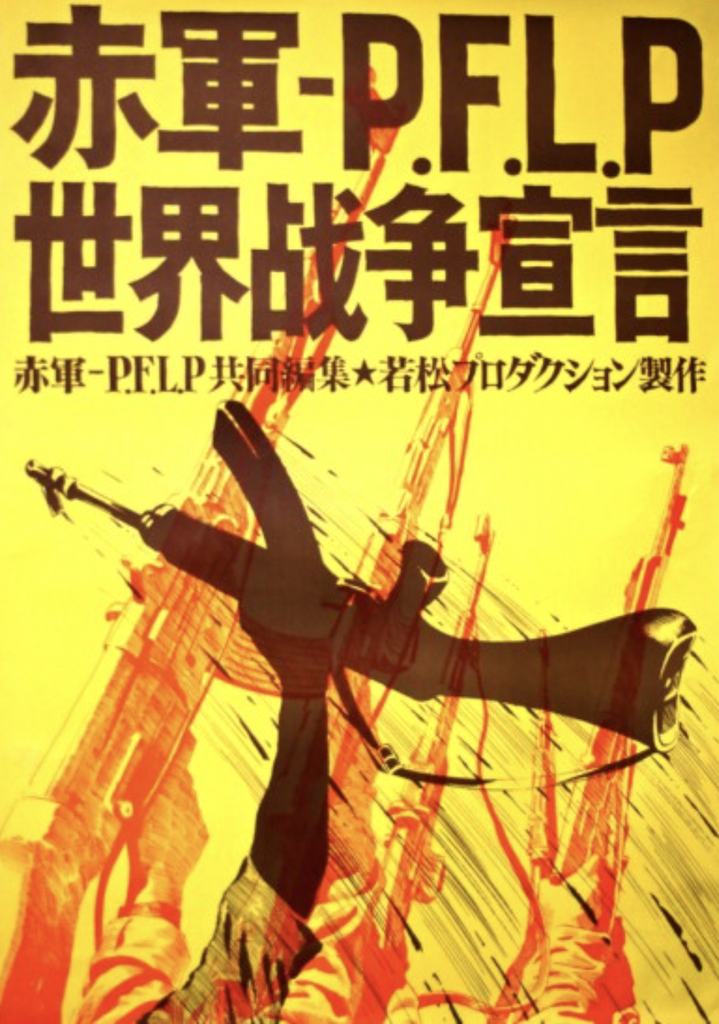
Andrews also gives an insightful rundown of Adachi’s most famous (or infamous) film, Red Army/PFLP: Declaration of World War (1971). Filmed while Adachi spent time in Lebanon with the Marxist guerrillas of the Popular Front for the Liberation of Palestine, the movie became a propaganda mainstay, playing in smoky screening rooms across leftist spaces in early 1970s Japan. The film exhorts Japan’s activists to take their struggle abroad. Andrews situates the propaganda film within Adachi’s (often oblique) worldview, showing the potential nuances in what usually seems a straightforward piece of pro-insurgency agitprop. But Andrews also addresses how frustrating Adachi’s equivocations can feel – how he seems to take a step back even as he’s creating a full-on propaganda film for the Marxist wing of armed Palestinian struggle.
Shigenobu Fusako had already decamped to Lebanon when Adachi and Wakamatsu first arrived to film RA/PFLP. At the time, she served as their fixer for interviews with the PFLP, even supplying an interview herself. The JRA was coming nebulously into being as the filming took place; it was the year after the film first screened, in 1972, that an event came that directly fused the Japanese militants’ connection to the Palestinian cause in the minds of the world. This was the Lod Airport attack.
Both Wakamatsu and Adachi gave their support to the Japanese attackers in the press in the days following Lod. There does seem to be an irony in continual references to Adachi’s sense of guilt over his films’ role in leading Japanese activists (and Okamoto Kozo in particular) to go to Lebanon and the horrific violence that followed; and yet, he invested even more time and energy in staging screenings of RA/PFLP following the attack. His newly created gazette, “International Revolution Front,” also directly praised the attack he claims to have been horrified by and, according to Andrews, essentially served as a domestic mouthpiece for the PFLP. The magazine went on to praise the brutal 1972 Munich Olympics massacre that claimed the lives of 11 Israeli athletes.
A Quarter Century in Hiding
Adachi’s time with the Palestinian guerrillas served as a breaking point from his earlier ambivalent political/exploitative work. His writing became more specifically concerned with revolution via the Palestinian struggle, and regular visits to Lebanon eventually led to an elongated self-imposed exile there. Adachi, so resistant to being pigeonholed in a specific movement or faction, ended up as a figurative card-carrying member of the Japanese Red Army. It’s at this point that “Pink Auteur” transforms more directly into “Red Outlaw,” as Adachi becomes directly involved with the JRA.
Here, the book serves as a great source for a murky period we’re only recently learning more about. When I wrote my own five-part history of the Japanese Red Army, much of the information presented in “Pink Auteur” was not yet public knowledge. Andrews’ interviews with Adachi also coaxed out new information about his time in the Japanese Red Army, both during the height of its operations and after – during the chaotic Lebanese Civil War and the 1982 Lebanon War with Israel. (It should be noted that “Pink Auteur” does not shy away from the fact that Adachi is not necessarily a reliable narrator.)
Equally interesting is learning of Adachi’s sudden arrest by Lebanese authorities in the late 1990s and extradition to Japan. Stories of his time in prison in both Lebanon and his own home country are insightful; so is coverage of his post-release life and work. Andrews told me of how Adachi’s continued post-release boom in filmmaking extended his writing for “Pink Auteur.” In 2022, Adachi, in his late 80s, released Revolution+1 – a new actuality film about Abe Shinzo’s assassin, Yamagami Tetsuya. In 2025 came his film on Kirishima, Escape. “Pink Auteur” takes us right up to the present moment.
A Guerrilla, or Not a Guerrilla?
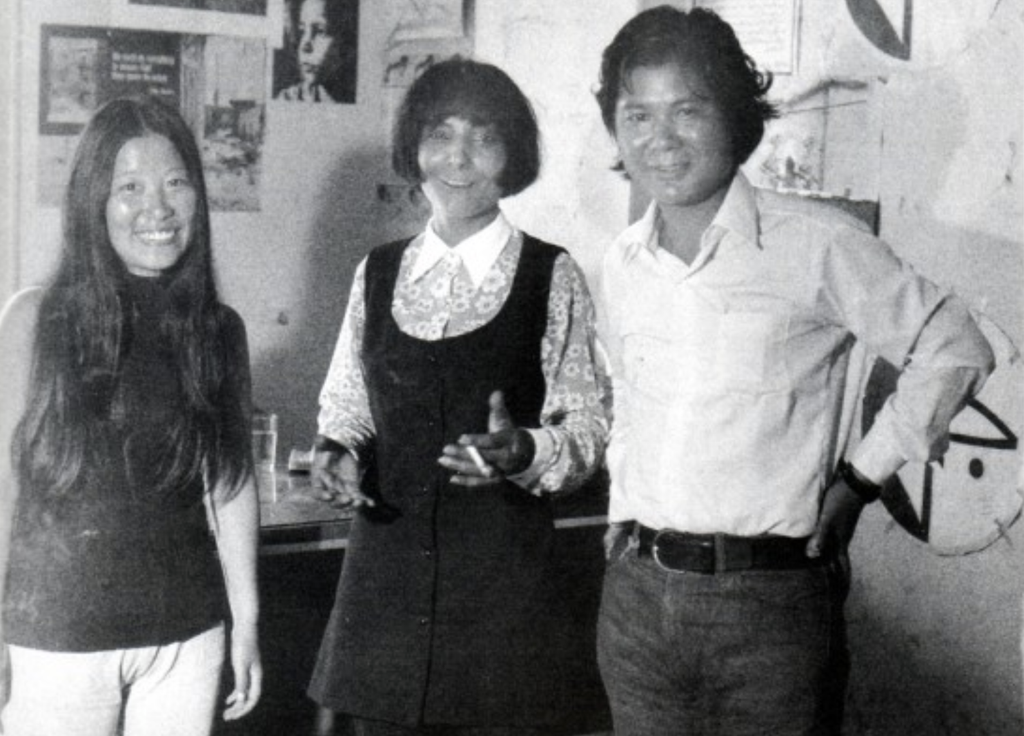
The elephant in the room of all coverage of film auteur Adachi is his involvement with a violent radical group. The exact distinction of Adachi’s status as a former “terrorist” is a point of contention. Andrews claims that Adachi was not a “violent paramilitary”, but rather an organizational staff member and spokesman for a militant group. The distinction seems to be whether Adachi physically took up arms or not; And yet, we do hear of Adachi laying landmines at the front during the First Israel-Lebanon War. If Adachi went as far as to physically lay landmines, was he not militarily involved in the conflict?
The book is a wonderful and detailed analysis and exploration of Adachi Masao’s life, work, views, and times. The nature of the highly contentious topic, however, almost inherently creates difficulty in coming to terms with Adachi’s decade-long involvement with the JRA, and why some – both individuals and authorities – would see this involvement in stark terms. Andrews frequently admits to problematics in Adachi’s work – his equivocation in his sympathetic 2007 film Prisoner / Terrorist about Lod attacker Okamoto Kozo, which portrays Okamoto’s mistreatment in Israeli prison but does not portray the massacre he directly engaged in that got him there. But these admissions of problematics, important as they are, are somewhat brief.
The book posits that Adachi’s own (comparatively short) imprisonment by Japanese authorities upon deportation to Japan may have been an overreaction; it also questions the validity of the government refusing to issue Adachi a passport to travel to the numerous foreign retrospectives featuring his work. Adachi is old, after all, and his direct revolutionary days are behind him.
But as Andrews describes in great detail, Adachi had spent decades working for and promoting a group the Japanese authorities termed a terrorist organization. He’d traveled extensively on falsified passports to make contacts for organizational purposes for a noted terror org. Why would the Japanese government be incentivized to issue him a passport and allow him to once again travel abroad, elderly or not? The image we get of Adachi is certainly not one that seems in any way “reformed,” from the viewpoint of the state he continued to rail against. To the very end, Adachi appears to be Adachi.
A Nuanced Portrait
Andrews says something very interesting about the way we view dramatic, conflictual movements from the past: “Counterculture is no longer rebellious once it’s treated as history.” Adachi himself seems very much a subject of this sort of commodification. Feted and analyzed by film and art circles around the world, his viewpoint is a (rightful) subject of fascination. But by diving so deeply into his artistic viewpoint, his actions seem to become flattened. This can also be a difficult topic to walk the tightrope on, as Adachi is a literal hero to many in the Middle East and beyond – someone who walked the walk, living amongst refugees, using art to fight for the subaltern. To others, if not a literal “terrorist,” Adachi has been someone who aided, abetted, and promoted terrorism for decades.
Dealing with Adachi’s true legacy is mostly left to the reader. While Andrews does spend some time on these issues, what the reader really receives is a fantastic rundown of Adachi’s work, life, and ethos. Moral judgements must be considered outside the purview of the para-academic writing style, and that leaves us with some truly interesting issues to grapple with.
“Pink Auteur, Red Outlaw: Adachi Masao and Japan’s Cinema of Revolution” should be required reading for anyone interested in the milieu of the Japanese New Left, underground film history, and the history of film-as-activism. Depending on your interests therein, you may find some sections more engaging than others. Still, the entire book transmits a type of holistic view of the era and its connected communities and movements that goes beyond simple film history. Andrews has added a great entry to the English-language canon on the subject – and one which should continue to spur interest and debate.
Interview with William Andrews
Conducted by Noah Oskow, Tokyo, September 15, 2026
Andrews kindly sat down with me to discuss his new book, “Pink Auteur, Red Outlaw: Adachi Masao and Japan’s Cinema of Revolution.” Presented here is an abridged version of our conversation.
Noah: To start, can you briefly introduce yourself for the Unseen Japan reading audience?
Andrews: Well, my name is William Andrews. I was born in the UK, but I’ve been in Japan for more than half of my life. I usually make my living through editorial work, translation work, and copywriting work. And I also write books when I’m able to publish them. I’m also a part-time PhD student, very slowly working towards finishing my dissertation.
Could you tell us about your dissertation?
My topic is about the interaction between underground culture and mass culture in the high growth period. Sounds quite grand, but I’m focusing on breaking this down into certain undercurrents and themes — I’m trying to use the word undercurrent, rather than theme — and certain case studies from different media. Theater, film, and a bit of literature, to TV commercials, things like that.
Very interesting, thank you. So, onto the book itself. Who did you envision as the primary reading audience for “Pink Auteur”? Those interested in cinema history, or, perhaps, political movements? A mix? These can be difficult topics for neophytes to jump into.
That’s for sure. I envision, hopefully, that it will appeal to readers interested in both topics. Like myself, and probably like you as well, Noah. Still, I think serious cinéastes will outnumber those who are more interested in the social movement side of things. But it’s one of the explicit theses of the book that such things are not really separate anyway. To use a loaded word these days, it should be seen as intersectional. Adachi himself kind of embodies that. He had no problem intermixing with people from one discipline. He’d go off, make an underground film, then go make a pink film; make a sort of independent film with Oshima [Nagisa], and then go back to hanging out with people from the visual arts. So for him, it was probably natural.
Likewise, I think, as readers, in terms of publishing as well, we should also see these things as synthetic. And I hope the balance is just about right in the book. But I certainly think the majority of people will know about Adachi through his films, and be interested to read more about his very long career. He made lots of films, actually more than I realized when I first started the book! It got longer and longer, and then he started making more films even before I finished it, which was kind of exciting, but also frustrating.
When I started the book [back in 2016], Adachi had just made Artist of Fasting. “Okay,” I thought, “that’s a good way to end the book.” And then, of course, he made two more films after that, which was, yeah, kind of a little bit annoying, to be honest! But they’re also very interesting films. They’re not masterpieces, but they’re very interesting within his career. So I was pleased to include them, but it meant that my final chapter became longer and longer. Still, I hope there’s enough on each film to please fans.
On the other hand, as I make quite clear in the book’s introduction, I am not a film scholar. I’m not quite sure what title to give myself, but I guess cultural historian would probably be the safest label. So, I mean… I love film; I’m not writing from a film studies background. My previous writings have been about social movements, but these are social culture movements. So it would be completely natural to me to also be interested in the other stuff as well: the intersections of underground arts and social movements.
Can you tell me about what drew you to Awai Books as a publisher?
Awai Books is based in New York, but one of the main people behind the publisher is Matthew Chozick, who’s based here [in Tokyo]. He’s a man of many talents and wears many hats. He’s a scholar who teaches at a university, and he does stuff on [Japanese] TV. He was a filmmaker and actor occasionally. And that sort of colors, I think, the catalog they have.
It’s a small publisher. They only publish one or two books a year. They have quite a strong focus on… I don’t want to say subculture, per se, but things which are not necessarily mainstream culturally. They had a book all about Toho Studios, and a great book about the live music scene in West Tokyo, which was quite successful, and translated into Japanese as well. When I saw their catalogue, it was a no-brainer to at least send them an inquiry. And Matthew was very enthusiastic from the get-go, although the book is perhaps more politically oriented than much of their publishing. They also go to great lengths when it comes to the visual presentation of their books.
How has the reaction to the book been so far?
Well, we’re always a little bit nervous, of course. Especially because I was working on the book for so long. It’s almost like there’s a strange mixture of anticlimax and relief when it finally comes out.
But so far, we’ve had some reviews, and they’ve been positive. Obviously, I’m expecting some negative feedback. Some, obviously, because this is Adachi. His history is complex, to say the least. He will attract critics, and perhaps we’ll be criticized for being, for example, maybe too easy on him. Or perhaps for putting him up on a plinth when, you know, he was a member of the Japanese Red Army. It could be seen that I’m sort of celebrating him, even if that’s not my intention, simply by making a book about him. ‘Cause there’s a celebratory aspect of that, right? I hope they actually keep reading the book and realize I’m a bit more ambivalent about certain things while celebrating other aspects. I hope there’ll be some nuance in there. Time will tell.
Can you tell me about how you first met Adachi Masao?
I write about this in the first chapter, but I encountered him, somewhere incongruously – or maybe not incongruously – amongst the love hotels of Shibuya. It was at this great cinema called Eurospace, which sort of nestles amongst the love hotels in Dogenzaka. And I was there for a preview screening of his newest film, now three films ago, called Artist of Fasting. I’d actually reached out to his team to conduct an interview. They just said to come to a screening first, which makes sense. And so we had a very brief interaction, and then later on I had an interview, and we got on quite well.
It was good. He wasn’t any sort of highfalutin, pretentious author, which I didn’t think he would be anyway. In fact, he was even easier to get on with than I expected. Very jokey, very jocular, very laid-back. I mean, he could also be quite sharp and blunt as well. He was smoking a lot. He wasn’t drinking, as we were at a coffee shop, because otherwise he would have been in an izakaya. He’s certainly a man of his generation, to a certain extent. But also quite easy to get on with. I realized he’d make for a great book-length interview subject, which was very embryonic in my mind.
Of course, that was way back in 2016, way before COVID, way before everything. Back then, he was in an interesting position. He just made a film with the assistance of a Korean cultural institution. It had very small reach in Japan, but it was still his first film in several years. He’d been in a sort of limbo stage, where he was having trouble getting films made.
Of course, he still has trouble now – but recently he’s been on a roll with two films made in quite quick succession. But at the time, he’d just made his first film in a while. There was a sort of sentiment, you know, of a possible renaissance coming; certainly, there was much more interest overseas in his work at that time, which has only grown in subsequent years, which is, yeah, good for the book as well, obviously. Cynical, yes, but it’s obviously very good for him as well.
My next question was actually directly related to that. What have you found to be the general reaction of individuals like Adachi to overseas interest in their films and actions during the New Left era? Does he ever express surprise that people outside of Japan are still interested in these subjects half a century after the fact?
He hasn’t expressed any surprise to me, although I’m sure he felt some surprise initially. Especially when he first arrived back in Japan in 2000, when he was deported — renditioned, really. In reality, there was already growing interest in underground cinema as a whole back in Japan at the time. I’m sure that came as a surprise to him, especially as access to his films isn’t like what we have now. They didn’t have online streaming. His films were much harder to get ahold of. Sure, some grainy VHS copies were floating around; that was it.
So his work was more esoteric in nature back then. I mean, it’s still esoteric now! Just even more so back then. But he never expressed that to me, likely because interest in his work has had such a slow percolation. Things slowly built up since the mid 2000s, with screenings at festivals and exhibitions abroad and the like. And there’s also been a shift in terms of what films are shown, and with what framing. I try to keep track of how his films appear at exhibitions, and it’s often the same films again and again. So, there’s been a lot of interest in landscape theory and AKA Serial Killer in particular. That has to be the most common one, with a handful of others.
He has become, essentially… I wouldn’t say pigeonholed. That sounds too negative. But there was a sense that he’s being framed as a political filmmaker who’s making a particular brand or style of political cinema, which is not untrue. But his actual filmography is much more diverse, which I try to show in the book.
Ok, now I have a few pointed questions on themes that “Pink Auteur” really got me thinking about. The first relates to the rejection of the charged label of “terrorist” or, perhaps less polemically, “militant” for Adachi. He seems to have never directly engaged in aggressive operations with a gun in his hand. Nonetheless, he was a member of the JRA for decades, directly involved with operational aspects, recruiting, and acting as a spokesperson – including continued efforts to make the Lod attack into a propaganda victory. He traveled on false identification to create links for the JRA abroad. We even hear of him laying landmines during the 1982 Lebanon War, though perhaps not as part of JRA operations, but rather for general defensive purposes at the front. To me, this seems like a rather murky area, where one could easily consider Adachi to have been a militant. Can you tell me a little more about your definition here?
I don’t think I said he was not a militant. Personally, I would say he was, if not a militant, certainly very close to being one. I think I would say, typically, that I don’t have any evidence of what we would call “terrorist” activities, whatever that really means. It’s a very emotive word, so probably best to avoid it. But in the sense that he wasn’t the one hijacking planes — when he properly converged with the JRA, they’d already done quite a few of those operations, as you know well. But he was obviously involved, probably at the very least, in creating PR. Quite likely in a planning capacity as well. There was probably some illegality involved there, if you want to get down to brass tacks.
But was he a militant? I would say he wasn’t not not a militant, if that makes sense. He certainly was involved in militant activity, whether he was actually firing guns or not. He certainly had a gun on him at times. But then, you know, he was living through the Lebanese Civil War, and doing so was not unusual for most people. When travelling around by car, either you or someone else in the vehicle would have to have a gun. That’s simply a reflection of reality.
This is obviously very murky, but it’s also one of the reasons why I find the sort of framing of him as a Kalashnikov-toting guerrilla to be a bit unhelpful sometimes. You might think, here’s a guy who’s filming, and then shooting, you know, with two forms of shooting, right? I know that sounds very cool, especially to certain tankies. I say this as a member of the Left myself, but I just don’t think it’s typically helpful. Especially given his age at the time. He was in his forties, like myself, while most of the JRA were a decade or more younger. It was the younger members who were all energetically trying to engage in these operations.
It’s frustrating, as I have to be careful about how I speak about this. I can really only write about what I can verify. I could listen to him speak about something – and it’s not that I distrust him — but I have to rely on verifiable public information, especially when it comes to allegations against him. He certainly used falsified papers and may have been moving explosives to other countries. I suspect that being able to read Arabic would give us more access to internal documents from the PFLP. I did get access to German materials — the East German Stasi had a file on him. That was very interesting. And of course there’s the fact that so much material is gone – blown up in bombings on the ground in Lebanon. Perhaps someday we’ll uncover a trunk full of old files.
Regarding the Lod attack, in the book, you get the sense that Adachi was initially greatly disturbed by the violence. Wakamatsu as well. Recently, Adachi has reiterated his sadness over the deaths caused. But at the same time, you know, he immediately went on to trumpet the attack as a propaganda victory, and continued to publicly laud the three men involved. It seems to have been a core point of pride and a major propaganda tool for both Adachi and the JRA as a whole for decades. Do you get a feeling for how Adachi reconciled all this?
I don’t think it was actually just him. I think a lot of people from that kind of circle had a similar reaction of personal shock. Not least of all because they had personal connections with people like Okamoto Kozo. Nonetheless, Wakamatsu almost immediately published a statement that, if not praising the attack, certainly did not condemn it. He recognized Lod as a type of anti-authoritarian resistance, given the level of state violence against the Palestinians. There sometimes seems to be a need to reconcile the irreconcilable when it comes to violence in a movement, and Adachi was perhaps involved in this with his writings.
And of course there’s the powerful way one can use public statements to get a message across. They may feel that once they’ve said something, they have to be straightforward; they have to stick to it. I don’t personally believe that, because I come from the humanities. I don’t see it as so black and white; people in the humanities tend to keep one foot on each side. Those who are more ideological may see things differently.
I do find the way the attack is framed in JRA literature and events to be troubling. And this is not just from an emotional point of view, but more from a logical point of view. The way it’s always framed as this great victory when, logically speaking, it wasn’t a victory. They lost three of their members. Two were killed, one drowned during training, and one ended up in prison. So, from an operational point of view, can you put that as a success? Most of the people who died were Christian pilgrims, if you break it down in a cold, logical way. It doesn’t make sense that they’re constantly proclaiming it a success.
But they did so for other reasons – like the publicity aspect. Like a lot of operations at the time, hijacking and so on — obviously the Munich attack is similar. They might say that you can’t just break down success to operational success. But yes, I find that confusing, problematic. Intriguing. All kinds of adjectives. And obviously, Adachi was part of that. And the sense is that they’re still sticking to that line. They have their reasons.
As a writer/scholar/historian, though, you have to be more critically engaged. It can’t all be exclamation marks and positive. You have to acknowledge the negative side of things. And obviously, we saw a lot of that when Okamoto died, with a resurgence of celebratory statements.
Thank you, very interesting. As a final question, do you currently have any subjects that you’re considering focusing on for a future book? I’m sure our reading audience would be very interested to hear about anything else you might be working on.
I have lots of topics and lots of half-started, half-arsed projects. But for now, I should probably focus on actually finishing my dissertation. I’d rather not publicly commit to anything else until I have at least finished that. I’m about halfway through, so I should have it written out for the next one or two years, fingers crossed. And that’s obviously an adjacent topic to this. It may become some article or chapter or something. Academic, unfortunately, so a more limited audience.
Thanks so much for your time, and I hope that our readers have a chance to engage with your work, and with “Pink Auteur” in particular.
“Pink Auteur, Red Outlaw: Adachi Masao and Japan’s Cinema of Revolution” is available from Awai Books. You can read more of William Andrews’ coverage of Japanese social and protest movements on his website, Throw Out You Books.