
Source: @nikkan_gendai on X (2026-04-17)
Overall verdictBacklash by jujitsu. The dominant response to Kado’s “pretend play” characterization wasn’t argument — it was reflection. Fully 37.4% of the thread’s engagement went to replies turning ごっこ遊び back on Kado, on Takaichi, and on the LDP itself: “議員ごっこ” (“playing politician”), “総理大臣ごっこ” (“playing prime minister”), even “陣笠” (a low-ranking foot soldier trading toadyism for a Diet seat). A secondary cluster (10%) pivoted to Kado’s history of blocking constituents on X, treating her disdain for demonstrators as a symptom of a broader aversion to hearing any voter she disagrees with. The conservative defense of Kado’s characterization — that the demonstrations were staged by communists, that 30,000 was inflated, that demos don’t change election outcomes — drew 16% of engagement combined (Communist/Foreign Plot + Kado Was Right), but was outpaced by pro-demo framings. Result: an LDP lawmaker’s attempt to shrink a 30,000-person assembly became, within 24 hours, one of the week’s most engaged anti-LDP conversations on Japanese X.
Note: Comments on X (formerly Twitter) in Japan tend to skew toward the political right, though individual threads may lean left depending on the original poster and topic. These comments are not necessarily representative of the Japanese population as a whole.
What the tweet was about
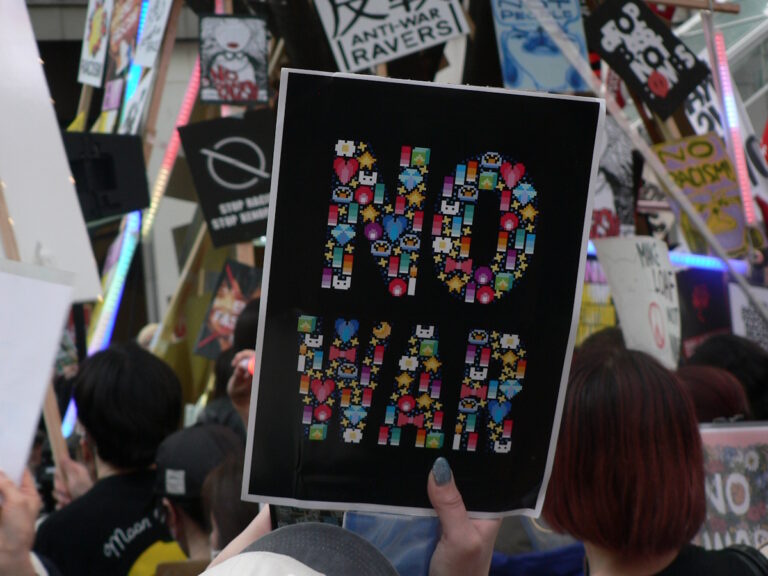
On April 14, 2026, LDP Rep. Kado Hiroko — a 45-year-old first-term member sometimes described in the press as a “Takaichi child” (高市チルドレン) — appeared on the AbemaPrime commentary program. Asked about the growing penlight demonstrations outside the Diet protesting PM Takaichi’s constitutional-revision push, Kado responded: “Gathering at the Diet and waving penlights isn’t going to change the government. You know that, right? People adopting those methods are just making themselves feel like they did something. I know it sounds harsh, but honestly it just looks like pretend play (ごっこ遊び) to me.”
The remark was picked up by Nikkan Gendai and spread rapidly on X, drawing roughly 16,800 likes and 1,410 replies within a day. The demonstrations Kado was dismissing had drawn organizer-reported crowds of 30,000 — a figure Kado herself disputed as inflated — and had been joined by a separate, quiet-but-consistent movement of citizen standing protests on the Osaka Loop and Yamanote lines. The underlying question the demonstrators raised — whether Takaichi’s constitutional-revision, arms-export-liberalization, and “anti-spy” legislation represent the direction the public voted for — is one Kado sidestepped.
The reply thread under Nikkan Gendai’s post functions as a near-perfect natural experiment: how does the Japanese X audience absorb an LDP lawmaker publicly mocking a 30,000-person demonstration as juvenile?
Sentiment distribution (engagement-weighted)
“you’re the one playing pretend”
“Kado was right”
Highest-engagement comments
Activity timeline (JST, 2026-04-17)
Key themes in detail
🪞 You’re the One Playing Pretend · 38.1% of engagement
The dominant theme in the thread by a wide margin (53 replies / 37.4% of engagement). The move is a single rhetorical flip: Kado called the demonstrations pretend play, so every piece of LDP governance looks like pretend play too. The variations are specific and cumulative: “総理大臣ごっこ” (playing PM, aimed at Takaichi), “議員ごっこ” (playing lawmaker, aimed at Kado), “陣笠” (a low-ranking vassal trading loyalty for a seat), “愛人ごっこ” (playing mistress, re. “hostess-style diplomacy” with foreign leaders), and “タレントごっこ” (playing celebrity, re. members who treat TV as their day job). The top reply, at 2,725 likes, captured the whole mode in one sentence: “Pass along to your useless PM that she should stop playing ‘prime minister’ herself.”
The accompanying hashtag #門寛子やめろ (“Kado Hiroko resign”) surfaced across this cluster alongside similar ones aimed at Takaichi. The thread turned, in effect, into a public vote-of-no-confidence-by-emoji — one in which the original insult became the organizing vocabulary of the response.
🚩 Communist/Foreign Plot · 11.4% of engagement
The second-largest cluster by reply count (39 replies / 11.8% of engagement). These replies didn’t defend Kado on democratic grounds; they defended the word ごっこ遊び by arguing the demonstrations weren’t legitimate expressions of Japanese public will at all. Substrands included: “communist-staged” (that the Japan Communist Party or the student militant group Zengakuren coordinated the penlight demos), “foreign-national infiltration” (that Chinese, Korean, and Kurdish participants meant the crowd wasn’t a Japanese sovereign assembly), and “Unification Church” accusations aimed back at the LDP in mirror form — the right-wing conspiratorial grammar applied to both directions.
A sub-pattern in this cluster: several replies cited “暴力革命” (violent revolution) rhetoric they attributed to individual protest-adjacent student voices as reason to dismiss the whole assembly as extremist. The mirror response in the pro-demo cluster explicitly addressed this: the main organizers (WE WANT OUR FUTURE and the “Don’t Break Article 9 Committee”) are distinct from Zengakuren, the argument went, and conflating them is the same type of sleight-of-hand that’s always been used to delegitimize street politics in Japan.
🔇 Block-and-Silence · 10.5% of engagement
A mid-sized cluster (18 replies / 10% of engagement) focused on Kado’s habit of blocking critics on X. Readers reported discovering they’d been blocked by her despite never interacting — their blocking reveal often came from reading other users’ screenshots. The cluster framed her block-first behavior as of a piece with her ごっこ遊び comment: a Diet member unwilling to hear dissenting constituents, who only recognizes political expression she approves of.
A representative 354-like reply: “Also worth noting — Kado Hiroko is a block-happy representative. Please include that in the reporting.” Another (195 likes, roughly): “Unknown person had me blocked, searched who — turned out to be this representative. Are you a Diet member? Are you okay?” The cluster translates a small technical behavior (blocking) into a durable political critique (refusal of democratic listening).
🗽 Demos Are Democracy · 8.9% of engagement
A substantial cluster (21 replies / 8.7% of engagement) answering Kado’s “pretend play” on principle rather than on form. Core arguments: sovereignty rests in the people; demonstrations are a primary civic act, not a secondary one; disdain for street assembly from an elected representative is a category error about what democracy is. One reply (1,670 likes): “Maybe this ‘pretend play’ will bear fruit by getting you voted out. Remember who put you in that position. Sovereignty belongs to the public. Demos are a fundamental form of their political participation. This is about the core of democracy.”
Sub-threads in this cluster cited the 田中角栄 maxim that politicians who cannot understand public pain cannot do the job; called out the refusal-to-listen posture as itself a constitutional violation (Article 16’s petition right, Article 21’s assembly right); and in several cases called for a #国会正門前大行動0419 follow-on demonstration scheduled for the weekend as a direct response to Kado’s remarks.
🔁 Backlash Helps Demos · 5.8% of engagement
A smaller cluster (24 replies / 6.0% of engagement, including 2 international-parallel replies) arguing that Kado’s comment didn’t just fail — it raised the demonstrations’ profile. “The fact you’re going this hard against demos means they’re working — now I really want to go to the next one.” “If they’re as meaningless as you claim, you’d be ignoring them, not turning red-faced and spluttering at them on TV.” One reader compared to the ongoing No Kings rallies in the U.S. (“800万人が参加するデモもただの『ごっこ遊び』にしか見えないのか” — “Is even the 8-million-person U.S. protest just ‘pretend play’ to you?”).
This cluster often joined with the “You’re the One Playing Pretend” cluster rhetorically, but its distinct rhetorical move is about second-order effects on the next demonstration’s turnout, not the substance of the LDP’s position.
✅ Kado Was Right · 3.8% of engagement
The smallest named cluster (13 replies / 4.3% of engagement). A minority position agreeing with Kado’s substantive claim: that the demonstrations are small relative to electoral margins, that “30,000” is inflated by organizers, and that people doing penlight displays at the Diet aren’t going to overturn a 20-million-vote LDP mandate. “The organizer headcount is like wartime General Staff propaganda — a communist-led demo isn’t expressing the public will, it’s expressing opposition to the public will. Win an election first, then come talk.”
Engagement-wise, this is a conservative-defense position that didn’t scale. That’s notable: it’s the position the mass-market LDP-adjacent audience might be expected to hold, and in this thread it drew less than a ninth of what reflexive-mockery drew. Either Nikkan Gendai’s reader base skews strongly anti-LDP (likely), or Kado’s specific use of ‘pretend play’ made the defense of her framing harder than the defense of the underlying political position would normally be.
💭 Other / Low-info · 21.5% of engagement
A large residual (227 replies / 21.8% of engagement) of short reactions, hashtag-only replies, link-only quote-tweets, emoji, repeated #自民党犯罪組織-style slogans without additional argument, and responses too short or off-topic to code elsewhere. Average engagement per reply in this bucket was roughly 22 likes — non-trivial, reflecting how virally the thread was amplified.