


February is upon us again (odd how that happens every year). In Japan, that means it’s time for the annual demon purging festival: Setsubun.
Nowadays, this Japanese festival, usually held on February 3rd, is mostly a “for kids” event with distinctive snacks and activities. But its origins tie into many fundamental aspects of Japan’s history: its ancient ties to China, its theocratic court system, and the way that peasant populations related to the philosophy and practices of the nobility and imperial court.
This article will break down the origins, meaning, and modern practices of Setsubun so you can understand why the neighborhood ojisan is dressing up as an oni and getting pelted with dry beans.
The origins of Setsubun
Like many of Japan’s ancient traditions, Setsubun originated in the imperial court as an offshoot of Chinese practices that Japanese ambassadors would recount from their journeys to the mainland. The ancient Chinese practice known in Japanese as tsuina (追儺) is recounted as a ceremony focused on driving out demonic spirits and invoking good fortune.
When brought back to Japan, these ceremonies were adapted and aligned with the Shinto-Buddhist principles that place great spiritual significance on the changing of seasons. The word “setsubun” (節分) itself is an abbreviation of 節分追儺, literally “seasonal demon purge.”
While it is generally regarded as an annual festival in modern times, its original form was held four times a year, once at each date marking the end of the last season and the start of the new. That is why the February 3rd date sometimes varies: it may be a day earlier or later, depending on how the seasons align with the calendar.
Though now only once a year, a number of temples around the country, including the famous Zojoji temple in Tokyo, still practice these traditional ceremonies. If you want to experience Setsubun in something close to its original form, you still can.
Planning a trip to Japan? Get an authentic, interpreted experience from Unseen Japan Tours and see a side of the country others miss!

Transforming into modern Setsubun
The ceremonial practices administered in the court spread around the country. Over time, the broader population adopted these practices.
The ritualistic practice was combined with folklore around demons. In one tale, a demon appeared on Mount Kurama and was successfully exorcised thanks to a divine message from the Buddhist guardian deity Vaisravana. The message said the demon could be defeated by throwing soybeans in its eyes.
Thus were born various regional practices of spreading dry soybeans around entryways to drive out demons. In some regions, this was combined with effigy practices where one community member would dress as a demon and be pelted with dry beans to realize the process.
Sending the demons away protected your family from disease and other misfortunes that these malicious spirits were said to cause. As such, the Setsubun festival would set you up for good fortune in the coming season. Over time, the four festivals dwindled down to one at the end of winter and beginning of spring, with the single ceremony protecting your household for the entire year.
How Setsubun is celebrated today
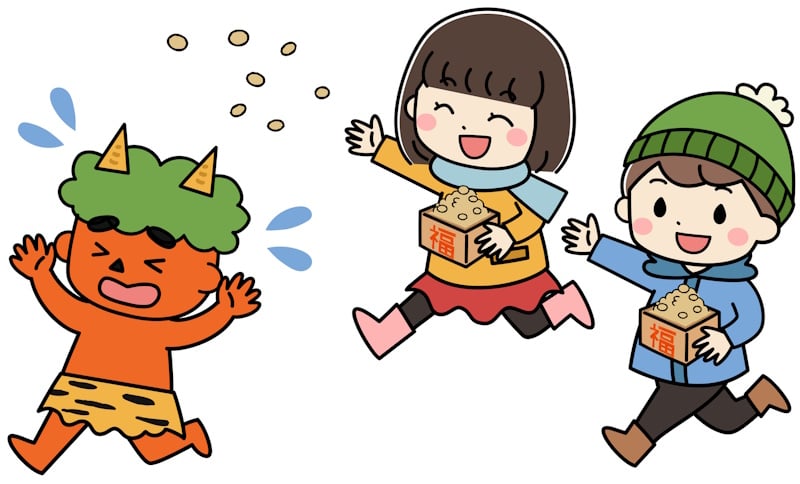
Setsubun practices vary from place to place, but the most common ritual follows this outline:
- When evening arrives, pass out soybeans among the family members. Setsubun ceremonies utilize “Fukumame,” soybeans specially dried for ceremonial purposes.
- Open the doors and windows, and spread the soybeans near the openings while chanting 「鬼は外」(oni wa soto, literally “demons out”). This drives away any evil spirits that have gathered over the last year.
- Now that the demons are gone, close the windows, and chant 「福は内」(fuku wa uchi, good luck in) while spreading another round of beans around the entryways again. This ensures that any demons you just sent out can’t come back in.
Regardless of whether people believe in the reality of demons or the power of Fukumame, Setsubun remains a popular event for families. It serves as a symbolic practice to express a wish for health and good fortune in the coming year.
Though some adults may celebrate on their own, nowadays Setsubun is mostly seen as an event for young children. Elementary schools may have a Setsubun day on February 3rd, where dry soybeans are handed out, and the kids spread them around. Later in the evening, their family may celebrate properly.
Planning a trip to Japan? Get an authentic, interpreted experience from Unseen Japan Tours and see a side of the country others miss!
In addition to the Fukumame scattering, modern Setsubun usually also features specific foods. Setsubun dishes are a selection of foods symbolizing the changing of seasons and good fortune:
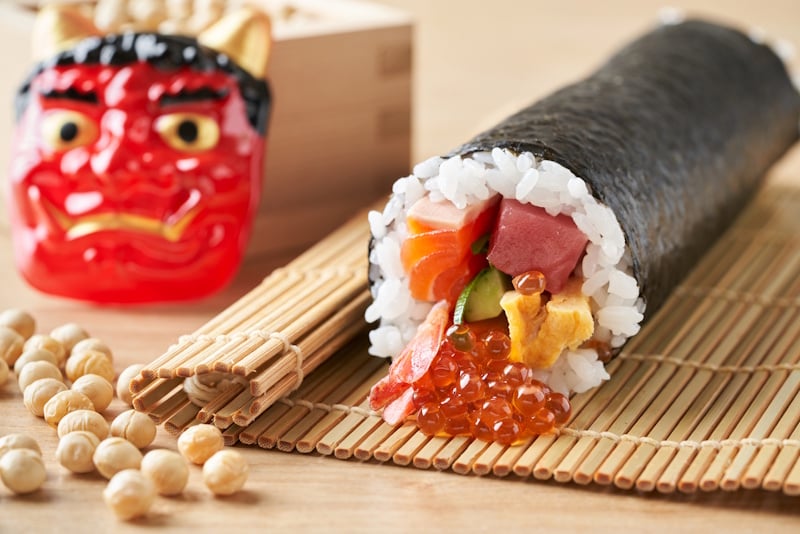
- Ehomaki – the most iconic Setsubun dish. Ehomaki is a sushi roll with seven different fillings, one for each of the seven Shinto gods of good fortune. Traditionally, the seven fillings are kanpyo (dried gourd), shiitake mushrooms, rolled omelette, eel, shrimp, cucumber, and sakura denbu (cherry blossom fish paste), but these days people usually just pick seven fillings they like.
- Sardines – In the Kansai region, the pungent odor and flavor of sardines were thought to drive demons away from the body, keeping one healthy. As such, roasting fresh sardines and eating them immediately became a part of the Kansai Setsubun festivals.
- Kenchin-jiru – A vegetable stew of varying ingredients like daikon radish, carrots, burdock, and others. Kenchin-jiru is a dish commonly prepared by Buddhist priests to support their vegetarian diet, but it has since become a Setsubun dish due to its seasonal ingredients.
- Setsubun soba – a type of soba noodle that was said to be purifying, and as such, became a part of the Setsubun festival. Along with driving demons out of your home, eating Setsubun soba purified your body, setting you up for the next year.
Celebrating Setsubun for yourself
Whether you are in Japan or not, it can be nice to take some time to wish for health and luck as the winter months draw to a close. If you can’t get your hands on Fukumame, in Hokkaido, they scatter peanuts, which should be easier to come by worldwide. Maybe roll yourself some Ehomaki with your seven favorite flavors, and think about what fortunes you wish to protect, and what demons you hope to turn away as you shout “demons out, good luck in.”
If you’re in Japan, consider searching for a temple that still practices traditional Setsubun ceremonies and visit at least once to understand the origins of this festival firsthand.

Japan gets less sleep than any other nation. But the country’s workaholic Prime Minister doesn’t seem to care.

It’s traditionally been expected that women in Japan will sacrifice their careers for their husbands. That might be changing.
It’s beginning to look a lot less like Christmas in Japan. Here’s why many say this year they’ll be tuning out of the holiday.
Sources
節分とは?由来・歴史や豆まきの意味などをご紹介. Hotel Ryumeikan Tokyo
節分と豆まきの由来. Kanshundo
節分とはどんな行事?由来や歴史、食べ物をわかりやすく解説. Hankyu Food
