
Kings of the US Box Office: Miyazaki’s The Boy and the Heron and Godzilla Minus One
Japanese media has never seemed as mainstream in North America as it does today. From the films of Kurosawa Akira opening in American theaters and the popularization of Americanized Godzilla films in the 1950s, to Astro Boy and Speed Racer enticing children to gather around TV sets in the ’60s, to the slow growth of anime from subculture to popular entertainment mainstay from the ’80s till today, the gestation of Japanese entertainment in America morphing from peculiar to conventional seems nearly complete. This weekend, for the first time, two films in the North American box office top-three will be Japanese movies.
The films in question are beloved animation director Miyazaki Hayao’s potential swan song, The Boy and the Heron, and the first new Japanese Godzilla film in seven years, Godzilla Minus One. Both films belong to parts of Japanese pop culture that have now firmly endeared themselves amongst fans worldwide. Godzilla has been thrilling viewers abroad for 3/4ths of a century; the output of Studio Ghibli, first formed by Miyazaki and Takahata Isao in the mid-80s, made its breakout in North America with 1997’s Princess Mononoke, and has slowly become as beloved and iconic for some overseas fans from younger generations as are the films of Walt Disney.
Despite passionate fanbases, the idea of two Japanese-language films resting at the top of the North American box office would still have been inconceivable only a decade ago. The previous Ghibli and Japanese Godzilla films didn’t exactly rock the world with their opening weekends; Anno Hideaki’s 2016 Shin-Godzilla made a mere $458,342 in its NA opening weekend. Meanwhile, Miyazaki’s The Wind Rises (2013) managed a relatively impressive $1.5 million during its first weekend in wide release. [1]
So, conceive of this: the top two movies in the United States and Canada this Friday were both Japanese.
US poster for The Boy and the Heron.
Unprecedented Box Office Success
Godzilla Minus One and The Boy and the Heron have crushed their predecessors’ opening weekend grosses in only their first Friday in theaters. Minus One made $4,726,373 on Friday, December 1st; this weekend (December 8th), Heron opened to a Friday (inclusive of previews) of $5.2 million. (That’s more than many Miyazaki films made in their entire North American runs.)
Right now, The Boy and the Heron is projected to take in at least $10 million over the weekend. [3] Minus One will likely come in as number 2 or number 3, facing most of its competition from HungerGames: Ballad of Songbirds & Snakes.
This opening marks several milestones for Studio Ghibli in the United States. It’s the biggest Miyazaki opening ever, and the only non-franchise anime film to ever be #1 at the NA box office. Additionally, it’s the first 2D-animated film to reach #1 since Disney’s The Princess and the Frog, way back in 2009. [4]
With this, Heron should be on track to best 2010’s Arrietty as Ghibli’s best-ever performer in North America. (Arrietty, an adaptation of the classic British children’s novel The Borrowers, made $19,202,743.) It will join other recent anime films with impressive box office runs. These include Demon Slayer: Mugen Train, which made a whopping $47.7 million. In 2022, the CG-animated Dragon Ball Super: Super Hero made $38.1 million, and also topped the box office for a weekend.
After a decade, master director Miyazaki Hayao is back with a full-length animated film. How does Studio Ghibli’s mysterious” How Do You Live” (Kimi-tachi wa Dou Ikiru Ka) stack up?
Watch our review of The Boy and the Heron.
A Bright Spot in a Tarnished Local Box Office
The relative and impressive success of Heron and Minus One comes amidst a notable downturn for the US box office. A series of major US releases have failed to meet expectations; DC’s The Flash, Marvel’s The Marvels, and Disney’s Wish have all been unqualified box office bombs. While all three films will likely make more than Heron and Minus One combined, the two Japanese films are outperforming expectations. Minus One, with a reported budget of around $13 million, will be highly profitable.
This weekend is also light on major domestic releases, making for a perfect window for these anticipated Japanese films to shine. Early December is often a dead zone for American theaters, with families being busy with preparations for the upcoming winter holidays. The successful industry strikes of the past year have also left theater marquees bereft of major releases.
So, there could be no better time for these two movies to soar into North American theaters. Together, they’ve accomplished something new, and impressive, and shown just how much of a hold Japanese popular culture continues to have on the hearts of many the world over.
Shinkai Makoto’s Suzume Ends Impressive Run in Japan
On May 27th, Shinkai Makoto’s hit new anime film, Suzume no Tojimari(すずめの戸締まり, called simply Suzume in English-language markets) ended its impressive run at the box office in its home country of Japan. The movie, which released on November 11th, 2022, was in theaters for an extended 198 days; even in its last weekend in theaters, it managed to gain 8th place at the box office. In all, Suzume has brought in ¥14.79 billion in Japan – equivalent to around $105.4 million USD. [1]
This puts Suzume snuggly in the top box office rankings in Japanese history, coming in at 14th. This means Suzume out-grossed Shinkai’s second-most-recent film, 2019’s Weathering with You, which raked in ¥14.23 billion. Sitting directly above Suzume at 13th is Miyazaki Hayao’s beloved 2008 anime film Ponyo.
While ¥14.79 billion is a strong showing, it still pales in comparison to Shinkai’s 2016 mega-hit Your Name (君の名は). That film made a massive ¥25.17 billion, and was the first-ever anime film not by Studio Ghibli’s Miyazaki to make over ¥10 billion in Japan. All-in-all, Suzume now ranks as the 8th biggest anime box office hit in Japanese history. Ahead of it are the gigantic covid-era breakaway hit Demon Slayer the Movie: Mugen Train (¥40.43b), Miyazaki’s beloved Spirited Away (¥31.68b), the aforementioned Your Name (¥25.17b), Miyazaki’s Princess Mononoke (¥20.18b), One Piece: Film Red (¥19.70b, also in 2022), and Miyazaki’s Howl’s Moving Castle (¥19.60b) and Ponyo (¥15.50).
Shinkai Makoto, famed director of Your Name and more, is back with yet another breathtakingly beautiful anime film. How does Suzume no Tojimari stack up?
Watch our review of Suzume on YouTube.
Suzume’s Dual Success
Suzume has engendered both financial and critical success; while the beautifully animated film strikes some similar beats to recent Shinkai fare, its focus on rural Japan’s population decline and the emptying of the countryside has won it laudits, both in Japan and abroad. In a compilation of reviews from the latter, Rottentomatoes.com ranks Suzume at 96% for critic reviews and 98% for audience score.
The story involves the titular Suzume, a high school student in rural Miyazaki Prefecture, Kyushu. One day, she encounters Souta, a college student who asks after the location of ruins near her town; she later witnesses him undertaking a dangerous ritual to seal away supernatural “worms” that emerge from abandoned spaces, threatening the areas around them. Suzume and Souta end up on a cross-country road trip to seal away these dangerous apparitions in the declining towns and villages of depopulating Japan.
The film’s box office accomplishments aren’t limited to Japan alone. In China, it’s the most successful Japanese film of all time, raking in the equivalent of over $112 million. In South Korea, Suzume made over $35 million, similarly becoming the biggest Japanese film ever in that country. [2] Overall, the total cumulative worldwide box office for Suzume is nearly $320 million. This makes it the 4th biggest Japanese film of all time worldwide, behind only Mugen Train, Spirited Away, and Shinkai’s own Your Name.
A theatrical poster for Suzume boasting of the film’s popularity.
A Banner Year for Theatrical Anime?
Suzume isn’t the only 2022 anime film to break out at the box office. The year’s surprise mass hit is perhaps The First Slam Dunk, based on Inoue Takehiko’s mega-popular Slam Dunk manga from the early ’90s. The film is now 15th in the JPN historical box office, coming right behind Suzume; meanwhile, it’s the 5th biggest anime film of all time internationally with over $258 million.
One Piece, which was long the perennial highest-selling manga each year over the past two decades, scored even bigger with its newest theatrical outing. One Piece: Film Red is the 15th entry in the film series following pirate Monkey D. Luffy’s quest to find the fabled “One Piece”; while other films in the series have done well, this entry blew them all out of the water. Taking in a major ¥19.7 billion ($140,374,000) domestically, Film Red was the biggest movie at the Japanese box office in 2022. It’s also the 5th highest-grossing film in Japanese history and 6th highest-grossing Japanese film worldwide.
Theatrical post for One Piece: Film Red.
What to Look Forward to Next
The success of these films played a large role in expanding the Japanese theatrical film market in 2022. The industry is still recovering from the COVID pandemic’s effects but is closing in on pre-COVID numbers. 2022 saw the Japanese box office rise to 80% of its 2019 pre-COVID stature. [3] But while the success of these films is a good sign for Japanese theaters, the fact that so many hits come from franchise films has implications regarding the direction of anime on the big screen.
Suzume could expect great success based on its coming from the highly popular Shinkai; the next non-franchise anime film with a shot at breaking out, in the same way, is Miyazaki Hayao’s upcoming How Do You Live. The first Studio Ghibli theatrical film in nearly a decade, the movie is building some real anticipation before its July 14th release.
Movies from the famed Studio Ghibli (from which came Spirited Away, Princess Mononoke, Howl’s Moving Castle, and more) were for many decades shoo-ins for being the most popular Japanese film of any year they released in. The last few films Ghibli released from last decade didn’t quite accomplish this, however; we’ll soon see if Miyazaki, one of the world’s most beloved directors, still has that old magic. We here at UJ will be on the scene to deliver a review as soon as that movie releases. For many fans of anime, animation, and Japanese film, it’s really something to look forward to.
It’s a strange but exciting time to be a fan of Japan’s most prestigious anime studio. We take a look at all the recent Ghibli news – Miyazaki’s new film How Do You Live? is half complete, another film is announced, the reception of Earwig and the Witch, the new Spirited Away stage play, the sad passing of legendary animator Otsuka Yasuo – and more.
Even though How Do You Live will release in less than 50 days, we know little more about it than when we made this video some two years ago.
Raking in huge money in Japan, Demon Slayer: Kimetsu no Yaiba the Movie: Mugen Train is already the 5th biggest box office hit in Japanese history. But what does Japan’s most famous anime director think of KIMETSU NO YAIBA?
Watch our video essay version of this article.
The past half-year hasn’t exactly been the best time for movie theaters the world over; rather, in most countries, the COVID-19 crisis has wreaked havoc on national box offices. Onetime-moviegoers are understandably wary of packing themselves into sealed rooms with strangers for two hours, and for the first months of the pandemic, many theaters were shut down altogether. Projected 2020 blockbusters like Marvel’s Black Widow or DC’s Wonder Woman 1984 have been indefinitely delayed. Famed director Christopher Nolan insisted on releasing his film Tenet to theaters, claiming it would revitalize the industry. Instead, it’s made a meek $55 million total domestically. (Comparatively, the director’s previous film, Dunkirk [2017], made $188 in the US and Canada.)
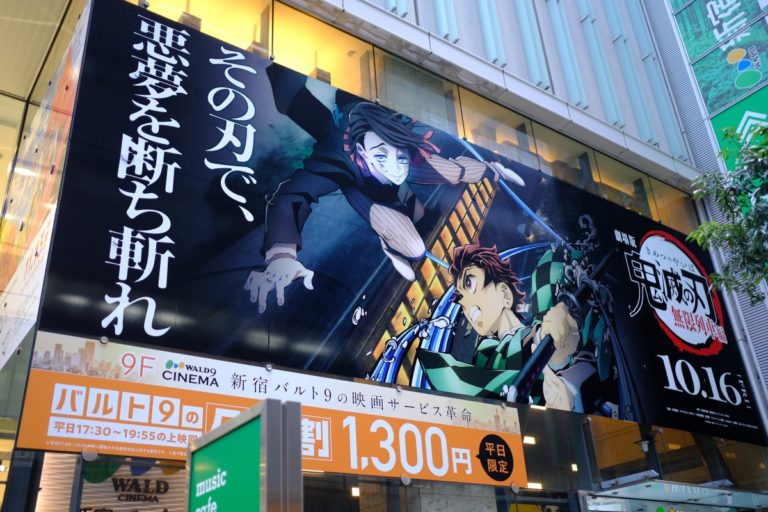
There’s one country, however, where things are currently looking very different: Japan. Proof positive of the still-active potential of the Japanese box office is the meteoric rise of Kimetsu no Yaiba – The Movie: Mugen Train (鬼滅の刃 無限列車編). (The series is known in English as Demon Slayer, which is how we’ll refer to it from here on out.) This mouthful of a movie title represents the first film for the mega-popular Demon Slayer series, based on the best-selling manga by Gotoge Koyohara and originally published in manga king-maker weekly publication Shonen Jump.
As of this writing, the anime film, released on October 16th, has seen record-breaking success in Japanese theaters. As of November 9th, Demon Slayer has amassed a stunning ¥20.4 billion (approximately US$197.9 million). In the era of COVID, this places the movie as the world’s 9th highest-grossing film of the year – and it looks to soon overtake DC’s equally laboriously-named Birds of Prey and the Fantabulous Emancipation of One Harley Quinn.
Ranking Globally
On the international front, this is a bit of a shock. Despite having one of the largest movie industries in the world (as of 2010, ranked fourth for the number of films produced), the Japanese movie-going audience isn’t quite as robust as one might imagine. The country has more-or-less half the population of the USA, and in 2019 the Japanese box office recorded a total of ¥261.2 billion (around 2.5 billion USD). A massive sum, to be sure, but a far cry from the domestic US box office total of $11.4 billion for the same year. People in Japan simply don’t go to the movies as much; additionally, movies just aren’t as much of a topic of everyday conversation, save for the occasional true cultural breakout. (Back in 2017, One Cut of the Dead represented one such film.)
Given all this, it’s exceedingly rare to see a Japanese film end up on a worldwide top-ten grossing list. Last year, Shinkai Makoto’s Weathering with You (天気の子), his follow-up to his massive hit Your Name., managed to rake in a regionally-impressive $193 million worldwide – but came in a distant 46th in global ticket sales for the year. Indeed, in 2019 terms, Demon Slayer itself, despite its massive haul, would currently only sit at 43rd, barely outpacing the theatrical Downton Abbey outing. Demon Slayer, however, has yet to be released outside of Japan, and likely still has some gas in the tank both domestically and internationally.
So, clearly, the incredible rank Demon Slayer currently holds on the world stage for 2020 is thanks, of course, to it being very specifically a 2020 release. The rest of the world is (rightfully) eschewing movie theaters. Most major releases have been delayed or consigned, like Mulan, Bill and Ted 3, or Borat 2, directly to streaming.
Compared to the vast majority of countries, however, Japan remains nominally on the low side when it comes to COVID danger. These past few days have seen rises in case numbers which rightfully worry those in Japan. But even these numbers are the envy of most countries in the Americas or Europe. So, movie theaters remain open and even fairly safe in Japan. Not only that, but foreign film releases – which, subbed and dubbed in Japanese, usually take up a significant portion of theater screens – have slowed to a crawl.
So, movie theaters are open for business, and Japanese films own the screens. The scene was set for a hot new property – or maybe one following up on a massive cultural hit – to come in and go, financially speaking, to town.
Speed Demon Slayer
Kimetsu no Yaiba began life in Weekly Shonen Jump magazine in late 2016, with a well-regarded anime adaptation following in 2019. The anime series, produced by studio Ufotable, was particularly praised for its high-quality animation. Its story, set in the Taisho era (1912-1926), centers around protagonist Kamado Tanjiro, who becomes a titular Demon Slayer after his family is massacred by a demon and his younger sister is transformed, vampiric-like, into a demon herself. The manga and anime alike have become a huge phenomenon, and the anime sequel film was expected to do well accordingly. Unlike most anime films belonging to popular TV franchises, the film is not a new story created solely for the theaters, but is in fact the continued adaptation of the manga, covering content from volume 7 and 8.
The film’s rise, however, has gone far beyond even optimistic estimates. Following its October 16th release, it took a mere ten days in theaters to rake in 10 billion yen in proceeds. This represented a new record – the current 1st and 2nd most-profitable theatrical Japanese films in local history, Studio Ghibli’s Spirited Away, and the aforementioned Your Name., both took over three weeks to do the same. Having spent less than a month in theaters, Demon Slayer is already the 5th most successful film in JP box office history – rocketing past the likes of Miyazaki Hayao’s Princess Mononoke and Howl’s Moving Castle (now ranked 7th and 8th for historical sales), the hugely profitable but still somewhat forgotten live-action Bayside Shakedown 2 (itself the highest-grossing domestic live-action film of all time), and the foreign mega-hits of the Harry Potter film franchise.
Only four films remain beyond Demon Slayer: Shinkai’s Your Name; the international monster-hit Frozen; Titanic (which itself spent many years as the biggest international box office hit of all time); and Miyazaki Hayao‘s Spirited Away, still the uncontested king of the Japanese box office since its release in 2001. Demon Slayer still has a chance to overcome some of these – Your Name, Frozen, and Titanic all sit around ¥6 billion (around $57 million) ahead, although Spirited Away still has over ¥10 billion on the movie.
Demon Slayer: A Unique Success for a Singular Time
A Demon Slayer (Kimetsu no Yaiba) tie-in at the major Japanese convenience store Lawson. (Picture: Shutterstock)
Either way, Demon Slayer is now the 3rd biggest Japanese film of all time in terms of domestic film box office receipts, and could easily take #2 in the next week. This is especially impressive for an anime franchise film. These often do quite well, with Detective Conan, Doraemon, Crayon Shin-Chan, and One Piece films often settling into annual top-ten spots. Despite the popularity of these franchise anime films, however, Demon Slayer is the only such film currently in Japan’s top-40 all-time box office rankings. Truly, quite a feat.
Speaking to The Mainichi, film journalist Otaka Hiro had the following to say regarding why Demon Slayer has been able to gain such unprecedented success:
Everything about this film’s run is out of the ordinary. The multiplex system involves concentrating on showings of popular movies, and with that in mind the industry initially had high expectations that the Demon Slayer film would make 10 billion yen. But with that said, in the past there would be considerations about its balance with other movies. This time, there are no other films like it out, and consequently there’s a focus on its showings.
Otaka Hiro, quoted in The Mainichi. (October 29, 2020.) What’s behind Demon Slayer anime’s monster success at Japan box office?
Ghibli Comparisons Abound
Despite the incredible success seen here by Demon Slayer, and in the past few years by the films of Shinkai Makoto, it is the films of the world-renowned Studio Ghibli, and director Miyazaki Hayao in particular, which still remain synonymous with box office success. The vast majority of Ghibli’s 22 films have ranked as the top domestically-produced film of whatever year they’re released, and both Spirited Away and Princess Mononoke have held the title of most successful Japanese film of all time.
Additionally, Howl’s Moving Castle and Ponyo are or have recently all been in the all-time top ten, and The Wind Rises is currently the 24th of all time. Six of the top-ten anime films of all time in Japan come from Ghibli. As such, any time another anime film sees similar success, reporters begin attempting to reach out to Miyazaki – they want to know how he feels about any potentiality of being financially overthrown.
Earlier this week, said reporters laid in wait outside of Miyazaki’s Tokyo home, waiting to pounce when the 79-year-old man stepped outside to take out his trash. In the early morning, as the elderly-yet-spry Miyazaki, mask-affixed, walked to the communal trash cans, the reporters stepped out from the shadows.
The Academy Museum of Motion Pictures’ first exhibit is all about Miyazaki Hayao. But the master director and the Oscars have a complex history.
Watch: Miyazaki’s ambivalent relationship with the Academy Awards.
Miyazaki (Begrudgingly) Weighs In
Reporter: Demon Slayer‘s earnings are approaching those of Spirited Away. How do you view this?
Miyazaki: Well, I think it has nothing to do with me. It’s more peaceful for those of us who make these films if we don’t have much to do with box office returns. All we have to do is put our all into making the films themselves.
Reporter: Have you seen Demon Slayer?
Miyazaki: I have not. I haven’t seen most things. I don’t watch TV or movies. I’m just an old retired fart taking out the trash.
Reporter: There are some fans of Spirited Away who think it’s unfortunate that it’ll lose its historic #1 spot.
Miyazaki: Who really cares about that? After all, inflation continues to go up around the world. Now, if you’ll excuse me, I have to take out the trash…”
(The joys of being Japan’s most famous creative.)
The Best is Yet to Come?
For those who have followed Miyazaki’s career closely, this response should come as no surprise. The director tends to pay little attention to such mundanities as, for example, being able to claim to be the most successful Japanese director of all time. His responses to similar questions over the years have usually contained a comparable combination of zen and curmudgeonliness.
Despite this, commentators continue to assume ulterior motives; for example, many have claimed that it was the success of Shinkai’s Your Name. which spurred Miyazaki out of retirement and towards making his new film. (Although Your Name. has become the most successful Japanese film of all time in terms of worldwide gross, it still trails behind Spirited Away in its own domestic box office.) However, Miyazaki rarely seems quite this petty – there is no recording of him equivalent to that of, say, George Lucas’ self-piteous lamentations that his new Star Wars film would “never catch Titanic” at the box office.
The question may be a moot one, in any case – whether or not Demon Slayer will catch up to Spirited Away is yet to be seen. Many “Ghibli-killer” films have risen over the past two decades, but none have even really come that close in the end, inflation or no. Still, this is a particularly unique moment for the Japanese and international box offices. Demon Slayer may just be the right film at the right time. And, even if not, its success has certainly been remarkable.
Get our free weekly newsletter to kick off every week. No BS stories on Japanese culture and travel. Sourced from Japanese media, written by Japan experts.