
All About Reiwa, Japan’s New Era

Back in January, Alyssa Pearl Fusek wrote about what would become one of the year’s biggest events: the new Imperial Era name. As Alyssa wrote, with Emperor Akihito abdicating his throne this year, and Crown Prince Naruhito assuming the position of Emperor, the government of Prime Minister Abe Shinzo had to decide on a new name for the Imperial Era – an older but still respected system for measuring the current year.

The selection process was run under intense secrecy. Experts who were called by Abe to serve on the committee had to hand over their cell phones and any other electronic equipment whenever they met. Speculation was rampant for months, with people making betting pools as to what the initial sound of the new era name would be. Teams of computer scientists used Big Data analytics to make their best-educated guesses.

In the end, however, pretty much everyone was taken aback when Cabinet Secretary Suga Yoshihide unveiled an option that no one had predicted: Reiwa (令和).
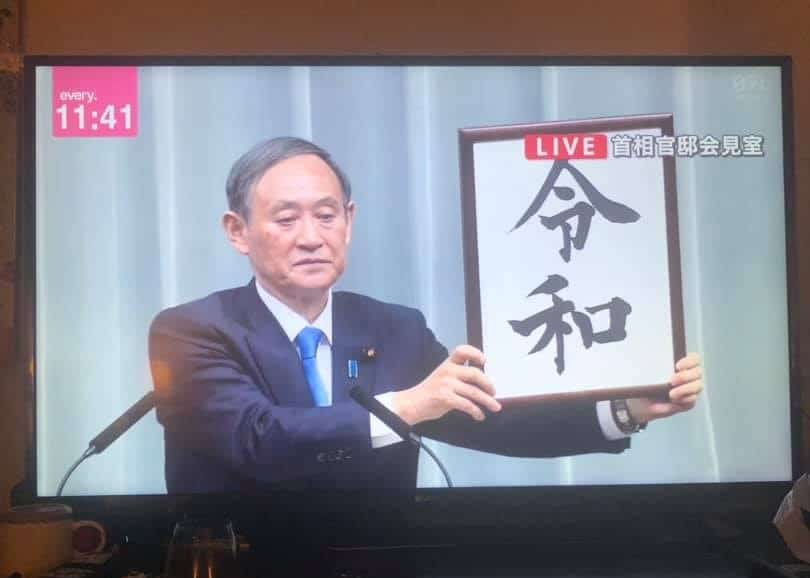
Cabinet Secretary Suga holding up Reiwa
Cabinet Secretary Suga Hideyoshi unveiling the new era name on live television. (Screenshot: NTV)

The Meaning – And The Also-Rans

As soon as the new era name was announced, it sparked a heated debate on Twitter among Japan-watchers over its meaning. The first character, 令, commonly carries a meaning of “following orders from above,” and is most used in words such as 命令 (meirei, order) and 司令部 (shireibu, headquarters). Many people, both in and outside of Japan, instantly raised suspicions that Abe – a right-leaning nationalist who’s passed most of his legislation by simply bulldozing over the objections of Japan’s minority parties – had specifically selected Reiwa for its “authoritarian” implications.

(Personally, I think that’s nonsense. However, as I argued on Twitter at the time, it was odd that Abe & Co. chose a name that opened it up to such obvious criticism.)

However, kanji (Chinese characters) often have multiple meanings. 令 is no exception. The characters were selected from one of Japan’s oldest collection of poems, the Manyoshu (万葉集), where it was used in the following poem (translation by Edwin Cranston):

It is now the choice month of early spring; the weather is fine, the wind is soft. The plum blossoms open–powder before a mirror; the orchids exhale–fragrance after a sachet.

In this case, 令 is used in the word 令月 (reigetsu), where its meaning is more along the lines of “good” or “excellent”. 和, by contrast, typically can mean “peace” (平和 – heiwa; peace) or even “Japan” (和食 – washoku; Japanese food), but here, it is used in the expression 風和らぎ (kaze yawaragi), or “soft wind.” (The fact that the full word was taken from two separate words across the span of a poem is part of what made it so hard to predict.)

The entire expression of Reiwa, taken when put in context of the poem, carries the sense of a renewal – a blossoming of flowers after a hard winter. As Prime Minister Abe Shinzo put it:

悠久の歴史と香り高き文化、四季折々の美しい自然、こうした日本の国柄をしっかりと次の時代へと引き継いでいく、厳しい寒さの後に春の訪れを告げ、見事に咲き誇る梅の花のように、一人一人の日本人が明日への希望とともにそれぞれの花を大きく咲かせることができる、そうした日本でありたいとの願いを込め、令和に決定致しました。

Like plum blossoms that blossom splendidly and signal the coming of spring after a harsh winter, it will allow each Japanese person with their hopes for the future to transmit our national character – its eternal history and richly redolent culture, its beautiful nature with its changing four seasons – to future generations, and make many flowers bloom to their fullest. It was with this desire for the Japan we wish to be that we decided on Reiwa.

Japan’s Foreign Ministry later tried to cut off speculation around the era name’s “real meaning” by announcing that the official English translation was “beautiful harmony.” And, much to its credit, the administration also released an official Japanese Sign Language sign for the new era.

The selection of Reiwa is a departure from past era names, which were all drawn from Chinese classics. This is the first time that Japan explicitly sought to pull an imperial era name from its own literary history. “Reiwa” was the ultimate winner from a list of six candidates, which included: 広至 (kouji); 万和 (banna); 万保 (banpou); 英弘 (eikou), and 久化 (kyuuka).

The selection is drawing favorable reactions from Japan, with 73.7% of respondents to a Kyodo News Service poll reacting well to the selection. The announcement has also given a hug favorability boost to the Abe admin, which saw its favorability ratings spike by 9.5 points to 52.8% – its highest levels since April 2017.

Reiwa 1 and The 10-Day Holiday

With the name of the new era decided, Japan will now move forward with the official abdication of Akihito, and the ascension of Naruhito (a fairly elaborate and somewhat expensive process that’s draw criticism from inside the country). May 1st, Ascension Day, will mark the official start of Reiwa.

The immediate upshot for most people in Japan is that most people are about to get one hell of a vacation.

The ascension of the new Emperor comes right at the tail end of the country’s famous Golden Week, a series of national holidays that have traditionally meant a week-long vacation for most residences. However, the Abe admin officially declared Ascension Day a holiday. Additionally, according to Japan’s Holiday Law, any day that comes between two national holidays must also itself be a day of rest. So this year’s Golden Week works out as follows:

DayReason for Holiday
April 27thSaturday
April 28thSunday
April 29thShowa Day
April 30thIn-Between Day
May 1stAscension Day
May 2ndIn-Between Day
May 3rdAnniversary of the Constitution
May 4thSaturday – Green Day
May 5thSunday – Kid’s Day
May 6thCompensatory Holiday

As a result, the country will basically have a large “Closed for Business” sign on its doors until May 7th. If you’re in business and have important information to communicate to your Japanese colleagues, make sure to get it to them by April 26th!

Reiwa Chocolates, and Even a Song

Post-announcement, Japan found itself in “Reiwa Fever.” News programs were pretty much “All Reiwa, All The Time” in the two days following the announcement. “Reiwa sales” could be seen everywhere, and Reiwa merchandise was even starting to hit the streets.

Amidst all the hype, two pieces of news really stood out to me – one sweet, one corny. On the sweet side (figuratively and literally), 116-year-old Tanaka Kane, the world’s oldest living person, received this large chocolate showing with the new era name, as a way to celebrate the fact that she’s now managed to live through four successive imperial eras – Meiji, Taisho, Showa, and Heisei.

Mulboyne on X (formerly Twitter): “116 year old Kane Tanaka, the world’s old living person, being presented with a chocolate rendering of the characters for Reiwa. She was born in 1903, which is the 36th year of the Meiji, so has already lived in four eras. pic.twitter.com/xRWB91dwE0 / X”

116 year old Kane Tanaka, the world’s old living person, being presented with a chocolate rendering of the characters for Reiwa. She was born in 1903, which is the 36th year of the Meiji, so has already lived in four eras. pic.twitter.com/xRWB91dwE0

And on the corny side, we have Golden Bomber. The famous air band group, best known for its 2009 song Memeshikute (女々しくて; “effeminate”), apparently saw the opportunity to be known for more than one song and seized it. Within less than 48 hours, the group had written, put together, and performed their new song, “Reiwa,” on NHK’s show Utakon, in a production that can only be described as…well, see it for yourself and fill in your own blanks. (Note – Tweet deleted.)

“Reiwa Debit Card Sagi”: The Reiwa Crime Wave Has Already Started

The Reiwa announcement wasn’t all songs and confections, however. It was also an opportunity for criminals to fleece people out of their hard-earned money.

I’ve written previously about various kinds of scams targeting primarily elderly people in Japan – such as the “Apo-den scam,” in which a scammer impersonating a family’s son attempts to convince someone to yank a bunch of cash from the bank, which the scammers then steal by breaking into the apartment. The introduction of the new era name provided scammers an opportunity to invent an entirely new form of deceit, in which they ring up elderly people and convince them that their debit cards are now “expired” due to the advent of Reiwa, and need to be turned in. The scammers then show up and confiscate both the card and the victim’s PIN, and use both to withdraw as much cash as they can.

https://www.sankei.com/west/news/190402/wst1904020011-n1.html
(JP) Link: Caution Needed on New Era Scams; Elderly Victims of “Cash Card Will Change with New Era”

At least five elderly women have fallen victim to the scam already.

It’s sad to think that, in the lead-up to the era announcement, some people sat around tables in smoke-filled rooms and debated the best schemes they could deploy to take advantage over the ensuing confusion. No matter where you live, it seems, someone’s always looking to make a quick buck at other peoples’ expense.

Japan Will Give The New Era Its True Meaning

tkasasagi 🐻 on X (formerly Twitter): “Newspaper today. How to beautifully write Reiwa. This is why I like this country so much. 😌 pic.twitter.com/4t66zchsvQ / X”

Newspaper today. How to beautifully write Reiwa. This is why I like this country so much. 😌 pic.twitter.com/4t66zchsvQ

Names are always ripe with meaning and open to interpretation. This is especially true with Japanese, a language with an extensive literary history that dates back to pre-Christian China. Officially, “Heisei” (平成) – the current era – was meant to symbolize “the establishment of people – inside and outside of Japan, in Heaven and on Earth.” However, some took advantage of the alternate meanings of the kanji to sneer that it really meant “flat growth” – a reference to the Japanese economy’s lackluster performance since the bubble of the 90’s.

Ultimately, only 39.8% of respondents to a Kyodo poll said they viewed Heisei favorably. (19.9% viewed it unfavorably; 40.3% were undecided.) So, how will people come to view Reiwa? Much of that will depend on how well the country’s leaders can respond to the various challenges Japan faces, such as de-population, immigration, economic growth, health and welfare, and protecting the rights of women and minorities. And it will also depend on the new Emperor, Naruhito, and the type of symbol he becomes for his people.

In the end, no scanning of kanji etymology will give Reiwa its meaning. Only the people of Japan – and the passage of time – will tell us what Reiwa truly means.

Sources

【全文書き起こし】新元号「令和」は万葉集から 安倍首相「『人々が美しく心を寄せ合う中で文化が生まれ育つ』という意味込めた」. ITMedia

Dawn of a New Era: Why Japan’s Calendars Will Change With the New Emperor

Abdication isn’t uncommon in Japanese history. Many emperors in pre-modern Japan were forced to abdicate due to sickness or political turmoil. However, Akihito’s abdication will be a seizen tai-i (生前退位) or “living abdication.” Since 1889, an emperor has to reign until his death — then, and only then, can an heir ascend the throne. Akihito’s abdication is especially rare in that he is willingly giving up power in favor of his son.

So how did this “living abdication” come about? Not easily, and not without heated debate.

Akihito’s Long Road to Abdication

It was a turbulent road for Emperor Akihito to secure his abdication, mostly due to the absence of legislature allowing a living emperor to abdicate.

Despite his status as Emperor, and therefore the living embodiment of Japan, Akihito isn’t free to act on his own accord. He can’t just up and retire to the countryside. The act of abdication involves ceremonies and rituals honoring the imperial family and the people as they ease into a new reign.

Officials close to the Emperor revealed that the emperor had been hinting at abdication for years, with 2010 being the earliest recorded date of abdication talks. In 2016 NHK aired a rare televised video message Akihito recorded for the people. Akihito’s decision to make a public address can be construed as a carefully calculated move; he forced the government to get involved by appealing to the people. With media outlets jumping on the news, both abroad and national, the government had no choice but to come up with a way to allow the emperor to abdicate.

天皇陛下「お気持ち」表明 ビデオメッセージで公開(16/08/08)

天皇陛下は、象徴天皇のあり方や公務についての今のお気持ちをビデオメッセージで国民に向け表明されました。 ・・・記事の続き、その他のニュースはコチラから! [テレ朝news] http://www.tv-asahi.co.jp/ann/

Emperor Akihito’s public address in August 2016, where he alludes to his desire to abdicate due to his age and health. One could say his decision to broadcast this message to the public was a shrewd way of forcing the government to take him seriously without actually calling them out.

As mentioned above, Akihito will be the first living Emperor to abdicate in over two hundred years. The last Emperor to do so was Emperor Kokaku (光格; Kokaku). He ruled from 1779-1817 and stepped down as Emperor to make way for his only living son. Emperors who abdicate become joko (上皇), or retired emperor, and the empress becomes a retired empress, joko-gou (上皇后). Even as a joko, Kokaku still exerted some power behind the throne, and many fear that this may happen with Akihito. Many have also voiced concerns that “coexistence of an emperor with a former emperor may…weaken the unity of the position’s symbolic nature and authority” (Hidehiko). However, there doesn’t seem to be any indication that Akihito intends to act behind the scenes; he seems to be fully withdrawing from imperial duties.

The Imperial Household Law

The imperial family is fairly restricted in their movements due to the Imperial Household Law (皇室典範; koushitsu tenpan). First established in 1889, the Imperial Household Law governs the issues of succession, marriage, regency, and other administrative matters.

When it became clear Akihito was serious in his wish to abdicate, a troubling question needed answering: should the abdication be a one-time thing specific to Emperor Akihito, or should it be codified into law for future Emperors wishing to abdicate? It fell to the Imperial Household Council (皇室会議; koushitsu kaigi) to make that decision. Headed by Prime Minister Abe and consisting of Diet and House members, the council convened to discuss how to address the abdication issue.

Inside the Imperial Abdication Panel: A Legal and Political Balancing Act

In the wake of a rare televised address in which Emperor Akihito obliquely conveyed a desire to step down, Prime Minister Abe Shinzō formed a six-member advisory panel to hammer out a legislative solution, given the lack of provision for abdication under current Japanese law.

One article in particular, Article 4, has been the crux of the debate for abdication. Article 4 states that a new heir will ascend to the throne only after the Emperor’s death. No exceptions. Past discussions of Article 4 have been invariably tangled in politics and war. The Imperial Household Law went into effect the same day as the Meiji Constitution in 1889. Political motives and fear of the Meiji emperor’s power severely curved the potential of Article 4 at that time. When the Law was revised again in 1947, Emperor Hirohito’s position in relation to war responsibility came into conflict with the draftees’ intentions, and Article 4 was left alone despite heated discussions. Article 4 remains unchanged since the Meiji era, and many say that’s not a good thing.

In a September 2018 Huffpost Japan interview, historian Kazuto Hongo of Tokyo University talked about imperial abdication and the legislature:

だけど、近代日本は法律、皇室典範が強く働いている。天皇陛下がお体を気になさって退位を望まれるのは誰しもが納得することだけど、そこで退位ができないのはやはり法律の不備。皇室典範をどうするかというのは問題になったが、特例法で対応することになった。

However, in modern Japanese law, the Imperial Household Law is strongly effective. Everyone understands that Emperor Akihito is concerned about his health and desires to abdicate, but there are inadequate laws in place that don’t allow the emperor to abdicate. How to deal with the Imperial Household Law was a difficulty, but it was eventually decided to respond with the special legislation.

(JP) Link: How Should We Face the “Joko” for the First Time in 200 Years? We Ask Professor Hongo of Tokyo University Before the Abdication

(Note: Link is no longer active)

In a survey conducted by Kyodo News in May 2017, a large majority supported a revision to constitutional law allowing future emperors to abdicate, with a clear opposition to the government’s idea of an ad hoc abdication law applicable only for Akihito. Nowhere in this Law has there been a provision made for living emperors to abdicate — until May 19, 2017 when the council announced that it would send a bill to the Diet for consideration. Much to the public’s dismay, it was an ad hoc provision solely for Akihito, and the Diet passed the bill in June 2017.

Aside from the abdication, another issue needs to be handled with as much delicacy as the abdication, and that is the selection of a new era name.

The Pre-Modern History of Era Names

Ancient Japan adopted many things from China — kanji, Buddhism, and the era name system, or gengo (元号; gengou). A gengo is a name given to a specific time period, usually an emperor’s reign. There were many false starts when this system was first implemented, with some emperors failing to reinstate it after a previous emperor’s death, leaving some time periods in Japanese history officially unnamed. Finally, in 701, the gengo became part of the Japanese calendar, and the succession of gengo has gone uninterrupted ever since.

For a long time, it wasn’t the rule to pair one emperor with one gengo, unlike in China. In pre-Meiji Restoration Japan, major events like natural disasters prompted the assignation of a new gengo. Sometimes two emperors would share a single gengo. Emperor Kokaku, the last emperor to abdicate prior to Akihito, reigned under five different gengo.

Emperor Kokaku was the last emperor to abdicate in favor of a successor. After his abdication, Emperor Kokaku traveled to the Sento Imperial Palace in Kyoto to live out his remaining days as a joko (上皇; *joukou*). (Source: Wikipedia)

“One Reign, One Era”

The 1868 Meiji Restoration brought revolutionary changes to Japan’s calendar system. With the Meiji Emperor’s ascension came the establishment of issei ichigen (一世一元), or “one reign, one era.” From then on, era names were subject to change only when an emperor’s reign came to an end. Other than some exceptions during the Heian period, gengo are typically made up of two kanji compounds taken from selected Japanese texts.

The Historical Background of How Japan Chooses Its Era Names

Japan counts years using a system of era names. The current era is Heisei, which began when Emperor Akihito succeeded his father in 1989. A new era will begin when his heir takes the throne. This article explains the historical background of the system and the procedures by which it is now implemented.

With the practice of issei ichigen, it became inevitable for an emperor to be automatically associated with a gengo. Indeed, emperors are posthumously named after the gengo of their reign. Emperor Hirohito, the current Emperor’s father, is also known as the Emperor Shōwa.

More Than Just a Name

A gengo is more than just a demarcation of time or an earmark in the long history of Japanese imperial reign. A gengo encapsulates an entire mood atmosphere, as well as any significant events that irrevocably changed the nation. It’s similar to how some Americans reminisce about the early 2000s and the ‘90s.

When asked to summarize the Heisei era in one word, Professor Hongou had this to say:

一言では言えない「混迷」の時代だったんだと思う。「昭和」と聞いた時に「右肩上がり」「高度経済成長」といったイメージはみんな見えていて、「昭和文学」のように「昭和○○」というのはいろいろなところで使われていた。ところが「平成○○」というのはあまりない。

I can’t say in a single word it was an era of “confusion.” When people hear “Showa” [the era name before Heisei], images of “expansion” and “rapid economic growth” come to mind, and as with “Showa literature”, the “Showa—” prefix was used in various places/ways. However, “Heisei” wasn’t used like that very much.

The Potential of Political and Societal Upheaval

Despite the public’s support for the Emperor’s abdication, the political world had other things to say about it. The timing of Akihito’s abdication couldn’t have been more upsetting, depending on your viewpoint. The abdication comes at a time when Prime Minister Shinzo Abe is reinforcing his rhetoric for constitutional reform, and the ascension of the new Emperor coupled with the establishment of a new era name will delay his plans, something his opponents will no doubt take advantage of.

Concerns for the widespread social effect have also played a factor in determining the date for Akihito’s abdication. Japan is known for its numerous national holidays, notably Golden Week. How to best accommodate the Emperor’s abdication and Naruhito’s ascension without coinciding with notable holidays? Taking consideration of Akihito’s wishes and those of the people, the date of April 30 was finally selected.

The abdication has an economic impact as well. Japan still uses era names in daily life. Everything from daily planners, court documents, guidebooks, calendars — they all use the gengo simultaneously with the Western calendar system. Until the new gengo is revealed in April before the abdication, publishers and companies alike will have to wait.

https://unseen-japan.com/japan-daylight-savings-it.html

Akihito’s abdication will take place on April 30, 2019, bookended by ceremonies and ritual observances meant to ease the transition between old and new. Many will remember him as the “traveling emperor,” one who visited disaster-struck areas and comforted the people. As for the Heisei era, many will know it as a time of great devastation and great renewal. Hopefully the new “gengo” will reflect hope for the future.

Sources

Hidehiko, Kasahara. “The Compromise and Contradictions in Emperor Akihito’s Abdication Legislation.” Nippon.com, April 18, 2017. Accessed Jan 6 2019. https://www.nippon.com/en/in-depth/a05402/