Has The Media Hounded Ex-Princess Mako Into Hiding?
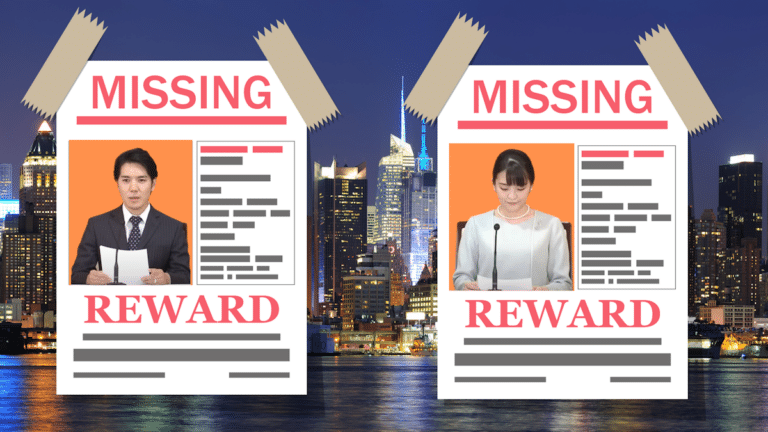
Reporters in Japan, the US, and the UK are distraught. According to them, Japanese lawyer Komuro Kei and his wife, Mako – a member of Japan’s imperial family – have “gone missing.” Looking back on how the press has treated the couple, who can blame them?
Komuro Mako – a.k.a. former Royal Princess Akishinonomiya Mako – met Komuro Kei at college. At some point, the two developed a relationship and began dating. In 2018, they made waves in Japan when they held a press conference announcing their intention to get married.
The marriage immediately became a big to-do. First, because it meant that, thanks to current laws, Mako would have to leave the imperial family in order to marry someone outside of the royal bloodline. But second, a prying media discovered that an ex-fiancee of Kei’s mother claimed the family owed him tens of thousands of dollars. The man claimed he supported Kei through school and that he deserved that money back.
Upon leaving the royal family, Mako would receive a payout to help her “retain her station” in life. The media speculated that they might use this taxpayer-supplied money to wipe out the Komuro family’s private debt. The ensuing controversy delayed the couple’s marriage by several years.
The media circus didn’t end after the Komuros moved to New York City. Kei took a job there with a local law firm. Mako, who has a Masters in Art Museum and Gallery Studies, was considering either looking for work or finishing her doctorate.
But pursuing your ambitions is hard when the press is on your ass. Kei took several attempts to pass the NY State Bar Exam, with the press seemingly reveling in each failed attempt. Paparazzi regularly staked out the couple’s apartment in Hell’s Kitchen, despite both now being private citizens.
(The Japanese media typically respects the privacy of 一般人, ippanjin, or “regular citizens”, married to celebrities. But that’s usually because the celebrity agencies will punish them with restriction of access if they fail to comply. Since the Komuros aren’t celebrities in that sense, the press seems to think they’re fair game.)
Gone Girl (and Boy)
Komuro Kei is still listed as an associate at his law firm, Lowenstein Sandler.
This week, the media found a new “controversy” they could use to put the couple back in the news.
The news was: there was no news. More to the point, the press couldn’t get so much as a single telephoto lens shot of the couple because no one had seen them in weeks.
According to Gendai Media, the couple haven’t been seen near their apartment for a while. The lease was originally for 11 months, which supposedly ended in November.
However, they also don’t appear to be preparing to move into the $1.3 million house they bought in the New York City suburbs. (Being an ex-princess has its privileges.) And the place appears only lightly renovated since they bought it.
Komuro Kei also hasn’t been seen at his law firm, Lowenstein Sandler, in weeks. However, he’s still listed as an Associate on their Web site. Gendai says he may have accepted a transfer to the firm’s Washington, D.C. office.
“Missing”?!
This has led the Japanese press to report that the couple are “missing”. The headlines use the same word for missing – 行方不明, yukuefumei – that one would use for a missing person. This has garnered derision on social media. As one poster on X put it, “By that definition, my first ex-gf, my grade-school best friend, & my former teacher are all ‘missing’.”
It’s apparent that the couple doesn’t want to be found. After years of press hounding, they’re likely enjoying a few weeks away from the media spotlight. At least a portion of the Japanese public hopes it stays that way. As one social media user, Shinohara Shuji, put it:
“An article titled ‘Komuro Kei’s gone missing!’ is trending but if you look closely, you’ll see the press just doesn’t know where they moved. Your lack of brain power doesn’t translate to ‘missing.’ Stop looking for them.”
I doubt the press will heed this wise advice. They’ll keep digging until they find the “missing” couple so that they can resume their long-distance paparazzi snaps and monthly hazing in earnest.
Which is a shame. It’d be wonderful if the Komuros could live out the rest of their lives as a normal, private couple, as they seem intent on doing. Sadly, the media seems intent on taking that from them.
Sources
小室圭さん・眞子さん夫妻が「行方不明」に…「2億円豪邸」も放置されたまま. Gendai Media
Will Japan’s Press Finally Leave Komuro Kei and Mako Alone?
In the Japanese entertainment world, there’s a clear distinction between celebrities (芸能人; geinoujin) and “regular folk” (一般人; ippanjin). If a celebrity marries a non-celebrity, the celeb’s agency can usually exert enough pressure on the press to protect a modicum of their privacy. You’ll generally only hear a non-celebrity spouse referred to as a “regular man” or “regular woman”.
And then there’s the case of The Princess Formerly Known as Akishinonomiya Mako and her husband, Komuro Kei.
Ever since former Princess Mako and Komuro announced their marriage, Komuro’s been an intense focus of the Japanese mainstream and tabloid presses. At first, the issue was a large debt that a former fiance of Komuro’s mother claimed the family owed him. He attested that he lent millions of yen to Komuro’s mom to help with her son’s education.
Komuro’s family denied the money was ever a loan. But the allegation led to fear-mongering in the tabloids. Mako’s marriage meant she’d have to leave the royal family, at which point she’d receive a lump sum to help her in her post-royal life. That raised the specter that the Komuro newlyweds would use public money to pay off a private debt.
The “concern” soon grew into a full-blown hate campaign against Komuro Kei. Detractors claimed he was “using” the royal family’s name to boost his own career[3].
Somehow, the couple pushed through the resistance, got married, and moved to New York. Kei paid off the debt – some 4 million yen – shortly before moving[1]. Mako even refused her million-dollar payout from the Japanese government to help smooth
You’d think that’d have been the end of their troubles. But the Japanese press wouldn’t let up. And the New York City press – mainly in the form of the low-morality troglodytes who drag their knuckles through the halls of the New York Post – decided to get its kicks in as well.
[ppp_patron_only level=”1″]
Let the mockery begin
Komuro Kei has been aiming for the international stage ever since he was a kid. He’s attended international schools for the majority of his life, where he’s worked assiduously on his English skills. He attended the Canadian International School for middle and high school and then went on to study at International Christian University and the University of California at Los Angeles (UCLA).
Komuro then subsequently studied at Fordham Law School. Part of the motivation for going to Fordham was to buy him and Mako some time to resolve the issues surrounding their engagement. But the couple still received a boatload of criticism when the Imperial Household officially announced their engagement in September 2021.
The couple was officially married on October 26th, 2021. Royal Princess Akishinonomiya Mako was now officially Komuro Mako – just a regular Japanese citizen like everyone else.
But she and her husband sure weren’t treated that way.
Around this same time, Kei took the New York State bar exam. He had a job lined up at a law firm in New York City, where the couple intended to move after they married.
Let that sink in for a moment. At the same time that Komuro Kei and Mako were enduring daily abuse by the press, Kei was attempting to pass a bar exam in his second language. I don’t know how he survived, honestly. The stress alone would’ve killed me.
Shortly after their marriage, the press caught on that Kei flunked his first run at the bar exam. Despite the couple now being regular citizens, the development somehow made headline news and entered Twitter’s trending topics.
The subject also grabbed the attention of the New York press, who seemed overjoyed to have a new target they could jeer at. Reporters from the New York Post, a used dishrag masquerading as legible English, rejoiced in how he failed after his wife had given up That Princess Life to be by his side.
Third time’s the charm
Bar exam shaming is the new black.
The situation didn’t get any better after Komuro failed the exam a second time. But his bumpy ride came to an abrupt end this month. Kei’s third attempt at the bar was a success and he is now a bar-certified attorney in the state of New York.
I can’t even imagine achieving something as difficult as Komuro did here. The only experience that comes close is taking the Japanese Language Proficiency Test (JLPT). I failed level N2 of that test three times. I passed the highest level, N1, after I spent three years basically watching Japanese TV and reading Japanese books daily.
Komuro didn’t just pass an exam in his non-native language. He did so on a subject – New York and United States law – that required extensive reading and memorization on top of his second language skills. The man should have a ticker tape parade in his honor.
Sources inside the royal family said that Mako’s father and mother were “happy” about Komuro’s accomplishment[4]. On Twitter, a large number of voices praised Komuro as well – and called for his detractors to back off.
Komuro’s success also means that he will transition out of his law clerk status at his firm – which means a huge boost in pay. This will take away some of the rampant speculations that the Komuros were piling up debt to afford their apartment in Hell’s Kitchen.
That doesn’t mean the press won’t have anything to talk about. There’s some speculation the couple and the royal family may reconnect after having little contact since their marriage. The press is also speculating what Mako will do for work. Mako has a Master’s in Museum Sciences from the University of Leicester. However, she would need a doctorate to work at New York City’s more lauded institutions, like the Metropolitan Museum of Art[5].
Of course, the press has another choice. They could let Mako and Kei, two private citizens, live out the rest of their lives free from the public spotlight.
Sadly, you and I both know how likely that is to happen.
Back in January, Alyssa Pearl Fusek wrote about what would become one of the year’s biggest events: the new Imperial Era name. As Alyssa wrote, with Emperor Akihito abdicating his throne this year, and Crown Prince Naruhito assuming the position of Emperor, the government of Prime Minister Abe Shinzo had to decide on a new name for the Imperial Era – an older but still respected system for measuring the current year.
The selection process was run under intense secrecy. Experts who were called by Abe to serve on the committee had to hand over their cell phones and any other electronic equipment whenever they met. Speculation was rampant for months, with people making betting pools as to what the initial sound of the new era name would be. Teams of computer scientists used Big Data analytics to make their best-educated guesses.
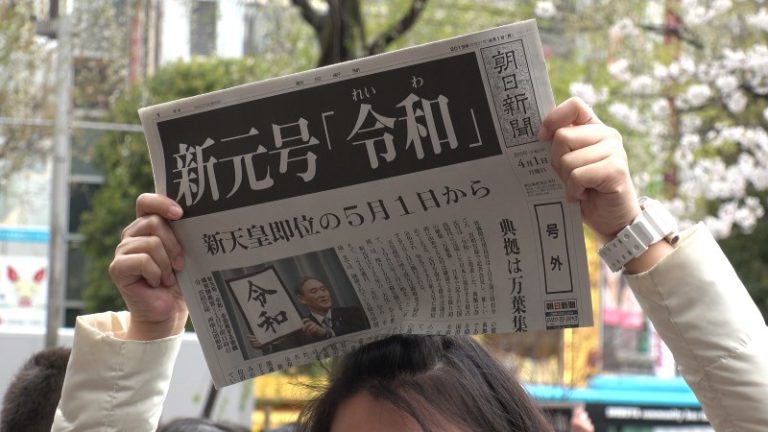
In the end, however, pretty much everyone was taken aback when Cabinet Secretary Suga Yoshihide unveiled an option that no one had predicted: Reiwa (令和).
Cabinet Secretary Suga Hideyoshi unveiling the new era name on live television. (Screenshot: NTV)
The Meaning – And The Also-Rans
As soon as the new era name was announced, it sparked a heated debate on Twitter among Japan-watchers over its meaning. The first character, 令, commonly carries a meaning of “following orders from above,” and is most used in words such as 命令 (meirei, order) and 司令部 (shireibu, headquarters). Many people, both in and outside of Japan, instantly raised suspicions that Abe – a right-leaning nationalist who’s passed most of his legislation by simply bulldozing over the objections of Japan’s minority parties – had specifically selected Reiwa for its “authoritarian” implications.
(Personally, I think that’s nonsense. However, as I argued on Twitter at the time, it was odd that Abe & Co. chose a name that opened it up to such obvious criticism.)
However, kanji (Chinese characters) often have multiple meanings. 令 is no exception. The characters were selected from one of Japan’s oldest collection of poems, the Manyoshu (万葉集), where it was used in the following poem (translation by Edwin Cranston):
The poem that provided the characters: pic.twitter.com/NwJTJ8RM12
It is now the choice month of early spring; the weather is fine, the wind is soft. The plum blossoms open–powder before a mirror; the orchids exhale–fragrance after a sachet.
In this case, 令 is used in the word 令月 (reigetsu), where its meaning is more along the lines of “good” or “excellent”. 和, by contrast, typically can mean “peace” (平和 – heiwa; peace) or even “Japan” (和食 – washoku; Japanese food), but here, it is used in the expression 風和らぎ (kaze yawaragi), or “soft wind.” (The fact that the full word was taken from two separate words across the span of a poem is part of what made it so hard to predict.)
The entire expression of Reiwa, taken when put in context of the poem, carries the sense of a renewal – a blossoming of flowers after a hard winter. As Prime Minister Abe Shinzo put it:
Like plum blossoms that blossom splendidly and signal the coming of spring after a harsh winter, it will allow each Japanese person with their hopes for the future to transmit our national character – its eternal history and richly redolent culture, its beautiful nature with its changing four seasons – to future generations, and make many flowers bloom to their fullest. It was with this desire for the Japan we wish to be that we decided on Reiwa.
Japan’s Foreign Ministry later tried to cut off speculation around the era name’s “real meaning” by announcing that the official English translation was “beautiful harmony.” And, much to its credit, the administration also released an official Japanese Sign Language sign for the new era.
Here is the official Japanese sign language for Reiwa. pic.twitter.com/ACQ4w93eXn
The selection of Reiwa is a departure from past era names, which were all drawn from Chinese classics. This is the first time that Japan explicitly sought to pull an imperial era name from its own literary history. “Reiwa” was the ultimate winner from a list of six candidates, which included: 広至 (kouji); 万和 (banna); 万保 (banpou); 英弘 (eikou), and 久化 (kyuuka).
The selection is drawing favorable reactions from Japan, with 73.7% of respondents to a Kyodo News Service poll reacting well to the selection. The announcement has also given a hug favorability boost to the Abe admin, which saw its favorability ratings spike by 9.5 points to 52.8% – its highest levels since April 2017.
The immediate upshot for most people in Japan is that most people are about to get one hell of a vacation.
The ascension of the new Emperor comes right at the tail end of the country’s famous Golden Week, a series of national holidays that have traditionally meant a week-long vacation for most residences. However, the Abe admin officially declared Ascension Day a holiday. Additionally, according to Japan’s Holiday Law, any day that comes between two national holidays must also itself be a day of rest. So this year’s Golden Week works out as follows:
Day
Reason for Holiday
April 27th
Saturday
April 28th
Sunday
April 29th
Showa Day
April 30th
In-Between Day
May 1st
Ascension Day
May 2nd
In-Between Day
May 3rd
Anniversary of the Constitution
May 4th
Saturday – Green Day
May 5th
Sunday – Kid’s Day
May 6th
Compensatory Holiday
As a result, the country will basically have a large “Closed for Business” sign on its doors until May 7th. If you’re in business and have important information to communicate to your Japanese colleagues, make sure to get it to them by April 26th!
Reiwa Chocolates, and Even a Song
Post-announcement, Japan found itself in “Reiwa Fever.” News programs were pretty much “All Reiwa, All The Time” in the two days following the announcement. “Reiwa sales” could be seen everywhere, and Reiwa merchandise was even starting to hit the streets.
Amidst all the hype, two pieces of news really stood out to me – one sweet, one corny. On the sweet side (figuratively and literally), 116-year-old Tanaka Kane, the world’s oldest living person, received this large chocolate showing with the new era name, as a way to celebrate the fact that she’s now managed to live through four successive imperial eras – Meiji, Taisho, Showa, and Heisei.
116 year old Kane Tanaka, the world’s old living person, being presented with a chocolate rendering of the characters for Reiwa. She was born in 1903, which is the 36th year of the Meiji, so has already lived in four eras. pic.twitter.com/xRWB91dwE0
And on the corny side, we have Golden Bomber. The famous air band group, best known for its 2009 song Memeshikute (女々しくて; “effeminate”), apparently saw the opportunity to be known for more than one song and seized it. Within less than 48 hours, the group had written, put together, and performed their new song, “Reiwa,” on NHK’s show Utakon, in a production that can only be described as…well, see it for yourself and fill in your own blanks. (Note – Tweet deleted.)
“Reiwa Debit Card Sagi”: The Reiwa Crime Wave Has Already Started
The Reiwa announcement wasn’t all songs and confections, however. It was also an opportunity for criminals to fleece people out of their hard-earned money.
I’ve written previously about various kinds of scams targeting primarily elderly people in Japan – such as the “Apo-den scam,” in which a scammer impersonating a family’s son attempts to convince someone to yank a bunch of cash from the bank, which the scammers then steal by breaking into the apartment. The introduction of the new era name provided scammers an opportunity to invent an entirely new form of deceit, in which they ring up elderly people and convince them that their debit cards are now “expired” due to the advent of Reiwa, and need to be turned in. The scammers then show up and confiscate both the card and the victim’s PIN, and use both to withdraw as much cash as they can.
(JP) Link: Caution Needed on New Era Scams; Elderly Victims of “Cash Card Will Change with New Era”
At least five elderly women have fallen victim to the scam already.
It’s sad to think that, in the lead-up to the era announcement, some people sat around tables in smoke-filled rooms and debated the best schemes they could deploy to take advantage over the ensuing confusion. No matter where you live, it seems, someone’s always looking to make a quick buck at other peoples’ expense.
Newspaper today. How to beautifully write Reiwa. This is why I like this country so much. 😌 pic.twitter.com/4t66zchsvQ
Names are always ripe with meaning and open to interpretation. This is especially true with Japanese, a language with an extensive literary history that dates back to pre-Christian China. Officially, “Heisei” (平成) – the current era – was meant to symbolize “the establishment of people – inside and outside of Japan, in Heaven and on Earth.” However, some took advantage of the alternate meanings of the kanji to sneer that it really meant “flat growth” – a reference to the Japanese economy’s lackluster performance since the bubble of the 90’s.
Ultimately, only 39.8% of respondents to a Kyodo poll said they viewed Heisei favorably. (19.9% viewed it unfavorably; 40.3% were undecided.) So, how will people come to view Reiwa? Much of that will depend on how well the country’s leaders can respond to the various challenges Japan faces, such as de-population, immigration, economic growth, health and welfare, and protecting the rights of women and minorities. And it will also depend on the new Emperor, Naruhito, and the type of symbol he becomes for his people.
In the end, no scanning of kanji etymology will give Reiwa its meaning. Only the people of Japan – and the passage of time – will tell us what Reiwa truly means.
Dawn of a New Era: Why Japan’s Calendars Will Change With the New Emperor
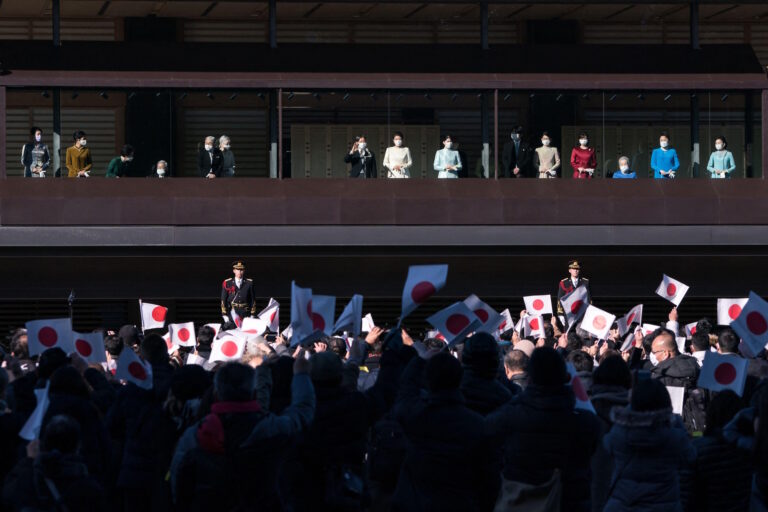
Abdication isn’t uncommon in Japanese history. Many emperors in pre-modern Japan were forced to abdicate due to sickness or political turmoil. However, Akihito’s abdication will be a seizen tai-i (生前退位) or “living abdication.” Since 1889, an emperor has to reign until his death — then, and only then, can an heir ascend the throne. Akihito’s abdication is especially rare in that he is willingly giving up power in favor of his son.
So how did this “living abdication” come about? Not easily, and not without heated debate.
Akihito’s Long Road to Abdication
It was a turbulent road for Emperor Akihito to secure his abdication, mostly due to the absence of legislature allowing a living emperor to abdicate.
Despite his status as Emperor, and therefore the living embodiment of Japan, Akihito isn’t free to act on his own accord. He can’t just up and retire to the countryside. The act of abdication involves ceremonies and rituals honoring the imperial family and the people as they ease into a new reign.
Officials close to the Emperor revealed that the emperor had been hinting at abdication for years, with 2010 being the earliest recorded date of abdication talks. In 2016 NHK aired a rare televised video message Akihito recorded for the people. Akihito’s decision to make a public address can be construed as a carefully calculated move; he forced the government to get involved by appealing to the people. With media outlets jumping on the news, both abroad and national, the government had no choice but to come up with a way to allow the emperor to abdicate.
Emperor Akihito’s public address in August 2016, where he alludes to his desire to abdicate due to his age and health. One could say his decision to broadcast this message to the public was a shrewd way of forcing the government to take him seriously without actually calling them out.
As mentioned above, Akihito will be the first living Emperor to abdicate in over two hundred years. The last Emperor to do so was Emperor Kokaku (光格; Kokaku). He ruled from 1779-1817 and stepped down as Emperor to make way for his only living son. Emperors who abdicate become joko (上皇), or retired emperor, and the empress becomes a retired empress, joko-gou (上皇后). Even as a joko, Kokaku still exerted some power behind the throne, and many fear that this may happen with Akihito. Many have also voiced concerns that “coexistence of an emperor with a former emperor may…weaken the unity of the position’s symbolic nature and authority” (Hidehiko). However, there doesn’t seem to be any indication that Akihito intends to act behind the scenes; he seems to be fully withdrawing from imperial duties.
The Imperial Household Law
The imperial family is fairly restricted in their movements due to the Imperial Household Law (皇室典範; koushitsu tenpan). First established in 1889, the Imperial Household Law governs the issues of succession, marriage, regency, and other administrative matters.
When it became clear Akihito was serious in his wish to abdicate, a troubling question needed answering: should the abdication be a one-time thing specific to Emperor Akihito, or should it be codified into law for future Emperors wishing to abdicate? It fell to the Imperial Household Council (皇室会議; koushitsu kaigi) to make that decision. Headed by Prime Minister Abe and consisting of Diet and House members, the council convened to discuss how to address the abdication issue.
In the wake of a rare televised address in which Emperor Akihito obliquely conveyed a desire to step down, Prime Minister Abe Shinzō formed a six-member advisory panel to hammer out a legislative solution, given the lack of provision for abdication under current Japanese law.
One article in particular, Article 4, has been the crux of the debate for abdication. Article 4 states that a new heir will ascend to the throne only after the Emperor’s death. No exceptions. Past discussions of Article 4 have been invariably tangled in politics and war. The Imperial Household Law went into effect the same day as the Meiji Constitution in 1889. Political motives and fear of the Meiji emperor’s power severely curved the potential of Article 4 at that time. When the Law was revised again in 1947, Emperor Hirohito’s position in relation to war responsibility came into conflict with the draftees’ intentions, and Article 4 was left alone despite heated discussions. Article 4 remains unchanged since the Meiji era, and many say that’s not a good thing.
In a September 2018 Huffpost Japan interview, historian Kazuto Hongo of Tokyo University talked about imperial abdication and the legislature:
However, in modern Japanese law, the Imperial Household Law is strongly effective. Everyone understands that Emperor Akihito is concerned about his health and desires to abdicate, but there are inadequate laws in place that don’t allow the emperor to abdicate. How to deal with the Imperial Household Law was a difficulty, but it was eventually decided to respond with the special legislation.
(JP) Link: How Should We Face the “Joko” for the First Time in 200 Years? We Ask Professor Hongo of Tokyo University Before the Abdication
(Note: Link is no longer active)
In a survey conducted by Kyodo News in May 2017, a large majority supported a revision to constitutional law allowing future emperors to abdicate, with a clear opposition to the government’s idea of an ad hoc abdication law applicable only for Akihito. Nowhere in this Law has there been a provision made for living emperors to abdicate — until May 19, 2017 when the council announced that it would send a bill to the Diet for consideration. Much to the public’s dismay, it was an ad hoc provision solely for Akihito, and the Diet passed the bill in June 2017.
Aside from the abdication, another issue needs to be handled with as much delicacy as the abdication, and that is the selection of a new era name.
The Pre-Modern History of Era Names
Ancient Japan adopted many things from China — kanji, Buddhism, and the era name system, or gengo (元号; gengou). A gengo is a name given to a specific time period, usually an emperor’s reign. There were many false starts when this system was first implemented, with some emperors failing to reinstate it after a previous emperor’s death, leaving some time periods in Japanese history officially unnamed. Finally, in 701, the gengo became part of the Japanese calendar, and the succession of gengo has gone uninterrupted ever since.
For a long time, it wasn’t the rule to pair one emperor with one gengo, unlike in China. In pre-Meiji Restoration Japan, major events like natural disasters prompted the assignation of a new gengo. Sometimes two emperors would share a single gengo. Emperor Kokaku, the last emperor to abdicate prior to Akihito, reigned under five different gengo.
Emperor Kokaku was the last emperor to abdicate in favor of a successor. After his abdication, Emperor Kokaku traveled to the Sento Imperial Palace in Kyoto to live out his remaining days as a joko (上皇; *joukou*). (Source: Wikipedia)
“One Reign, One Era”
The 1868 Meiji Restoration brought revolutionary changes to Japan’s calendar system. With the Meiji Emperor’s ascension came the establishment of issei ichigen (一世一元), or “one reign, one era.” From then on, era names were subject to change only when an emperor’s reign came to an end. Other than some exceptions during the Heian period, gengo are typically made up of two kanji compounds taken from selected Japanese texts.
Japan counts years using a system of era names. The current era is Heisei, which began when Emperor Akihito succeeded his father in 1989. A new era will begin when his heir takes the throne. This article explains the historical background of the system and the procedures by which it is now implemented.
With the practice of issei ichigen, it became inevitable for an emperor to be automatically associated with a gengo. Indeed, emperors are posthumously named after the gengo of their reign. Emperor Hirohito, the current Emperor’s father, is also known as the Emperor Shōwa.
More Than Just a Name
A gengo is more than just a demarcation of time or an earmark in the long history of Japanese imperial reign. A gengo encapsulates an entire mood atmosphere, as well as any significant events that irrevocably changed the nation. It’s similar to how some Americans reminisce about the early 2000s and the ‘90s.
When asked to summarize the Heisei era in one word, Professor Hongou had this to say:
I can’t say in a single word it was an era of “confusion.” When people hear “Showa” [the era name before Heisei], images of “expansion” and “rapid economic growth” come to mind, and as with “Showa literature”, the “Showa—” prefix was used in various places/ways. However, “Heisei” wasn’t used like that very much.
The Potential of Political and Societal Upheaval
Despite the public’s support for the Emperor’s abdication, the political world had other things to say about it. The timing of Akihito’s abdication couldn’t have been more upsetting, depending on your viewpoint. The abdication comes at a time when Prime Minister Shinzo Abe is reinforcing his rhetoric for constitutional reform, and the ascension of the new Emperor coupled with the establishment of a new era name will delay his plans, something his opponents will no doubt take advantage of.
Concerns for the widespread social effect have also played a factor in determining the date for Akihito’s abdication. Japan is known for its numerous national holidays, notably Golden Week. How to best accommodate the Emperor’s abdication and Naruhito’s ascension without coinciding with notable holidays? Taking consideration of Akihito’s wishes and those of the people, the date of April 30 was finally selected.
The abdication has an economic impact as well. Japan still uses era names in daily life. Everything from daily planners, court documents, guidebooks, calendars — they all use the gengo simultaneously with the Western calendar system. Until the new gengo is revealed in April before the abdication, publishers and companies alike will have to wait.
Akihito’s abdication will take place on April 30, 2019, bookended by ceremonies and ritual observances meant to ease the transition between old and new. Many will remember him as the “traveling emperor,” one who visited disaster-struck areas and comforted the people. As for the Heisei era, many will know it as a time of great devastation and great renewal. Hopefully the new “gengo” will reflect hope for the future.
Sources
Hidehiko, Kasahara. “The Compromise and Contradictions in Emperor Akihito’s Abdication Legislation.” Nippon.com, April 18, 2017. Accessed Jan 6 2019. https://www.nippon.com/en/in-depth/a05402/
Before you go…
Get the Japan stories you don't see elsewhere.
Get our free weekly newsletter to kick off every week. No BS stories on Japanese culture and travel. Sourced from Japanese media, written by Japan experts.