Sakamichi Brewing: Crafting Japanese Beer Culture in Tachikawa

For five years, a warm, inviting light has streamed from a corner street in Tachikawa, a major city in Tokyo Prefecture’s western suburban reaches. The light emanates from the sliding glass doors leading into the taproom at Sakamichi Brewing; an intimate space where revelers and lovers of good beer gather most evenings. Behind the taproom, with its iconic unvarnished wooden tap handles, is Sakamichi’s very own brewery; a small space filled with metallic piping and tanks. A different type of magic happens in both spaces: in the brewery, Sakamichi’s cycle of craft beers are brewed to perfection. In the taproom, customers, both Japanese and international, get to enjoy those beers straight out of the tap.

Sakamichi Brewing is the creation of two foreign residents of Japan: Matthew Boynton, originally from England, and Daniel Bellamy, hailing from the USA. Their friendship originated from a mutual love of cycling that led them on numerous trips around Japan, evolving into a successful business with major indie beer cred in western Tokyo.

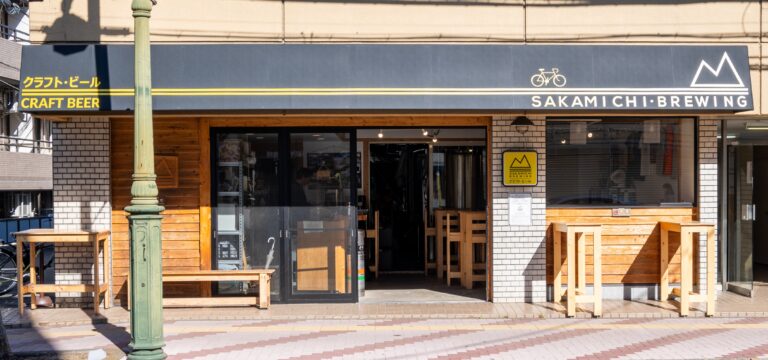
A view into the Sakamichi Brewing taproom in Tachikawa, Tokyo. Photo by author.

Their story can seem an unlikely one. The Japanese craft beer industry is only now reaching a state of maturity, following decades of languishing behind restrictive tax structures. Until recently, the Japanese populace as a whole was perhaps uninterested in more complex beers than the usual seasonal Ebisu offerings.

Now, however, craft beer is finally making itself known throughout Japan. Japanese governmental licensors have become more friendly to smaller establishments; for the first time, craft beer is a viable business at smaller scales. [1] Amongst these changes, Sakamichi has staked out its place amongst the best local beers in Tokyo – even if you’ll have to take a train out west to sample it.

On a recent snowy Tachikawa day, I sat down with Matthew and Daniel (over a delicious pint of their crisp “Tipsy-T” razcherry sour ale) at their brand-new Sakamichi North venue. There, we discussed their craft beer journey, current 5th-anniversary celebrations, the state of the industry, and what beer enthusiasts have to look forward to in Japan’s craft scene.

Matt and Daniel of Sakamichi Brewing stand in front of a wood-paneled walk with bare ceiling in their new Sakamichi North location.

Matthew and Daniel of Sakamichi Brewing at their new Sakamichi North location. Photo by author.

Lifting a Pint to the Japanese Beer Scene

Q: The first thing I’ll ask you is actually about the beer that I’m drinking right now. It’s a “Razcherry” sour ale – it’s a new one, right?

Matthew: So, when we were planning to open Sakamichi North, we did a crowdfunding campaign on Campfire. The top tier of support that people could offer was “Make a Beer with Us.” We limited it to just five people. They all got snapped up almost immediately, which was pretty cool. We sort of asked them, “What kind of beer do you want to make?” Like, coordinate with us on the recipe. And the most important things of all: pick the name of the beer. Really, the reason we’re in the business is to put up silly names for the beer.

(Previous Sakamichi beers have included such names as: “Mount Crushmore,” a Mountain IPA; “Mr. Bones,” a Milk Stout; and “Hop Executor,” a DDH Imperial Pale Ale made for the colloquial May 4th Star Wars holiday.)

Matthew: Then they got to come to the brewery for brewday itself. The “Tispy-T” was made in coordination with one of our top-tier supporters. He really likes sour beers. He’s also from Switzerland – and we got hold of some Swiss cherries! We had cherry puree, which we used in the beer, as well as some Oregon raspberries. And yeah, I think it’s come out really well. It has a little bit of sourness, and a little bit of sweetness to balance it out. It’s almost like a glass of raspberry lemonade. And at an ABC of 6%, like all of our beers, it is dangerously crushable.

A glass of “No Rest for the Wicked,” Sakamichi’s 9.0% Cherry Chocolate Imperial Stout. Photo by author.

Sakamichi North: The Newest Addition to the Suburban Tokyo Craft Scene

Q: That’s great. So, I want to talk to you about the history of Sakamichi – but first, let’s talk about the big news: the opening of your new location: Sakamichi North. Can you tell me about the genesis of this new location, so close to Tachikawa Station?

Daniel: Our first location (about a seven-minute walk west of Tachikawa Station) has been and continues to be a really great location for us. It really suited our needs when we first opened up. And it has the space to have a tap room within the brewery. But, if you were to split the area around Tachikawa Station into four quadrants, it’s kinda in the quietest one. We don’t get a lot of foot traffic out there, except for people who live in that area. It continues to be our nice, cozy home base with a lot of regular customers. But in looking for a second location, we wanted somewhere a little more lively, with a little more foot traffic. A little bit more in the middle of everything.

Q: Did you consider locations elsewhere in Tokyo beyond Tachikawa?

Daniel: We didn’t necessarily limit ourselves to Tachikawa. But the brewery is in Tachikawa, and we’re proud to be in Tachikawa, so when this space opened up, it pretty much met all of our needs.

Q: Being so close to the station must be a real boon. Sakamachi North is only about one block away from the north exit.

Daniel: There’s a few train lines that converge in Tachikawa. Say you work in central Tokyo, and you take the Chuo Line to Tachikawa and transfer to the Monorail to go to your home station. Our original place isn’t that far from the station, but if you’re just changing trains, it’s a little bit distant to say, “I’ll just pop out and have a beer before I get my train home.” Whereas the new location is a lot more accessible for a pop-in drink on the way back from work.

Sakamichi North, nearby to Tachikawa Station. Photo by author.

“A Node in the Culture of Tachikawa”

Matthew: Tachikawa North opened in December of 2024, and so far, so good. One of our goals is to be, if not quite like a British pub, a sort of node in the culture of Tachikawa. In other words, a place where people can come and coordinate events and meet people. In fact, one of the events that we do is a monthly craft beer run. The local running store organizes the route, and we organize the beer. Everyone who finishes the run in a Sakamichi-branded T-shirt gets a free beer at the entrance. We’ve been able to do that from our new location.

Q: Speaking of which, can you tell me a bit about your connection to Tachikawa? How does the local clientele interact with Sakamichi Brewing?

Daniel: When Matthew and I started developing this idea and were looking at where we wanted to put it, Tachikawa seemed like a great location. There’s a lot of people here, a lot of train lines joining here. You’re still in Tokyo, but you can get into the countryside pretty quickly. It’s a great hub location for West Tokyo where people gather to do their drinking, their shopping, go out on dates; all of that kind of stuff.

But when we first opened, there wasn’t a lot of craft beer either. That market was kind of underserved. At the same time, there were enough customers in the area to make it viable. We also heard from other restaurant owners that Tachikawa locals really love to support local businesses. It’s quite a big city, with the full range of the usual chain bars and restaurants. 
But it’s also full of tons and tons of tiny little locally-owned restaurants and bars. Of course, not everybody is a success, but we’ve found that people in Tachikawa really are interested in supporting a local Tachikawa brewery.

The greenery and cityscape of Tachikawa. The Tama Monorail is seen in the foreground.

Support in Tough Times

Matthew: There were some fairly tough times when we first opened. It was right in the middle of the pandemic. And I remember one particular event, where the ruling had come down that we were gonna have to stop serving alcohol for an indeterminate amount of time. So, we held an event to try and finish up everything that we had in our fridge; we put the call out to our customers. And the response was quite extraordinary. That night, the tap room was absolutely packed. Everyone was delighted every time a kegger kicked. 
We were wiping the on-tap beer names off the boards, one after another. Seeing people come together like that to support us, even when we hadn’t been in business for that long; it was very gratifying.

Q: Tachikawa is certainly an interesting location. When I lead hikes up Mount Takao in far western Tokyo as part of Unseen Japan Tours, we often stop off at your taproom as a capstone to that day trip.

Matthew: I think we get a lot of people who are heading back into Central Tokyo from being up in the mountains, or in the countryside. My general theory is that the center of Tokyo is moving westwards as well. There’s no room east – you just hit Tokyo Bay. 
So the only space for people to move is out west. So, who knows in – another 10 or 15 years, this could be the center of Tokyo.

The current tap line up at Sakamichi North. All beers on tap at this location are Sakamichi Brewing originals. Photo by author.

The Birth of Sakamichi

Q: So, let’s walk this back a bit and talk about the origins of Sakamichi Brewing. What was the process that led to the genesis of this business?

Matthew: So, I had been working at a couple of different breweries in Japan. I worked at Baird Beer in Shizuoka, and then at Ishikawa Shuzo here in Tokyo. And I was foolish enough to think that it was time for me to set up my own thing. I was planning on leaving there and going independent. Around about the same time, Dan had just come back from what had been quite a long time abroad.

Daniel: I got a little burnout and I left Japan, taking a two-year bike tour down the coast of America and through Central and South America. I came back to Japan afterward and was at a little bit of a loose end, but maybe not quite willing to step back into some kind of corporate job. I wanted to do my own thing; something a little bit unique. Actually, in my younger days, I did a lot of manual labor jobs. A lot of carpentry and woodworking; things like that. And there’s something quite rewarding about actually making something and being able to quantify your work. Like, even working behind the bar, right? You can look at the number of customers that came through and say, “I did this today,” right? “I hope these people have a good time and enjoy some good beers.”

A Hilly Road

Q: Tell me about how you two met.

Matthew: Cycle touring. We actually have some photos on the wall you can check out. We got to know each other by riding bicycles throughout Japan. That’s actually where the name “Sakamichi” (坂道, “Hill Road”) comes from!

During trips, we would often find ourselves having to ride up a staircase or, on one memorable occasion, along the top of a sea wall for a few kilometers. And the (facetious) line was always, “What an interesting road! What an interesting road we found here.” So when it came time to start the company, that phrase was quite resonant. We couldn’t translate it directly, but we wanted to have something that was easy to say in Japanese and in English, and was recognizably Japanese. 
So that’s where the “Sakamichi” came from.

A lot of people have remarked that the road on which the brewery is located is not steep at all. But it’s a nice opportunity to tell that story. I also think that the process of starting your own beer brewery is a fairly steep road.

The Sakamichi founders, in can form. Photo by author.

Craft to the Future

Q: How has the Japanese craft scene evolved in the five years since you established Sakamichi Brewing?

Matthew: I think over the last five or six years, independent of us, the quality of craft beer in Japan has increased extraordinarily. And a lot of this came down to timing. When global shipping completely ground to a halt, that coincided with the increase in good quality, locally-brewed craft beer. And so it was suddenly a lot more difficult and a lot more expensive to buy beer imported from America, New Zealand, the UK, what have you. But the beer here in Japan was of an equal or even a better quality, because it’s so fresh, right? Somebody can package your beer on a Monday, send it out on a Tuesday, and you can be drinking it on a Wednesday. You can’t do that with beer from overseas, you know?

So, that’s been a really big change just over the last five years. A lot of those breweries are quite large, but many are very locally focused. They support a very local area. The scale of operations here in Japan is so much smaller than it is in the US, for example. The US is kind of the north star of the global craft beer industry, right? We had the annual Japan Brewers Cup recently, and I was able to chat with a few visiting brewers from America. When I told them about the scale of our operations here, they almost couldn’t believe how small Japanese breweries are compared to the scale of those in the US. But that means that we just really focus on our local area rather than trying to produce beer for a country the size of the US.

Matthew Boynton hard at work brewing the newest Sakamiachi beer. Photograph courtesy of Sakamichi Brewing.

Encountering the Cans

Q: These days, you encounter craft beer in spaces that would have been unimaginable fifteen or twenty years ago. There’s a certain amount in groceries and convenience stores around the country. Of course, many of these are “craft” beers made by massive companies. What’s your perception of this change?

Daniel: It all comes down to scale. Most small-scale craft beer producers like ourselves aren’t making enough beer to be able to can it and get it into supermarkets. You can maybe get into convenience stores locally, cause a lot of those are franchises; you’re dealing with an owner of that particular convenience store rather than a huge chain. But if you’re talking about getting craft into a supermarket chain, they’re dealing with potentially thousands and thousands of cans, like a massive order every month. Most of the breweries that are operating in Japan nowadays just don’t have that kind of scale.

I mean, in our case, we’re not canning at all right now. We would like to be, but even if we were, we wouldn’t be able to produce enough to supply places in Tachikawa alone. Whereas a company like Kirin can start Spring Valley, they can begin making beers in more modern craft beer styles; pale ales, and IPAs. 
But they have the production scale behind them to produce in quantities, and the business relationships to get beer into the supermarkets and convenience stores that people go to every day.

Matthew: I’d add that I think that the scale at which large corporations produce beer makes it a fundamentally different product than what we make. Under modern capitalism, it’s common for people to feel a sense of alienation regarding the products they consume. Because that’s what they are; just products that they consume. 


Whereas the beer that we make here– the people who live in our neighborhood know who we are. We talk to people in the streets. They can come to the brewery and look through the window and see us at work. You can see the raw ingredients that we use. You can taste and experience the beer differently than you would something that is a fungible product; something made in a massive facility somewhere in the countryside that you don’t understand, using huge machines that are beyond the limit of human comprehension. That’s just a different product. Maybe we’re using similar ingredients, similar processes, similar recipes. But the big corporations are missing that connection, which makes the business a very different beast.

Customers enjoying beer on tap at the original Sakamichi location. Photograph courtesy of Sakamichi Brewing.

The Tachikawa Locals Learning to Love Craft Beer

Q: Tell me a bit about Sakamichi’s clientele. Is it a pretty equal balance between local Japanese Tachikawans and foreign residents looking to get their craft beer fix?

Daniel: In terms of demographic breakdown, our customer base is probably 90% Japanese and 10% foreign. But yeah, we do benefit a little bit from having the base nearby. [Editor’s note: Sakamichi is near JSDF Camp Tachikawa and U.S. Air Base Yokota Japan.] Tourists and foreign residents in Japan may have a higher per capita interest in craft beer, although I think the percentage is growing in Japan as well. But we knew that opening in a place like Tachikawa would mean serving many customers unfamiliar with craft beer. So, we made a lot of decisions in terms of our price and the kind of beer that we make and serve to meet that audience.

We still have people coming in and say, “What’s the most normal beer you have? Ichinban futsu no beer.” 
It is a pretty regular question. You know, if you don’t know anything about craft beer, then starting off with the cherry raspberry sour might not be quite what you’re looking for. You can save that for the second visit. So yeah, being mindful of first-time customers, we help them learn about craft, and in that way, turn first-time customers into future second, third, and fourth-time customers. Understanding that people are coming in here for different reasons and with different goals and with different backgrounds in craft beer– I think that’s an important part of this business, and probably any business.

Q: That makes sense. Is the “Shibasaki Session” Session IPA a beer you might recommend to a first-timer?

Daniel: It’s our flagship beer. I think it’s maybe a little bit too bitter for people who come in and say, “I want something like a Japanese macro lager.” But we always do have a lager or two on tap, usually with some dry hops to make it a little more aromatic. So, we do often recommend the Shibasaki Session, but sometimes we go with a lager as well. The hope is that people can taste something a little bit different in that beer. And then, you know, maybe they drink that the first few times. And then they branch out after that and start trying other things. From there, they may move on to an IPA… or even a sour.

Central Tachikawa, featuring the Tama Monorail.

A Taste of Things to Come

Q: Lastly, would you care to introduce a specific beer to our reading audience?

Matthew: We’re constantly brewing new and seasonal beers, so there’s a lot of tap turnover. Of course, there’s Shibasaki Session, our standard. We try to have that on tap all the time, in both our original location and in Sakamichi North. It’s not that strong, at only 4.5%, but we try to cram a lot of charcter right there. So it uses a lot of Amarillo hops, which have a kind of dank, citrusy, grapefruity kind of character. Really nice, very flavorful, but also very crushable.

Tomorrow, I will be kegging the anniversary IPA. Every year we make an anniversary IPA, which is usually a hazy double IPA. Recently we’ve been building up our connections in our relationships with hop growers in New Zealand. So we used a lot of New Zealand hops in this one, including one called Kohia Nelson, which is a blend of hops and dried passion fruit. I tried some on Friday evening, pouring a little bit off the tank to check the gravity. It smelled pretty incredible, so I’m looking forward to carrying that.

One that’s coming back soon is the “Mr. Bones.” That was one where the entire concept for the beer came to me all at once. It was like, who would drink a milk snout? 
Well, obviously, an extreme skeleton who loves dangerous sports and is always breaking his bones. And of course, what’s his name? His name is “Mr. Bones.” So that all came together all at once. It’s been a while since we’ve last had that one, so it’s nice to revisit some of the recipes we haven’t been to for a while. We like making new things, but also we have a few standards that people look forward to coming back to.

Excellent. Thanks so much for your time, guys – and thanks for the beer!

Sakamichi Brewing is celebrating its 5th anniversary over the coming weekend. You can visit them at their new Sakamichi North location, or at their original brewery and tap room. You can also listen to Matthew and Daniel’s podcast, Sakamichi Nights – maybe even the episode featuring yours truly. Drink responsibly.

The author at the Sakamichi Brewing taproom.

Sources

[1] Lyman, S. and Bunting, C. (2019). The Complete Guide to Japanese Drinks. Tuttle.

Emergent Tokyo: What Makes Japan’s Capital so Alluring?

Twilight was coming on as I walked through the narrow alleyways of Shibuya’s diminutive Nonbei Yokocho neighborhood. Despite over a decade of visiting Shibuya for the usual carousing and shopping, I’d somehow missed the yokocho‘s existence; something that has only become easier as Shibuya has been built up, massive highrises obscuring even more of its environs.

As the book in my backpack described, the block of minuscule bars “sits relatively unnoticed between giant modern skyscrapers, a pocket of life in the midst of the global city.” Somehow, it took reading Emergent Tokyo (note: affiliate link) to introduce me to one of the city’s coolest backstreets.

The backstreets in question are one of many distinctive yokocho neighborhoods scattered across Tokyo. Yokocho (横丁) are narrow, semi-hidden alleyways filled with bars and restaurants. They often carry a feeling of old Tokyo, like something out of the early postwar era. That makes sense, since many of the most famous yokocho emerged from the black markets that crowded around major train stations in the wake of the devastation of WWII. Shinjuku’s now-internationally famous Golden Gai is an especially prominent yokocho; Nonbei Yokocho (“Drunkard’s Alley”) is smaller, both in terms of overall footprint and bar size.

I was with two friends, none of us strangers to Shibuya, but all first-timers to Nonbei. We managed to grab three of the roughly six seats available at Bar Usagi. The tiny space, intimate in the extreme, felt familiar; that would be because ‘Emergent Tokyo’ happens to feature a detailed cross-section of the bar. We got some beers, raised our glasses in the standard kanpai, and enjoyed the cozy ambiance of a space only 4.8m2 wide – and yet representative of one of the urban phenomena that make Tokyo such an incredibly alluring city.

Red lanterns hang above the narrow entrances to small concrete buildings that house the bars of Nonbei Yokocho.
Nonbei Yokocho.

Tokyo Emerges

I’ve lived in Tokyo for years; for even longer, Tokyo was a central location visited on weekends while I was working in Japan’s distant rural spaces. I’ve always loved this city, ever since I first briefly set foot in it as a fresh-faced high school exchange student in 2006. While the sheer size and clamor of Tokyo can overwhelm, for many, visitors or residents, Tokyo holds an almost unmatchable charm. And if you’re looking to understand more of this city – how it came to be, how it functions, what makes it unique – and where it may be heading – it would be hard to find better reading material than ‘Emergent Tokyo’.

The book is equally fascinating from an academic and a tourist perspective. Are you an old hand to Tokyo, interested in learning more about its zoning and right-to-light laws? Great, you should read it. New to Tokyo, and hoping to have a deeper understanding of the iconic sights in Kabuki-cho and Shibuya? You’re also in luck! ‘Emergent Tokyo’ is both approachable and scholarly. It manages to do all this within a framework that both highlights Tokyo’s strengths as a city without essentializing or, worse, exoticizing.

The book Emergent Tokyo open to a double page image of the densely packed bars of Golden Gai, while behind the book is an actual Golden Gai alleyway.
Golden Gai within Golden Gai. Photograph by author.

The Seven Tokyos

‘Emergent Tokyo’ tackles the massive physical diversity of the megacity by breaking it down into component archetypes. These seven neighborhood types will be instantly recognizable for those who have spent time in Tokyo. Village, Local, Pocket, Mercantile Yamanote, Mercantile Shitamachi, Mass Residential, and Office Tower; each is defined and mapped out based on the chome blocks designated by each Tokyo Ward. The authors acknowledge the porous nature of these divisions, and set out what makes them unique – all while attempting to avoid hierarchies. “There is a different Tokyo for every season,” say the authors in the introduction. “Even the most humdrum neighborhoods can evolve in new directions over time.”

Amongst these divisions are found “urban patterns” that typify what makes Tokyo special. Describing and enumerating these unique features of the city takes up the majority of the book. These are the aforementioned yokocho; recognizable Zakkyo buildings, narrow rectangles where each floor hosts a different business; Undertrack infills, where the space underneath raised train tracks and highways take on a vibrant urban life; ankyo streets, filled-in rivers and canals that help trace the old features of Meiji Tokyo and the feudal Edo before it; and, lastly, the dense low-rise neighborhoods that so many Tokyoites call home.

The book provides case studies for each of these urban patterns. For yokocho, we learn about ever-popular Golden Gai, the tiny drinking spaces of Nonbei Yokocho, and the al fresco bars of Yanagi Koji in Nishi-Ogikubo. Detailed but aesthetically pleasing graphs, diagrams, and maps abound in each section. Readers may find themselves pouring over the visuals for almost as much time as they spend reading.

A diagram of the entirety of the Golden Gai bar district.

Theorizing Tokyo

‘Emergent Tokyo’ does more than simply indulge the sheer interest inherent in delving into each of these Tokyo phenomena. Instead, the book examines what exactly it is that makes Tokyo so, well, Tokyo. Central here is the concept of ’emergence.’

What, exactly is emergence? The book offers the unified behavior of large flocks of birds as an example. “This is not the result of a leading bird somehow transmitting orders with a mysterious animal telepathy; the flock’s coherent behavior simply emerges from each bird responding to the movements of its neighbors.”

The book posits that Tokyo, too, functions in this way. Historical events – the war, the postwar economic boom – create rippling changes. Neighborhoods are built on the patterns of the rice paddies and canals that once dotted the land underneath them. Bureaucracy and commerce have their say. But on the micro-scale, people are still making their own decisions.

High and Low in Tokyo

Take, for example, the dense housing on the island of Tsukishima, in Tokyo Bay. An artificial island, perhaps best known for its street of monjyayaki restaurants, Tsukishima fits a surprising amount of Tokyo archetypes and trends inside of its small footprint. Narrow alleyways separate rows of low single-family houses, their concrete covered in greenery. These tiny roji streets allow for “an extension of the domestic space.” Housing melds naturalistically with small commercial enterprises.

Look skyward, however, and one sees the giant high-rise apartment blocks that epitomize modern urban building trends – a common sight all around Tokyo Bay. In fact, the government aims to keep building more of these thousand-family structures in Tsukishima. The older dense residential neighborhoods are too dense, and seen as a fire hazard in case of earthquakes. Macro trends and local decision making are part of what makes these neighborhoods what they are.

A narrow residential street in Tsukishima combines housing and small commercial properties. (Photograph by author)

Going Behind the Scenes

All this detail and insight makes ‘Emergent Tokyo’ required reading for anyone captivated by Japan’s capital city. On my own bookshelf, it’s already taken pride of place next to other classics of accessible Tokyology, like Seidensticker’s seminal “Low City, High City: Tokyo from Edo to the Earthquake.”

Fascinated by the content of Emergent Tokyo as I was, I jumped at the opportunity to find out a little more about the background of the book. Co-author Joe McReynolds, one-third of the book’s editorial team alongside Jorge Almazan and Saito Naoki, was kind enough to give me a short interview. Hopefully, you find it as insightful as I did.

How did you become involved with the Almazán Architecture and Urban Studies Laboratory, and with the creation of this book in particular?

Joe: It’s the unlikeliest thing that’s ever happened to me, a journey spanning a decade! I spent the 2010s working as a national security analyst in DC and full of wanderlust, traveling the world as much as I could. Tokyo was always my favorite city in the world — this city of endless possibility, yet it seemed to function so differently than any other place I’d encountered. I dreamed of actually studying how Tokyo works, but I assumed that was an “in another life…” fantasy rather than a real possibility. I kept collecting Japanese-language writings on Tokyo over the years, in case I might have a use for them someday.

[Joe speaks Japanese and studied abroad in Japan, but his day job in DC focuses instead on China.]
Joe McReynolds, co-author of ‘Emergent Tokyo’. Photograph provided by Mr. McReynolds.

One leap led to another. I befriended Japanese national security researchers, and they offered me a visiting defense fellowship in 2019. I used that visa to finally embark on the urban studies research I’d always dreamed of, applying my training as an intelligence analyst to a city instead of military matters. And for some of the corners of Tokyo’s cityscape I was investigating, I found out there was another researcher in town who’d been looking into the same issues: my co-author on Emergent Tokyo, Jorge Almazan. I asked him to grab a coffee in the summer of 2019, and it was like meeting your counterpart from an alternate universe. We had very similar lenses on the city, though coming from totally different perspectives — he’s a practicing architect and a PhD-ed academic.

Four years ago this month, Jorge invited me to join his urban studies laboratory at Keio University, and the rest is history. It honestly felt like Kamala Khan getting called up to the Avengers, having the chance to work with urban studies scholars I’d idolized for years! We spent the two years of the pandemic debating and sharpening every single sentence in Emergent Tokyo, and now we’re hard at work on its sequel together with the rest of the incredible Studiolab team.

The famed Zakkyo buildings of Yasukuni Street, Kabuki-cho. (Photograph by author)

What was it like working on Emergent Tokyo, and what was your role?

It was an absolute dream. For the book research, I had to immerse myself into both the penthouses and dives of Tokyo, so to speak. My goal was to intimately understand both the major players behind both its gleaming redevelopment projects and the myriad subcultures of the night city. It was also, on some days, a nightmare; I had given myself a one-year, one-time shot to pursue the pipe dream of a lifetime, so the stakes felt intense.

I was working 100-hour weeks in a field I have no formal training in, operating in a foreign language I had never used professionally before, without a real paycheck of any kind, to write something that I assumed three people at most would ever read. It was an insane thing to do, even if it all worked out somehow in the end. As for my role — Emergent Tokyo is first and foremost a group effort. Jorge and I wrote and refined the text together over the two years of the pandemic, with Saito Naoki filling the book with beautiful graphics. We were backed up by over a dozen Studiolab graduate students and architects who carried out field research and case studies. The end result is, I believe, a far better book than any single one of us could have made on our own.

What is an area of Tokyo that you find particularly fascinating or enjoyable to spend time in?

The areas I love most in Tokyo are its intimate little communities, which often exist right in the shadow of megacity developments. Drunkard’s Alley (Nonbei Yokocho) and the Dogenzaka hill in Shibuya, where old-time postwar grit juts up against the shiny new corporate towers. Arakicho, the former geisha district turned ‘snack pub’ haven, in the heart of Shinjuku. Kyojima, one of Tokyo’s last century-old cityscapes and an old-school ‘low city’ (shitamachi) neighborhood of the highest order, where a new generation of DIY young artists is now making it their own. Omoide Nukemichi in Kabukicho, with its two-seat bars in back-alley shacks. The used bookstores of Jimbocho. I could go on and on. God, I love this city.

What makes you most worried about Tokyo’s future, and most hopeful?

I worry for Tokyo’s future when I hop into the redeveloped sections of the city that feel as if they could just as easily be in any capital city anywhere in the world. The Odaibas and the like. Overall, I’m less worried about that future than you might think; property rights are so strong in Japan that you can’t really bulldoze over individual landowners unless they decide to sell, and Tokyo itself is so vast. But I foresee those corporate redevelopments growing, and I don’t love it.

As for what makes me most hopeful about Tokyo, it’s tempting to say ‘the people’, isn’t it? After all, Tokyoites are an endlessly creative and resourceful bunch. But the core message of our book is that Tokyo’s genius isn’t down to the unique personal qualities of Tokyoites, or of Japanese culture more broadly — people are people, and practical, concrete factors change how people interact with their cities.

So I’ll say that Japan’s friendly zoning rules give me hope. Japanese zoning is a big part of why Tokyo is — and will remain — a city with a near-limitless supply of ‘micro-spaces.’ These are the sort of places you can put a tiny bar or restaurant or boutique and have it not just be a place of commerce, but also a place for intimate social community at human scale; the sort of place where a person can feel genuinely known and seen. As long as Tokyo doesn’t lose that secret sauce, it’ll remain the world’s most fascinating city.

Buy Emergent Tokyo on Amazon.com today

Terao Saho: Singer-songwriter-essayist floats between real and ethereal

Terao Saho (寺尾紗穂) begins this year’s “Someone’s melody” with her breathy voice floating down from a piercing high note along with a flowing piano arpeggio. This characteristic, lighter-than-air lilt to her voice has defined Terao’s nearly two-decade-long musical career. But an especially melancholy edge and a full orchestral backing make her 2022 solo effort one of her best albums yet.

Someone’s melody

Listen to Someone’s melody on Spotify · album · Saho Terao · 2022 · 10 songs

“Good end,” an emotional piano ballad with spunk. “Under the black locust,” a jittering, wandering tune with harmonica and guitar solos. The halting plea “Putting aside expectations” featuring artful flute harmonies. These are just a few of the highlights of this unique, affecting album. But Terao’s ethereal voice is the glue that holds it all together.

“I believe the message of a song is the place where my music is born,” says Terao. “I can try out some wordplay and layer the words with atmosphere. But when I sing the lyrics, the message comes from the heart, and that’s what I really want to come across in my music.”

Terao has been active musically, producing two albums in 2020 and a soundtrack in 2021 after her last solo records in 2016 and 2017. But she’s also been focusing on writing more than ever before. She published essay collections focusing on “the things our eyes can’t see” as well as original reporting on World War II history and Japanese society. Terao’s work has yet to be translated into English, so we had a conversation with her to explore her diverse body of work and her differing approaches to music and writing.

Terao’s diverse musical career

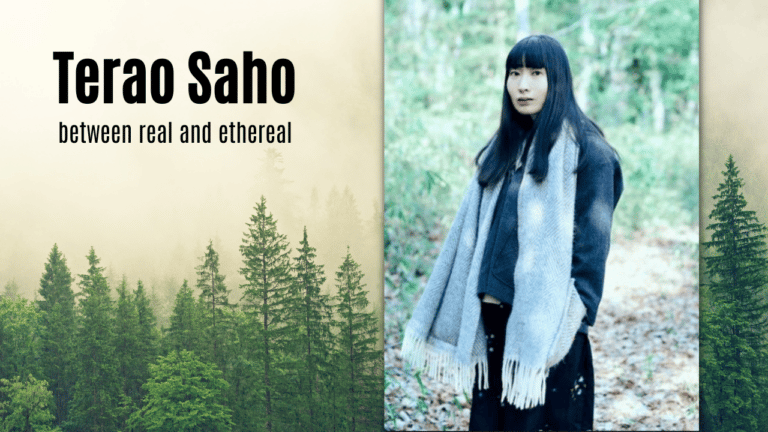
Saho Terao stands in front of forest wearing a long grey scarf and grey jacket.

The Tokyo-born Terao has always made music. “I’ve been singing my own songs since I was three years old,” Terao says. She joined the chorus and her own music club in high school, and then joined a band with classmates from a stargazing club while also researching jazz. This band became the Thousand Birdies’ Legs, where Terao sung and composed music, before playing piano for her own first solo album in 2007, “Onmi.”

Terao says major influences on her composition style include city pop legend Onuki Taeko, Disney, and classic choral music. Meanwhile, encountering Nina Simone influenced her approach to piano and vocal performance. A variety of collaborations has also led to her composing soundtracks and joining the 3-piece band Fuyuni Wakarete, which performs with more funk and jazz flair than Terao’s other efforts but still boasts the pathos of her vocal performances.

“There will always be differences of opinion with a band, so it can be tough during production,” says Terao. “There are times when I cry on the way home from recording [laughs].”

“But the result is music that I couldn’t come up with on my own. I actually prefer live performances to recordings. I’m not very good at recording, re-recording, and fiddling with something over and over again. I think the most important thing is to simply have fun, and to express that in the music.”

Essays and social exposés

Terao’s parallel writing career dates back all the way to 2008 with the publication of Yoshiko Kawashima: A Stranger in Men’s Clothing. This reported nonfiction book tells the story of the life of Kawashima Yoshiko, the Qing dynasty princess who was raised in Japan and served as a spy for the Japanese army during World War II. Six years later, Terao released her first essay collection. Since then, she has released two more essay collections plus works of reported nonfiction on workers in the nuclear power industry, the survivors of the Battle of Saipan, and life in Palau during its days as a Japanese colony.

Terao says that music is more like a home station to her, where inspiration comes in flashes. “In terms of how I come up with inspiration, musical ideas come to me passively, while I need to be active to create works of writing. I hope that my writing can serve as a gateway to understanding the past, reviving the memory of the people who lived through history,” she says.

This deep interest in history and especially the memory of World War II shines through with her books on Palau and Saipan. Ano koro no Parao o Sagashite (“searching for the Palau of that time”) revolves around the work of Nakajima Atsushi who lived in Palau during the Japanese colonial period. His story inspired Terao to go to Saipan and interview locals when she was still a student, although she had no idea it would turn into a book for her at the time.

Her nonfiction reporting of working conditions in the nuclear power industry seems, on the surface, to be a very different subject matter. But Terao’s chief concern is the same: the struggles and experiences of everyday people living through adversity, whether imperial occupation or a dangerous working environment. It was a different book, a Higuchi Kenji exposé of the industry, that inspired Terao to begin her own research. “I heard the voices of the former laborers who were suffering. I realized that the energy that people claimed to be ‘clean’ was actually stained with blood,” Terao says.

A longing for “blank space”

A concrete, humanistic concern permeates Terao’s writing. But this subject matter doesn’t clash with the emotional, instinctive approach that Terao takes with her music. In Terao’s lyrics, she often sings not about the black or the white but the gray, not about the sphere but about the ellipse, about blank space, the margins. “The root of singing is the feeling that something is lost and a longing for it,” Terao says.

Terao’s instinctive approach ends up combining with her passion for thinking about real-world problems. “There’s always a hidden feeling inside of me,” Terao says. “On a daily basis, I’m thinking about the problems of the world; war and peace, love and death. And because of some trigger, those feelings get drawn outside, and become songs. The trigger could be scenery, something someone said, or meeting someone new.”

寺尾紗穂 on X (formerly Twitter): “あらためてサントリーホール・ブルーローズ満員御礼、お越しいただきありがとうございました。管弦と音の風をおこす心地よさ。いつも一人奮闘するピアノが仲間を得て喜んでいました。 pic.twitter.com/bSuQ6utETc / X”

あらためてサントリーホール・ブルーローズ満員御礼、お越しいただきありがとうございました。管弦と音の風をおこす心地よさ。いつも一人奮闘するピアノが仲間を得て喜んでいました。 pic.twitter.com/bSuQ6utETc

Terao posting a photo of a recent performance on Twitter

Currently, Terao is working on researching local and folk history in Nagano and Kochi prefectures. She’s also focusing on a book project about Japanese World War II repatriates, including those who went on to immigrate to South America.

Terao embraces the fact that she isn’t sure where her projects are taking her. “My work is more like a record of my life, a diary,” she says. “I don’t have any enthusiasm for intentionally trying to make this type or that type of song. It’s impossible for me to come up with a predetermined concept. It’s just that the songs that I come up with need to find some kind of arrangement.”

Terao Saho’s official website can be found here.

Untranslated: Philosophy and Prose Collide in Masaya Chiba’s Playful World

Masaya Chiba, an expert on French philosopher Gilles Deleuze, has written best-selling works of philosophy and award-winning queer fiction. His writing hasn’t been translated into English yet, so we connected with one of Japan’s most notable contemporary writers to uncover his perspective on art and life.

Making philosophy fun

If Masaya Chiba’s books didn’t make philosophy fun, they wouldn’t be selling more copies than every other philosophy book on the Japanese market. His latest release, Gendai Shiso Nyuumon (“Introduction to Contemporary Thought”) “describes the essence of contemporary thought in an unprecedented way.” Derrida, Deleuze, Foucault, Lacan—Chiba breaks down the who’s-who of postmodern and post-structural philosophy. He explores deconstruction, power, exploitation, difference, psychoanalysis, and more, directly applying the concepts to everyday life in a way that’s almost astonishingly easy to understand.

フクロウ on X (formerly Twitter): “現代思想入門、自分には難しいかなぁとか思って積んでたけど、読めなくても読んでよい的なツイートみて勇気でたのと、メリーゴーランド京都の鳥羽さんトークの配信聞いて興味出て。読み始めたら面白い。みんなこんなこと理解してあの本読んでたんならわたしよりさらに数倍面白かったでしょ!と思った→ pic.twitter.com/jR41niPQXa / X”

現代思想入門、自分には難しいかなぁとか思って積んでたけど、読めなくても読んでよい的なツイートみて勇気でたのと、メリーゴーランド京都の鳥羽さんトークの配信聞いて興味出て。読み始めたら面白い。みんなこんなこと理解してあの本読んでたんならわたしよりさらに数倍面白かったでしょ!と思った→ pic.twitter.com/jR41niPQXa

“The concepts are abstract in themselves. But I connect them to human relationships, to everyday human life,” Chiba says. “I believe that ultimately, the biggest of questions are reflected in mundane, incredibly small details of everyday life. So I try to analyze the minute as much as I can.”

Chiba has written a whopping seven books in the last four years. There’s Gendai Shiso Nyuumon, two Akutagawa prize-nominated novels. He’s penned best-selling books of philosophy about Deleuze, about how to study, about meaninglessness. He’s even written an American travelogue. He regularly publishes philosophy essays in peer-reviewed journals in Japan. He even does some music on the side. It’s an impressive resume boosted by a substantial social media following to boot.

“Researchers are writers by nature,” Chiba says. “It’s not just about thinking inside your own head but making things. That’s why I’m also interested in making art and music. Not obeying the set rules is at the center of Deleuze’s philosophy. It’s about combining all sorts of things and experiencing connectivity among them. A philosophy of creativity.”

The path to Deleuze

Deadline by Masaya Chiba

Masaya Chiba grew up as an artist and became interested in contemporary art as a high school student in the mid-1990s. But a high school teacher got him interested in art criticism. This was just as Windows ’95 came out and the internet became a phenomenon in Japan. “That’s when I started to focus on writing instead,” Chiba says. “I wanted to do art criticism at first, but I realized I had to study conceptual theories and moved over to philosophy.”

In college, he studied anthropology and began researching the French structuralists and post-structuralists, with the inscrutable and near-incomprehensible Deleuze looming large. He was aware of Deleuze since high school. In fact, he had three heavy volumes of Deleuze sitting in his room since that time, waiting for him to develop the knowledge and background to break through the wisdom hiding within.

Deleuze is known for his bold attempts to rethink metaphysics and his intimidating writing style that keeps readers on their toes. “There’s no strict hierarchy in Deleuze – it goes all over the place, expanding horizontally,” Chiba explains. “For me, one of the important themes in Deleuze is that there aren’t distinctions between things in the way we typically imagine. In fact, many things are connected.”

Two notoriously difficult French philosophers

Before the internet, high culture and pop culture were vastly divided, without much of a bridge between them. So in the context of Deleuze’s philosophy, an online age seemed to offer the potential for connectivity.

But instead, as social networking increased, connectivity became too extreme. “Rather than boosting creativity, we started to feel pressure and judgment from others, effectively suppressing creativity,” Chiba says. “As I started to read Deleuze deeper, I realized he wasn’t saying that connectivity was strictly a good thing. He saw the dangers of an over-connected ‘society of control.’”

Lately, Chiba has reconnected with his intellectual roots by thinking and writing more about art. Chiba sees art as revolutionary in a society focused on efficiency, where people want to do everything they can to be productive and avoid unnecessary tasks. “Art doesn’t have a specific objective,” Chiba says. “The art is the objective in itself—a non-objective, so to speak.” 

Fiction, philosophy, what’s the difference?

Chiba didn’t write any novels until his editor suggested he give it a shot. But they quickly became a new kind of vehicle for exploring the same ideas he takes an interest in philosophically.

Just as his essays incorporate figurative language and refuse to be purely logical arguments, his writing grapple with plenty of philosophical ideas. Deadline, his debut, and Overheat, his latest, are both intense first-person, nearly stream-of-consciousness journeys amidst the philosophy, relationships, desire, queerness, and memories that emerge from the midst of changing life. The first focuses on an upcoming masters’ thesis deadline, and the second on a move from Tokyo to Osaka.

Stylistically, Chiba is influenced by Samuel Beckett and the diaries of Paul Klee, who both intrigued Chiba with the extreme simplicity of their prose. “I wanted to write simply about things that happened, plain descriptions,” says Chiba. “So I used my memories from Tokyo as a basis for the story and started to write.”

Chiba’s fiction is notable for its queer themes. His interest in sexuality is a core motivator behind his writing. As LGTBQ people have been gradually (albeit at a much slower pace than the West) accepted in Japan, Chiba says he wants to focus on complex problems, not advocate for simple “acceptance.”

開けば居心地良い空間広がる本!千葉雅也『オーバーヒート』を紹介!

千葉雅也さん『オーバーヒート』を紹介いたします。 https://amzn.to/3z0IOkh 書棚から手に取ったこの本を開けばたちまち、居心地の良いバーのような空間が広がります。 その居心地の良さの正体とはなにか? わけのわからない方向へと進みがちな社会の中で、主人公が言葉を駆使し、そして欲望に忠実なまま、楽しそうに日常を送る様子を見せてくれます。

“It’s important to recognize that there are fundamental differences in life and society being queer,” Chiba says. “The ‘normal life course’ doesn’t apply in the same way. With literature, I can express the incredible complexity of sexuality, the negative aspects of desire.” 

What’s next?

Chiba recently finished a novel to complete the loose trilogy formed by Deadline and Overheat, scheduled to come out in Japan next year. Moving forward, he plans to think about a new fiction project and advancing philosophical writing around the theme of time and temporality.

While his short story “Magic Mirror” received a French translation, his writings have yet to get English translations. “It’s very complicated so it would be difficult, but I’d love to see my book on Deleuze, Ugokisugite ha Ikenai (Don’t Move Too Much) translated into English,” Chiba says.

Masaya Chiba’s open romp between philosophy, fiction, and art offers up powerful possibilities for free and empowering ways to live life. Hopefully, we’ll see his ideas, which are already exerting a real influence in Japan, expressed in English in the coming years.

What to read next

Man of Masks: The Strange Life of Author Mishima Yukio

Comedian Yuki Nivez Talks Stand-Up in Japan; Upcoming Show

Stand-up may not be the first thing that comes to mind when considering comedy in Japan. The country has its own time-honored humorous performance stylings: The much-beloved Manzai format, where a duo with set roles interact via jokes and anecdotes; Rakugo, where a singular performer regales the audience with humorous stories from the seiza position, using a fan and a cloth as props. (Since the rakugo performer cannot rise from this position, it’s more like sit-down comedy.) In the ubiquitous owarai comedy shows seen on TV, comedians bumble about, make fun of each other, and strike funny faces and poses. However, proper “stand-up” – with a single performer on stage, often talking directly to the audience using observational humor – hasn’t been a Japanese mainstay. But, comedian Yuki Nivez would like you to know, stand-up very much does exist in Japan.

Yuki is the creator of the comedy project “Not Just a Diversity Hire,” whose goal is to provide a stand-up experience geared towards women. Yuki originally envisioned the event as a one-off performance, but positive reactions from the community have seen it grow into something more. Now, NJaDH has its biggest show yet coming up in a little more than a week’s time.

“I planned it as a one-off special event for Women’s History month,” said Yuki in a recent interview with UJ. “But to my surprise, I received an overwhelming amount of positive feedback, requests for the next one, and offers to help. Since then, the show has grown itself with the support of a lot of people.” 

Not Just a Diversity Hire

The upcoming Tokyo show, set for September 30th at the Hypermix, even goes beyond stand-up; featuring a diverse line-up of four comedians (Yuki herself, Bobby Judo, Mx Terious, and Freddy Slash’em), it will also a panel discussion featuring people in creative industries. [Tickets are available HERE!] I sat down with headliner Yuki and opening act Bobby Judo to discuss their paths to comedy, what the scene is like in Japan, and what we can look forward to with Not Just a Diversity Hire.

Hype poster for the upcoming NJaDH show – Yuki and Bobby are featured at the top.

Q: Can you tell us a bit about yourself, how you came to comedy, and how you’ve broken into the scene?

Yuki:

I was born and raised in Japan, and had little to no knowledge or interest in standup comedy.

I think during the New year’s holiday in 2019, I came across Ali Wong’s Netflix specials, and was thunderstruck. Not only was it hilarious and cracked me up for 2 hours straight, but it was also exhilarating to see a woman taking down common remarks that are said to women based on double standards like “If you sleep with a man right away you don’t respect yourself.”

That’s how I first took interest in standup comedy, but what inspired me to actually start doing it myself was Hasan Minhaj’s Homecoming King. In this special, he talks about what it was like to grow up with Asian parents as the oldest child, etc, and there were so many things that I could really relate to. I was tearing up from both laughing and being emotional, and thought that standup has that power.

Bobby:

I’m from the US, from Florida. I came to Japan as an ALT in 2006, and started working for Japanese TV in 2009; I’ve been a local TV personality in Fukuoka and Saga as my main gig for ten years now. I had always loved standup comedy, and when a British comedian named Ollie Horn started organizing bilingual comedy events in Fukuoka, he reached out to me to get me to perform in Japanese. [Editor’s note: Bobby and Olly host the popular podcast Japan By River Cruise, which UJ staff may have appeared on a time or two.] Once I had done it in Japanese, the idea of trying it in English wasn’t as scary anymore. Started by performing in English regularly in Fukuoka, and pre-Corona I would often travel around Kyushu, and to Osaka and Tokyo for gigs as well.

As part of my television work, of course, I’m always trying to be entertaining and always thinking of ways to be funny. Starting to perform standup comedy gave me a lot of new perspectives on joke writing and increased the amount of time I was dedicating to it. I found that having a bigger stock of material and more experience with what worked for an audience did benefit my TV work quite a bit; but at the same time, there are big differences between what works for an English-speaking standup crowd and what works on Japanese broadcast TV. There was a bit of a learning curve there.

In western comedy, performers tend to strongly voice personal opinions, especially about political or social topics, but Japanese TV is almost required (by the way the industry is modeled) to be as uncontroversial as possible, so even bringing up a potentially dangerous or critical topic can be inappropriate for Japanese TV. One of my favorite examples was during the Beijing Olympics, when I was asked during rehearsal what I enjoyed watching, and I said, “I enjoy watching Japanese commentators try as hard as they can to NOT say something racist about China.” Sometimes a joke like that will get a laugh in rehearsal, but it will always get a warning to not say it on air.

Q: What is the comedy scene like in Japan? How does the English-language scene compare to the Japanese-language scene?

Yuki:

As for the Japanese stand-up scene, the Japan Standup Comedy Association (日本スタンダップコメディ協会) was founded by Shimizu Hiroshi, Zenjiro, and LaSalle Ishii in 2016, and has been holding weekly open mics and standup festivals as well as showcases.

At their open mics, big-name comedians and complete first-timers share the stage, which is extremely rare in Japan. I occasionally perform at their mics, and I always have so much fun there.

Actually, I was a bit hesitant at first to join them and do standup in Japanese; I was worried that my jokes might not translate/be taken well, or that the older big-name comedians would be strict and scary. I had the preconceived notion that Japanese people are not used to the style of standup comedy, and that Japanese entertainment industry culture is very hierarchical.

Despite my concerns, my jokes have been received very well, and the big-name comedians have been very friendly and welcoming.

Since the concept of standup comedy is still relatively new in Japan, the hosts always make sure to explain all the differences between mainstream Japanese comedy, and also announce that no punching-down jokes (racist/sexist/lookism, etc) are allowed at their mics.

Bobby:

Being based in rural Kyushu, I’m not super knowledgeable about the history of the scene in Tokyo, but there has been a western community in Japan for more than 20 or 25 years?

[Bobby then proceeded to give a detailed account of the English scene’s genisis.]

There’s a comedian named Dave Gutteridge who ran shows for years and years, on and off, and I think the events that he was doing provided inspiration for people who wanted to see a more regular (and a more profitable) Tokyo scene. There’s also been a really consistent Improv comedy scene, with Pirates of Tokyo Bay, and Pirates of the Dotombori in Osaka. In the handful of years prior to Corona, with the Inbound Japan boom, we started to see lots of different groups making the most of not only incoming audiences, but also big-name western comics who were traveling to Japan. The group ROR in Osaka did weekly shows that were ranked the top Osaka attraction on Trip Advisor, and at one point, there were at least one or two different venues doing live comedy in Tokyo almost every night of the week.

Stand-up Tokyo produced regular professional shows and open Mic Nights. JJ Wakrat, who was a comedy organizer in Shanghai, moved over and brought in relationships with international shows like Roast Battle and Your Hood’s a Joke, founding Tokyo’s own Roast Battle chapter. Japanese performers, like YouTuber Meshida started organizing their own English comedy nights. The scene got so vibrant that, even post (mid?) Corona, Stand-up Tokyo showrunner BJ Fox (of NHK World fame), and others were finally able to open Japan’s first dedicated stand-up comedy venue, Tokyo Comedy Bar, where they’re successfully hosting regular English and Japanese language stand-up events.

Yuki Nivez performs at a previous Not Just a Diversity Hire show.

As for what sets stand-up apart…

Bobby:

The Japanese comedy scene is, of course, dominated by Japanese culture and Japanese groups, with most Japanese comedy theaters controlled by a major comedy talent agency, and the prominent style of comedy is Manzai. There are lots of Japanese comedians performing all kinds of comedy, including more controversial, political, or personal material, but currently, financial success as a comedian in Japan is still dependent on being as broadly appealing to the TV market and to sponsors as possible. So, mainstream comedy in Japan (the comedy that reaches most TV-watching residents) tends to be lowest-common-denominator, very easy-to-understand stuff.

Unfortunately, that tends to include a lot of slapstick, a lot of fat-shaming, and a lot of punching down based on being conventionally unattractive or stupid. There also isn’t really much meaningful dialogue in Japanese media about diversity, equity, and inclusion, so that’s why it’s still not rare to see Japanese comedy that relies on stereotypes of minorities, misogyny, sexual harassment, and bullying. In my experience, even very famous Japanese comedians tend to be funnier and perform more targeted, smarter, and riskier material at live venues, because the audience is smaller and it limits their liability.

Fuji Television HQ stands above the waters of Tokyo Bay; it's a boxy silver building with a strange ball-shaped feature at the top.
Fuji TV headquarters in Odaiba, where a good deal of Japan’s variety comedy shows is filmed.

Q: Speaking of, what do you think is important in comedy in terms of messaging? Do you think comedy has a special power when it comes to social movements, etc.?

Yuki:

The number one rule in comedy is that it has to be funny. And for me personally, I also like to be authentic, so I actually mean most of the things I say during my sets. I don’t say things that might pander to toxic stereotypes of women. While self-deprecating humor can be a good way to cope, and even healing sometimes, personally I do not do self-deprecating jokes that might send the wrong message to someone like me. 

Finding the balance between messaging and being funny is challenging. When I can create something that achieves both and the audience loves it, it’s the best feeling.

I also often find myself struggling with the dilemma of making jokes about issues that women actually face in today’s society.

For example, I have jokes about receiving unwanted messages/remarks, which actually often happens to me, or about deep-fake porn, which is a real threat that affects many women today, including myself.

I usually tackle these issues and fears by turning them into something that instead empowers me. But also, I sometimes question myself, “Am I trivializing the real issues that women face/are victimized by in real life?”

Finding that balance between going reclaiming power from these topics vs. trivializing real issues is something that I will keep struggling with as long as I keep doing comedy, I think.

At a grassroots level, I think comedy definitely has the power to influence people. For example, starting NJaDH has connected me with so many people who share the same struggles/values. Collective laughter can definitely bring people together. 

Bobby:

I really like the idea of comedy as a voice that speaks truth to power and that can be a force for social movements. But, honestly, in the current global climate, I don’t see that being the case. I kind of feel like comedians today (especially the almost entirely political comedy of late-night shows, etc.) are the band on the Titanic. We can play all we want, but the ship is still going down.

I worry that, too often, people targeting a social issue with comedy, or attacking injustice with comedy, is replacing more effective forms of activism. If you joked about it, and you all made fun of it, maybe you feel like you’ve dealt with a problem; in reality, you haven’t dealt with it, you’ve just turned it into entertainment.

At the same time, I think comedy is a very effective tool for dealing with personal anxiety and trauma. It helps you control the lens through which you view the things that scare you or harm you. It gives the comedian agency and, in the best cases, it can be cathartic for the audience as well. For me, I think that the best comedy comes from a place of personal truth, it exists in a space that has real stakes in terms of what it’s saying about the world, and if comedy is going to be used to attack, it should be attacking the flaws in the power structures in society, and not the people who suffer under those power structures.

I don’t know if my own comedy accomplishes any of that, but I definitely use it as a way to deal with my anxiety about the state of the world, and to work through how I feel about raising a family between the US and Japan, especially in the midst of all this environmental, economic, and social turmoil.

Q: Tell me a bit more about Not a Diversity Hire. What you’re excited about for the show on the 30th  – and what should our readers look out for?

Yuki:

This show is first and foremost a safe space for women, but also, there’s no punching-down jokes at NJaDH. So, no homophobic jokes, transphobic jokes, racist jokes, etc, even in an “I’m doing it ironically” way. 

There is a big difference between punching-up and punching-down, and just because this show doesn’t allow punching-down jokes, it doesn’t mean it’s a “clean” or “wholesome” comedy.

Especially, me personally, I go hard on making fun of assholes.

The show on the 30th is a special edition, where we also have a short panel talk session with guest panelists: Film director Lilou Augier, and Samantha Lassaux, host of the Femin Tokyo Podcast, sharing their experiences in the creative field.

Bobby:

One of the great things about comedy is that there are so many themes to work with and so many audiences to cater to. You can have a Dirty Jokes show, you can have a Maternity show, you can have a Christian show, you can have an LGBTQ+ show; there are shows built for Black audiences, asian audiences, ESOL audiences, anything. Not Just a Diversity Hire is a show that was built to cater, first and foremost, to women. 


Yuki started it because, at the time, there were no other shows in Tokyo that were catering to that specific niche, and she was noticing that many of her female friends and fans felt like the broader shows, which were supposed to be “for everyone” could actually feel like they were “for men” at the best and misogynistic at the worst. It’s not like there are any comedy venues in Tokyo that are actively anti-women, but comedy showrunners aren’t (and shouldn’t be) responsible for the individual jokes performed by each comedian, so you never know what you’re going to hear.

I can absolutely understand the feelings of a woman who does NOT want her night out at a fun comedy show to include having to sit through a male comedian’s ill-advised bit about train gropers, or pedophilia, or worse.
I’ve also seen how sometimes my own comedy can be grounded in things that are widely accepted as social norms and hinged on things like ageism, sexism, lookism… attitudes that affect women much more severely during daily life, and I get how someone wouldn’t enjoy being confronted with those same attitudes, ones that carry real consequences and cause real harm to them, in a way that makes light of them, normalizes them, or espouses them.

I’m excited for the show on the 30th because it’s the first time I’ll get to be a part of a show that has ALWAYS been a rampant success. The audience always loves it, the comedians always feel great about it, and it creates one more option for audience representation in an already vibrant comedy scene, making the community as a whole more inclusive. 


I’ll be doing a longer set about the real questions that I wrestle with as a parent of mixed-race daughters, as I watch my home country and my adopted country both fail miserably at women’s rights. That sounds hilarious, right?
The show is open for anyone to attend, but we especially hope to reach women who don’t yet know that there’s a space where they can enjoy comedy that’s performed with their enjoyment in mind.

All That’s Left is to Laugh

So, there you have it – English-language, woman-oriented stand-up flourishing amidst the comedic ecosystem of Japan. If that sounds appealing, and you’re in Tokyo, consider joining in on the 30th. I’ll be there for what will actually be my first-ever stand-up experience in Japan. See you there – and watch out for Yuki Nivez’s comedy career as it continues to develop!

Tickets for Not Just a Diversity Hire: Special Edition are available HERE.

What to Read Next:

‘Bullet Train’ is Fantasyland-Japan Action Pulp