
Shikoku: Japan’s Most Overlooked Main Island for Travelers?

Japan has four main islands: Hokkaido, Honshu, Shikoku, and Kyushu. Tourists flock to three of them. Shikoku, the smallest, remains stubbornly off the radar – and that’s exactly what makes it worth the trip.

Nowadays, overtourism plagues many parts of Japan. Meanwhile, Shikoku is loaded with fascinating landscapes and unique quirks that most foreigners simply haven’t discovered yet. Don’t let the fact that it only has four prefectures deter you: each one packs a lot of punch.

Why Shikoku gets skipped

Exactly why do travelers overlook Shikoku? The main reason is likely a practical one: getting around can be a daunting task. International flights are limited and English-language translations are few and far between.

Especially when compared with Kansai to the northeast and Kyushu to the southwest, transit times might not seem worth it.

However, with proper planning, it’s easier to overcome these obstacles than one might think. Plus, once you see the kind of hidden gems that await, a little inconvenience doesn’t seem like so much of a hassle anymore.

Steep in a 3,000-year-old hot spring at Dōgo Onsen
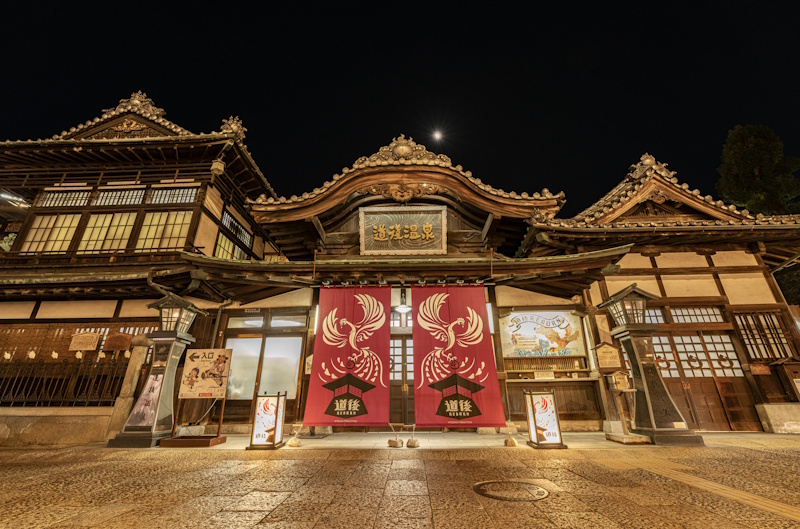
Night view of the Dogo Onsen main bathhouse in Matsuyama, a wooden structure with red phoenix-patterned curtains at the entrance.

We’ve mentioned this one before on the top ten winter onsen, and it’s one you don’t want to miss. Dōgo Onsen lays claim as one of Japan’s oldest hot springs, its origins reaching back some 3,000 years.

To this day, the ornate wooden bathhouse, recently renovated, continues to welcome guests with elegant simplicity and steaming mineral water said to heal fatigue.

Not only that, but fans of Studio Ghibli may recognize echoes of this onsen’s architecture. Director Miyazaki Hayao got inspiration for the fantastical bathhouse in Spirited Away from Dōgo Onsen.

Address: 19-22 Dōgo Yuno Machi, Matsuyama City, Ehime 790-0842

See the pristine waters of the Shimanto River
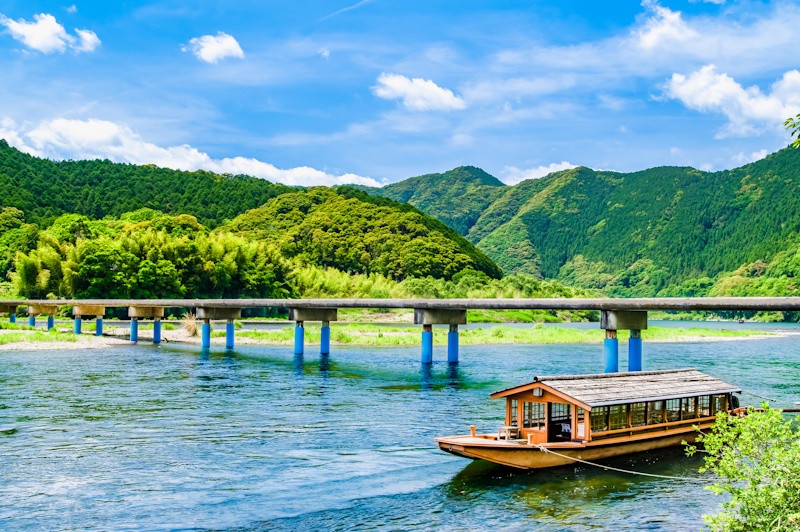
Shimanto River, Kochi Prefecture
Picture: denkei / PIXTA(ピクスタ)

Over in Kochi Prefecture in western Shikoku, some call the Shimanto River “Japan’s last clear stream,” a title earned through decades of protection and crystalline water. Starting from mountain headwaters, it winds its way through fields and countryside until it reaches the ocean.

Visitors love to come in spring and summer to get the most out of enjoying the water: fishing, swimming, canoeing, or taking a boat tour. Cycling along the banks is another great way to experience the scenery.

Fishermen cast lines from low, bridgeless causeways, and in summer, locals chat over the sound of cicadas. This is Japan at its most grounded and calm, far removed from the hectic streets of Tokyo.

Ancient vine bridges and ancient pilgrimage paths
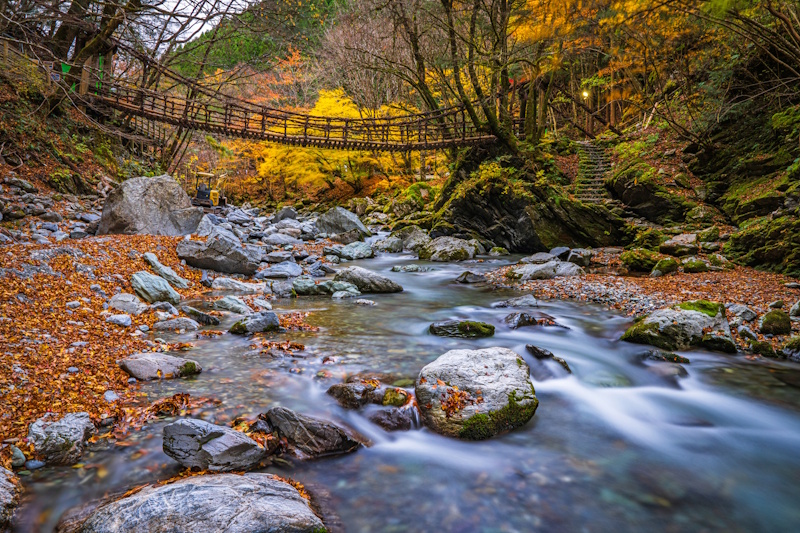
Autumn view of a traditional vine bridge in Iya Valley, Tokushima, spanning a clear mountain stream.
Picture: Hiroshi-N / PIXTA(ピクスタ)

Deep in Tokushima Prefecture lies Iya Valley. The landscape feels cut straight from a storybook: vine bridges swaying over rocky gorges, traditional Japanese houses perched along riverbanks, and an atmosphere of true remoteness that modern Japan rarely allows.

Also, for no reason, a statue of a naked child peeing off a ledge. Who says the Japanese don’t have a sense of humor?

Tokushima Prefecture is also the starting point of the Shikoku 88-Temple Pilgrimage. Like Iya Valley, it’s a journey that can feel like a walk through time. Those who embark on this pilgrimage visit 88 different temples rimming Shikoku Island, engaging in a unique, spiritual adventure following Kobo Daishi’s footsteps.

Kagawa Prefecture: from udon noodles to art museums

Screenshot of the Udon Taxi website in Kagawa Prefecture, showing a cartoon driver greeting two customers by a taxi.
Picture: Udon Taxi website

Kagawa Prefecture has a lot going on, and I’d be remiss in not telling you that here, noodles are a way of life. Its specialty is sanuki udon (讃岐うどん), and it’s so beloved that some undertake an udon pilgrimage.

For these pilgrimages, many hop between the hundreds of tiny shops serving hand-kneaded noodles for under 300 yen (2 USD) a bowl. Some visitors even book a ride with the Udon Taxi, whose drivers whisk pilgrims from one humble storefront to the next, charting a map that’s part cuisine, part culture.

Meanwhile, on the outskirts of Kagawa, an island called Naoshima holds a treasure trove of art museums and architectural wonders. Tadao Ando, famous for his minimalist architecture blending Japanese and Western styles, designed several museums on the island, including Chichu Art Museum and Benesse House.

That’s not all, of course. Naoshima holds over a dozen art museums and galleries, many featuring avant-garde, contemporary works, or set outside in the open air. This evolving art archipelago connects beautifully to Shikoku’s broader theme: a balance of tradition, isolation, and innovation.

Getting to Shikoku and getting around

For those coming from overseas, you’ll need to arrange a connection, but that’s much easier than you might think. Shikoku has four main airports, the main one in Ehime Prefecture.

Ferries also connect it to Honshu and Kyushu, as does the Seto Ohashi Bridge stretching from Okayama Prefecture to Kagawa and the Second Kurushima-Kaikyo Bridge in Ehime.Tokyo dwellers can take the Tōkaidō Shinkansen to Okayama and hop a bus over the bridge. Just be warned – that journey can take up to seven hours. (Flights from Tokyo are only 90 minutes.)

Shikoku’s small size means that regular train service provides more than enough convenience in traveling between the island’s main cities. For remote and rural locations, consider taking a bus, renting a car, or even renting a bike.

Whatever Shikoku lacks in quick convenience, it more than makes up for in the quiet escape it offers, one that’s hard (though not impossible) to find in the city.

Need help fitting a trip to Shikoku into your stay in Japan? Let Unseen Japan Tours create a custom itinerary for you based on your interests.
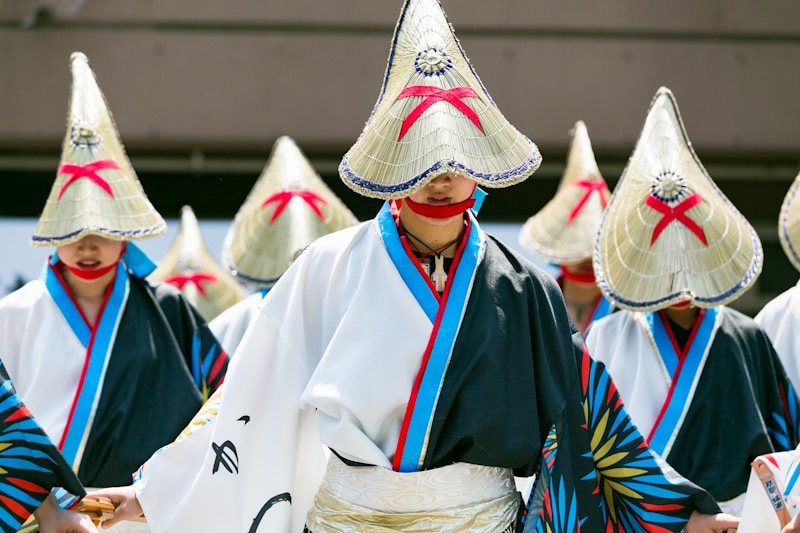
Yosakoi Festivals: The Global Phenomenon of a Local Dance

It’s prime summer. That means that Japan’s city centers, streets, and shrines come alive with the song, dance, parades, and food stalls of festival season. Most festivals are hyper-local to the history, culture, mythology, and religion of their respective towns. However, one festival has expanded to cross borders, not just within Japan’s prefectures but across the globe: Yosakoi.

2019よさこい祭り金賞受賞チーム!濱長花神楽

2019よさこい祭り後夜祭 帯屋町筋会場にて撮影。 #よさこい鳴子踊り #よさこい祭り#よさこい2019 #濱長 #祭り #高知 #高知市

While the Yosakoi dance festival has hyper-local origins in Kochi City, it’s become a global phenomenon. The dances are now held in Osaka and Sapporo, New York, Paris, and Sao Paulo. Kochi’s main festival features Yosakoi dance teams coming from 34 different countries and regions.

Unlike the specific sets for most festival dances, dancers create their own choreography in massive, fiercely competitive contests held every year. Yosakoi uniquely centers creativity and freedom, which has led to all sorts of unusual and fun variations. Read on to discover the most transcultural festival in Japan and its epic dance teams that have captured viral attention.

Yosakoi’s history and origins

Yosakoi does not have the deep historical, religious, or cultural roots of most other Japanese festivals. Instead, Kochi City, the prefectural capital located on the southern coast of Japan’s island of Shikoku, established the festival in 1954.

The city founded the festival to pray for citizens’ prosperity and revitalize the city post-war by promoting economic activity in the downtown shopping areas.

Similar dance styles did exist previously. The legendary Awa Odori dance festival in nearby Tokushima is often cited as inspiration. But Yosakoi adapted an approach unprecedented for Japanese festivals: encouraging freedom.

Tokushima Awa Odori 2022 | Japan’s Biggest Dance Festival | #awaodori | #shikoku | #japantravel

hi guys , On this vlog i will be showing you the famous and largest festival held across japan during the Obon season in mid August. You will see group of dancers with colorful clothes . Women wear cotton robes called yukata, while men wear happi (shorter yukata over shorts or pants).

The festival has six core components. Firstly, the use of naruko, or colorful hand clappers. Secondly, the traditional song can be adapted into style or genre from traditional to pop, rock, funk, and samba so long as the song includes the phrase “Yosakoi naruko odori!”. Likewise, choreographers can choose their own inventive styles for their team. The sole requirement? You just need to shake the naruko.

After that, there are costumes (again, of nearly any kind) and a decorated jikatasha vehicle that fronts the parade of dancers and blasts the music. Lastly, judges to award medals to the best dance teams of the festival evening.

The result is essentially a super-sized dance contest, with teams of dozens and dozens of local participants coming up with their own highly elaborate choreographies.

十人十彩 追手筋 第64回よさこい祭り よさこい大賞

十人十彩 2017 追手筋 地方車  本部審査での演舞 よさこい大賞 おめでとう! 地方車から観て笠が凄く綺麗でしたよ!

The first year of the festival, there were 21 teams and 750 dancers. By the 60th festival in 2013, there were 211 teams and 20,000 dancers at the main event in Kochi alone. In 2017, international delegations from around the world came to participate in the Kochi festival for the first time.

Japan’s Yosakoi festivals

The dance festival has since expanded to become a worldwide phenomenon. But the biggest event is still located at its origin, Kochi.

Held over four days from August 9th to 12th, sixteen different venues host over 200 teams. The top teams perform at the Otetsuji Kyoenjo hall. Many are long-established groups that have been performing for decades – and some are even famous around Japan.

To catch the performances there, visitors need to get their hands on paid tickets far in advance. However, yosakoi teams also dance around the city, so visitors can see the dance even for free. 

There have been Yosakoi festivals held in over 200 locations around Japan. But the first major festival to migrate outside of Kochi was Soran Matsuri in Sapporo. Yosakoi Soran, founded in 1992 by 1,000 participants, stars the simple tagline “The streets are our stage!” Due to its location in the popular Hokkaido summer destination, Soran hosts an astounding 30,000 dancers and two million visitors across 15 sites and stages in early June.

The other major Yosakoi festivals in Japan include Nippon Domanakka Matsuri in Nagoya (held in late August, ~23,000 performers), Harajuku Omotesando Genki Matsuri Super Yosakoi in Tokyo (late August, ~5,000 performers), and Koiya Matsuri in Osaka (early September, ~5,000 performers).

Epic performances

The Kochi, Sapporo, and Nagoya festivals in particular feature a truly epic scale. And the level of skill, coordination, and preparation in the top teams’ performances regularly capture viral attention.

This super high-energy and hip-hop-infused performance by the Chiba prefecture-based Yosakoi team REDA Maikagura recently made a run to the finals at 2023’s Soran festival:

[4K] REDA舞神楽 【YOSAKOIソーラン大賞披露演舞】YOSAKOIソーラン祭り 2023 日曜日 ファイナル

第32回 YOSAKOIソーラン祭り 2023年6月11日(日) 大通公園西8丁目メイン会場 #YOSAKOIソーラン祭り #YOSAKOIソーラン #YOSAKOI #よさこい #札幌 #北海道

Another great example is the grand champion-winning performance at the 2017 Nagoya festival. It features storytelling elements and sparklingly colorful costume changes:

But the full extent of Yosakoi’s potential for creativity is even greater. This fierce railway and martial arts-themed performance by Japan Railways Kyushu’s delegation at the Ryoma Yosakoi festival in Kyoto is a perfect example:

Yosakoi around the world

While it took over a half-century for Yosakoi to expand throughout Japan, it didn’t take long after for the dance festival to expand abroad. Japanese living around the world and fans of Japanese culture and festivals have taken up Yosakoi in most of the world’s major, diverse cities. Kochi’s main Yosakoi festival even runs an ambassador program to bring foreign Yosakoi teams to Japan for exchange and dance.

Vietnam has at least four Yosakoi teams. New York City has two teams alone: Kogyoku Yosakoi and 10tecomai, performing at nationwide Japanese festivals and NYC dance festivals. As does Sau Paulo, home to a large Nikkei population: Ryo Kochi Yosakoi, an official Yosakoi ambassador, and Ishin Yosakoi Soran, founded in 2002 as one of the first international Yosakoi groups. Paris’s team Hinodemai is another one of the international delegations that joined the festival in Kochi.

Even this grainy 2008 footage of the Ghanaian Yosakoi is a joy of cultural fusion to behold:

ghanaian dance yosakoi accra

ghanaian dance yosakoi accra

Enthusiasts can also find teams in Melbourne and Toronto, as well as universities like UC Berkeley, Kansas State University, and Leiden University. Some of the world’s major yosakoi festivals happen outside of Japan, in Accra, Penang, and Hanoi.

An international team has yet to take the main prize at any of Japan’s biggest competitions. It’s not surprising, given the famous, long-established teams that pose a high hurdle for any new competition. After all, some Yosakoi teams have full-on advertising, marketing, and pop-star-level production and music videos:

2022 ほにやよさこい(HONIYA YOSAKOI)

2022よさこい鳴子踊り特別演舞 よさこい祭りから3年。 高知で踊れる喜び。 よさこいがある高知が好きなんです。 2日間、ありがとうございました。 #おかえりよさこい #ほにや #よさこい #高知 #honiya #yosakoi #kochi

The way Yosakoi has expanded beyond Kochi is one-of-a-kind. And it’s all because of the freedom and creativity of expression that the dance has promoted and engendered around Japan and the world.