
The Meiji Government’s Failed Attempt to Ban Cremation

Following the tumultuous 1868 Meiji Restoration, the new government was dead-set on doing away with practices and institutions deemed uncivilized. They introduced new tax laws, a conscription army, and began emphasizing nativist teachings over Buddhism. There was no room for anything considered barbaric, not even in death.

While full-body burials were the norm, cremation was becoming more popular, much to the annoyance of Japanese Confucians and nativists in the government. In a bid to embrace modernity and advance the nation, in July 1873, the government made an unprecedented first: banning cremation nationwide.

A Brief Overview of Cremation in Japan

Cremation isn’t a new phenomenon in Japan; there’s strong evidence suggesting cremation was performed to some extent beginning in the Jomon period. The 700 AD cremation of Buddhist priest Dosho, followed by Empress Jito’s cremation in 703 AD, legitimized cremation among the aristocracy. Cremation spread to the common people in the Kamakura period when it became more closely associated with Buddhism.

Empress Jito, first cremated Japanese imperial.
Empress Jito’s cremation was the first in a long line of imperial cremations. (Source: Wikipedia)

While Buddhist doctrine didn’t mandate cremation as the sole means of burial, cremation became inseparable from Buddhism due in part to the temple-parishioner or danka system. The Tokugawa regime required all households to be registered with a temple, and many temples relied heavily on income from funerary rites to stay in operation.

The close association between Buddhism and cremation would prove detrimental after the Meiji Restoration. The metropolitan triumvirate of Tokyo, Kyoto, and Osaka began contending with shrinking land and crowded temple cemeteries as populations increased. Cremation and the resulting compact, easily transportable remains quickly became more appealing to residents.

People also held fast to the prevailing folk belief that burning the dead eradicated pollution, or kegare (汚れ). Yet it would be concern over the supposed pollution of cremation that prompted the government to take steps to outlaw it.

Out With the Old, In With the New

Small-scale attempts to ban cremation weren’t uncommon in the Edo period.

The administrator of the Tosa domain managed to “soft-ban” the practice by mandating the cremation of all convicted criminals, thereby discouraging families from giving their dead loved ones a dishonorable burial. The Aizu, Mito, and Choshu domains also implemented bans, but how strictly these were enforced is unclear.

Anti-cremation — and by default anti-Buddhist — activists saw their chance to ban cremation once and for all after the Restoration. The loudest detractors were Japanese Confucians. They shared a stance with 17th-century Chinese Confucians, who considered cremation a grave form of disrespect to the dead and a threat to the filial order bolstering society.

On the other hand, Buddhists believed consigning the dead to the flames was the highest act of respect, the ultimate representation of impermanence.

Adding Fuel to the Flames

Japanese Confucians may have been a vocal minority. But what really propelled the government to ban cremation was a proposal from the Tokyo police. In May 1873, they suggested relocating crematoriums, notably the Senju temple ones, outside the city’s “red line” (shubiki, 朱引). They claimed the “severe stench [from burning bodies] injures people’s health.”

No mention was made of outright banning cremation. However, in a desperate bid for modernity, the Council of State decided to take it a step further and outlaw cremation.

The government hinged its reasoning on two main points. First, burning the dead was disrespectful and unfilial. Second, the smoke from burning corpses posed a threat to public health. No exceptions would be allowed, not even for those who died far from home. Never before had the government enacted such a stringent policy on death rites.
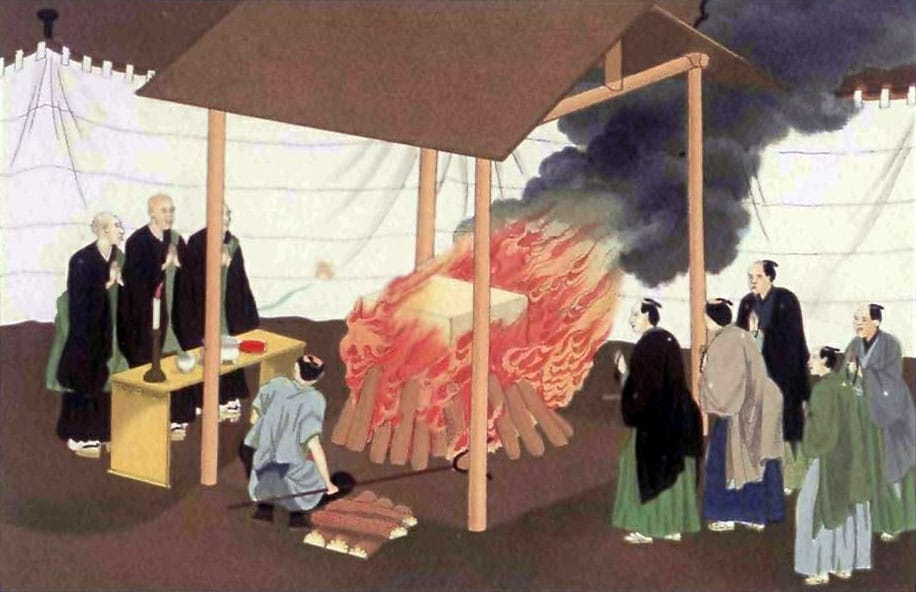
A print portrays late Edo-era Japanese cremations rituals.
The roofs of hiya (“fire huts”) were more to keep out the rain than contain smoke, an issue which the Senju temples would remedy in the 1870s. (Source: Wikipedia)

Battling the Ban

Opposition to the ban was instantaneous. People from all over sent letters and memorials to leading newspapers arguing against the ban. The government didn’t explicitly condemn Buddhism in its decree, so pro-cremation activists avoided promoting cremation in association with Buddhism. Instead, they constructed their arguments on cremation’s other positive benefits, mainly its space-saving attributes.

Cremation was also less costly and allowed families to maintain graves close to home. This ensured strong ties between the living and the dead.

Some cremation advocates, like Buddhist activist Ouichi Seiran, predicted fields reserved for burial would reach capacity in a few years. Ouchi also argued that the government overstepped itself in asserting a one-size-fits-all policy:

“…it is insupportable to say that districts practicing cremation do not produce any good, filial people and that households practicing burial do not produce wicked, immoral children. Therefore, we should not argue about the reasonableness, the feeling, and finally, the right and wrong, of cremation versus earth burial… This is a matter already within the hearts of the people, and the government should not interfere.”

Quoted in Andrew Bernstein. “Fire and Earth: The Forging of Modern Cremation in Meiji Japan” p.311

The Class Divide Widens Further

Unsurprisingly, the ban more adversely affected the poor than the affluent. After announcing the ban, the government ordered major cities to set aside land for full-body burial, and even reclaim temple property if necessary.

Kyoto was more than happy to comply — authorities had petitioned to ban cremation in 1869 to no effect. It was a different story in Osaka and Tokyo. The gentry quickly snatched up available land plots, and despite price control measures, plots were still exorbitantly priced far above what a poor family could afford. Things were so out of hand that in 1874, the governor of Hyogo prefecture, Kanda Takahira, penned a strongly worded letter to the Council of State demanding it lift the ban, citing public resentment over unavailable land.
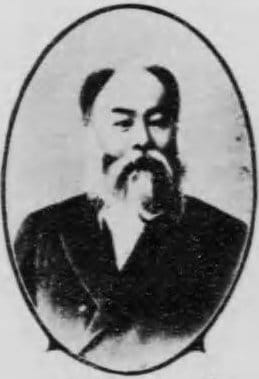
Kanda Takahira, governor of Hyogo, who opposed the cremation ban upon seeing the issues it was causing in his prefecture.
As a government official, governor Kanda Takahira delivered one of the biggest blows to the cremation ban. (Source: Wikipedia)

An Angered Public

In rural areas, some mourners openly defied the ban, but crackdowns in urban areas were common, generating more ill-will towards the government. This resentment only increased when Tokyo banned any type of burial within the red line, forcing families to abandon ancestral graves they’d tended for generations. Temple priests and crematory workers, or onbo (隠亡) witnessed first-hand the anguish bereaved families faced. The onbo of Tokyo’s Senju temple wrote about the difficult logistics of performing full-body burials:

“… the gravestones of different households are lined up right next to each other, so when you try to bury a body, you have to dig up not only the gravestone of the mourning family but also those of neighboring plots….”

Quoted in Andrew Bernstein. Modern Passings: Death Rites, Politics, and Social Change in Imperial Japan, p. 75

Tokunaga Kanmyo, a priest in Yotsuya, wrote how he had to field questions from distraught parishioners on a daily basis. He echoed what other like-minded thinkers said before: lift the ban.

A Real Modernization Takes Place

It didn’t take long for the anti-cremation movement, never large to begin with, to lose steam in the face of a growing bitter populace. In May 1875, the government bowed to public pressure and repealed the ban. Cremation advocates and citizens alike rejoiced; some families who’d unwillingly buried their dead exhumed and cremated them.

Crematory Workers Step Up

As unpopular as the ban was, it revealed serious infrastructural problems requiring immediate solutions. Smoke remained an issue for many health-conscious citizens. Not long after the ban ended, the Senju onbo submitted blueprints for a more modern crematorium, including smokestacks, separate structures for different types of cremation, and a thorough sanitary protocol. Sects in Kyoto dug deep into their coffers and constructed two “Western-style” brick crematoriums that soon became a tourist attraction. These crematoriums were so impressive that in 1884 the British government requested the blueprints to aid in the construction of London’s first crematorium. Open-air cremations still remained popular in rural areas, but over the years more modern crematoriums slowly spread throughout the nation.

Japanese mourners gather at a modern crematorium in the early 20th century.
Mourners attend a funeral in a modern crematorium (Source: Image from Andrew Bernstein’s “Modern Passings”)

Ban Begone

The government wasn’t quite done controlling how people handled their dead, though it certainly learned not to overstep again. In 1897, the government decreed mandatory cremation of people who died from infectious diseases. Ironically enough, the government touted the power of fire as a destroyer of pollution and disease. Cremation also became so secular that in the 1880s some Buddhists felt it necessary to remind the public of cremation’s ties with Buddhism.

Today, Japan boasts one of the highest cremation rates in the world at 99.9% in 2018. Death rites have become even more streamlined. So, while the failed Meiji era cremation ban barely lasted two years, it unexpectedly provided the springboard for a true modernization of Japan’s crematorium infrastructure that is still in place today.

Sources

Bernstein, Andrew. “Fire and Earth: The Forging of Modern Cremation in Meiji Japan.” Japanese Journal of Religious Studies, vol. 27, no. 3/4, 2000, pp. 297-334.

Bernstein, Andrew. Modern Passings: Death Rites, Politics, and Social Change in Imperial Japan. University of Hawai’i Press, 2006.

Fujii, Masao. “Maintenance and Change in Japanese Traditional Funerals and Death-Related Behavior.” Japanese Journal of Religious Studies, vol. 10, no. 1, 1983, pp. 39-64.

Hiatt, Anna. “The History of Cremation in Japan.” JSTOR, 9 September 2015, https://daily.jstor.org/history-japan-cremation/.

Video: The Explosion of Mt. Bandai

The Explosion of Fukushima’s Mt Bandai

The year was 1888. On a pleasant summer day in Japan, the early-morning tranquility of rural Fukushima Prefecture was suddenly interrupted by an earth-shattering explosion. Mt. Bandai, “the Mount Fuji of the North” had erupted so fiercely that it remade the local landscape.

In 1888, “the Mount Fuji of the North” erupted so fiercely that it remade the local landscape. The incredible story of how Meiji Japan suffered – and recovered – from the worst volcanic disaster in modern Japanese history.

Please enjoy the latest video from Unseen Japan’s YouTube channel, written and narrated by Noah Oskow. If you enjoy this, make sure to subscribe to our YouTube channel to get all of our latest video content!

You can also read the text version of Noah’s original article here:

Cataclysm: The 1888 Eruption of Fukushima’s Mount Bandai

Why Not? How Japan Danced Away Its Samurai Past

Anybody who knows anything about Japanese history is aware of the chaos in the years leading up to the Meiji Restoration. Commodore Perry’s arrival in 1853 hastened the end of Japan’s isolationist policy and wreaked havoc on Japan’s government and culture. The Tokugawa shogunate, or bakufu (幕府), were scrambling to retain control while foreign and civil bombardments racked the country. Yet amid all the political maneuvering for power, in the final years of the Shogunate, a different type of movement sprang up among the populace that is now commonly known as ええじゃないか (ee ja nai ka).

No, we’re not talking about the popular Fuji-Q roller coaster, but something with as many twists and turns.

There have been a couple of instances in history of mass dance manias overwhelming a city or village. The Dancing Plague of 1518 in Europe is probably the most well-known, involving villagers, mostly female, dancing for days on end, seemingly without cause, with some eventually dying from exertion and heart failure.

https://owlcation.com/humanities/dancing-plague-of-1518

While the ee ja nai ka dance craze didn’t lead to any grisly deaths (as far as we know), a sense of desperation did tinge the atmosphere as the participants partied, danced, cross-dressed, and even undressed.

Before we dive too deep into the ee ja nai ka phenomenon, we must first understand what was happening at the time in Japan that gave rise to such a massive outburst of civilian ribaldry and emotion.

Painted depiction of ee ja nai ka dancing
A painting by popular caricaturist Kawanabe Kyosai depicting an ee ja nai ka party scene. Even rabbits and snakes are joining in on the celebrations. Notice the party-goer dressed as a lion, eerily reminiscent of a modern-day kigurumi (costumed character). (Source: Wikipedia)

The Historical Context of Japan’s Dance Craze Movement

The transitioning years between the Tokugawa era and the Meiji era, known as the bakumatsu (幕末), paid witness to a turbulent time, with shifts in politics and society that left no one unaffected. Civilian riots had been breaking out across the country in response to the high taxes, political corruption, and the increasing presence of gaijin (外人), or foreigners, entering the country and disrupting the domestic markets:

天明以来の饑饉が相次ぎ、開国の結果として国内の伝統的な産業は大打撃をうけ、米価を中心とする物価の上昇で、民衆の生活は極度に苦しくなっていました。

The famines since the Tenmei era (roughly 1781-1789) continued one after another, and as a result of the opening of the country [to foreign trade], the domestic traditional industry suffered a heavy blow. Rising costs, especially the price of rice, played a central role, resulting in extreme difficulties in the civilians’ lives.

People were tired of airing their grievances to an uncaring shogunate, and receiving little to no assistance. For a while, everything seemed hopeless.

So when hundreds of Shinto shrine amulets known as ofuda (御札) rained down from the sky one day in Japan’s capital of Edo, people reacted in an unprecedented manner.

Japanese ofuda (御札)
A typical ofuda issued from a Shinto shrine. I think anybody seeing hundreds of these raining from the sky would cause a ruckus. (Source: Wikipedia)

Where did the ofuda come from? Most of them were rumored to be ofuda from the Ise Shrine, Japan’s premier Shinto shrine dedicated to the sun goddess Amaterasu. Naturally, many people believed they really were blessings from the gods, or kami (神). Others believe that a large number of merchants were behind some of the ofuda rainfalls, as some ofuda were blatant advertisements for local businesses.

(JP) Link: The Theory That “Ee Ja Nai Ka” Was a Campaign Strategy By the Bunka School!? (Note – link no longer active)

Whoever cooked up the idea to create this benevolent rainfall, it was soon copied in multiple areas of Japan:

騒動の分布は江戸から北には及んでいません。江戸から東海道を通り、名古屋、京都、大坂、広島あたりがその中心です。

The ee ja nai ka disturbances did not migrate north from Edo. From Edo, the movement spread through the Tokaido to Nagoya, Kyoto, Osaka, and Hiroshima.

The Tokaido was one of the most traveled roads in the Edo period, with its various stations and sceneries famously depicted in the work of renowned woodblock artist Hiroshige. People on pilgrimages, merchants, priests, and other travelers relied on the Tokaido for transport, food, shelter, and most importantly, information. It makes sense that ee ja nai ka spread across Japan along this well-used route.

The ee ja nai ka partying didn’t start right away, however. Researcher Yoshinori Watanabe of Aoyama Gakuin University & Women’s Junior College described the general, almost benign, beginnings of the ee ja nai ka celebrations:

ええじゃないかの具体的様相は地域ごとに多少変化がみられたが、大体次のように展開した。 降札があった家では、まず葉のついた青竹を立てて注連縄を張り、神棚をつくって神符を祭り、神酒、洗米、燈明などを供える。ご馳走をつくり親類や近所の人々を招いて、主演を催す。次第に男が女に、女が男に姿を変えたり、様々なものに仮装して往来を行き来する人々が多くなり、ええじゃないかと囃したてて騒ぐ。大体三日三晩お祭りして、四日目に祭りは終わる。

Although there were some definite aspects of ee ja nai ka that varied slightly in each region, ee ja nai ka generally developed in the following manner: In the house where the ofuda fell, a green bamboo shoot with leaves was first set up, and a shimenawa [a rope used as a talisman against evil or to protect sacred areas] was put out. A kamidana [household shrine] was made where the gods were celebrated, and things such as miki [sacred sake], consecrated washed rice, and a votive light were offered to the gods. Relatives and neighbors were invited to a feast, the leading role in the celebrations. Gradually, men changed into [cross-dressed as] women, and women changed into men in various disguises, and many people came and went in the streets, all the while cheering “ee ja nai ka?” and making a ruckus. The festivals ended on the fourth day, after about three days and three nights of celebrations.

I think it’s fascinating to note how peaceful the celebrations began, and the quick acceleration from reverence to the gods to outright carnival-style craziness. It’s a definite indicator of how quick to react these people were to any sudden changes in their daily lives, especially given the upheaval of the times.

ええじゃないか(予告)

ええじゃないか 本編はこちら→https://www.youtube.com/watch?v=B6bVZ_wE7g8 …

A preview of director Shohei Imamura’s 1981 film Eejanaika. Imamura purposefully embellished his interpretation of this movement. While certainly an exaggerated take on this historical event, the partying and raucousness is true to what actually happened.

Social and physical boundaries were largely abandoned during these celebrations. People of all social classes intermingled in the streets — samurai, merchants, farmers, and so on. Dwellings and businesses were crowded with party-goers. Gender roles were constantly, and eagerly, reversed. Gifts were exchanged daily. While ee ja nai ka occurred mostly in urban areas, it did find its way to rural farming communities. No matter what form the ee ja nai ka partying took, that one phrase remained a commonality across all of Japan.

The People’s Chants

So, what does ee ja nai ka even mean?

Opinions vary, as the phrase, simple as it sounds, is tricky to translate. One of the few accepted translations is, “Why not?” or “Why the hell not?” The tone of the phrase is almost flippant, a kind of “what-the-hell” or “so what” feeling, a way of validating the people’s various nefarious activities while simultaneously expressing their feelings about current events.

Many chants were sung over and over during these celebrations. Scholar George M. Wilson in his book Patriots and Redeemers in Japan: Motives in the Meiji Restoration, translated one chant vocalized during the ee ja nai ka heyday:

Nishi kara chôchô ga tonde kite,
  Butterflies come in from the west,
Kôbe no hama ni kane nuite,
  Attracted to money in Kobe’s harbor,
Ee ja nai ka, ee ja nai ka!
  So what! So what!

Nipponkoku e wa kami ga furu,
  The gods will descend to Japan,
Tôjin yashiki nya ishi ga furu,
  While rocks fall on the foreigners in their residences,

Ee ja nai ka, ee ja nai ka!
  So what, so what!
Ee ja nai ka, ee ja nai ka!
  So what, so what!

Needless to say, the main sentiment shared by the people at the time was xenophobia. The ofuda definitely sparked a religious feeling among the people, as they looked to the gods to save Japan from this incursion by greedy foreigners. Also note that they wished rocks to fall on the foreigners, definitely the complete opposite of the gentle ofuda blessings showered upon the Japanese.

Japanese ofuda (御札) falling from the sky
People look up in glee at the falling ofuda. Notice the wooden structure on the left, which is a tori, a gate that marks the entrance to a Shinto shrine. Makes sense for the gods to bestow ofuda right outside their home. (Source: columbia.edu)

How Did the Movement Begin?

Given the political upheavals at the time, one would naturally suspect that a political party or disgruntled group of nobles wanting to thwart the military factions spurred the ee ja nai ka movement along, but scholars generally agree that this is not the case. For starters, the movement was far too widespread and uncontrollable to have its beginnings rooted in political motives. The fervor wasn’t directed at any specific politically or socially affluent person or group. Yet due to the presence of ofuda, some believe that religious groups were behind the initial spark:

また、イギリスの外交官アーネスト・サトウが大坂で目撃した騒動では、人々が真っ赤な着物で踊っていたそうです。

In addition, British diplomat Ernesto Sato witnessed the ee ja nai ka celebration in Osaka, and observed that it seemed the people were dancing in bright red kimono.

Red kimono are usually worn on merry or celebratory occasions, leading some to wonder if members of these groups were “planted” in towns to spur on the ee ja nai ka celebrations. This hasn’t been confirmed, however, and remains only a theory, albeit an intriguing one.

Whoever was behind ee ja nai ka, as abruptly as the movement began, it just as quickly ended with the Meiji Restoration in 1868. No more falling ofuda, no more cross-dressing, no more chants with the repeated ee ja nai ka phrase. A new national order was in place, and it was time to move on, regardless of the doubts people had for what the future held in store for them. Whatever its motives or original intent, the ee ja nai ka movement remains one of many powerful displays of emotion that heralded a new era for Japan.

Sources

Wilson, George M. Patriots and Redeemers: Motives in the Meiji Restoration. Chicago and London: University of Chicago Press, 1992. Print.

渡辺良智, “「ええじゃないか」の民衆運動.” 青山學院女子短期大學紀要, 50, 251-284, 1996-12-10. https://www.agulin.aoyama.ac.jp/opac/repository/1000/897/. Accessed 25 October. 2018.