
Muslim Burial in Japan: Government Surveys Cities as Tensions Rise

When someone dies in Japan, cremation is almost always the only option. More than 99% of deaths follow this practice, shaped by a combination of cultural norms, limited land, and postwar public health policy.

For the growing number of Muslim residents, however, this clashes with what is permitted under their faith. As the country’s Muslim population continues to increase, that tension has become harder to ignore.

Government assesses ability to meet residents’ burial needs

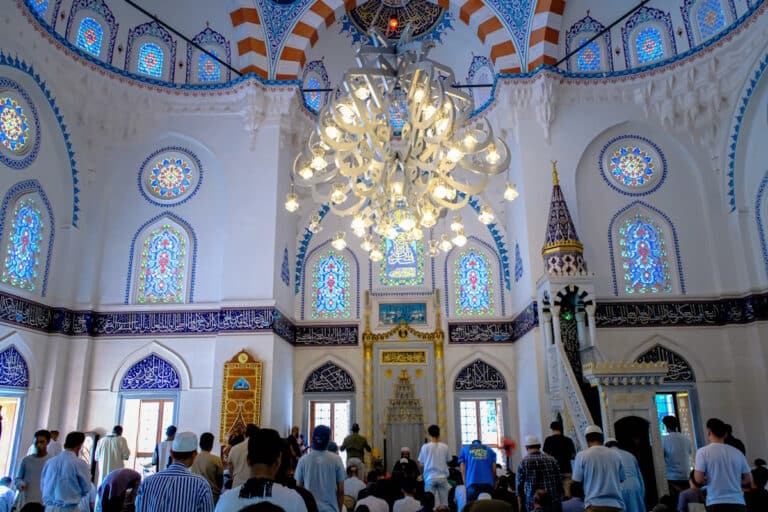
Worshippers inside the prayer hall of Tokyo Camii, the Turkish mosque in Tokyo, with stained glass windows and a domed ceiling
Picture: Shutterstock

On paper, burial is not illegal in Japan, and a small number of cemeteries do allow it. In practice, however, options are extremely limited.

Fewer than a dozen facilities nationwide currently accept Muslim burials, and none are located west of the Chūgoku region. That’s a significant gap given that many foreign workers and their families live in areas such as Kansai and Kyushu. For Muslim families who have made Japan their home, that leaves few realistic choices.

For observant Muslims, burial is not simply a preference: it’s a religious obligation. Islamic tradition requires the body to be washed, wrapped in a simple white shroud, and buried as soon as possible, typically within 24 hours, facing Mecca. Cremation is strictly prohibited.

In response, the Japanese government has begun surveying burial practices across the country. Since January 2026, it has asked 129 prefectures and major cities about their cemetery regulations and whether they can accommodate forms of burial beyond cremation. The effort is part of a broader set of policies aimed at managing Japan’s growing foreign resident population.

As a result, some families must transport bodies long distances within Japan to find a suitable burial site, while others are forced to repatriate their loved ones abroad at significant cost. In both cases, what should be a private moment of mourning becomes a logistical and financial burden.

Where policy meets resistance 

Efforts to establish Muslim burial sites have met with local resistance more than once.

In Hiji Town, Oita Prefecture, a plan to build a cemetery for Muslim burials drew national attention – and not all of it positive. A local Islamic association had reached an agreement to acquire municipal land for the project, with support from nearby residents. The number of plots was capped, restrictions on who could be buried there were clearly defined, and environmental safeguards, including groundwater testing, were put in place.

Despite these measures, opposition grew. Some residents in neighboring areas raised concerns about possible contamination of local water sources. Others submitted complaints that included discriminatory language, prompting warnings from legal experts that parts of the backlash could constitute hate speech.

Similar patterns of misinformation and backlash have appeared in other contexts, including false claims targeting Muslim communities that have led to waves of complaints against local governments. Some rhetoric has extended beyond local concerns, with commentators suggesting that Muslim residents who require burial should return their deceased to their countries of origin. Critics say that overlooks the reality that many Muslims in Japan are long-term residents, and in some cases, citizens.

The issue quickly became political. In the town’s 2024 mayoral election, a candidate opposing the cemetery defeated the incumbent by a wide margin. Shortly after taking office, the new mayor reversed course and refused to proceed with the land sale, effectively halting the project.

A similar pattern unfolded in Sakuragawa City, Ibaraki Prefecture. There, a Buddhist-affiliated religious organization had applied to develop a burial site intended for Muslim use, working in collaboration with Muslim groups. After local opposition, including complaints that residents had not been adequately consulted about the plan, the organization withdrew its application in early 2024.

Together, these cases highlight a recurring problem. Even when burial is legally permitted, even when organizers take steps to address local concerns, projects often stall and fall apart before they have a chance to move forward.

A system under strain

A cleric chants the adhan inside Kobe Muslim Mosque, Japan's first mosque, with its stained glass windows and chandelier
Picture: Shutterstock

As Japan continues to expand its foreign workforce, this problem is likely to become more pronounced.

By the end of 2024, the number of foreign workers in the country had reached roughly 2.3 million – nearly triple what it was a decade earlier. A significant portion of these workers come from Muslim-majority countries, particularly Indonesia. Many are employed in sectors facing acute labor shortages, such as caregiving, construction, and food processing.

With more Muslims calling Japan home, the government’s decision to survey burial practices reflects a growing awareness of the issue. However, it has largely been framed within the context of foreign resident policy. Treating it primarily as a matter concerning foreigners, rather than one of religious accommodation, shapes how solutions are discussed, and whether they gain acceptance.

In the meantime, the lack of accessible burial options continues to affect families at a deeply personal level. Funeral arrangements that might otherwise be handled locally instead require coordination across prefectures or international borders, adding time, cost, and uncertainty during moments of grief.

Uneven progress

Not all efforts to address the issue have stalled. In some areas, local governments and organizations have begun exploring ways to expand burial options, even in the face of public opposition.

In Miyagi Prefecture, Governor Murai Yoshihiro announced plans to pursue an earth-burial cemetery intended to serve the region’s growing foreign population. The proposal drew hundreds of complaints shortly after it was made public, many expressing concern or opposition. Even so, the prefectural government has indicated it intends to continue examining the plan.

Elsewhere, smaller-scale solutions have emerged with less visibility. In Kyoto, a temple-run cemetery quietly began offering a limited number of plots for Muslim burials after recognizing the shortage. While the number of available spaces remains small, it represents a rare example of an existing institution adapting to meet a specific religious need.

These contrasting approaches suggest that change is possible, but uneven. While some communities move to accommodate new residents, others remain hesitant, leaving the overall landscape fragmented and uncertain.

A widening gap

Muslim woman in scarf with Japanese flag at sunset
Picture: FTiare / PIXTA(ピクスタ)

For now, the gap remains. Burial may be legally permitted in Japan, but for many Muslim residents, it is still difficult to access in practice. As the population continues to grow, that disconnect is becoming harder to overlook.

Japan has spent much of the past decade expanding its foreign workforce to meet economic needs. Less attention has been paid to what it means to support those workers beyond the workplace, including how they practice their beliefs and how their families navigate moments of loss.

The government’s survey may be a first step toward understanding the issue. Whether it leads to meaningful change will depend on how that understanding is translated into policy – and whether local communities are willing to accept it.

In the end, the question is not simply whether burial is allowed in Japan. It’s whether it will be realistically possible.

Sources

ムスリム土葬、全国の実態調査 政府、外国人政策巡り自治体に 共同通信 (via Yahoo!ニュース)

イスラム墓地不足、外国人材受容の壁に 動く県や寺も 日本経済新聞

「なぜ土葬はダメ?」 多文化共生を問われる日本社会 nippon.com

「ヘイトスピーチ」との指摘も…イスラム教徒向け土葬墓地 町などに差別的言葉含む反対意見相次ぐ TOSオンライン

日出町長選挙 無所属新人・安部徹也氏が初当選 イスラム土葬墓地「反対の姿勢を貫きたい」 TOSオンライン

「土地売却しない」日出町が別府ムスリム教会に伝える 新町長が方針転換 イスラム土葬墓地問題 TOSオンライン

イスラム土葬墓地「埋葬は焼骨」条例に明記求める住民陳情 町議会委員会で「不採択」大分県日出町 TOSオンライン

宗教法人別府ムスリム教会 土葬墓地について 日出町公式サイト

【共生リアル―新たな隣人たち】日出町のムスリム土葬墓地計画頓挫1年、遠い根本解決 政府に対応求める声強まる 大分合同新聞プレミアムオンライン Gate

「日本で土葬はできない」ってウソ?ホント? ムスリム対応で物議…ネット情報の真偽を調べる 河北新報オンライン

Halal Ramen in Tokyo: A Look at the Expanding Scene

In recent years, Tokyo has seen a rapid increase in restaurants that cater to vegetarians, vegans, and halal diners. A diverse food culture is taking root to meet the needs of both local residents and international visitors.

Ramen, one of the most popular Japanese dishes among tourists, is no exception. Today, Tokyo is home to many halal-friendly ramen places. Here are five of the best-rated and most popular.

Catering to the needs of a growing Muslim population

Picture: ささざわ / PIXTA(ピクスタ)

Halal is a set of Islamic laws governing a range of behaviors in several fields, including business, finance, and personal ethics. It’s most often used to refer to Islam’s dietary laws, which specify that Muslims must avoid pork and alcohol, among other restrictions.

As part of a general rise in foreign residents, Japan has also seen a steady rise in its Islamic population. There were an estimated 350,000 living here in 2023, a threefold increase from 2010. (Around 54,000 of these are Japanese converts.) Japan also has a small but growing number of Muslim cemeteries to cater to the needs of deceased residents and citizens who wish to be interred here.

Between this and Japan’s huge tourist influx, it’s no surprise that there are more restaurants – and even some public schools – catering to Muslims and serving halal food. In particular, halal ramen restaurants give Muslims a chance to eat one of Japan’s staple dishes that they otherwise wouldn’t be able to enjoy, as most ramen contains both pork and alcohol (alcohol is used to preserve the shelf life of the noodles).

Five Tokyo halal ramen shops

Picture: Mazulu Halal Beef Noodles website

Mazulu Halal Beef Noodles: Handcrafted Lanzhou-style ramen

The first is Mazulu Halal Beef Noodles in Jinbōchō, which serves Lanzhou-style ramen originating from northwestern China. The restaurant uses halal-certified Japanese beef and over ten spices to create a rich, flavorful broth. All noodles are handmade in-house and come in three types: thin, flat, or triangular.

The shop holds a 3.59 rating on Tabelog, one of Japan’s largest restaurant review platforms. Tabelog uses a weighted review system; a 3.59 puts Mazulu in the top 3% of all reviewed ramen shops.

One reviewer said, “The soup feels familiar like pho, with added medicinal herbs, spices, and fragrant chili oil. It’s light yet spicy and rich in flavor. White radish adds a nice accent, and the freshly made noodles are smooth and delicious.”

Ayam-ya Okachimachi: Certified by Japan and Malaysia

Ayam-ya Okachimachi operates in the Okachimachi district and holds halal certification from both the Japan Halal Foundation and Malaysia Halal Corporation. It primarily serves classic soy sauce and salt-based ramen, with spicy variations available for each. In addition, the shop offers tsukemen-style ramen, where it serves cold noodles separately from hot broth, along with its signature crispy and juicy karaage chicken.

It currently holds a 3.11 rating on Tabelog. One reviewer wrote, “I tried the halal ramen and karaage. I chose the spicy salt flavor, and the balance with the chicken chashu was excellent. The green onions nicely mellowed the spiciness.”

Another reviewer added, “There was already a line of international tourists ten minutes before opening,” and praised the spicy chicken ramen as “deep in flavor and richly spiced.”

Gyu-mon Halal Ramen: Prayer room and premium Wagyu

Picture: Gyu-mon Halal Ramen Ikebukuro website

Gyu-mon Halal Ramen Ikebukuro opened with the goal of letting Muslim customers enjoy authentic Japanese ramen. The restaurant holds full halal certification and avoids all pork and alcohol, while also welcoming vegan and vegetarian diners. It offers a clean and tranquil prayer room that guests can use at any time.

Diners can choose between two signature styles: a “rich and creamy” halal beef bone broth or a spicy soup made with original spicy miso. The kitchen prepares both with homemade medium-thick curly noodles. Each bowl features marble-patterned A5-grade halal wagyu and a secret spice blend.

The restaurant holds a 3.04 rating on Tabelog, where reviewers praised its “milky beef bone broth with deep umami, perfectly balanced with sweet-simmered beef shigureni, fried shallots, scallions, and chili threads.”

Honolu Ebisu: Fan favorite under 1,000 yen ($6.58)

Some ramen chains are starting to breach the so-called “1,000 yen wall” and offer their product for a more modern price. Not Honolu, which still keeps its bowl at Showa-era prices.

Honolu Ebisu is the third branch of the Honolu ramen chain and is located in Tokyo’s Ebisu district. The restaurant offers Muslim-friendly menus certified by the Malaysia Halal Corporation. It has earned a 3.25 rating on Tabelog, and is known as a trusted and popular spot.

Its signature chicken ramen features a rich chicken paitan broth, soft noodles, chicken, corn, seaweed, and a half-boiled egg with a deep orange yolk. The karaage ramen is also popular, as are the spicy ramen and halal dumplings filled with chicken and tofu. In addition, each bowl costs under 1,000 yen.

One reviewer especially praised the special chicken paitan (a thick and creamy chicken bone broth) ramen, saying, “The broth is thick and rich yet surprisingly light on the finish, the medium-thick curly noodles cling perfectly, and the toppings are luxurious, especially the meltingly soft half-boiled egg.”

Note: Only the Ebisu and Osaka branches offer halal-certified menus.

HALAL WAGYU Ramen & Tempura KONOHA: Premium Wagyu with tempura

HALAL WAGYU Ramen & Tempura KONOHA is located near Kanda Station in Tokyo’s Chiyoda Ward, close to Akihabara. The restaurant is officially listed as “Partially Halal Certified” and uses no pork or alcohol in its menu. Its signature dish is a light-style wagyu ramen topped generously with A5-grade wagyu beef, with optional spicy ramen and tempura toppings.

The shop holds a 4.9-star rating on Google. One reviewer said, “Very tasty ramen, the wagyu meat was delicious and the fried chicken was insanely good. I found it a little bit too expensive but it could be due to the price of the meat being halal.”

Another wrote, “Wow! This food was SO GOOD! The spicy wagyu special ramen was blowtorched. The karaage and tempura and ramen were delicious. The place is cozy, with 6 bar seats and 2 tables that can each sit 4. Our server spoke English and was very nice. I highly recommend it!!!”

Sources

ハラルらーめんを発売開始しました!Menya-Iroha

東京でおすすめのハラールラーメン店5選   byFood

ラーメンを食べられないイスラム教の方へ、「ハラル」対応ラーメンを!Nippon Hoso News Online


False Claim of “Muslim Lunches” Makes Japan’s Kitakyushu a Hate Target

Misinformation about school lunches has sparked a storm in Kitakyushu City in Fukuoka Prefecture. There, false claims of Muslim-friendly meals triggered more than 1,000 complaints and disrupted city operations. The controversy stemmed from confusion over an allergy-friendly lunch served once in 2023 and a petition later scrapped in 2025.

While the city faced backlash, towns in Ibaraki Prefecture have moved in the opposite direction. There, schools have introduced halal school lunches, so Muslim students can eat alongside their classmates.

City denies social media rumors of Muslim-friendly school lunches

Women wearing blue gloves and preparing bento lunches with kitchen chopsticks
Picture: buritora / PIXTA(ピクスタ)

False claims spread on social media that Kitakyushu City had decided to serve Muslim-friendly school lunches. The city soon received a flood of protest calls and emails.

The number of complaints, including objections to the city’s international exchange policies, surpassed 1,000 and disrupted municipal operations. On the night of the 22nd, the city’s Board of Education posted a statement on its website, stressing that the claims were false.

The misinformation alleged that an Afghan Muslim woman petitioned the city to provide school lunches for her elementary school child that excluded pork and pork extract, which are religiously prohibited. It further claimed that the City Council’s Education and Culture Committee approved the petition and that “Muslim-friendly lunches” had already begun in Kitakyushu City.

In reality, the council received the woman’s petition in June 2023 and reviewed it in August. The council chose to continue deliberations at that stage, but in February 2025, after a reshuffle, the council scrapped the petition. The council never approved it.

City swamped with complaints

Kitakyushu City never decided to serve Muslim-friendly school lunches. However, in 2023, the city introduced a special meal called “Nikoniko Lunch.”

The lunch excluded 28 specific ingredients, including soy, dairy, and other designated allergens. This enabled children with food allergies to eat safely. The school also removed pork from the menu. That just happened to meet the needs of Muslim students as well.

The “Nikoniko Lunch” was created as an allergy-friendly option, not for religious purposes. However, some people distorted this fact and spread false claims on social media, saying the City Council had approved the woman’s petition and that Muslim-friendly lunches had begun.

The misinformation circulated alongside xenophobic messages such as, “You came from abroad, so why are you making demands?” and “Go back to your country if you don’t like school lunches.”

In 2025, misinformation that wrongly linked the one-time 2023 lunch with a petition—scrapped in February 2025—spread on social media and prompted a wave of complaints.

Between September 19 and 22, the city received about 1,000 calls and emails. Many of them also targeted Kitakyushu’s friendship and cooperation agreement signed in June 2025 with Telangana State in India.

Protesters confused the agreement with the national policy of promoting “people-to-people exchanges of more than 500,000 in five years” and accused the city of adopting an “immigration policy.” City officials said the flood of protests disrupted their operations.

The incident is similar to another recent disinformation campaign in Japan. In-person protests broke out after some news services misinterpreted the Japan International Cooperation Agency’s “hometown” program between cities in Japan and African countries as creating a special immigration status.

Right-wing agitators and politicians have spread other disinformation about foreigners. One campaign accused immigrants of exploiting the country’s high-cost health care system. Another accused Chinese PhD students of taking money away from Japanese college students – a charge with no basis in fact.

Ibaraki towns serve halal school lunches to include Muslim students

Oxtail soup, traditional muslim food with ox tail puree with spices
Picture: nuruddean / PIXTA(ピクスタ)

Some regions in Japan have, in fact, begun serving Muslim-friendly school lunches. And for good reasons.

Sakai and Goka in Ibaraki Prefecture provided halal food in school lunches for the first time starting in 2024, so that Muslim students could also eat. The Sakai School Lunch Center, which supplies meals to elementary and junior high schools in both towns, said, “We want children to enjoy the same lunch together regardless of religion. We also want Japanese children to learn about global diets and diversity.”

Under Islamic law, Muslims cannot eat pork, and cannot eat meat that is not processed according to prescribed methods. Because of this, 35 students in Sakai and 4 students in Goka were unable to eat school lunches. Instead, they had to pack and bring their own.

In September, the lunch center prepared a special menu that Muslim students could eat. The meal included squid tempura, egg bowl topping, rice, miso soup, apple juice, and frozen mandarin orange.

At Sakai Elementary School, 23 foreign students experienced school lunch for the first time. Fatima Yussuf, a 10-year-old fourth grader from Pakistan, said with a smile, “My first school lunch was delicious. I was happy to eat together with everyone.”

At the time, the Sakai School Lunch Center said it planned to continue offering halal meals regularly. It was also considering menus that meet other dietary needs, including vegan options.

The cases of Kitakyushu and Ibaraki show the challenges Japan faces in handling religious and dietary diversity and the different paths local communities are taking. It also shows how some in Japan are willing to exploit the spike in the country’s immigrant population to stoke division and fear.

Sources

「北九州市がムスリム給食」誤情報拡散→市に苦情殺到 業務に支障も 毎日新聞

ムスリムの児童も一緒にごはん 茨城2町でハラール給食   毎日新聞

Muslim Cemetery in Miyagi Prefecture Will Proceed Despite Resistance

Some far-right voices in Japan are objecting to the creation of a new cemetery in Miyagi Prefecture that will cater to Japan’s growing Muslim population. However, the Prefecture’s governor says the project is necessary and will proceed as planned.

With Japan in the grips of population decline and a severe labor shortage, it’s relying on foreign labor more than ever. As a result, the number of people practicing Islam has shot up in the past decade. As of 2023, there are 350,000 Muslims in Japan – over three times the 110,000 Muslims in 2010. 54,000 of those are Japanese converts to the religion.

In 1980, Japan had a total of four mosques in the entire country. Due to increased immigration of workers from countries such as Iran and Pakistan as well as conversion, it has 149 mosques as of June 2024 – a 10-fold increase.

However, Japan – a country where 99.7% of citizens are cremated – still lags in cemeteries that can conduct an Islamic burial. When a practicing Muslim dies, their faith specifies direct burial in the ground (no casket) with their head pointing towards Mecca. There are currently 10 Muslim cemeteries in the entirety of Japan.

400 complaints over proposed cemetery

Islamic women
Picture:
dotshock
 / PIXTA(ピクスタ)

The 11th may soon be a new cemetery in Miyagi Prefecture. It would be the first in the Tohoku region.

However, even this vague whiff of a plan has resulted in 400 complaints to the prefectural office. Many claim that the site represents a “potential health hazard,” such as contamination of local water supplies.

According to a survey by Oita Prefecture of 13 Christian and Muslim cemeteries across Japan, no recorded incidents of environmental pollution are attributed to the facilities.

A lot of the opposition online seems driven more by pure racism. A thread on the Miyagi plan on social media site X is filled with comments such as, “Bury yourself in your own country” and “Go home if you can’t understand Japan’s rules!”

(That last comment is funny, considering the country’s history. Although cremation is overwhelmingly the norm now, Japan’s Meiji government banned the practice in 1873, labeling it disrespectful and unsanitary.)

Islamic cemetery “must happen”

Muslim associations in Japan have worked with residents in the past to reach an agreement on the location and conditions of Muslim cemeteries. However, after local and political opposition, one association abandoned plans in Ibaraki Prefecture. Another effort in Oita Prefecture’s Hijimachi is in danger after the town elected a mayor who opposes the facility.

At a press conference last month, Miyagi governor Murai Yoshihiro said the cemetery in his prefecture “must happen in spite of the criticism.”

“As the number of foreigners increases, so are people who get married and have kids. There are also Japanese people converting to Islam who want an Islamic burial.”

Responding to the “get buried in your own country” comments, Murai said, “There are people with family here, and people who came here alone and can only be buried here. It’s important we meet their needs.”

Murai is a pro-immigration governor who has said in the past that Japan needs more immigration in the short term to overcome its chronic labor shortage.