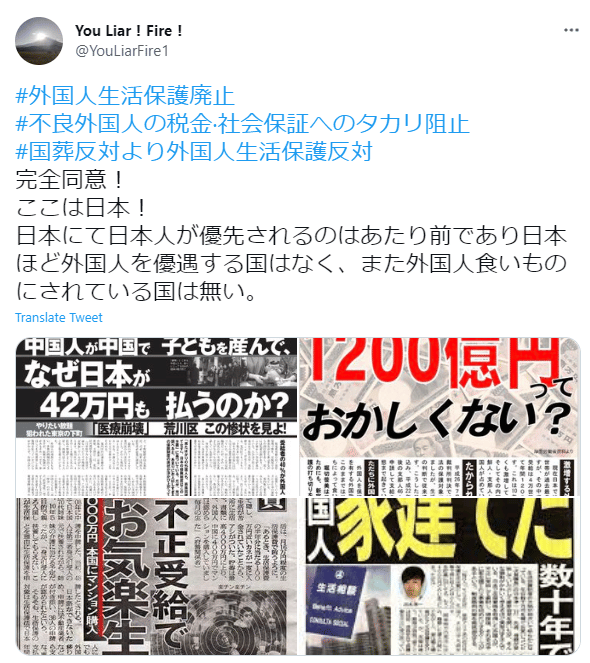
A popular Japanese right-wing meme on social media holds that foreigners are bleeding Japan dry. Is that true? A series of articles citing actual data show that the reality for foreigners living in Japan is far different than right-wingers suggest. In fact, many foreign workers and residents can’t get support even when they desperately need it.
“Stop giving money to foreigners!”
It’s a common trope from right-wingers worldwide. “They” – in this case, immigrants – have come to our glorious nation to take advantage of our social safety net. Nationalists even say this in my country, the United States, where our “safety net” is a tin of biscuits and a kick in the ass.
This trope kicks up on right-wing Japanese Twitter frequently. It surfaced again recently in reaction to former Prime Minister Abe Shinzo’s expensive state funeral. Recent polls show a majority of people in Japan oppose using public funds for his send-off.
In response, right-wingers took to Twitter to trend the hashtag #国葬反対より外国人生活保護反対 (“Forget the state funeral, I’m against public benefits for foreigners”). One account spewed: “Hard agree! This is Japan! Why wouldn’t we prioritize Japanese people?”
The reality of foreigners and public assistance in Japan
Given this, you’d think that a majority of people on public assistance in Japan are foreign residents who came to the country specifically to feed off of the hard work of others. But as an article in Huffington Post Japan makes clear, the reality is starkly at odds with right-wing rhetoric[1].
Writing for HuffPo, author and activist Amamiya Karin first looks at the law. Right-wingers insist that public assistance in Japan should be for the Japanese. But, Amamiya notes, it primarily is.
First off, she writes, foreigners only make up 2% of Japan’s total population – about 2.93 million people. And by law, they generally can’t get public assistance. It’s only available via special dispensation to foreigners who have permanent resident status and who pay taxes. That limits the number of foreigners even eligible for public assistance to 47.5% of Japan’s permanent residents, or about 1.37 million people.
Looking at the actual distribution of benefits, then, it’s no surprise that 96.7% of all public benefits go to Japanese citizens. Only a mere 3.3% goes to foreigners. Looking at the total population, 1.6% of all Japanese citizens receive assistance.
The percentage for foreigners is higher, Amamiya says: it’s 2.3% of the foreign population. However, there are good reasons for that. The majority of that support goes to Zainichi (resident) Koreans (6.2%), with the next highest percentages being Filipinos (3.8%), Brazilians (1.2%), and Chinese (0.9%).
Of the largest chunk – Koreans – some 67.1% of the recipients are elderly. Most are receiving assistance because they have suffered systemic discrimination in the past. For example, until 1982, most Zainichi Koreans were barred from the public pension system. They also suffered other forms of discrimination, such as ineligibility from working as public servants.
For Filipinos, 53% are from single-mother households. And Brazilians, like Filipinos, came to the country in search of work. (The Japan-Brazil connection, which we’ve discussed extensively on UJ, extends over a century.)
No help – even when it was desperately needed
I’d summarize the rest of Amamiya’s amazing article at length here if I had the time. But I’ll leave with one salient point. Amamiya, who’s spent time working with COVID-19 relief efforts, relates how many foreigners couldn’t get help even when they needed it.
Many who lost their jobs during the pandemic, she says, weren’t able to get any form of assistance. (Remember, over half of all foreigners don’t qualify for benefits under any circumstances.) Some couldn’t even get basic health care: over 100,000 foreigners in Japan don’t qualify for basic health services.
The people most at risk, Amamiya says, are those who are on temporary release from Japan’s immigration system. “These people can’t work because they’re forbidden from working. But there’s no support for them and they don’t qualify for public assistance. It’s like those approximately 6,000 people are being told to die.”
“If people can’t get help, they’ll die”
Huffington Post Japan wasn’t the only publication to rebut the specious claim that foreigners are living the high life at the expense of hard-working Japanese.
Writing for Mainichi Shimbun, Yamashita Chie starts with the claim of right-wingers that, while Abe’s funeral cost over 1.6 billion yen (appr. USD $11 million at the time of writing’s absurd exchange rates), the country spends 1.2 billion yen on assistance to foreigners[2].
But this number, Yamashita says, is a spitball made by a politician in Japan’s Diet. The Ministry of Health, Labor and Welfare says it doesn’t publish a breakdown of who receives how much assistance.
The entire accusation, hate speech expert Akedo Takahiro tells Yamashita, is tantamount to a hate campaign. “They’re switching up the story from the funeral costs to the unrelated issue of public assistance for foreigners. It’s a crude, desperate play by the funeral’s supporters.”
Osawa Yuma, who works for lifestyle support center NPO AMIGOS[3], puts it more bluntly. “Foreigners and other minorities have been used as scapegoats to change the subject before. The fact is, if people can’t get assistance, they’ll die. There are foreigners today who can’t get basic necessities and medical care. They’re falling into poverty and dying. I wish people understood that this is a matter of life and death.”
Sadly, I think that for many people on the political right, the mass death of minorities would suit them just fine.
References
[1] 外国人と生活保護について. Huffington Post Japan
[2] 拡散した「国葬反対より外国人生活保護反対」 支援者「実情知って」. Mainichi Shimbun
[3] NPO AMIGOS