Report: Japan Monitored Korean Students After Kanto Massacre to Keep Them Quiet
A report from a Japanese newspaper brings new documents to light showing that Japan’s government in 1923 kept tabs on Korean student victims after the Kanto Earthquake. The documents, the paper says, show that the government was wary the students would talk about the subsequent Kanto Massacre that residents and authorities waged against resident Koreans.
The new report from Mainichi Shimbun says that Japan’s Education Ministry set up a “Korean student relief department,” ostensibly to help students in the wake of the tragedy. The department did, indeed, distribute food and other relief to Korean students.
To facilitate this, the department, says Mainichi, also kept a meticulous list of Korean students, including a summary of their “character and conduct.” That wasn’t atypical in Imperial Japan.
However, the department also contains mentions of the massacre – such as a soldier telling a student he couldn’t return to Korea because he’d “spread the story” of the killings. There are also records of authorities in Korea, which was then colonized by Japan, cracking down on talk of the massacre. The Japanese government feared that awareness of the massacre would weaken its grip on the country.
The documents in question are currently at the National Archives of Japan in Chiyoda City, Tokyo. They cast additional historical light on the function of the relief department, whose exact activities were previously unknown.
The struggle to remember the Kanto Massacre
Today, the government estimates some 105,385 people died in the devastating 1923 quake. In its aftermath, however, disinformation spread that Korean residents were poisoning water supplies and engaging in other acts of terrorism.
Vigilante groups, with the help of police and the military, slaughtered thousands of Koreans based on this pretext. They also killed Japanese citizens, including so-called burakumin and even Japanese people whose regional accents made them sound “foreign.”
The Japanese government has only performed a single study into the Massacre, estimating the total number of victims at 6,000. Activists say that’s way too low.
The government refuses to perform any further research. Current Tokyo governor Koike Yuriko has refused to attend a memorial for the Massacre victims every single year she’s been in office.
Racial prejudice against Koreans is an unfortunate fact of life even in modern-day Japan. One restaurant recently made headlines by proudly asserting it wouldn’t serve Korean customers. (Ironically, the restaurant serves kimchi.) Korean and Chinese residents are also often singled out for housing discrimination.
One Week After Bear Occupation, Japanese Supermarket Finally Reopens
One week after a bear invaded and refused to leave for over 50 hours, a supermarket in Japan’s Akita City has finally reopened. However, a flood of bear sightings continues to leave residents on edge as the city also deals with anger over the bear’s extermination.
On November 30th, a wild male bear, about one meter long and around 2 years old, made its way into an Itoku supermarket in Akita City, Akita Prefecture, in Japan’s northern Tohoku region. The bear assaulted a 47yo male employee, who later recovered from his injuries.
The creature then proceeded to trash the store as authorities tried to figure out how to remove it. The story made headlines and was the talk of Japanese morning shows for two days.
Authorities eventually euthanized the bear and hauled its body out of the store some 50 hours after it had originally invaded and camped out.
The bear’s killing brought a small wave of protests. Akita City says it received over 100 complaints. Some said the city shouldn’t exterminate wildlife “based on human whims,” with others saying the city should have performed a catch and release.
Many residents, however, say they’re happy to have their supermarket back.
“I come here about four times a week,” said one. “I’m grateful it’s operating again.”
However, since that incident, there have been around three more sightings of bears in the area. That’s raising fears of further trespassing into human territory. Some stores are responding by putting out plastic bottles of water tainted with a smell that bears find irritating.
This isn’t the first instance of bears coming closer to human populations. We wrote last year about a bear who camped out in a tree in front of the Rikuzen-Ochiai Station in Sendai.
Japan’s wild animal problem isn’t limited to bears – boars are also running wild in the nation. As the country’s population ages, there are fewer hunters to cull the naturally occurring wild animal population. Additionally, the country’s accelerating depopulation means that there are more abandoned areas for animals to roam free. That’s allowing them to move steadily closer to Japan’s population centers.
Various towns and prefectures around the country are experimenting with ways to track and cull the wild animal population. In 2022, Yamagata Prefecture experimented with animal-tracking drones.
Shizuoka Mulls Steep Fee to Climb Mt. Fuji as Overtourism Continues
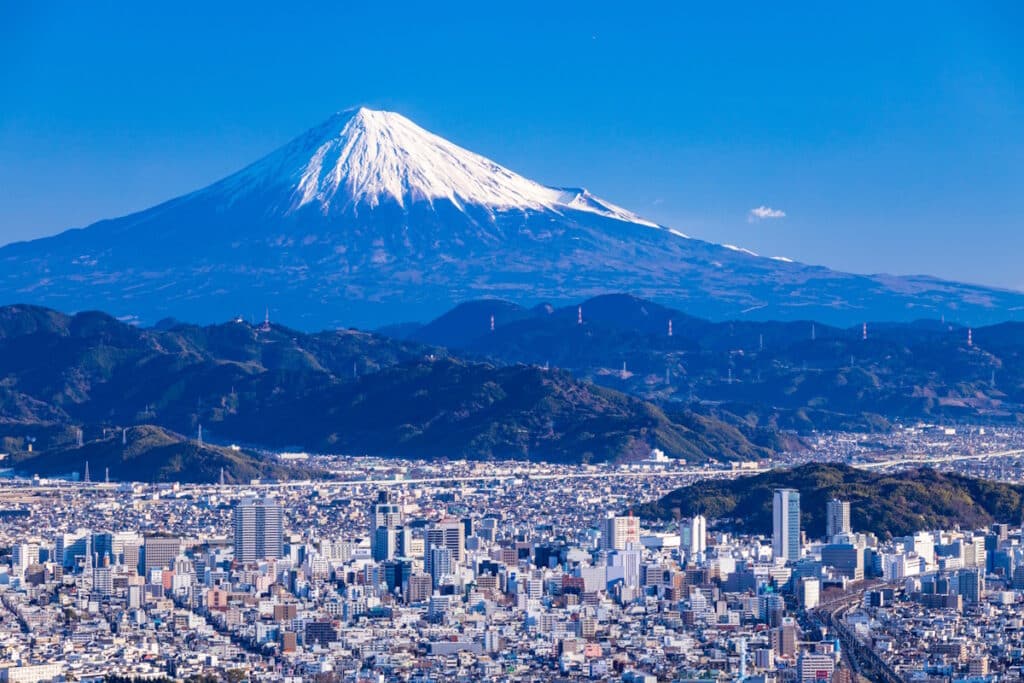
Mt. Fuji is one of many tourist destinations in Japan struggling with overtourism. Now, local reports say Shizuoka Prefecture may emulate neighboring Yamanashi Prefecture by imposing fees on Fuji climbers.
Reports say that Shizuoka is considering imposing a 4000 yen (USD $27) fee on hikers when the next Fuji tourist season starts. The Prefecture says it’ll consider the rate hike during its next regular meeting scheduled for February 2025.
Mt. Fuji has found itself beset by a record number of tourists. The surge has complicated efforts to keep both domestic and foreign tourists safe on the trail.
One recurring issue is so-called “bullet climbing” (弾丸登山; dangan tozan), where climbers push themselves to hike the trail overnight to see the sunrise in the morning. 30% of climbers attempt bullet climbing, which forces emergency personnel to scramble as some fall victim to exhaustion.
A change of heart
Picture: Yoshitaka / PIXTA(ピクスタ)
Yamanashi and Shizuoka Prefectures are both host to multiple hiking entrances for Mt. Fuji. For the first time this year, Yamanashi instituted a reservation system for Mt. Fuji hikers along with a 2000 yen ($13) mandatory fee. The prefecture also forbids anyone except people who had rented huts on the mountain for an overnight from entering the land after 4pm.
Shizuoka has also contemplated adding fees to its trails. However, Shizuoka’s case is complicated, as it only owns part of the trails. On the Shizuoka side, the trailheads at Fujinomiya, Gotenba, and Subarashi are technically owned by the Fujisan Hongū Sengen-Taisha Shrine (富士山本宮浅間大社).
Shizuoka now says that it wants to move ahead with a fee system after Yamanashi officials said that the fee has cut down on bullet climbing and other safety-related issues. The fee would apply to all three Shizuoka-side routes.
The prefecture says it plans to iron out details of the plan with officials in Yamanashi. As with Yamanashi’s fees, revenues would go towards preserving the beauty and sanctity of the mountain, which Japan’s native Shinto religion has long regarded as a holy site.
Overtourism issues abound in Japan
Hiking isn’t the only tourism-related issue to beset Mt. Fuji. Earlier this year, the own of Fujikawaguchiko erected a black curtain in front of a famous spot where the mountain looms in the background of a local Lawson combini. The curtain was in response to residents complaining that tourists frequently clogged the road in the front of the Lawson.
“Untamed Kitty”: Misbehaving Hello Kitty Meme Spreads from China to Japan
A meme surrounding one of the world’s most beloved Japanese characters that started in China has caught people’s attention in Japan. In particular, the meme’s anti-work vibes seem to resonate with overworked and underpaid Japanese office workers.
The “Untamed” or “Wild” Kitty (破天荒キティ; hatenkou kiti) trend uses what appears to be AI-generated images of Sanrio’s hallmark character, who’s ringing in her 50th birthday this year. However, rather than showing the sweet, angelic princess that most know and love, Kitty-chan is depicted committing various acts of mischief, such as arson and property destruction.
AI Hello Kitty watching her monitor go up in flames.
The images bear watermarks noting that they come from the Chinese service Xiaohongshu (“Little Red Book”), a.k.a. RED, REDnote, or XHS. Hello Kitty is extremely popular in China, with her fame there akin to that of Barbie in the West. She served as the Japanese “tourism ambassador” for China and Hong Kong in 2008 – the first time a fictional character ever served that role.
The images caught notice on Japanese Twitter (also known as X) over the past few days. As local Japanese magazine ITMedia notes, many users seemed to resonate with pictures showing Kitty taking out her workplace frustrations.
In several images, Kitty can be seen smashing a laptop or desktop with a hammer. In another, she points a gun at her monitor. Other images show her on fire as she tries to concentrate on her work or, presumably, reads an angry e-mail.
“I feel this,” one Japanese user wrote.
Others, however, weren’t so happy. “Kitty would never do that,” they griped. Other users also lamented what they saw as a sullying of Kitty-chan’s wholesome image.
English Japan fans on Unseen Japan’s Bluesky account were split. While some enjoyed the images, others branded them a cheap AI-generated Aggretsuko rip-off – a reference to the Japanese-American animated comedy that depicts Retsuko, a “salarypanda,” as she overcomes numerous struggles in the Japanese workplace. (Aggretsuko is also owned by Sanrio.)
(Note: Unseen Japan does not support AI art and does not use AI-generated art in our articles. We always commission artists and pay them a fair rate for their work.)
Report: Tokyo University Program Used “Tiananmen Square” Keyword to Block Chinese Admissions
In a bombshell accusation, Todai Shimbun, the student-run paper of Tokyo University, alleges that a graduate admissions site embedded a keyword related to Tiananmen Square for over a year. The goal was apparently to prevent the page from loading in mainland Chinese and thus block Chinese students from attending, the paper alleges.
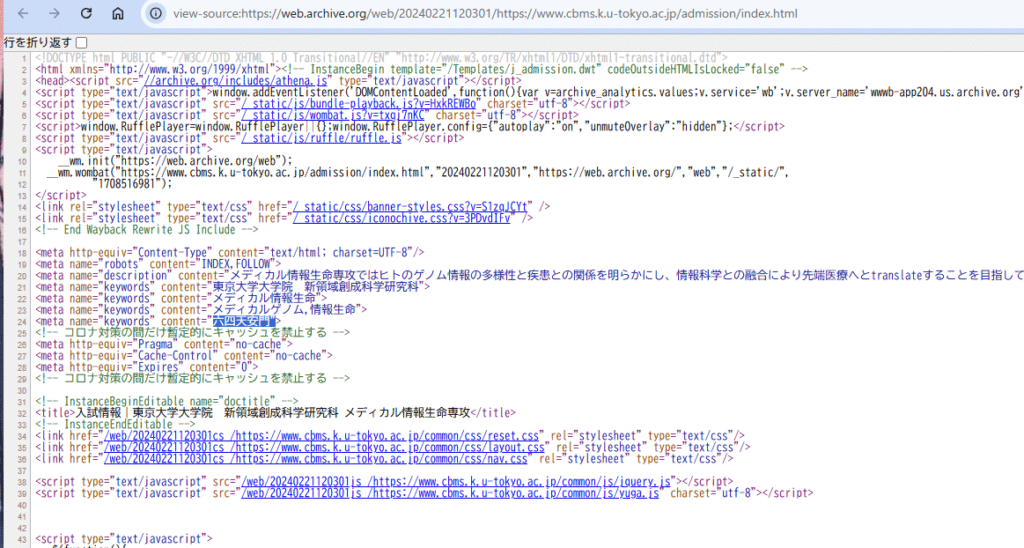
Todai Shimbun reports that the keyword appeared on the website for graduate admissions to its Computational Biology and Medical Sciences Program (メディカル情報生命専攻). The keyword used was 六四天安門 (roku-shi tenanmon), or “June 4th Tiananmen.” June 4th was the date of the student Tiananmen Square uprising in 1989.
The paper says the keyword can still be seen in the Internet Archive’s version of the page dating from between August 12, 2023 and September 29th, 2024. UJ confirmed the keyword’s existing using the Wayback Machine’s February 21st, 2024 version of the page:
The keyword is banned by China’s Great Firewall, which filters out any news critical of the ruling regime. That means there’s a strong possibility that the admissions page wouldn’t load for Chinese students looking to apply to the program for at least a portion of the 13 months between August 2023 and September 2024.
Tokyo U officially acknowledged the incident in the wake of the paper’s report. The University says it has since removed the keyword from its page. It also says it’s updated its source code check-in verification procedures to prevent anyone from entering the keyword into the University’s HTML code a second time.
This isn’t the first controversy involving Japan-China relations at the University. In 2019, associate professor Osawa Shohei, who ran a company called Daisy, wrote extensively on Twitter about how he refuses to hire Chinese people, saying they exhibit “poor performance.” His department issued a rare rebuke, and the university dismissed him the next year.
Tokyo Godfathers: Kon Satoshi’s Film is a Christmas Classic
The nights are coming earlier, and the days are getting colder, with the promise of a few flurries falling on the concrete warrens of Tokyo. It can only mean one thing: Christmas is coming to the Japanese capital. A purely secular holiday for the vast majority in Japan, Christmas is nonetheless a prime day for celebration. (Even if mostly as an excuse to string up multi-colored lights, grab a cake from 7-11 and a bucket of chicken from KFC, and go out on expensive date nights.) And for those looking for a Japanese film to add to your seasonal rotation, one stands above them all: renowned director Kon Satoshi’s anime Christmas classic, Tokyo Godfathers.
Debuting in Japanese theaters in 2003, Tokyo Godfathers was a marked departure for Kon. An auteur of the highest order, his previous two films – Perfect Blue (1997) and Millenium Actress (2001) – were noted for their blending of the real and unreal, moving from grounded scenes to surrealistic, hallucinatory imagery, constantly asking the audience to decipher which was which. His future TV series, Paranoia Agent (2004), and final film, Paprika (2006), would take these mind-bending, often sinister flights of fantasy to new heights. Smack in the middle of these hallucinatory outings is Tokyo Godfathers: a comparatively grounded, hilarious, and even downright wholesome Christmas film.
(Well, it’s wholesome in outcome and message, if not even close to being a squeaky-clean Hallmark film. It’s a film about family, but it may not be fit the entire family.)
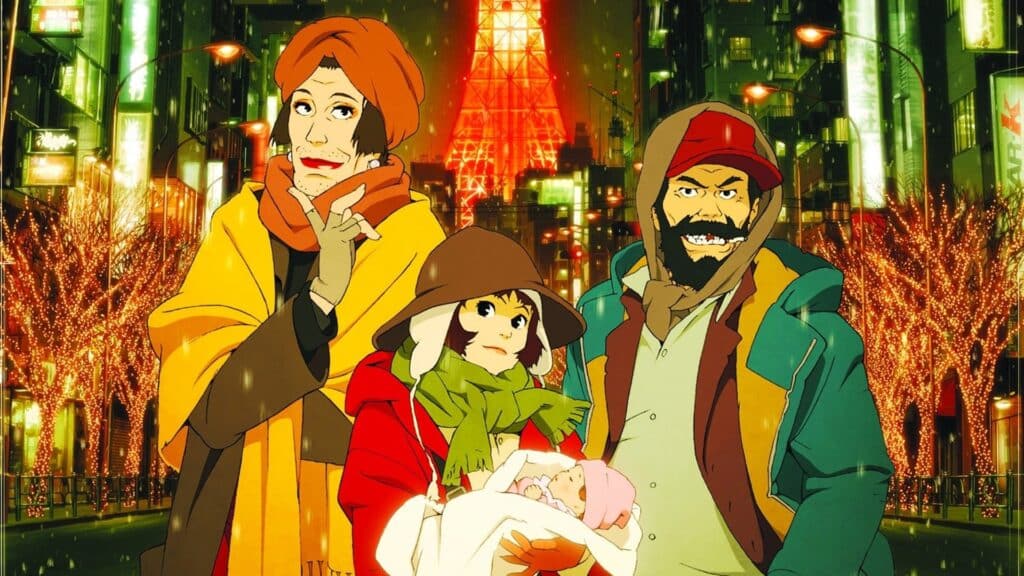
Our three protagonists: Hana, Miyuki, and Gin. Baby Kiyoko at center.
The Godfather of Anime Christmas Films
Tokyo Godfathers is the Christmas-set story of three homeless Tokyoites – middle-aged drunk Gin, trans woman Hana, and runaway Miyuki. The three struggle to get by, existing as a sort of dysfunctional found family, living out of cardboard shanties in a park in the shadow of Shinjuku’s Tokyo Metropolitan Government Building. On Christmas Eve, while sifting through recycling, they chance upon an abandoned baby. Their journey to bring the baby back to its parents draws them into a series of semi-miraculous adventures through the Tokyo underworld and beyond.
The result is a bonafide Christmas classic. Tokyo Godfathers starts with a sermon half-heartedly attended by a group of the unhoused, and ends with salvation. It blends mediums and genres, creating one of Japan’s most unique films – and an excitingly atypical holiday tale from one of the greatest anime directors of all time.
In 2003, anime auteur Kon Satoshi released Tokyo Godfathers, an anime Christmas classic. Find out more about this socially and seasonally relevant film.
Watch this article in video form on our YouTube channel.
In a 2002 interview, Kon said:
“It’s in different taste than my previous two movies. It doesn’t mix unreality and reality in the same way… I’d call it a ‘twisted tale of human empathy.'”
Kon served as director, creator, and co-scriptwriter. He was joined by screenwriter Nobumoto Keiko, notable for her roles as head writer on the anime classic Cowboy Bebop and as creator of Wolf’s Rain. Kon called Nobumoto his “drinking buddy,” and said she brought “a warm, kind lens when creating characters” to his “love of tricky, sneaky structures.” [1] The two of them set off to create a story combining elements of a shelved Kon concept called “Tokyo Ghost,” a supernatural mystery about a homeless man who meets the spirit of a deceased young woman, [2] and the Hollywood classic Three Godfathers. Kon read deeply on the topic of homelessness, adding elements of real stories he encountered.
Unlike his previous films, the main focus of this film would be “character.” Nobumoto would be invaluable in crafting the individualistic and deeply drawn personages in question. Meanwhile, Kon made the intial character designs himself; his goal was to make them as physically distinctive as possible. (He hated how similar many anime faces looked.) [3] He then set these characters within a living, breathing animated Tokyo.
The late, great Kon Satoshi. (1963-2010)
Tokyo in the Spotlight
Having now lived in Tokyo for over five years total, it’s shocking how well this film inhabits the city. One can unironically use the cliche “New York was like a character in the film,” with NYC replaced by the Japanese capital. But Kon goes beyond the surface, showing us Tokyo on the fringes, by turns vibrant and dingey. This is the Tokyo the tourism board wants to draw you away from; of people teetering on the edge of poverty and living on the streets. It’s a Tokyo where the nightlife word of hostesses and drag bars intersect with organized crime and gambling; where the debt-hounded slip away into the night, disappearing to places where creditors can’t find them. This is all more appropriate for a film about the unhoused, who have to exist in the urban environment much more directly than most of us.
There are shades of more recent directors like Sean Baker, creator of films about people on the fringes like Tangerine (2015), The Florida Project (2017), and Red Rocket (2021). Baker’s films also contain honest and at times humorous depictions of poverty and intersections with nightlife and sex work; the difference with Tokyo Godfathers is the extremely optimistic view it takes. Godfathers shows a grimy reality twinned with a story of lucky breaks, found-family ties; even heroism. Kon perfectly meshes realism and surrealism, human tragedy and zany humor. The universe bends and contorts to draw our down-on-their-luck heroes towards the saving of a single baby, and the redemption of us all. Even the buildings of Tokyo seem to express pleasure and distress at the goings-on.
Gin, Hana, Miyuki, and baby Kiyoko journey from their humble homes in Shinjuku all the way across the Sumida River to Kinshicho. Back across the river, the orange glow of Tokyo Tower dominates. Scenes are set in convenience stores and family restaurants, snack bars, and unfinished high rises. Cardboard encampments become welcoming homes. It’s a Tokyo anyone who’s lived here can recognize. It’s also not the way the city is usually depicted.
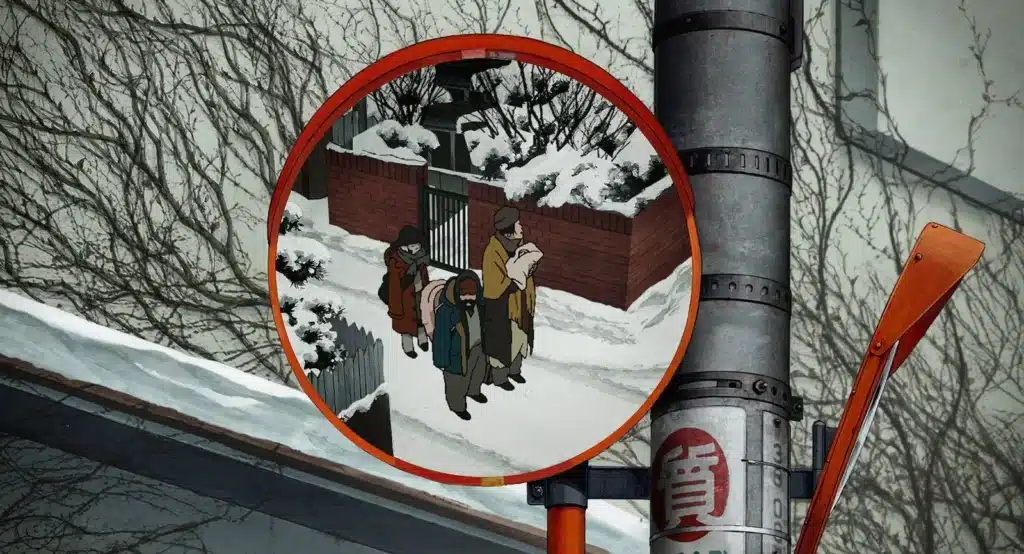
Our principles reflected in a ubiquitous Tokyo traffic mirror.
The Christmas of it All
All this takes place within a snowy December backdrop. Christmas and the New Year season are the direct settings, referenced from the sermon that starts the film until the story’s conclusion on New Year’s Day. The imagery of angels – whether the angelic baby Kiyoko or a bewinged drag club host – is numerous. The movie’s themes include redemption, grace, salvation, and divine providence. With its constant background refrains of Ode to Joy and early rendition of Holy Night, the Christmas themeing is surprisingly deep. (And all this from a director not known to be Christian, working for a film audience that certainly wasn’t.)
Tokyo Godfathers is actually rather shockingly Christmas-oriented, and in a deeper way than the secularized Japanese Christmas usually allows for. Gin, Hana, and Miyuki are essentially the three Magi, trumpeting the birth of the “pure child,” Kiyoko. (This makes sense, given Kon’s inspiration from John Ford’s 1948 Three Godfathers. That film features three cowboys who rescue a newborn, with one of the lot self-comparing to the Three Wise Men.)
As an example of how far this version of Christmas is from the usual Japanese experience: Miyuki’s voice actress, Okamoto Aya, asked Kon about his own celebratory style for Christmas during a press interview. “Tokyo Godfathers depicts a snowy Christmas day in Tokyo, right? How do you spend your Christmas?” “I usually yell out ‘kampai!’ and throw back a bunch of drinks!”
Aya turned this around, intimating that Kon liked to be surrounded by people during the holiday. Kon, though, jokingly insisted his Christmas drinking style was more boisterous than sentimental. Aya, for her part, said she mostly worked on Christmas days. (A good example of how many people here spend the holiday – which, of course, is not a regular day off.)
Aya’s character, Miyuki, in the Tokyo snow.
A Wide Embrace
In a film full of warmly depicted characters, one stands out: Hana, a down-on-her-luck trans woman and former hostess. Hana is a particularly notable character for having emerged all the way back in 2003. Her depiction is sympathetic, theatrical, and funny; while other characters often say snide things about her, she emerges as the single most relatable, entertaining, and heroic person in the film. Her unflappable English-language rendition of “Climb Every Mountain” from The Sound of Music is iconic. No wonder Hana has become something of a cult film hero for many in the international trans community.
Hana’s tragic fall from nightlife personage (in a marginalized niche, at that) into homelessness is sadly believable. Tokyo Godfathers presents other pathways to homelessness in Japan; regretful Gin is a former gambler whose debts resulted in him abandoning his family. This type of sudden disappearance is known in Japanese as Johatsu (蒸発) – “evaporation.” Many of those living rough in Tokyo are people who’ve felt the need to disappear. Bad debts, criminal convictions, bankruptcies, domestic violence, or personal scandals – all can drive people to evaporate. An entire cottage industry exists around helping people disappear, assisting in moving house and identity in the dead of the night. (UJ regular contributor Jake Adelstein has a great podcast series on this very topic: “Evaporated: Gone with the Gods.”)
Tokyo Godfathers depicts additional marginalized Tokyo communities. One of the film’s many providential twists brings Miyuki to the home of Latino immigrants; foreigners, often portrayed as walking jokes or stereotypes, are instead here treated warmly. (Even if one is a paid mob assassin.) Both Latino characters even speak Spanish, dubbed in the Japanese version by native speakers. That Miyuki can only think to respond in her own broken English is hilarious, and very real.
Hana, as seen in flashback.
Tokyo Godfathers is Just a Lot of Fun
I could keep heaping praise onto the themes and stylings of Tokyo Godfathers. Perhaps more importantly, though; the film is just fun. There’s never a dull moment here. Each scene sets up our characters, their dynamics, with plot threads primed for payoff. Scenes are deeply humorous or emotionally resonant. The pacing is immaculate, leading to a surprisingly thrilling story climax. All this is done within a context where the movie gets to have its cake and eat it too; it’s a film built around ridiculous coincidences, but this structure never feels cheap. It feels, instead, exciting.
I treasure Tokyo Godfathers all the more for being one of Kon Satoshi’s few films; he only completed four before his death at the all-too-young age of 46. With Perfect Blue debuting in 1997, and his last film, Paprika, in 2006, his directorial career was shockingly short. So, we only received nine years of Kon films. And yet, each of his four movies (and sole TV series) are classics. It’s hard to beat that batting average.
Tokyo Godfathers is a particularly Japanese film, a celebration of Tokyo, and yet also a gift to all film-going mankind. So, grab some eggnog – or, as Gin might prefer, sake – and sit back for a viewing. And thank Kon Satoshi for the enduring Christmas gift that is Tokyo Godfathers.