
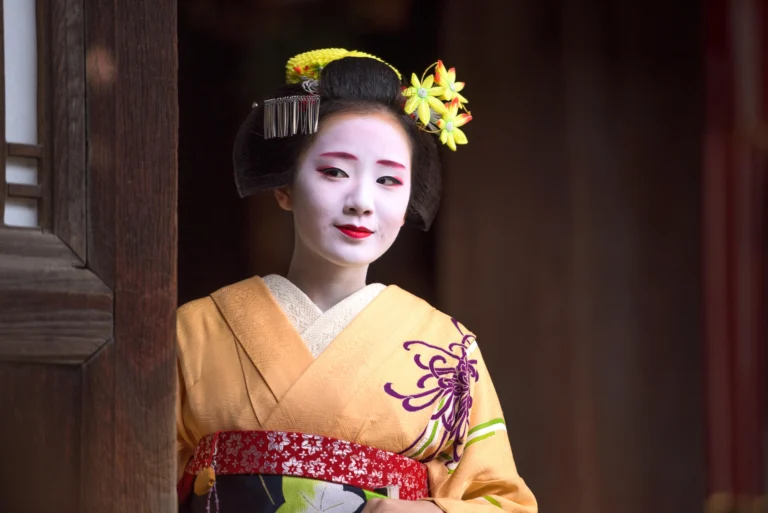
With their colorful kimono, stark white makeup, and extravagant hair ornaments, geisha are one of the most recognizable images of traditional Japanese culture. But like a lot of history, the reality was very different from the picture most people carry around today.
Japanese geisha: a history
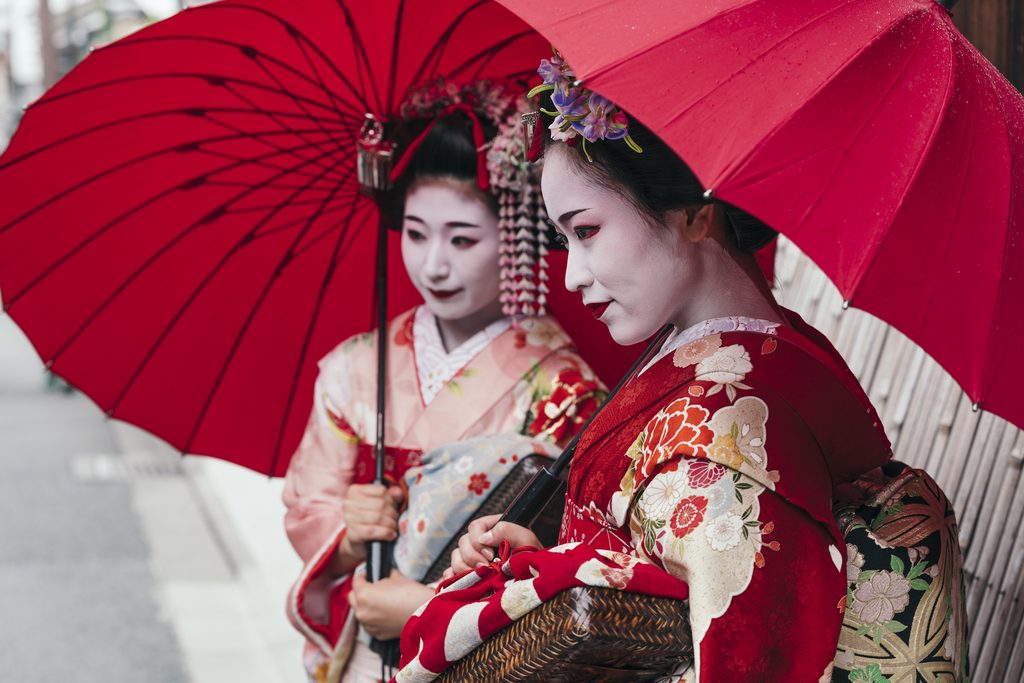
The term “geisha” (芸者) is originally a genderless word. In the beginning, it simply meant “entertainer” or “person of the arts,” and the first geisha were all male performers. Contrary to popular belief, female geisha weren’t licensed prostitutes. They sold performance and attention, under a slogan that ran “we sell art, not lust.” While that line was real, it was also thinner than the slogan suggests.
Early Japan was also a time of turmoil and upheaval. War and disaster tore families apart, leaving many children on their own. There were not a lot of job options for women at the time, let alone for young girls without family to support them.
Many became “saburuko,” or wandering “service girls.” The job did indeed often involve sexual services. However, girls from a “better background” found they could sell their services at high-class events as entertainers rather than prostitutes. It was these more advantaged young women who would start the movement of the traditional female Japanese geisha.
Setting the stage for Japanese geisha
In the late 700s, Kyoto (then Heian-kyō) became the imperial capital of Japan. At the same time, Kyoto flourished as a center of culture and art. With this new artistic boom came a new appreciation – or obsession – for the beautiful. And elite young women, many talented performers, flourished as well.
By the 1600s, the shogunate established the “pleasure quarters.” Prostitution was legal here. Common courtesans made their living as professional sex workers. However, some of these women developed their skills as well.
These women were yūjo (遊女), a general word for courtesans and prostitutes that long predates the licensed quarters. Their work combined acting, dancing, and sexual services, and their performances often carried an erotic charge. Troupes of them took up the kabuki-odori that Izumo no Okuni had introduced in 1603, and the resulting yūjo-kabuki got rowdy enough that the shogunate banned women from the stage altogether in 1629.
An emphasis on modesty
Eventually, people started to distinguish between elegant performances and pure pleasure. Elites began to focus more on skill and talent. Chaste female performers who worked outside of the sex industry were glamorized. Patrons paid a pretty penny for performances by the most skilled, most beautiful, and most modest young women.
This created a split between female entertainers. Skilled women who continued to sell sexual services became “oiran,” or skilled courtesans. Those who did not became “odoriko,” or dancing girls. These odoriko were the predecessors to female Japanese geisha.
Odoriko were young dancers hired directly by wealthy patrons, and they were supposed to be chaste. In practice, plenty of them sold sex on the side, which is exactly why the shogunate kept sweeping them up. Odoriko peaked as a profession in the late 1600s.
But the original odoriko grew old, and because the work only took young women, mostly teenagers, older performers needed somewhere to go. Some turned to prostitution. Many took real pride in their skills and wanted to keep performing.
These older former dancers needed a new name for themselves. They began to call themselves geisha, after their original male counterparts.
The first female Japanese geisha
The woman usually credited as the first is Kikuya (菊弥). She’d worked as an odoriko in Yoshichō, a Nihonbashi district built around the kabuki theaters, until the male entertainers there got tired of being outshone and drove her out.
Kikuya took her shamisen and her singing east to Fukagawa, opened a teahouse, and began training other women. By the Hōreki era (1751 to 1764), the women coming out of that district were being called onna-geisha (女芸者), female geisha, to mark them off from the men who’d held the title until then.
They were mature, fashionable trend-setters. Many modern Japanese styles you see today have their roots in Japanese geisha fashion. By the 1830s, geisha dominated the scene, and oiran fell out of style.
Becoming a geisha
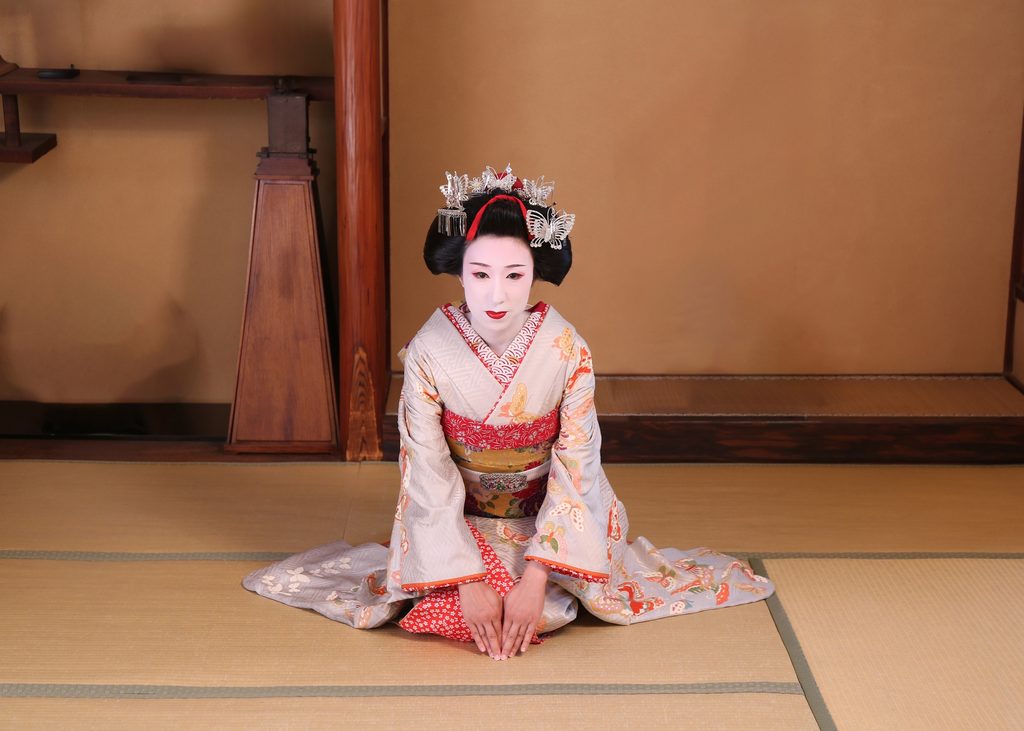
While almost any young girl could start training to become a geisha, not everyone could join the elite. A ranking system was established, along with a rigid training protocol. Many factors determined how high a woman could rise in the ranks, as well as how much money she could make.
Japanese geisha in training
Historically, training began very young. The youngest entered the okiya (置屋), or geisha house, at around age six, following an old custom of starting a child’s arts training on the sixth day of the sixth month of their sixth year. The okiya became her home, and training became her entire life. That isn’t how it works now: a Kyoto apprentice today starts after finishing compulsory school, at 15.
It was (and still is) very expensive to become a geisha. Once an apprentice joined a particular house, she became bound by contract. These expenses included all training and necessities, which she would eventually pay off with her individual income.
This meant that a working geisha usually didn’t see any of her earnings for quite a while. The less-expensive option was to be born into it. Daughters of elder geisha were often trained as heiresses to the position.
A woman would continue to work under contract to her okiya even after completing training to pay off her debt. When she finally settled her debt, she became a full-fledged geisha and could leave the home.
Minarai: watch and learn
Training started with minarai (見習い), literally “learning by watching.” Minarai helped around the house and attended to older, more established geisha. Established geisha acted as mentors, and minarai students often accompanied their seniors to observe. Some also worked at teahouses and learned informally through the shop owner, who acted as a mother figure.
Girls graduated from minarai with misedashi (店出し), the ceremony that marked her official start as a maiko, or apprentice geisha.
Maiko: hands-on apprenticeship
There were three main elements of a maiko’s formal training: arts, entertainment, and social etiquette. Here, the senior geisha fully took on the role of an older sister. Through schooling and mentorship, maiko developed a well-rounded skill set and prepared for their debut as an official geisha.
Mizuage (水揚げ) marked a maiko’s advancement to senior rank. The term literally means “raising water,” and originally referred to unloading a ship’s cargo; a second sense meant turning a profit in the entertainment business. At its simplest the ceremony was a change of hairstyle and wardrobe. But it came to carry something less modest as well.
That was the auctioning of an apprentice’s virginity to the highest-bidding patron. In the licensed quarters, a courtesan’s mizuage was her formal entry into sex work. Among geisha the emphasis was different, a rite of passage into full status rather than into prostitution, but the record doesn’t support the tidier claim that a paying first patron was never part of it. Most English-language readers met the practice through the 2005 film “Memoirs of a Geisha,” released in Japan as “SAYURI.”
Whatever its older forms, it didn’t survive the 1956 Anti-Prostitution Law. A Kyoto maiko’s mizuage today is a change of hairstyle, nothing more.
Japanese geisha aesthetics
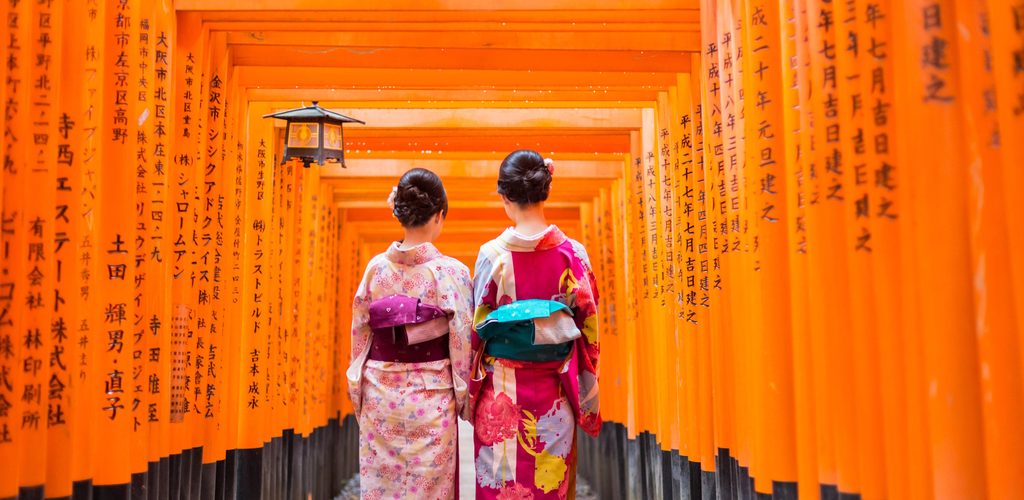
There were many distinguishing features marking both maiko and full-fledged geisha. Maiko focused more on a youthful appearance, with vibrant colors and heavy makeup. Japanese geisha aesthetics were more elegant and mature.
Maiko wore thick white face makeup, with vivid pinks and reds accenting the eyes and lips. The white ran down the neck and upper back, with two or three prongs of bare skin deliberately left unpainted at the nape, a detail called the eri-ashi.
You could read a maiko’s experience in her makeup, too: a first-year maiko painted only her lower lip, and from her second year she painted both. A full-fledged geisha painted both, more sparingly than a maiko would. In her last weeks as an apprentice, a maiko also blackened her teeth with kanemizu, an iron-and-vinegar solution layered with a tannin-rich gall powder.
Dress was another indicator. Both maiko and geisha wore kimono, but a maiko’s were more vibrant and flashy while a geisha’s stayed subdued. Their obi, or sashes, were tied differently according to rank and season. Footwear gave it away too: a maiko wore okobo, tall wooden platforms, while a geisha wore flat zōri or geta. Losing the okobo is one of the things graduating apprentices remember most.
Finally is hairstyle. Again, these differed with experience and rank. But they were all very elaborate and required plenty of maintenance. In training, a maiko would sleep with her head on a raised pillow to keep her hair from touching the ground. This was very uncomfortable, as she could not move in her sleep.
To establish discipline, seniors poured rice around the maiko’s pillow at night, which would stick in her hair if her head happened to fall off the pillow. It was a pain to remove, so it didn’t take long for a young maiko to get used to her new sleeping habits.
Question: do you like UJ's independent coverage of Japan? Our writers are supported by our members. Join Unseen Japan Insider to get bonus content every week, an ad-free website, and access to our large and growing Insider archive.If you love UJ's independent coverage of Japan, join Unseen Japan Insider to get content every week, an ad-free website, and access to our large and growing Insider archive.
Life and interaction with guests
Part of why the pleasure quarters flourished is that elite marriage in this period wasn’t built around romance. Among the samurai and merchant classes a marriage was a contract for continuing a household line, and a husband’s patronage of the quarters was widely tolerated.
A pleasure-seeking patriarchy
The role of the traditional Japanese wife was to raise children and take care of the home. For romance, men sought out “pleasure women,” such as courtesans and geisha.
Despite the focus on modesty and purity, geisha carried an erotic charge that respectable women weren’t permitted. Watching a geisha entertain was a good deal more exciting than an evening at home, especially with the occasional glimpse of bare skin at a wrist or a nape.
Edo-period society was rigidly patriarchal, and the assumption that a woman’s role was to serve men went largely unquestioned. Geisha performances, and the looseness of the pleasure quarters, gave men an escape from their daily lives. For the women working there it was also one of the few routes to real earnings and some measure of independence, which isn’t the same as saying it was a good bargain.
Marrying into luxury
Japanese geisha could not marry while in the profession. However, higher-ranked and well-established geisha could marry into retirement.
This was the final step in a geisha’s career, the equivalent of retiring with a loaded 401(k). Successful geisha could find a wealthy, upper-class man, to sponsor her retirement. These men, or “danna,” (literally “master,” but also meaning “husband” in modern Japanese) paid off any remaining debt the geisha owed to the okiya, liberating her from the contract and securing her independence.
The danna didn’t always pursue official marriage, though some did. For geisha, marriage wasn’t always about love, either. Though there have been cases involving romance, it was often for financial freedom, the ability to retire and live in luxury under the patronage of a wealthy man.
War and changes
Japanese geisha continued to flourish and oiran straggled behind until World War II. Even though Kyoto was not as affected as other parts of Japan by physical damage, nation-wide war efforts brought a decline in business to geisha houses. By 1944, geisha districts were completely shut down, and many women were forced into more laborious jobs.
After the war, many tried to pick back up where they left off, but business wasn’t the same. Prostitutes began offering themselves to American soldiers as “geisha girls.” By the time geisha houses were allowed to reopen in October 1945, the name had already been tarnished. Occupation authorities ordered Japan’s licensed-prostitution system abolished the following January, though prostitution itself stayed legal until the 1956 Anti-Prostitution Law came fully into force in 1958. And with the country turning toward Western styles, geisha were no longer the forerunners of fashion.
Even with their slight recovery in the ’60s with the economic boom, new advancements in the entertainment and pleasure industry (such as the introduction of nightlife and love hotels) only blurred the lines further. Younger people were clearly choosing modernism in favor of tradition.
Modern-day Japanese geisha
Existing maiko and geisha are still a part of Japanese society. They still inhabit okiya, and live in traditional towns like Gion in Kyoto. However, unlike days of old, their roles now often involve entertaining tourists.
While there are certainly many who enjoy this position, there are a number who also lament the changing times. Many feel pressured by the threat of over-tourism reducing their tradition to a mere attraction. In 2024, Gion started warning tourists they’d be fined for wandering onto its private streets.
Some geisha have tried to adapt, working more modern elements into their style, though plenty in the profession see that as a betrayal of tradition. The numbers keep shrinking either way. Kyoto’s five hanamachi counted 155 geiko and 56 maiko in April 2024, down from 175 and 79 five years earlier, and down from roughly 1,200 Kyoto geiko around 1960.
It’s still a working profession, albeit a contested one. In 2022, a former maiko went public with allegations of underage drinking and sexual assault that put the training system under national scrutiny.
Despite controversies and the passage of time, geisha remain a vivid worldwide symbol of the refined, elegant side of Japanese culture. It’s unlikely this tradition will disappear completely. It will, however, need to keep adapting to the times.
Keep reading




Sources
花魁と芸者(芸妓)はどう違うの? About difference between Oiran and Geisha. スタジオ七色 (archived)
花柳界の歴史(江戸時代~幕末) 東京花柳界情報舎
花魁の歴史について History of Oiran スタジオ七色 (archived)
舞妓と芸子(芸妓・芸者)の違いとは?年齢・お給料・髪型・着物は? PIKARINE
水揚げ (花街) Wikipedia(日本語版)
売春防止法 Wikipedia(日本語版)
Differences between a Geiko (Geisha) and a Maiko (with subtitles) 【HD】 Kyoto Fan (YouTube)
舞妓さんって何者?そのお仕事と生活を紹介します。 お座敷体験 宴-UTAGE-
Geisha vs Oiran: What’s the Difference? 花魁と芸者の違い WAO RYU!ONLY in JAPAN (YouTube)
海外における「ゲイシャ」のイメージについて(上田卓爾) 大阪観光大学紀要 第13号 (archived)