
Stockings have been a staple of women’s fashion ever since nylon showed up on the market in 1939. They just have one major Achilles’ heel: running at the slightest snag. A fingernail, a rough edge on a chair, or an unfortunate encounter with a zipper can turn an otherwise perfectly good pair into trash. Surely, with modern textile technology, someone could make a better product?
Apparently, even the hint of such a product can get people worked up. Japanese entrepreneur Ōhashi Marika, better known online as “Moto Suzuki-san,” decided to take on the challenge of making stockings that don’t run.
Nearly two years later, she says she’s close to having a marketable product. But the project has also brought her considerable online harassment, including an alleged bomb threat.
It all started with a sock company’s social media account
The story goes back to December 2024, when a user on X suggested that manufacturers deliberately make clothing wear out so consumers have to replace it. The post specifically mentioned stockings, arguing that today’s technology should make it possible to make a pair that doesn’t run.
The official account of Kutsushitaya, a Japanese sock retailer operated by Tabio, wasn’t impressed. On December 13, it responded that “unbreakable stockings” belonged in the realm of urban legends and conspiracy theories. It said that if manufacturers could make them, they would.
Some users described the response as condescending and accused the company of responding from a male perspective. Tabio apologized three days later for inappropriate social media posts but did not retract its claim that the challenge was difficult.
Two days after the original exchange, however, Ōhashi Marika jumped into the discussion with a simple message: “Unbreakable stockings! Hell yeah, let’s do this!”
From a stocking challenge to online harassment
Ōhashi is the president of Tokyo-based apparel company Alyo and the founder of the CINEMATIQ clothing brand. Her designs are known for practical features, particularly pockets large enough to hold a 600-milliliter (or 20-fluid-ounce) bottle. She is also associated with the corset brand Enchanted Corset.
In February 2025, Ōhashi said she had received threats serious enough that she asked Akasaka police to investigate. A few months later, she revealed that someone had used her name to order expensive soap and fugu hot pot for cash on delivery. Orders had also reportedly been placed in her name for hotels and women’s adult services.
Cash-on-delivery harassment is particularly inconvenient because the recipient can be left dealing with unexpected packages and bills for things they never ordered.
The situation escalated again on November 4, 2026, when Ōhashi posted an update about the project. She said the announcement had generated hundreds of abusive messages, unwanted food deliveries, and even a bomb threat.
Her post struck a nerve. It attracted approximately 15 million views, while an English-language post quoting it received about 200,000 likes. And it likely drew so much attention because a woman trying to make a practical product for other women had seemingly become the target of hostility from people who weren’t even potential customers.
How do you make stockings that don’t run?
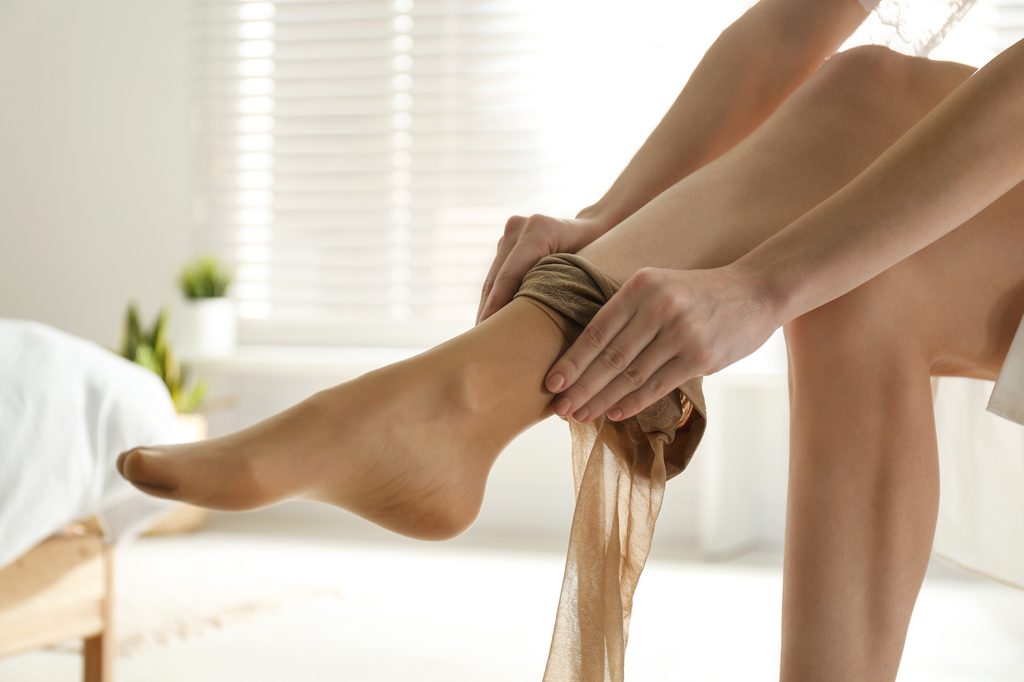
The idea of no-run stockings isn’t entirely new. In fact, another Japanese manufacturer, Atsugi, introduced its Sugosuto stockings in March 2025. It came about after more than two years of development, long before the Kutsushitaya controversy.
Sugosuto uses approximately 50-denier fabric, considerably thicker than conventional sheer stockings. Its construction combines two materials to maintain a relatively transparent appearance while providing greater durability.
According to Atsugi, the fabric survived more than 20,000 abrasion cycles in testing: about 3.6 times the performance of a comparable 25-denier stocking. The product also has reinforced toes and additional material around the waist and thighs.
The trade-off is thicker fabric. Also, they can still be cut or snagged, so calling them completely indestructible would be misleading.
Ōhashi, meanwhile, says her own project has made significant progress. In August 2026, she announced that she had developed fabric she considered resistant to runs and found a machine that could knit it. She also believed she could bring the product to consumers at an affordable price.
Her November update included video of the material, although she has not yet disclosed the fabric’s specifications or published any independent durability testing.
Question: do you like UJ's independent coverage of Japan? Our writers are supported by our members. Join Unseen Japan Insider to get bonus content every week, an ad-free website, and access to our large and growing Insider archive.If you love what we do, help us pay our writers to do more of it by joining Insider. You'll get bonus content every week, an ad-free website, and access to our large and growing Insider archive.
Not everyone is celebrating
Much of the international reaction has focused on the apparent absurdity of men becoming angry over a product designed for women. Some Japanese women also mocked arguments that stronger stockings could be dangerous around escalators, pointing out that ordinary clothing can get caught in machinery, too.
However, the Japanese response hasn’t been entirely one-sided.
Some critics argue that Ōhashi is presenting the original challenge too broadly. They point out that asking whether a product is technically feasible or requesting development updates isn’t necessarily harassment. Others have questioned whether legitimate skepticism has been lumped together with genuinely abusive behavior, a fight that echoes past backlash against women-only products.
Those are reasonable distinctions. Not everyone questioning a new product is an online bully, and not every disagreement deserves to be treated as an attack. But obviously, sending unwanted deliveries, making threats, or trying to intimidate someone is much more than simple criticism or “asking questions.”
The final test will be the price
For now, Ōhashi’s stockings remain a work in progress. She says the material is strong enough to sell, but her company hasn’t decided on a final price or shown any samples. It also doesn’t have a confirmed release date yet.
The irony is that the original argument was about whether manufacturers could make stockings that didn’t run. Atsugi has already shown it’s possible to make stronger versions, and another option is making progress.
Ultimately, consumers will decide whether the product is worth buying. If it works and the price is reasonable, women who are tired of throwing away stockings after one unfortunate snag might be willing to pull out their wallets.
Keep reading




Sources
炎上した「靴下屋」Xは、一体何に謝罪しているのか 発端の「破れないストッキング」論にもダンマリ J-CASTニュース
靴下屋、「破れないストッキング」めぐる投稿を謝罪 「意見を真摯に受け止める」 J-CASTニュース
靴下ブランド『靴下屋』公式アカウントが炎上して謝罪、企業SNS“中の人”から漏れ出す“自我”は嫌われる 週刊女性PRIME
靴下屋「”キレ気味”投稿で炎上」から得られた学び 過去には同アカウントの投稿が称賛されていたが… 東洋経済オンライン
元鈴木さん、「一線を越えた内容の脅迫」を受け、警察への捜査依頼を告白。「異常すぎる」と心配相次ぐ All About ニュース
起業家・元鈴木さん、ふぐちり着払い「嫌がらせ」被害明かす 過去に「破れないストッキング」騒動で警察沙汰も J-CASTニュース
コルセットオタクが高じて起業 ”元鈴木さん”って何者? WWDJAPAN
タイツの強度とストッキングのような透明感 新次元レッグウェア「スゴスト」発売 アツギ株式会社