
Most English speakers out there are probably already familiar with the term “pink tax,” but it’s a new one in Japan. The topic came up when a viral X post pointed out that MUJI’s linen pants cost the same for men and women, even though the women’s version uses less fabric.
For those who don’t know, the pink tax refers to a phenomenon where the women’s version of a given product costs more than the men’s version. Or, such as with the above example, that the women’s and men’s versions have the same cost, but the women’s version comes with less than its counterpart, whether less fabric, less soap, etc.
In a country where sexism has long been an issue, it’s no surprise the discussion is catching people’s attention.
A pink tax discussion that started with a simple tweet
On May 25, 2026, X user @femimi33 posted a simple observation: MUJI’s men’s and women’s linen pants are sold at identical prices even though they each clearly use a different amount of material, with the women’s version having less pockets. The post quickly picked up traction, with over 15,000 likes and nearly 2,000 reposts within three days.
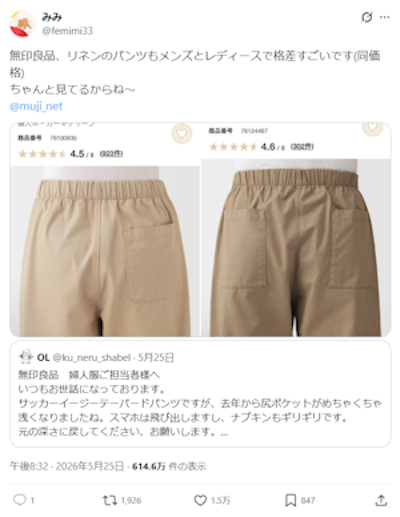
Some users accused OP of needlessly injecting gender where it doesn’t belong. Others, however, agreed, noting that the men’s pants were built better and last longer despite costing the same.
Earlier that same day, the same user shared another data point: a 65-year-old female colleague with 20 years of tenure who earned ¥180,000 (USD $1,128) per month, while male peers in similar roles made over ¥300,000 (USD $1,881). That’s a gender wage gap issue rather than the pink tax, and it’s a whole other can of worms with women’s rights issues in the workplace.
Together, the posts represent a snapshot of “women’s everyday economics” in Japan: small, cumulative inequalities that add up over time.
This isn’t the first time people have side-eyed MUJI, specifically, for treating men and women differently. In March 2025, people noticed that MUJI displayed women’s underwear on live models, while men’s was shown only on mannequins. Parent company Ryohin Keikaku explained that customers wanted to see how women’s items fit, whereas men weren’t as interested in that.
Certainly, gendered stereotypes would agree that women care a lot more about fashion. However, in any case where companies treat the genders differently, people are going to ask questions, as they should. It’s important to examine these issues and determine whether it’s harmless or discrimination.
Glaring price difference in other arenas
The pink tax shows up most clearly in everyday services. Take dry cleaning. According to Financial Field (2024, updated 2025), cleaning a standard men’s dress shirt (ワイシャツ) costs around ¥200 (USD $1.25). But for a women’s blouse? Typically ¥400 (USD $2.50), up to twice as much.
The reason for this is actually pretty straightforward. Men’s shirts pretty much have the same cut across the board, and dry cleaners can process them on high-speed press machines.
Women’s blouses, on the other hand, don’t have such a cookie-cutter style. Shape and design details can vary widely between blouses, so they can’t be tossed into a one-size-fits-all machine. Dry cleaning staff need to iron them by hand, which naturally takes a lot more time and effort.
Hair salons offer another example. When it comes to hair salons, women pay on average about ¥2,300 (USD $14.40) more per visit than men. Some of that gap comes from add-on services like coloring or perms, but many salons build in the base price difference from the start.
Oh… did you think I was out of examples? I wish. A widely shared 2023 essay on feminist blog Gender Cooking described a woman switching to her partner’s razors. She found them cheaper, more durable, and easier to use.
Technically and legally, there is no discrimination going on. The cashier at the register isn’t going to charge a woman more for the exact same cartful of products. As with the feminist blogger above, women can buy men’s products instead if they’re dissatisfied.
Still, it’s hard not to get annoyed when products and services specifically targeting women so consistently have a steep upcharge.
Question: do you like UJ's independent coverage of Japan? Our writers are supported by our members. Join Unseen Japan Insider to get bonus content every week, an ad-free website, and access to our large and growing Insider archive.We manage to keep most of our content free thanks to the generosity of our members. Join Unseen Japan Insider and you'll get access to new, exclusive UJ member content weekly, an ad-free website, and access to our large and growing Insider archive.
How the pink tax looks globally
These are small examples, but they mirror global data: products marketed to women often cost more, even when they’re functionally identical.
A 2015 New York City study found women paid about 7% more on average across product categories, with higher gaps in personal care and clothing. Part of this is simply that women tend to prefer fragrances in lotions, deodorants, and soaps. It’s not even about pickiness, necessarily; women tend to have a much keener sense of smell than men (thanks, estrogen!).
Men’s personal care products often have no added smells or offer less variety. Less added fragrance equals cheaper.
As for clothes, a large portion of the fashion industry targets women, with constantly changing styles and designs to grab people’s attention. That naturally creates more behind-the-scenes cost. So, the reasons for the gap in costs are a lot more complicated than simply “sexism.” (Though that is unarguably still a problem in some areas.)
That doesn’t mean the issue should be so easily dismissed. A frequently cited 2004 California estimate suggested that women could pay up to $100,000 more over a lifetime for similar goods and services, roughly ¥10 million at the time.
It’s precisely because of these issues that some countries, like Belgium, have begun experimenting with gender-neutral pricing models. Japan, though, hasn’t followed suit.
Pinkflation (because it wasn’t pink enough yet)

There’s also a related concept gaining attention in Japan: pinkflation (ピンクフレーション). This refers to the idea that prices for women’s goods rise faster over time.
One analysis found that women’s clothing prices increased significantly between 2000 and 2022, while men’s remained nearly flat. The pinkflation theory says that brands assume women are less price-sensitive when it comes to fashion, and price accordingly.
All of this plays out against a broader economic backdrop. Japan ranked 118th out of 148 countries in the World Economic Forum’s 2025 Gender Gap Index, the lowest among G7 nations. While some economic indicators have improved compared to earlier years, Japan has a long way to go.
For readers familiar with similar debates in the U.S. or Europe, none of this is surprising. But in Japan, the conversation’s just getting started.
Keep reading



Sources
@femimi33 — 「無印良品、リネンのパンツもメンズとレディースで格差すごいです(同価格)」 X (Twitter)
ワイシャツのクリーニング代は「メンズ200円」なのに「レディースは400円」でびっくり! ほぼ同じ形状なのに「料金差」がある理由とは? ファイナンシャルフィールド
〈女性は鑑賞対象という認識があるのでは〉『無印良品』女性用ショーツのみモデル着用のオンラインストアに議論〈女性客のために企業側が金かけている〉との意見も…広報の公式回答は NEWSポストセブン
ピンクタックス(ピンク税)とは?男女の価格格差の実態とジェンダーレスな解決策 TSUNAGOOD
生涯1,000万円以上の損? 欧米で問題視される「ピンクタックス」と撤廃を唱える企業の取り組み AMP(アンプ)
なぜ高い「女性価格」 スイスのピンクタックス SWI swissinfo.ch
払ってました、ピンクタックス ジェンダー3分クッキング (The Secret Recipe of Gender)
ピンク税 ウィキペディア(日本語版)
ピンクフレーションとは・意味 IDEAS FOR GOOD
男女でヘアサロンのカット料金を変えない「ジェンダーニュートラル料金」 IDEAS FOR GOOD Business Design Lab
「ジェンダー・ギャップ指数」2025が発表 日本は前年と同じ118位。政治分野は後退 国際協力NGOジョイセフ(JOICFP)
“女性用”が高くなるカラクリ、ピンク税を排除「指毛もわき毛も剃りたい」女子のためのカミソリブランドが登場 HEAPS Magazine