
Publisher’s note: Part of this article is paywalled. I get pushback from paywalling articles on topics such as this, as our readers say that it’s important for English consumers of Japanese news to understand how people in Japan are fighting against discrimination. I agree. That’s why, unlike other publishers that paywall everything, UJ only locks a single article every week in an effort to help fund the freely available work we do.
I’ve put as much useful information in this article as I can above the fold. If you can afford it and value the work we do, I encourage you to subscribe to Unseen Japan Insider either on this site or via our Substack. If this article gets over $200 in new support, we’ll make it free for all.
Along with the global surge in fascism, we’ve seen the Overton Window move to the right when it comes to publishing salacious and outrageous content. With cancel culture canceled, racists, sexists, and homophobes feel emboldened to keep pushing society further to the right.
The same is happening in Japan. I’ve documented how the right-wing here is using tactics similar to those of the worldwide right, particularly the MAGA movement in the US, to inflame hate against foreign residents.
Fortunately, despite the world’s rightward lurch, some people still have the courage to push back against these narratives and stand up for human rights. The latest such story involves a bestselling novelist.
If you’re into novels from Japan, you’ve heard of Yuzuki Asako. Yuzuki is author of the popular work Butter, which has sold over 1.7 million copies worldwide in 40 countries (around 650K copies sold in Japan). It’s available in English, translated by Polly Barton, for those who want to read it.
The work, which I’m enjoying on audiobook right now, is loosely based on the Kijima Kanae or “konkatsu” (marriage dating) murder case. It follows a reporter who tries to solve the case of a former food blogger accused of serial murder. (“There are two things I simply cannot tolerate,” accused killer Kajii Manako sniffs. “Feminists, and margarine.”)
An author not afraid to make strong statements
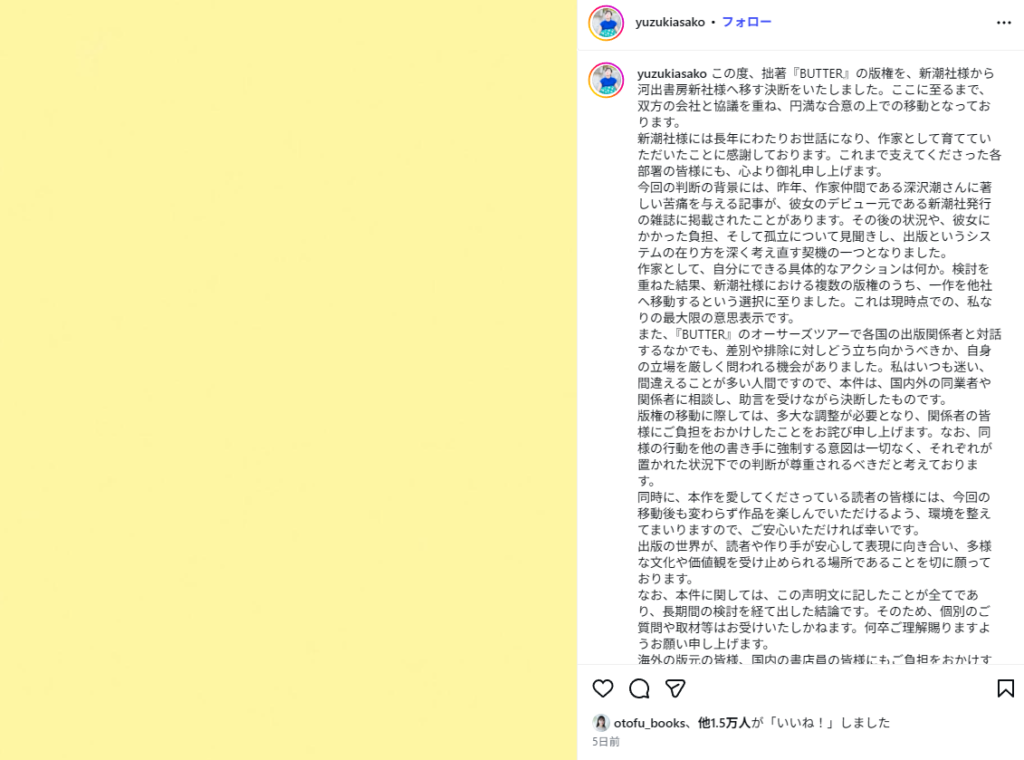
Until now, Butter has been published by Shinchōsha. That changed this week when Yuzuki announced she was moving the publishing rights to the title to Kawade Bunko. Kawade will release Butter in paperback starting in mid-June 2026. It’s only one of several titles to which Shinchōsha holds publishing rights – but it’s also the most popular. Yuzuki also said she wishes to be contacted professionally through Kawade now.
“This is the strongest statement I can make,” Yuzuki said in her statement. She says the transfer of rights required extensive groundwork and apologized to those who were inconvenienced.
Yuzuki is no slouch when it comes to making strong statements. Her previous post before this one announced her support for the Proud Futures initiative, which seeks to perform outreach to LGBTQ+ kids to let them know that “you’re not alone.” She also has posted repeatedly about feminist issues, such as commemorating the anniversary of the Iceland Women’s Strike.
What caused Yuzuki to do something as dramatic as leave her publisher? A magazine article by her publisher that Yuzuki – and many others – found blatantly discriminatory against novelists of Korean heritage. It wasn’t just discriminatory – it discriminated against an author whose debut novel was published by Shinchōsha.
“Stop using Japanese names,” bleats Shinchō columnist
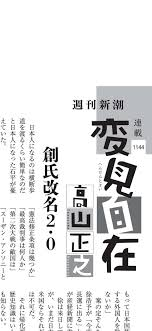
The article by right-wing commentator Takayama Masayuki appeared in the November 2025 issue of Shūkan Shinchō (週刊新潮). The article was called “Sōshi Kaimei 2.0.”
Now this, alone, is bad. Let me take a minute to explain why this is bad.
Sōshi Kaimei (創氏改名) was an assimilationist policy in World War II that was part of Japan’s effort to wipe out Korean culture in occupied Korea. It forced Japanese assimilation by requiring Koreans to adopt Japanese names. There’s open debate about how much this was pushed as official government policy versus “encouraged” by local Japanese officials in Korea. Koreans who refused to adopt a Japanese name, however, suffered blanket discrimination in employment, education, and healthcare services.
Takayama, of course, wasn’t invoking this word to suggest that Japan resume these policies. Rather, he’s stoking fear around a secret “Korean invasion”: people taking Japanese names and “acting” Japanese but then, in his view, “using” their “Japanese-ness” to stoke “hate” against Japan.
What constitutes “hate” against Japan? As a liberal publisher, I can tell you: anything that comes off as mildly critical of Japan’s current state. Anyone who points out, for example, that women in Japan suffer sexual harassment, that women should have the right to choose their last names, or even that Japanese LGBTQ people exist get accused of trying to “change” Japan.
In his column, Takayama specifically singled out several Zainichi (resident Korean) celebrities in Japan who have naturalized and taken Japanese names. One of them was author Fukazawa Ushio (深沢潮), who was born in Japan a Zainichi Korean in 1966 but took Japanese citizenship in 1993.
“It’s up to these people if they wanna hate Japan and Japanese people. But at least stop using Japanese names.”