

A recurring theme in Japan these days is the tension between needing kids and raising kids. On the one hand, Japan’s government is spending trillions of yen on programs aimed at encouraging childbirth and countering population decline. On the other hand, parents in Japan say that the country’s long work hours and gender inequality makes childrearing difficult.
A new story this week highlights this tension, as the first female mayor in Japan announced she would take maternity leave. When some prominent members of Japan’s old guard lectured her for the decision, a cadre of online voices rose up to support her.
Calls for her pay to be zeroed out during leave
Kawata Shōko (川田翔子), a native of Nara, worked as a welfare case worker and was a private secretary to a member of Japan’s Upper House from 2022 to 2023. In 2023, she was elected mayor of Yawata in Kyoto Prefecture, becoming Japan’s youngest female mayor. Kawata ran as an independent and was backed by the Liberal Democratic Party (LDP), Kōmeitō, and the Constitutional Democratic Party (CDP).
On May 20th, Kawata revealed to Asahi Shimbun that she planned to take maternity leave. She later explained her plans in more detail at a press conference on May 21st. The mayor plans to take six to eight weeks of prenatal maternity leave and eight weeks of postnatal maternity leave, followed by childcare leave.
Vice mayor Nose Shigeto will be in charge during her absence. However, Kawata says she’ll be online attending key meetings and available by phone and email. During childcare leave, she plans to work a reduced schedule.
In her interview with Asahi, Kawata talked about how she wants to create a Japan “where women can compete easily at the top jobs, and that means a society where women at the top of an organization can take maternity and parental leave.”
“I’ve also felt the need to push myself to work in order to get where I am. I’ve had to postpone life events to do it.”
The announcement triggered a debate in Japanese news media and online. Multiple online commentators said that her pay should be zeroed out or at least not count toward her severance.
A couple of days after the announcement, Former Japanese Air Self-Defense Force chief of staff Tamogami Toshio (a man, of course) posted on X that he felt “great unease” as “someone of an older generation” over her decision. “If a long leave’s foreseeable, I don’t think you should run for offices like mayor.”
Question: do you like UJ's independent coverage of Japan? Our writers are supported by our members. Join Unseen Japan Insider to get bonus content every week, an ad-free website, and access to our large and growing Insider archive.If you love UJ's independent coverage of Japan, join Unseen Japan Insider to get content every week, an ad-free website, and access to our large and growing Insider archive.
A discriminatory double standard
Those arguments from the “older generation” aren’t getting a lot of sympathy online.
On Yahoo! News JP’s post on X, a majority of comments (over 60%) defended Kawata’s right to take leave. One popular comment with over 2,300 likes argued against critics, “Anyone can fall ill at any time; why does someone taking maternity leave set you off?”
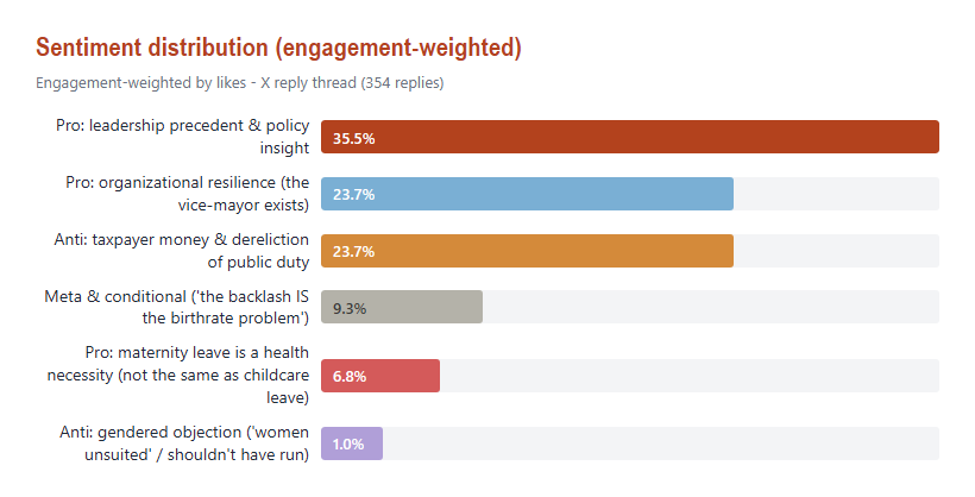
Only around 25% of comments were anti-leave. Some of the most-liked comments were outright misogynistic. A comment with over 2,300 likes labeled the leave as “private use of tax money” and declared, “When the hen crows, the nation falls” (雌鶏鳴けば国滅ぶ), a reference to an ancient Chinese proverb from the Book of Documents (尚書) that argues that women obtaining political power dooms a country.
On Yahoo! News JP, comments were supportive but a little more nuanced. The top comment, with over 9K likes, supported Kawata’s decision to take maternity leave (which is guaranteed by law), but questioned whether childcare leave would be “disruptive.”
Meanwhile, ex-JSADF chief Tamogami got bodied on his own thread. While 27% of users agreed with him, 72% laid into him with harsh language. Most comments pointed out that Tamogami’s logic would bar old men like him from serving in public office, too.
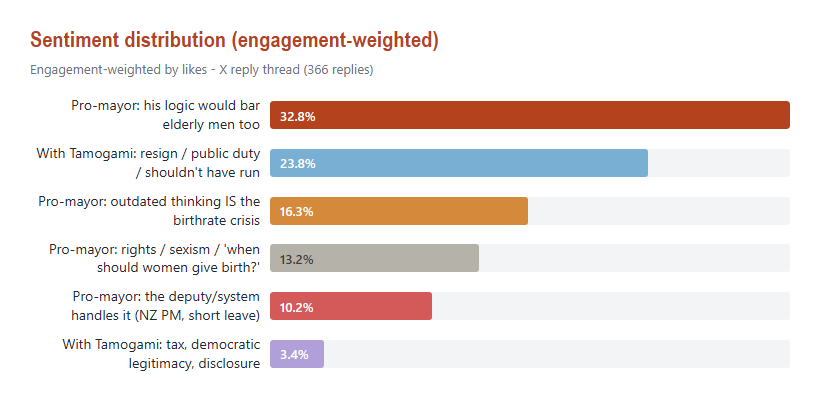
One user pointed out that, if taken seriously, this stance would bar women from politics. “You’re effectively telling women under 40 not to become politicians, or to stay childless.” That’s a hot button issue, as Japan already suffers from a dearth of women in politics; its low annual rating on the World Economic Forum’s Gender Gap Report is due in no small part to how few women hold positions of political power.
Give us kids, but don’t ask for help
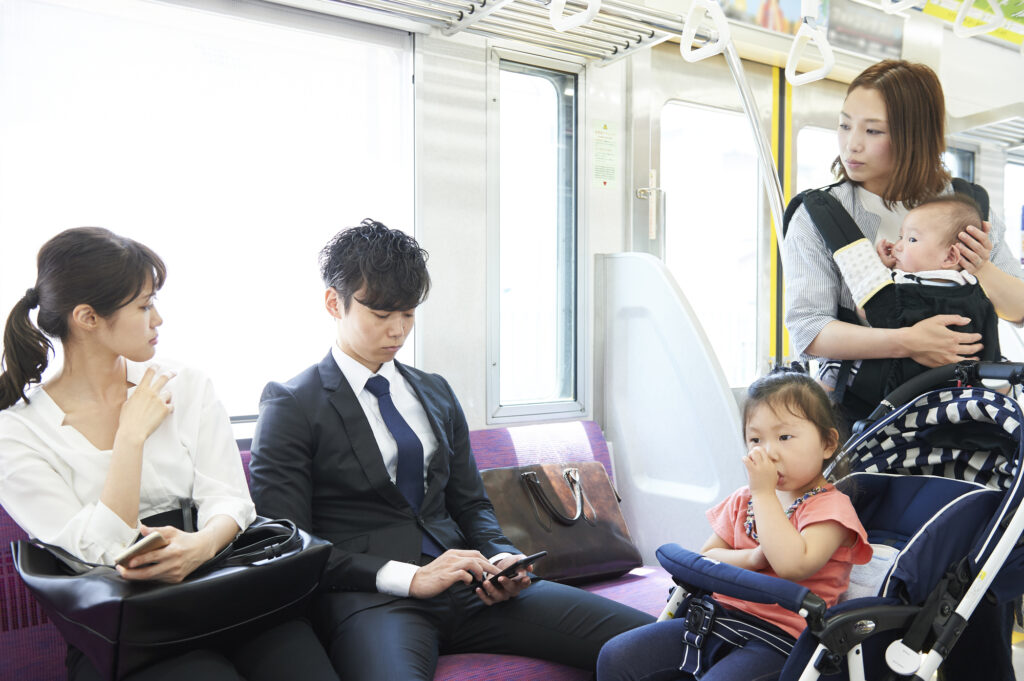
The debate surfaces a theme I’ve covered for years here on UJ: Japan wants more kids, but balks at making it easy to raise them.
Having kids isn’t just expensive; it creates societal friction. For example, many parents for years have complained about how they feel unwelcome bringing baby strollers onto public transit. Major brands have faced backlash for supporting parents with small children, such as when Soup Stock Tokyo announced it would offer free baby food. Meanwhile, elderly residents have lobbed noise complaints at daycare centers and public parks.
Japan also refuses to address the unfair burden that childcare places on mothers. Women in Japan do far more housework than their husbands. Even in households where the men say they believe in equality, women do most of the chores.
It’s not all men’s fault, though. Even men who want to take more of a role in childrearing run into obstacles. Some men have reported being demoted or even transferred for daring to take parental leave. Former Prime Minister Kishida Fumio drew criticism when he suggested that workers on parental leave use the time to “reskill.” (Instead of, you know, caring for their kids!)
Around 70% of married-couple households in Japan these days are dual income. If the country wants to bolster its birth rate, it needs to support working mothers. On the one hand, it’s heartening to see so much backlash against outdated notions that women should stay home if they want to have kids.
On the other hand, Tamogami’s comments show that the “old guard” is still set in its old ways. And unfortunately for Japan, they’re the ones running the country. But if voters elect more young talent like Kawata, maybe that’ll change.
Keep reading



Sources
全国最年少の女性市長、産休取得へ 現職は全国初か 夏から十数週間 朝日新聞 (via Yahoo!ニュース)
京都・八幡市の川田翔子市長、産休取得へ 現職女性首長で全国初か 日本経済新聞
最年少女性市長、産休取得へ 現職で初か―京都府八幡市 時事ドットコム
京都八幡市 川田翔子市長産休を巡りSNS大論争に 全国初の女性首長に賛否激突 coki (公器)
史上最年少の女性市長が登庁 33歳川田氏、京都・八幡 日本経済新聞
川田翔子 (八幡市長) ウィキペディア日本語版
プロフィール(川田翔子市長) 八幡市役所