
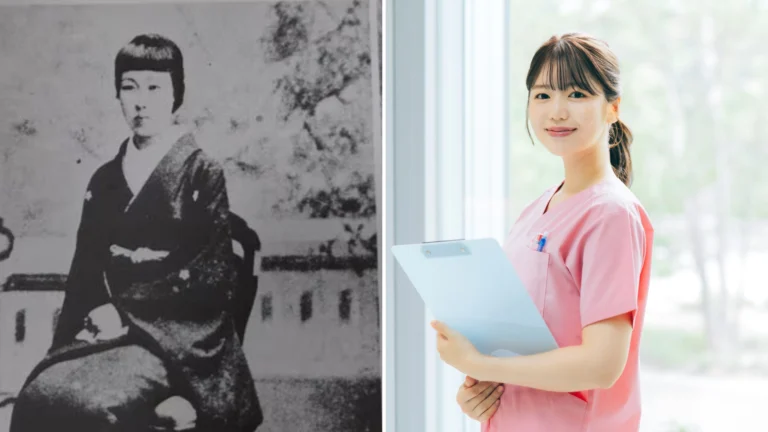
NHK’s 2026 morning drama Kaze, Kaoru has brought renewed attention to the early days of modern nursing in Japan. The show follows two heroines, one modeled on the well-known Ōzeki Chika and the other on a far less familiar figure: Suzuki Masa.
In the drama, the fictional character Oya Naomi represents Suzuki. Still, her real-life story is just as compelling as the drama she’s featured in.
The real-life history of Suzuki Masa
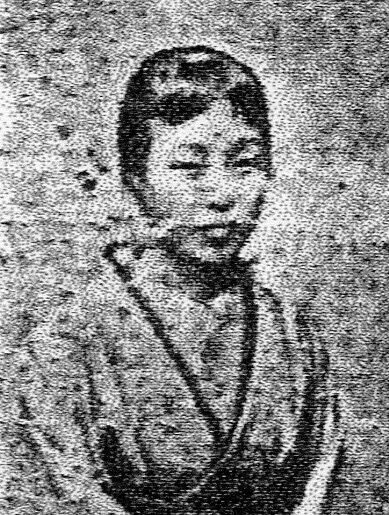
Despite her historical importance, Suzuki isn’t a household name, even in Japan. Since she didn’t write a lot about herself, what we know of her comes mostly from other people. For example, some descendants described her as “cool, sharp, and very charismatic.” It’s a fitting set of adjectives for someone who, much like Ogino Ginko, helped shape the entire nursing profession in Japan.
Born in 1858 to a samurai family as Katō Masa, she lived during a transformative moment in Japanese history. When she was just 10 years old, the Boshin War broke out, as shogunate loyalists tried to resist the Meiji Restoration and preserve the old order. Her own father participated in the war, which ultimately failed to stop Japan’s march into the modern age.
One of her biggest turning points came when she studied at Ferris Seminary in Yokohama from 1876-1877. There, she became fluent in English, which was an exceptionally rare skill for a Japanese woman at the time. It would also prove indispensable to her later career as a nurse.
Suzuki’s training as a nurse and her classmate, the Meiji Nightingale
In 1878, Katō married Suzuki Yoshimitsu and became Suzuki Masa. Unfortunately, her married life was short-lived, as her husband died just five years later, leaving her a widow with two children. This was right in the thick of the Meiji Era, when feminism in Japan was gaining momentum.
She moved to Tokyo and, a few years later, entered one of the most significant institutions in Japanese medical history: the nurse-training annex of Sakurai Girls’ School. Founded by missionary Maria True and educator Sakurai Chika, it was Japan’s first formal program for modern nursing education.
Suzuki was part of the school’s first class, alongside Ōzeki Chika, who would later become famous as “the Nightingale of the Meiji Era.” (Not to be confused with Yamamoto Yae, who was “Japan’s Florence Nightingale.”) The name comes from the style of nursing taught at Sakurai Girls’ School, which was Florence Nightingale’s Nursing Theory. In Japanese, it’s called Naichingēru-hōshiki no kango (ナイチンゲール方式の看護).
Florence Nightingale was another legendary figure in the field of nursing. Her theories, such as the Environmental Theory that says environmental factors are crucial in improving a patient’s health, are still used today.
Agnes Vetch, a British nurse trained in this style of nursing, came to Japan to teach the most advanced nursing practices of the time. Suzuki, with her high-level English skills, served as an interpreter for Vetch. In fact, Tanaka Hikaru, a noted writer and academic, argues that it was likely because of Suzuki translating Nightingale’s ideas into Japanese that Ōzeki was able to fully flourish as a nurse.
Question: do you like UJ's independent coverage of Japan? Our writers are supported by our members. Join Unseen Japan Insider to get bonus content every week, an ad-free website, and access to our large and growing Insider archive.We manage to keep most of our content free thanks to the generosity of our members. Join Unseen Japan Insider and you'll get access to new, exclusive UJ member content weekly, an ad-free website, and access to our large and growing Insider archive.
An indelible mark left in history: dispatch nursing and labor rights
After completing her training, Suzuki became head nurse of internal medicine at the Imperial University’s First Hospital. Not only that, but in 1891, she founded the Charity Nursing Association in Hongo. This was one of Japan’s first private “dispatch nurse” organizations. The association sent trained nurses to patients’ homes, which broadened access to healthcare beyond hospitals.
Later, she established the Tokyo Nurse Training Institute and also helped organize the Greater Japan Women’s Hygiene Association. She contributed many articles to the latter’s publications, mainly on public health and women’s roles in society.
From a broader perspective, what set her apart from Ōzeki was her philosophy. Ōzeki saw nursing as a moral, Christian calling centered on self-sacrifice, but Suzuki approached it as a profession. She understood that, however important healthcare is, the people who administer that care are not saints or angels, but humans.
Because of this, she believed that nurses should be paid enough to become financially independent. She also advocated for labor protections that guaranteed nurses rest and that people didn’t dump unrelated chores on them. (And when those rights aren’t protected, it’s not pretty.)
Ōzeki and Suzuki’s lasting friendship and legacy
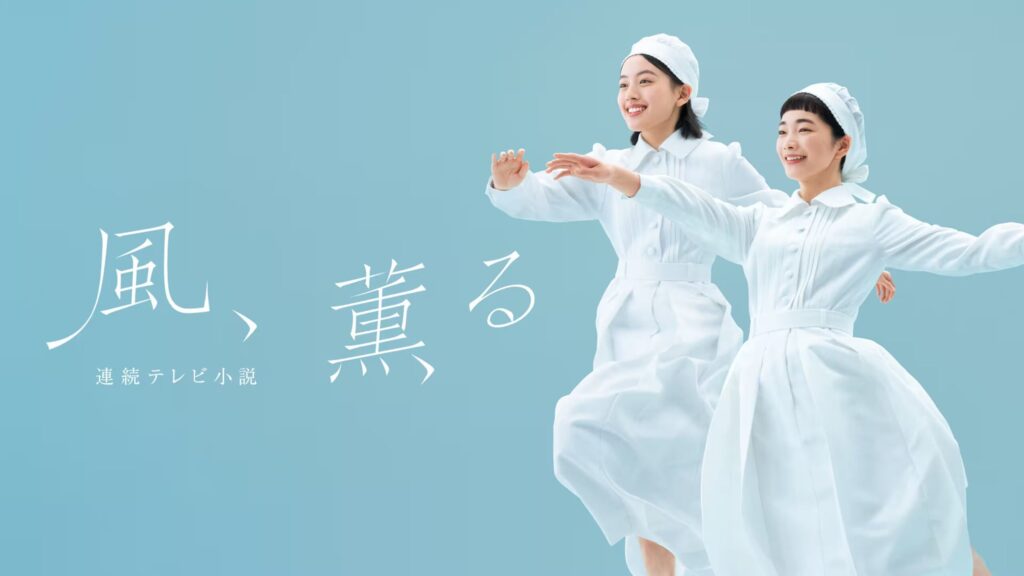
Despite their differences, the relationship between Suzuki and Ōzeki appears to have been one of deep mutual respect. When Suzuki retired, she handed over her organization to Ōzeki. That gesture is often seen as clear evidence of trust between two people whose paths had run in parallel since their student days.
Ōzeki is a figure that people write books about (case in point being “Meiji Nightingale: the Story of Ōzeki Chika” that the drama Kaze, Kaoru is based on). She was an activist and the author of key nursing manuals, and left behind a very public legacy.
However, Suzuki’s legacy was no less foundational than Ōzeki’s, though it’s less talked about. That’s one of the great things about dramas like Kaze, Kaoru, because it highlights real-life, behind-the-scenes figures who often get overlooked in history.
After all, not every pioneer writes a book or becomes a symbol. Most, arguably, build lasting systems, translate knowledge, and create conditions that allow others to shine. Suzuki was one of those, and one worth knowing about.
Keep reading



Sources
『風、薫る』大家直美のモチーフ「鈴木雅」とは。武家の娘がフェリスで磨いた英語力で日本の近代看護の礎を確立 婦人公論.jp
鈴木雅 (看護師) Wikipedia
大関和 Wikipedia
『風、薫る』大関和、鈴木雅 近代看護の礎を築いた2人のシングルマザー 日経BOOKプラス
朝ドラ『風、薫る』のモデル、大関和と鈴木雅―看護の道を切り開いた2人の歩み エキスパートナースweb
風、薫る Wikipedia
特設サイト 大関ちかの歩みをたどって ~日本のナイチンゲールと呼ばれて~ 女子学院中学校・高等学校
アグネス・ヴェッチ Wikipedia
Florence Nightingale – Nursing Theorist Nursing Theory