
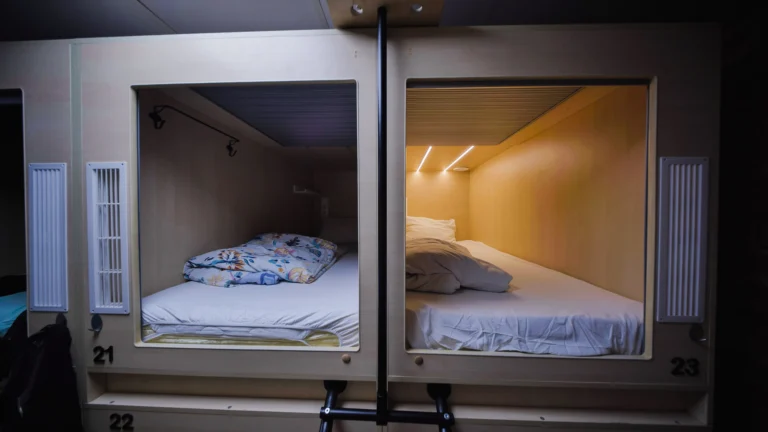
I’ve known about capsule hotels for decades. I’ve never stayed in one, however, because…well, because I’m a grown-up with a job. They always struck me as something you’d use traveling alone in your 20s, when you’re so dead-ass broke you think the large bowl of ramen at Jirō is a luxury meal.
However, on a recent trip to Kyoto, I discovered at least one capsule hotel chain that did things a little different. And no, they didn’t pay me to write this. In fact, I don’t even know if I’d stay there a second time.
But, hey – for $31 a night, I found it hard to complain.
If you’re looking for a budget experience that’s a step above a hole in the wall, this capsule hotel chain might be just what you’re looking for. That recommendation, however, still comes with a number of caveats.
The origin of Japan’s capsule hotels
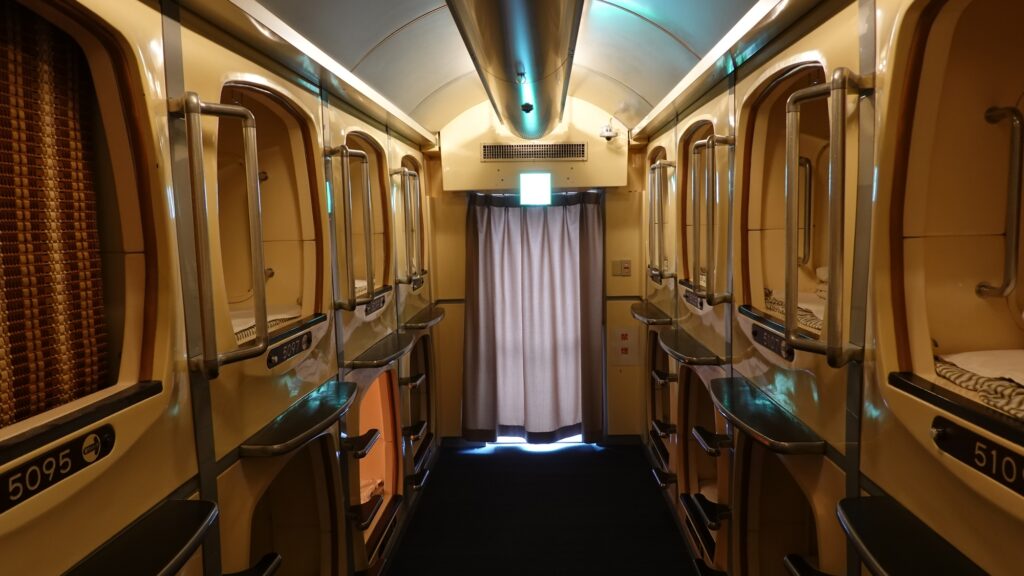
Capsule hotels use the “capsule housing” concept created by architect Kurokawa Kishō, which he premiered at the 1970 Osaka Expo. Operator Nakano Yukio opened Capsule Inn Osaka on February 1st, 1979, to give customers who used his saunas and cabaret clubs a cheap place to crash. They quickly caught on during the 1979 transit crisis, fueled by working men who missed the last train home.
Capsule hotel “rooms” consist of fiber-reinforced plastic (FRP) shells that are generally one by two meters. They’re double-stacked, like bunk beds, meaning occupants in the top bunk have to lift their way into their bed.
The rooms are as stripped down as can be. There’s enough space for a single person to sleep, but not do much else. They’re outfitted with a small TV, which occupants can listen to using headphones. There are communal showers, bathrooms, and lounge areas to while away your time during the day or eat a cheap konbini meal.
Originally, capsule hotels were men-only. Women-only facilities didn’t appear in significant numbers until the 2010s. Because capsule hotels operate as shared facilities like hostels, capsule hotels that cater to both sexes segregate them to different floors for safety reasons.
First Cabin: A capsule hotel with options
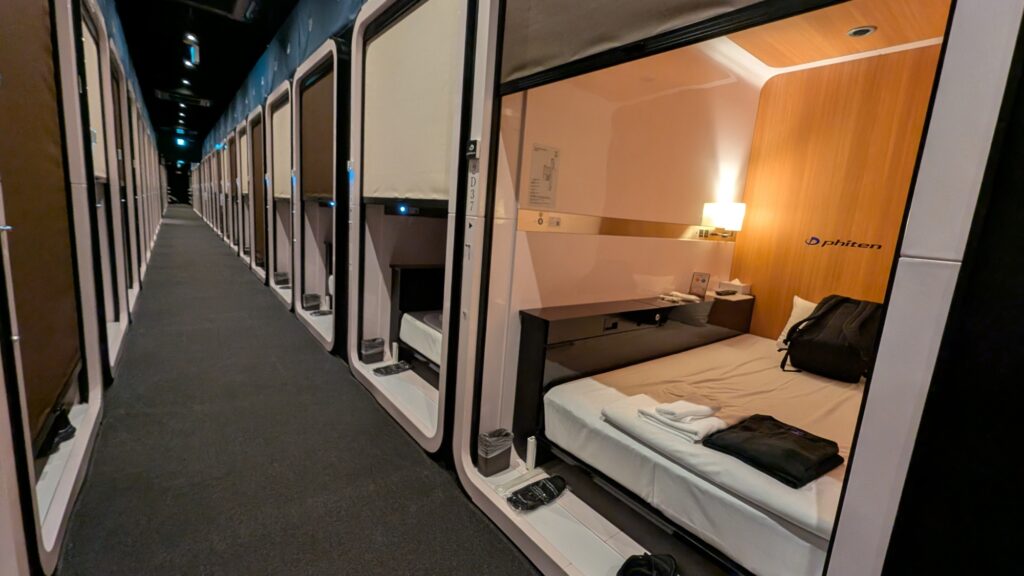
Recently, I had to bust down to Kyoto for a business meeting. I went on Agoda to search for hotels. For some reason, I clicked on the result for First Cabin Kyoto Nijōjō – and was surprised by what I found.
Most capsule hotels offer a room of a single, cramped size. First Cabin is a “cabin type” capsule hotel offering with rooms modeled after airplane classes. The Premium Economy class is the traditional double-stacked capsule room that’s become an undeserving symbol of “weird Japan.”
But the facility also touts Business Class and First Class cabins that offer more space. There’s even a “Premier Cabin” that looks like a regular hotel room.
Having never experienced a capsule hotel, I decided to book the Business Class room for two nights. Hey, at 4,000 yen a night ($24.70), it was a cheap experiment! I could check in after 5pm (which was fine, as I had a 5pm meeting) and checkout was two days later at 10am.
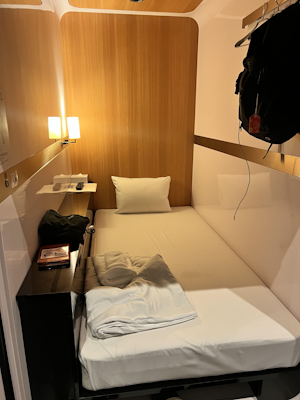
The floor-to-ceiling room was a step above a capsule, to be sure. At 1.2m x 2.1m x 2.1m, it gave more floor-to-ceiling space. That made it a little easier to move around when needed.
After one night, however, I was a bit disgruntled. Moving around in the confined space still felt too constraining. Whenever I wanted to get something out of my bags, I had to plan a series of coordinated steps to accomplish it.
I talked to reception and discovered I could give them a paltry 1,000 yen ($6) to upgrade to the First Class cabin. First Class is a floor-to-ceiling room with 2.1m x 2.1m x 2.1m dimensions. Basically, a big human box.
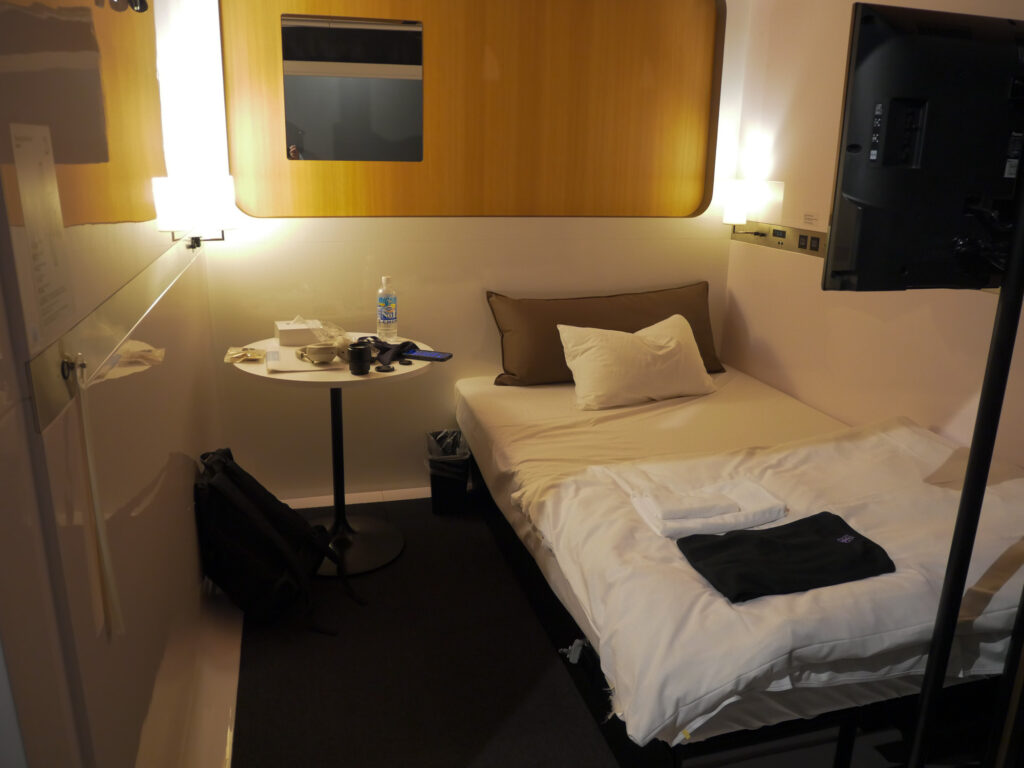
An extra meter of space doesn’t sound like much on paper. But in practice, it made a huge difference. I had a small table on which I could set up my laptop and work. I could freely move around without bumping into anything.
Honestly, for $31 a night, it felt like a steal.
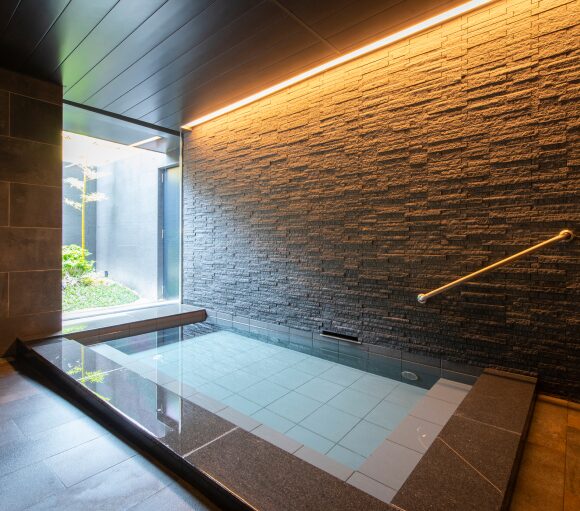
Additionally, the facilities themselves were very nice. The lounge area had free coffee and tea, plus plentiful seating. The shared baths contained not just showers, but an artificial onsen (hot spring) with water supplied from a nearby onsen. Location-wise, the facility was next to historic Nijō Castle and a short walk (30 minutes) or train ride to Kyoto’s Shijōkawaramachi shopping district.
The downsides of First Cabin (and all capsule hotels)
At the end of the day, however, First Cabin is a capsule hotel. And as a capsule hotel, it has the same downsides that all capsule hotels have.
First of all, there’s no soundproofing to speak of in capsule hotels. They are, for all intents and purposes, hostels with a few extra walls. This is by design: legally, capsule hotels are categorized as simple lodging (簡易宿所 ; kan-i shukusho) under Japan’s Hotel Business Act. To keep fire-escape routes clear, rooms can’t have solid, lockable doors.
This means that the “doors” to capsule hotels are just screens. (This is why capsule hotels have gender-segregated floors.) Even in First Cabin’s First Class cabins, if someone is snoring or talking in the hallway, you’ll hear it. (Someone in the First Class area was snoring when I stayed there. LOUDLY.) You’ll also see light filter in from beneath the door, as dim lights stay on all evening.
There’s a standing rule that lodgers should refrain from talking in the cabin area. Several people, however, didn’t seem to get that message; friends that were staying together in separate units kept talking loudly in the hallway. I had to poke my head out of the room twice to tell people to zip it or more their conversations to the lounge.
This isn’t anything you can’t solve with a good eye mask and earplugs. (First Cabin hands out earplugs for free at the front desk.) But if you’re a stickler for privacy, the dormitory atmosphere of a capsule hotel will likely drive you mad.
Alternatives to capsule hotels
Unfortunately, from what I can tell, First Cabin is the only chain that differentiates itself based on room size. All other capsule hotels seem to offer different amenities and services but keep the one-size-fits-all concept.
There are only 13 First Cabins across Japan (including one in Matsue in Shimane Prefecture; a perfect excuse to go see Izumo Taisha on the cheap!), so you may be hard-pressed to book a room at a given time. There are other cheap lodging options in Japan, though.
First, there’s the step up from capsule hotels: the business hotels. Business hotels in Japan, historically, provide a small but navigable room for a much lower price than a standard hotel.
The problem is that this is increasingly no longer true. As hotel prices rocket skyward, business hotel prices are also climbing rapidly. It’s becoming increasingly hard (sometimes impossible) to find a business hotel below 10K yen ($61).
As a result, Internet cafes are increasingly becoming a go-to location for overnight crashing. These offer common areas and open booths with manga and free drinks. Some, like Kaikatsu Club (快活CLUB), offer lockable rooms with either a chair or a sleepable floor mat, plus showers.
At between 3K to 4K yen ($19-24) for a private room, the price can’t be beat. Their low cost has made them a staple of Japan’s working poor: it’s estimated some 3,000 to 4,000 people in Tokyo, such as members of the Toyoko Kids, permanently live out of net cafes while working precarious part-time jobs.
Finally, there are traditional dormitory-style hostels. While they’re cheap, you’ll have zero personal space.
Frankly, I’m a hotel guy. I’d rather stay in a cool themed Pokémon room, a Japanese ryokan, or a nice Marriott property. I don’t know if the communal vibe of First Cabin was my thing. But it was a fun way to try one of Japan’s most iconic lodging experiences without feeling like a body in the morgue.
Keep reading

Sources
カプセルホテルの歴史 カプセル建築プロジェクト (Capsule Architecture Project)
世界初のカプセルホテル「カプセル・イン大阪」。黒川紀章、カプセル住宅の宿泊所版の今 LIFULL HOME’S PRESS
カプセルホテル Wikipedia
カプセルホテルの集客方法とは?他社との差別化&インバウンド対応がカギ! 訪日ラボ (Honichi Lab)
訪日外国人の増加で、「カプセルホテル」はどう変化しているだろうか。 Global Daily
カプセルホテル市場レポート (Capsule Hotel Market Report) GII / IMARC
ファーストキャビン京都二条城 (公式サイト) ファーストキャビン (First Cabin)
ファーストキャビンが経営破綻、新型コロナと競争激化で、JR西日本との合弁会社が運営する店舗も営業終了 トラベルボイス (Travel Voice)
新日本建物の子会社、ホテルのフランチャイズ事業及び運営受託事業を譲受け M&Aニュース / 日本M&Aセンター
ファーストキャビンの経営理念 (会社概要) FIRST CABIN HD (株式会社ファーストキャビンHD)
ビジネスホテルとカプセルホテル安心お宿の比較!料金・設備・サービスの違いを解説 安心お宿 (Anshin Oyado)
漫画喫茶《快活CLUB》が超進化していた「1泊3000円で清潔な空間」「カプセルホテルよりコスパ抜群!」→ビジネスホテル高騰で注目されるワケ 東洋経済オンライン (Toyo Keizai Online)
料金プラン (ナイトパック・完全個室) | カスタマカフェ カスタマカフェ (Customa Cafe)
「住居喪失不安定就労者等の実態に関する調査」の結果 東京都福祉局 (Tokyo Metropolitan Government, Welfare Bureau)