
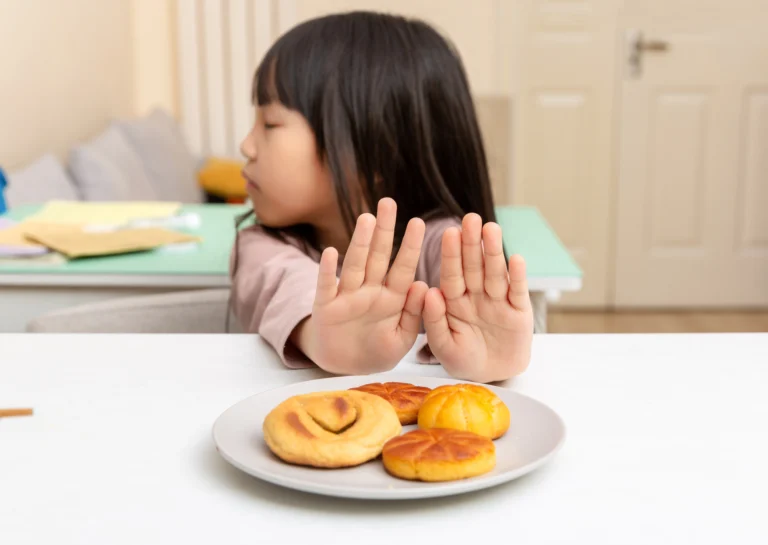
Add a new entry to the キャンセル (cancel) vocabulary of Japan’s youth. The “meal-cancel crowd” (食事キャンセル界隈; shokuji kyanseru kaiwai) is spreading online and gaining mainstream media attention. But some on social media say the term isn’t a cute new linguistic turn of phrase, but a sign that Japan is slipping deeper into poverty. The numbers back them up.
Too busy to eat

The phrase キャンセル界隈 (cancel crowd) is used in online discourse to denote things the younger generation is giving up for one reason or another. It builds on the larger kaiwai (crowd) linguistic trend that UJ’s discussed before.
In some cases, these are mere lifestyle choices, such as 自炊キャンセル界隈 (jisui kyanseru kaiwai), giving up on home cooking. In other cases, the choices of what to give up stink. Literally. One idol trended in Japanese news when she said she was joining the 風呂キャンセル界隈 (furo kyanseru kaiwai), young people who were giving up on bathing.
The latest cancel crowd phenomenon, meals (食事), refers to youth who are “canceling” at least one meal a day. As reported by Nikkei MJ, the market-research firm Intage dug into this phenomenon to see who was using the term and why.
Among 2,754 people aged 15-49 nationwide, a full 34% said they skip meals once a week or more. The highest concentration was among people aged 18-24 (41%). The main reason for not eating? 31% said they were simply too busy to stop for a meal.
Question: do you like UJ's independent coverage of Japan? Our writers are supported by our members. Join Unseen Japan Insider to get bonus content every week, an ad-free website, and access to our large and growing Insider archive.We manage to keep most of our content free thanks to the generosity of our members. Join Unseen Japan Insider and you'll get access to new, exclusive UJ member content weekly, an ad-free website, and access to our large and growing Insider archive.
A nation sinking further into poverty?
Not everyone, however, thinks the term is a cute, quirky reflection on “kids these days.”
In a viral tweet, the X account “Dr. Papa” (@DrKarte) drew 30K likes with a post arguing that “skipping meals isn’t ‘canceling.'” They point to the survey’s own data, which shows a full 18.6% of respondents in their late 20s said they’re skipping meals in order to save on food costs.
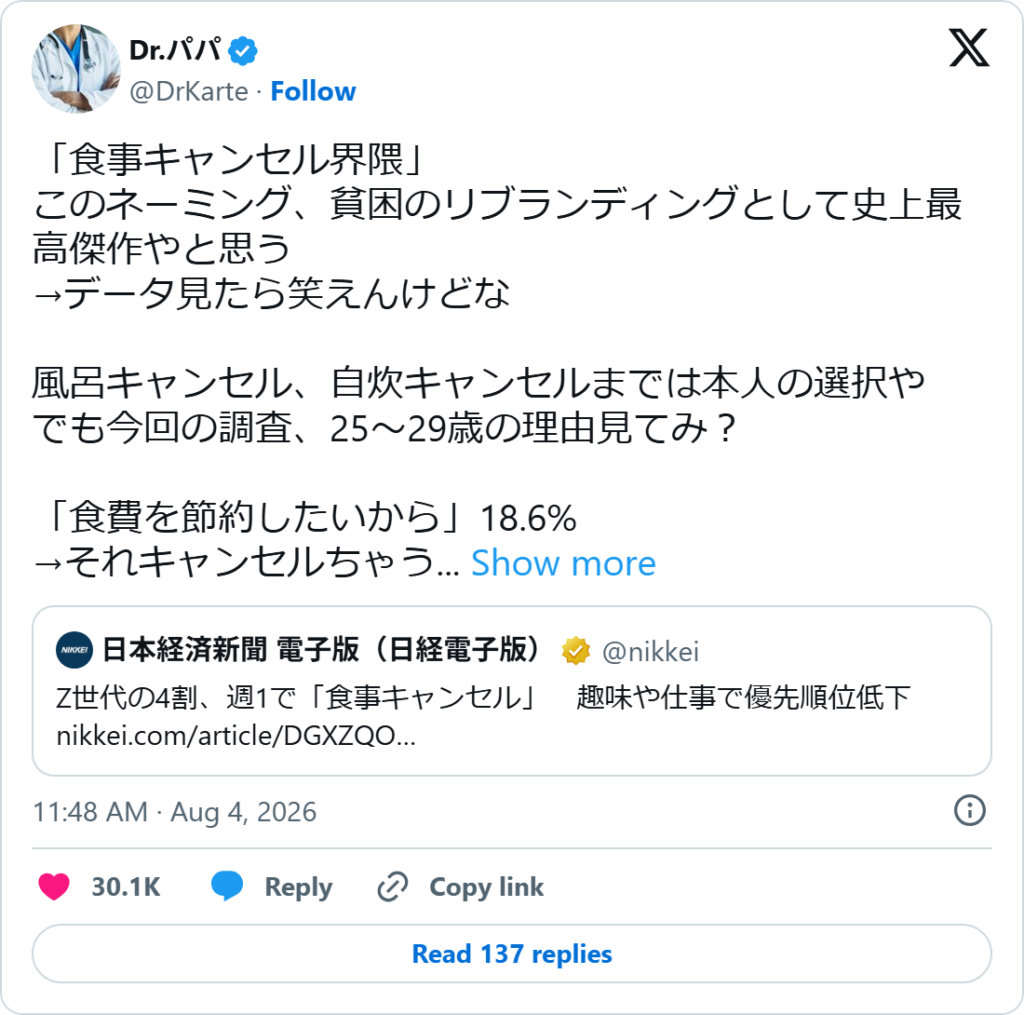
DrKarte also points out that Japan’s Engel coefficient, the share of household spending that goes to food, recently hit its highest level in 44 years, according to the Statistics Bureau of Japan. The 2025 coefficient hit 28.6%, the highest since 1981.
Note that little is known about this poster’s identity. It’s not even clear they’re a certified medical doctor. However, given the reach, their comments obviously struck a chord.
Some users in DrKarte’s thread backed up their argument with math. On a ¥200,000 (~$1,270) monthly salary yielding ¥160,000 (~$1,010) take-home, a 34.4% Engel coefficient means ~¥55,000 (~$350) on food while over ¥60,000 (~$380) goes to social insurance premiums.
Some argued that Japan levies overly burdensome taxes. Others pushed back, saying Japan’s consumption tax is lower when compared to other countries; the issue, they said, is unequal income distribution.
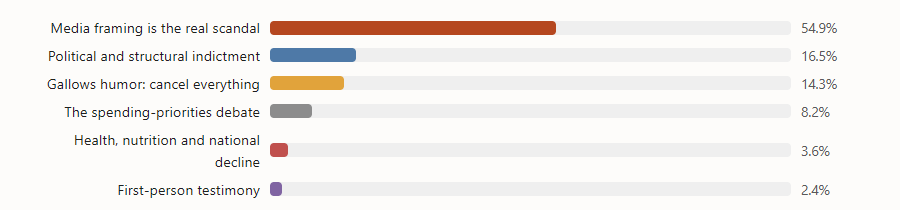
The most liked comments (54.9% of likes) blamed the media’s framing. They argued that terms like “cancel” and “-banare” (離れ, “leaving behind”; e.g., 酒離れ, sake-banare, no longer drinking alcohol as a lifestyle choice) are media framing devices used to dance around the real underlying issue. Talking about poverty, they say, doesn’t generate clicks. Talking about “canceling” as a matter of “youth culture,” by contrast, drives engagement.
Moreover, by using words like kyanseru and banare, the media frames it as a matter of individual preference. That short-circuits discussion of poverty in Japan, a topic the country hates to dwell on. Anti-poverty advocates would argue that this attitude is what leads to private organizations, such as “kids’ cafeterias,” shouldering the burden of child poverty in the absence of social policy.
You can eat or have hobbies, not both

However, some commenters on X pushed back against the poverty narrative. After all, cost concerns trailed well behind those top reasons in Intage’s survey.
26.9% of X commenters in the above thread also argued that people had enough money; they were just choosing to spend it on their hobbies, like oshikatsu and microtransactions in mobile games. Some took the argument to extremes, proclaiming that “seeking spiritual richness even at the cost of your life is the right answer.” (I don’t know how much spiritual richness one can find in Genshin Impact or NIKKE, but alright.)
This “sacrifice everything for oshikatsu” argument only drew 8.2% of all likes, though. Other users argued against it, pointing out that, if people had more money, they wouldn’t have to choose between hobbies and food.
In the end, there are multiple, complex reasons people may be “canceling” meals. Oda Toranosuke of Intage attributes meal canceling to competing priorities. With so many things young people want to do, including hobbies and sleep, “the priority of eating is relatively low.” Additionally, around 16% of 15-18-year-olds tend to skip meals due to dieting, the highest of any age bracket.
Ultimately, this may be a case of two things being true at once. Rising prices have become such a flashpoint in Japan that it’s sinking Prime Minister Takaichi Sanae’s poll numbers. There’s no doubt economic conditions are taking a toll. But Japanese people may have more reasons to forego lunch than a lack of spare change.
Keep reading



Sources
Z世代の4割、週1で「食事キャンセル」 趣味や仕事で優先順位低下 日本経済新聞 (Nikkei)
2025年のエンゲル係数、44年ぶり高水準 12月実質消費支出は2.6%減少 日本経済新聞 (Nikkei)
25年消費支出、0.9%増=3年ぶりプラス、万博効果で―エンゲル係数は44年ぶりの高さ・総務省 時事エクイティ (Jiji Equity)
上昇が続くエンゲル係数 ~食料品価格の上昇が押し上げ要因に~ 第一生命経済研究所
Z世代の4割が週1で食事キャンセル?趣味や人間関係を優先していると言うが実際は金がないだけなのでは…?と疑問が集まる「なんでもキャンセルって言うのやめない?」 Togetter
「食キャンセル界隈」のリアル…背景に給食?専門家「旧来型の食育はオワコン」どうアプデ? ABEMA TIMES
エンゲル係数 Wikipedia (日本語版)
令和6年分 民間給与実態統計調査 国税庁 (National Tax Agency)