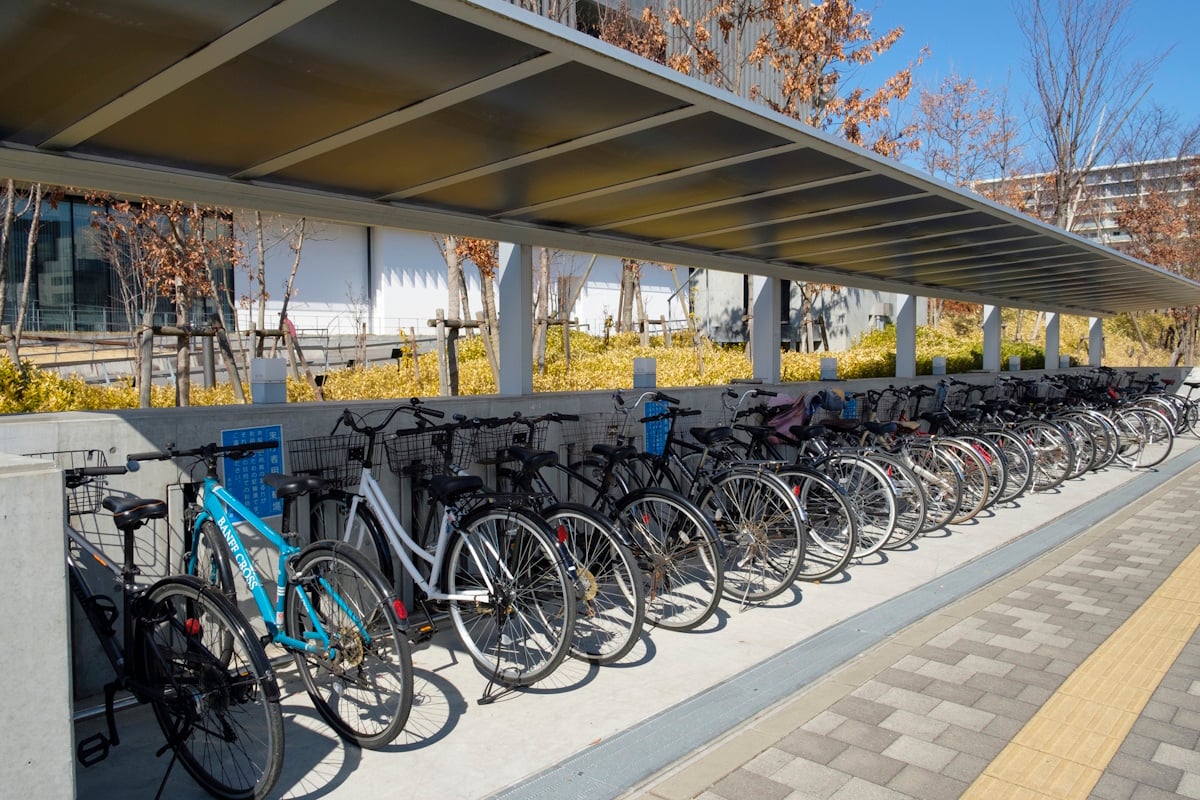


Let me get this out of the way before the pro-biking Internet descends upon me: I like bicycles. Love ’em. Cycling is my favorite form of transportation (and cardio).
But even I’m forced to admit – bicycle commuters in Japan (particularly Tokyo) are reckless. Often dangerous. From riding on sidewalks to blowing stop lights and riding against traffic, most cycling commuters act like the law doesn’t apply to them. So I’m all for legislation that makes cyclists, pedestrians, and drivers safer.
Last year, Japan passed new legislation to dole out financial penalties to riders who break the rules. Those laws go into effect at the top of April 2026. Unfortunately, a new survey shows that few people are actually aware of what the rules are. Others are arguing that fines aren’t enough and that Japan needs to invest more heavily in creating dedicated spaces for riders.
Blue ticket system will levy heavy fines

Bicycling is a big part of Japan’s transportation infrastructure. In Tokyo, some 20% of people say they commute to school or work via bike. In Osaka, that number is closer to 28%.
Unfortunately, many riders mean many problems. After years of complaints, Japan has committed to cracking down on lax behavior.
Under the new “blue ticket” system (kōtsū hansoku tsūkoku seido), riders caught running red lights, failing to stop at intersections, or using their smartphones while cycling will face on-the-spot fines. The system mirrors how traffic violations for motor vehicles have long been handled, with blue tickets serving as a penalty notice requiring payment of a set fine.
The list of offenses covered is extensive, with roughly 110 types of violations now subject to blue ticket fines. For example:
- Smartphone use while cycling, which was previously handled with the more serious “red ticket,” will now carry a fine of 12,000 yen.
- Running a red light or violating lane regulations will cost 6,000 yen.
- Riding on a sidewalk not demarcated for bikes or riding with an umbrella (yes, this happens a LOT) will incur a 6,000 yen fine.
There are some exceptions built into the rules. Cyclists under 13 or over 70, as well as those riding on sidewalks marked with “bicycle sidewalk permitted” signs, won’t be penalized for sidewalk riding.
The crackdown comes as data from Kochi Prefecture raises warning signs around cycling safety.

Want more news and views from Japan? Donate $5/month ($60 one-time donation) to the Unseen Japan Journalism Fund to join Unseen Japan Insider. You'll get our Insider newsletter with more news and deep dives, a chance to get your burning Japan questions answered, and a voice in our future editorial direction.
According to Prefectural Police, 85% of the 152 bicycle-related injury accidents in the prefecture in 2025 involved some form of traffic violation. The most common offenses were failures to watch the road ahead and neglecting to check other road users’ movements, followed by unsafe intersection behavior and signal violations.
One notable aspect of the new system is that it applies to anyone aged 16 or older, which means high school students are bound by the rules. In a country where cycling is a primary mode of transportation for students commuting to school, this is a significant shift. Teenagers who might have previously been let off with a verbal warning will now face the same fines as adult riders.
Survey: Many unaware of what new law entails
Data show that authorities may face an uphill climb in raising awareness of the new regulations. A survey by Cross Marketing, conducted March 6–9, 2026, with 1,100 respondents aged 20 to 69 nationwide, took stock of how well people actually understand what’s coming.
The good news: 82.4% of respondents have heard about the new system. The less-good news: only 7.6% say they know all the specific violations it covers. About half said they know some violations but not others, and roughly one in five respondents in their 20s through 40s had never heard of the system at all.
When asked which violations they thought were covered, people most commonly pointed to riding while using a smartphone and riding with earphones or headphones – so-called nagara unten (ながら運転), or “distracted riding.” Other commonly cited answers included running red lights, ignoring stop signs, riding one-handed (say, while holding an umbrella), riding double, and cycling without lights at night.
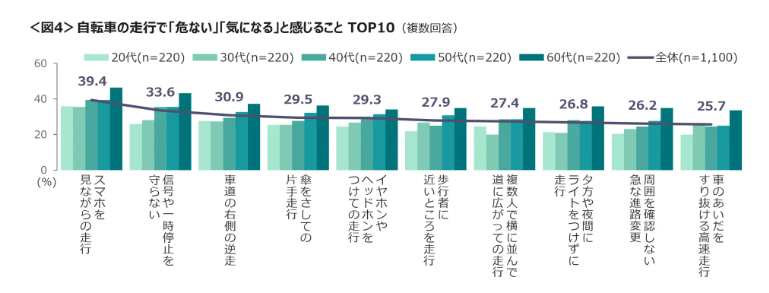
Interestingly, some respondents incorrectly flagged drunk cycling and not wearing a helmet as blue-ticket offenses. Drunk cycling is actually a more serious red-ticket violation, while helmet use remains a voluntary “best effort” obligation rather than a fineable rule.
On the broader question of cycling behavior, 83.7% of respondents said they follow traffic rules, with 48.1% saying they always make a conscious effort to do so. Thirty-somethings were the least conscientious group, with only 42.2% saying they always follow the rules.
As for which behaviors respondents find most dangerous or annoying, the top three were: riding while looking at a smartphone, ignoring traffic signals or stop signs, and riding against traffic on the right side of the road. Older respondents were more likely to flag dangerous riding behaviors across the board, with people in their 60s reporting the highest levels of concern.
Changing behavior without infrastructure?
Another issue authorities might face: Most Japanese cities just aren’t built for cyclists. Many ride on narrow sidewalks, for example, because there are no clearly demarcated bike lanes, and riding on the road feels frightening without them.
See a side of Tokyo that other tourists can't. Book a tour with Unseen Japan Tours - we'll tailor your trip to your interests and guide you through experiences usually closed off to non-Japanese speakers.

One social media user pointed this out in a recent X post, noting that Tokyo’s Minato City was one of the few areas with a road featuring a properly demarcated bike lane, separated from traffic by pipes.
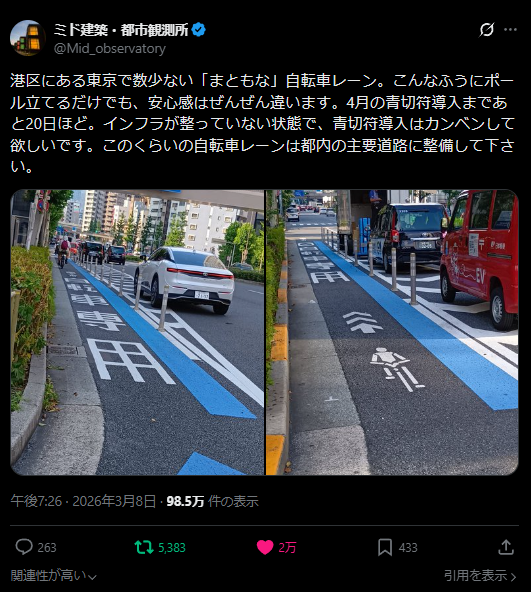
“One of Tokyo’s only dedicated bike lanes in Minato City,” writes user @Mid_observatory. “Just putting up some poles makes a huge difference in feeling safe….They should back off introducing blue tickets until there’s infrastructure in place. Please put at least this much onto the city’s main roads.”
As a resident of Minato, I can testify that it’s even worse than this. The road above is Highway 1 in the Takanawa area. While it’s an extremely useful bike lane, it’s the only one like it (that I know of) in the city. The rest of Minato uses either sidewalk bike lanes or, more commonly, a “sharrow” system indicating that cyclists “share” the road with drivers.
Other users concurred with the poster. “They should also fine drivers who block bike lanes,” another fumed. Again, as someone who frequently has to depart from the bike lane pictured above because a delivery truck is dangling out from a building’s driveway, it’s hard to disagree.
Obviously, no one should be running red lights or carrying an umbrella while pedaling. Infrastructure changes can’t address all bad behavior. But giving cyclists a safe lane, separated from both pedestrian and car traffic, would be a great first step toward making everyone safer.

The shop in Saitama Prefecture said it instituted the policy after a customer watched an “inappropriate” video.
Why many Japanese social media users are decrying the long detention of actress Sakaguchi Anri as excessive and unwarranted.
Critics say that police and prosecutors could have done more to monitor the murderer after he was released from jail after paying a fine.
Sources
自転車「青切符」来月導入、交通違反すれば高校生でも反則金支払うことに…スマホ使用なら「1万2000円」. Yomiuri Shimbun
第2章 現状と課題. Tokyo Metropolitan Government
自転車の青切符制度の認知はあるが、違反内容は知らない 危険な走行は「スマホのながら運転」. Cross Marketing via PRTimes
