
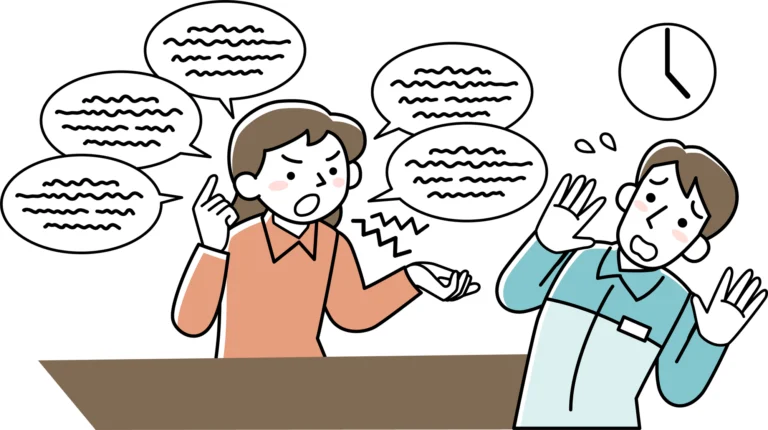
Japan has endured a long-running phenomenon known as “customer harassment,” or abuse of store and municipal employees by customers and citizens. Up until now, Japanese companies had no legal obligation to protect their employees from irate customers.
That’s set to change on October 1, 2026, when a nationwide legal requirement will oblige employers across Japan, from convenience store chains to city halls, to take measures to protect their employees from kasuhara.
Kasuhara: The new legal definition

Japan’s customer service is known for being impeccable. But the cultural expectation that “the customer is God” has long left employees vulnerable to kasuhara (カスハラ; customer harassment), including abusive behavior, unreasonable demands and bullying. In some cases, customers have even demanded that employees perform dogeza (土下座), a head-to-floor apology.
The revised Comprehensive Labor Policy Promotion Act, the same law that has required employers, including small businesses, to prevent pawahara (パワハラ; power harassment) since April 2022, will now require employers to take measures against this. The revisions also strengthen protections against harassment targeting job applicants and interns.
The law defines kasuhara through three conditions:
- Conduct or behavior by customers or others;
- That exceeds what is socially acceptable in light of the nature of the work performed by the employee and other relevant circumstances; and
- That thereby harms the employee’s working environment.
“Customers or others” covers more than people making purchases. It can include clients, business partners, users of stations, airports, hospitals, schools and other facilities, as well as prospective customers.
The definition also covers harassment carried out by phone or through social media.
Guidelines issued by the Ministry of Health, Labour and Welfare (MHLW) in February 2026 give examples ranging from violence and threats to forcing an employee to perform dogeza. Other examples include threatening to post negative reviews, filming staff without permission, making demands that go substantially beyond what a contract covers, and keeping employees on the phone or in person for hours.
The National Personnel Authority has introduced similar duties for national government ministries starting in October. According to Kyodo News, the rules can cover conduct not only by members of the public but also by businesses, members of the press, other government ministries, local governments and legislators.
A duty for employers, a request for customers
Employers will be required to put 10 measures against kasuhara in place, including one that goes beyond existing harassment rules.
Many of the measures mirror Japan’s existing workplace harassment rules. Employers must establish a policy stating that they will protect employees and respond firmly to harassment, set up a consultation desk, investigate complaints promptly, provide care for affected employees, take steps to prevent repeat incidents, protect the privacy of those involved, and ensure employees aren’t penalized for reporting harassment.
Employers must also prepare a response plan for “particularly malicious cases.” Depending on the circumstances, this can include contacting police about suspected crimes, sending a warning letter, refusing sales or service within the limits of the law, banning a person from entering the premises, or seeking a court injunction.
Employers are also instructed, where possible, to avoid leaving a worker alone to deal with a customer.
The obligation placed on customers is considerably weaker.
Article 34(5) of the amended act states that “customers and others must endeavor to exercise the necessary care to ensure that their words and conduct toward workers do not harm the workers’ working environment.” This is a doryoku gimu (努力義務), meaning an obligation to make a good-faith effort rather than a legally enforceable duty backed by a penalty.
The national law itself does not establish a penalty specifically for committing kasuhara. The new guidelines instead tell employers to contact police when conduct involves assault, injury, or threats.
For employers, enforcement centers on administrative recommendations and public disclosure, with a fine for failing to cooperate with the ministry. The health minister can issue advice and instructions and, if necessary, formally recommend that an employer take corrective action. An employer that ignores such a recommendation can be publicly named.
The law’s fine of up to ¥200,000 (about $1,300) applies when an employer refuses to provide information requested by the ministry or submits false information. There’s no direct fine for simply failing to establish the required kasuhara measures.
How common is kasuhara?

About one worker in 10 had experienced kasuhara in the MHLW’s most recent national survey, rising to about one in six in retail and hospitality.
The fiscal 2023 survey of 8,000 workers found that 10.8% had experienced kasuhara in the previous three years. The rate was 16.6% in personal services and entertainment, and 16.0% in both wholesale and retail and hotels and restaurants.
Among companies surveyed, 27.9% had received consultations about kasuhara. It was the only type of harassment for which more companies reported that cases were increasing than decreasing.
Six months into Tokyo’s ordinance, most Tokyo companies had not yet introduced kasuhara measures.
Tokyo’s ordinance took effect April 1, 2025, 18 months before the national requirements. It states that no one may commit kasuhara in Tokyo, but does not impose penalties on perpetrators. The Tokyo government has said that specifically listing punishable acts could imply that conduct not on the list is acceptable.
In Tokyo’s October 2025 survey, 38.5% of 4,727 companies had kasuhara measures in place. Among employees, 11.9% said they had experienced kasuhara in the previous year. The most common reason companies gave for not taking measures, cited by 29.6%, was difficulty distinguishing harassment from legitimate complaints.
UA Zensen, a major Japanese union federation representing workers in retail, restaurants and other service industries, surveyed 33,133 members between January and March 2024. Of those surveyed, 46.8% said they had experienced kasuhara in the previous two years, down from 56.7% in the union’s 2020 survey.
The union attributed the decline to greater awareness and cooperation between companies and unions.
Question: do you like UJ's independent coverage of Japan? Our writers are supported by our members. Join Unseen Japan Insider to get bonus content every week, an ad-free website, and access to our large and growing Insider archive.If you love UJ's independent coverage of Japan, join Unseen Japan Insider to get content every week, an ad-free website, and access to our large and growing Insider archive.
Osaka’s lawsuit, pseudonyms and a voice-softening AI
Meanwhile, Osaka City plans to sue a resident after recording 641 calls and visits over three years.
According to city records covering May 2023 through June 2026, the man called city offices 548 times and visited 93 times, demanding explanations and apologies over broken equipment and dirt at a municipal swimming pool.
Staff members reported hearing remarks including “Damn you,” “Quit your job,” and “I’ll get you, brace yourself.”
The city plans to ask the Osaka District Court to prohibit the man from making forced visits and lengthy calls. It’s also seeking about ¥400,000 (about $2,500) to cover staff time spent dealing with the incidents. The city assembly unanimously approved the suit on Sept. 30, and the city plans to file it as early as October.
“When someone crosses the line, we have to stand firm and tell them we can’t do it,” Mayor Yokoyama Hideyuki (横山英幸) said.
Other employers are turning to pseudonyms and technology to protect workers.
Neyagawa City Hall in Osaka Prefecture has allowed employees to use business names since April 2025 after a counter clerk was identified by name and subsequently contacted directly through social media.
SoftBank’s SoftVoice app, released in February 2026, converts an angry caller’s voice into a calmer-sounding voice in real time while leaving the caller’s words unchanged. SoftBank says its tests reduced perceived anger by more than 30%. Banks are among the early users.
Convenience store chains have also previously introduced initials and nicknames on employees’ name tags as a measure against kasuhara.
Yahoo! News commenters side with the staff

Reaction online has also focused on protecting employees from abusive customers.
Among the most-recommended comments on Yahoo! News Japan, comments supporting the employees accounted for 39.7% of comments and 48.6% of empathy votes. The single most-endorsed comment, with 6,101 votes, proposed using AI to handle repeat callers.
Comments that questioned the city’s handling of the case or warned that legitimate complaints could be labeled kasuhara accounted for 17.7% of the sample but received 2.3% of the votes.
Several of the most-viewed Togetter posts under its kasuhara tag this year have focused on bystanders intervening when employees are harassed. One post published September 7, which received 62,227 views, described a shopper seeing a clerk being yelled at for more than 10 minutes and calling the supermarket from inside the store. Police arrived about 30 minutes later.
Two other posts, published in February and March, received 67,670 and 114,209 views respectively after customers confronted people accused of harassment and, in one case, a diner called police.
One commenter responding to the first incident wrote: “Take one step outside and that’s intimidation, but inside a store, between customer and clerk, it’s tolerated. I want that attitude to end.”
Some commenters on both sides have invoked the phrase okyakusama wa kamisama desu (お客様は神様です; “the customer is God”), which is often cited in discussions about Japanese customer service.
The official website of enka singer Minami Haruo (三波春夫), who popularized the phrase, says television segments about kasuhara sometimes quote it without explaining its original context. According to the site, Minami first used the phrase onstage in 1961 when describing his relationship with his audience. The site says he never intended it to mean that performers should “put up with anything and keep serving” their customers.
Where a complaint turns into harassment
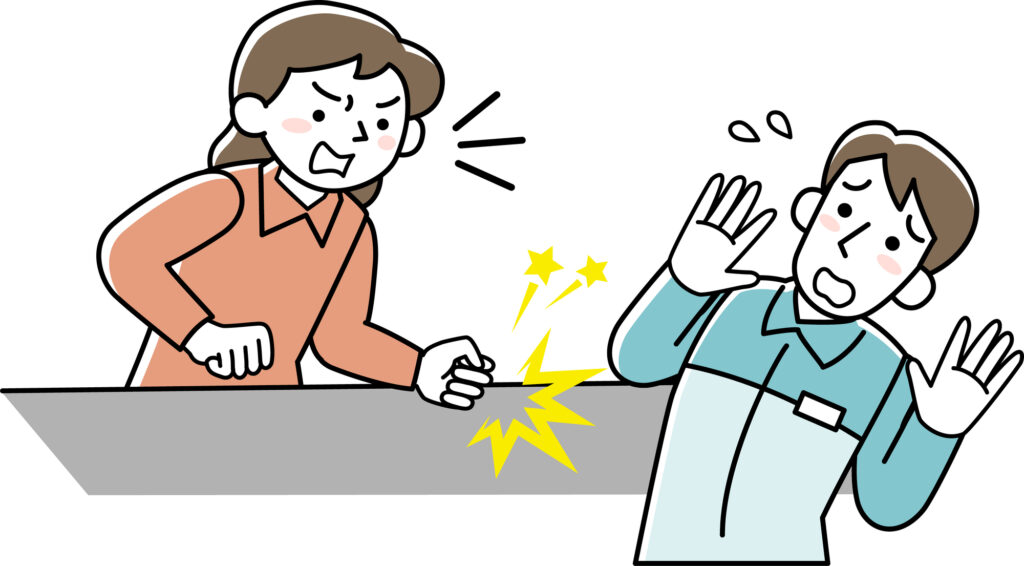
The guidelines make clear that legitimate complaints are not automatically kasuhara.
Complaints made within socially acceptable limits do not constitute kasuhara, and a disabled customer requesting reasonable accommodation isn’t considered to be engaging in customer harassment.
When determining whether conduct constitutes kasuhara, employers are also required to consider whether the company or its employees contributed to the complaint through their own mistakes or misconduct, while respecting consumers’ rights.
Nearly four in 10 working adults say they worry they might be committing kasuhara without realizing it.
In a report published in September 2026, Job Sōken found that 37.8% of 463 respondents believed they might unknowingly engage in customer harassment. Most of the respondents, 77.1%, said they had previously been dissatisfied with a store or service.
At the same time, 87.2% said they supported telling businesses when they were dissatisfied. Posting complaints about businesses on social media was among the behaviors respondents said they would refrain from, at 36.1%.
Keep reading


Sources
「106万円の壁」廃止、酒税見直し…10月から暮らしどう変わる? Yahoo!ニュース/毎日新聞
令和7年の労働施策の総合的な推進並びに労働者の雇用の安定及び職業生活の充実等に関する法律(労働施策総合推進法)等の一部改正について 厚生労働省
事業主が職場における顧客等の言動に起因する問題に関して雇用管理上講ずべき措置等についての指針(令和8年厚生労働省告示第51号) 厚生労働省
各省庁にカスハラ対策を義務化 国家公務員守る、10月から Yahoo!ニュース/共同通信
令和5年度 厚生労働省委託事業 職場のハラスメントに関する実態調査報告書(概要版) 厚生労働省
東京都カスタマー・ハラスメント防止条例 Q&A 東京都
カスタマーハラスメントに関する実態調査の結果 東京都
「カスタマーハラスメント対策アンケート調査結果」記者レクチャー資料 UAゼンセン
「カスハラ」市民に損害賠償求め提訴へ 電話・面談対応600回超 朝日新聞
大阪市「カスハラ」で住民提訴へ 北日本新聞webunプラス/共同通信
10月から始まる「カスハラ対策」義務化 大阪市は市民を“カスハラ”で提訴へ 現場では“カスハラ”と“正当なクレーム”の線引きに苦慮 対策にビジネスネームやAIの活用も Yahoo!ニュース/FNNプライムオンライン
「お客様は神様です」について 三波春夫オフィシャルサイト
Job総研『2026年 カスハラに関する意識調査』を実施しました Job総研