

Japan has a (in my mind, deserved) reputation for general honesty. If you lose something somewhere, even a wallet full of cash, odds are good you’ll be able to retrieve it.
For years, however, some Japanese women online have warned about the dangers of retrieving a lost item from a police box. The reason? Thanks to Japanese law, claiming lost property puts them in danger of being sexually harassed by men.
The law gives strangers your name and address
The issue came up recently thanks to a viral post by X user @natinotakini. They report that a friend got a call from police because someone had found their lost pharmacy point card. All well and good so far…except they report the police officer encouraged the woman not to claim it.
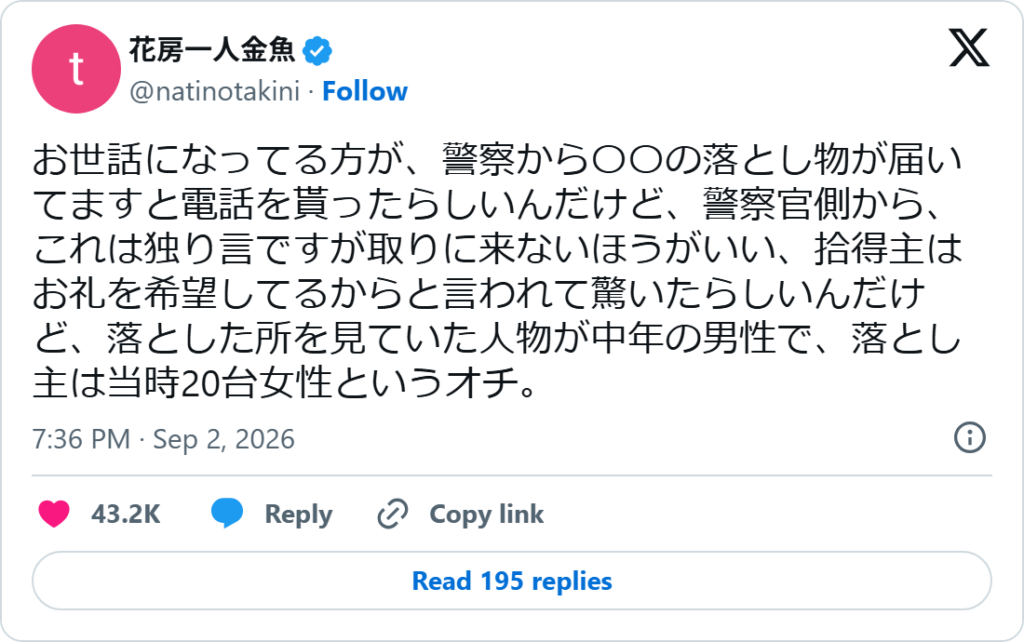
“I’m just talking out loud here, but you shouldn’t come and get it,” the officer allegedly said. “The finder wants to be thanked.”
The person who found the item was apparently a middle-aged man. The woman was in her 20s at the time. The man, it seems, was hoping to engineer some sort of anime-esque meet-cute over the lost item.
Japan’s Lost Property Act has some interesting provisions around lost property. The first is that, according to Article 28, the finder is entitled to between 5% and 20% of the lost value. If it’s found at a business, such as a department store, this “finder’s fee” is split between the finder and the facility.
Additionally, under Article 11 ¶2, the police may share the finder’s details with the loser with the finder’s consent. That means the finder can supply the loser with their name and address, presumably to “thank” them at some point.
However, the law’s asymmetric. If the finder provides their name and address, the police may, upon request, provide the finder with the loser‘s name and address. The loser, legally, doesn’t have to consent. Depending on the station, they may never even be asked.
How do women avoid this? Under Article 31, they have only one option: give up the claim to their lost property.
Question: do you like UJ's independent coverage of Japan? Our writers are supported by our members. Join Unseen Japan Insider to get bonus content every week, an ad-free website, and access to our large and growing Insider archive.If you love UJ's independent coverage of Japan, join Unseen Japan Insider to get content every week, an ad-free website, and access to our large and growing Insider archive.
Women share their lost-and-found horror stories
The Tokyo Metropolitan Police Department reports 4,538,244 cases of found property a year. Of those, 596,513 cases ended with the property returned to its owner. This includes an impressive 338,104 wallets, of which 226,993 are returned. The single largest category of lost items is certificates and identity documents, at around 819,602.
Even at that volume, there are no known documented legal cases involving stalking or harassment from lost property. No one has apparently ever been arrested or prosecuted for such a crime. However, women on the X thread were clear that plenty of creeps have tried to abuse the system for their benefit.
User @takkenmama said she met the finder of her lost item and gave him a ¥10,000 (~$65) finder’s fee. Later, she ran into him at a convenience store near her home.
“So you live near here, huh?” the man reportedly asked. When the woman reported the incident to police, an officer called her “ungrateful.”
Another user, @takitakihare, said she got a thank-you call from her finder. That resulted in days’ worth of text messages saying things like “what are you doing right now” and “please be my friend.” Other users report being kept on the phone for an hour a day for a week, being followed, and being forced to change their phone numbers.
This isn’t a new problem. Back in 2017, a woman lost house keys sporting a handmade keychain. Police handed her a document saying that the finder didn’t want a reward but was asking for a thank-you call. The woman called from a payphone to hide her identity. The man, she said, pressed her on what she did for a living and where she lived.
In many cases, it’s clear that the finder isn’t after a financial award and is instead trying to engineer an encounter with a member of the opposite sex. In the case above, for example, there’s no economic reward involved in returning someone’s points card to them. User @p_r_p_r_namek says their finder declined compensation but wanted their details shared anyway. Another user, @fox_kokon, said their finder demanded a reward for finding a Suica commuter pass that had under ¥1,000 (~$6) on it.
Interestingly, other users in the latest thread reported police officers going above and beyond the law to keep people safe. One user, @e3panmag, handed in a stranger’s driver’s license she’d found in her bag. The officer offered to list himself as the finder, so that the license’s owner couldn’t obtain her personal details.
Japan’s stalking problem
This issue is pertinent as cases of stalking are garnering media scrutiny in Japan. Tokyo police logged 1,751 stalking consultations in 2025, a 20.3% increase from the previous year and the highest since the department began publishing comparable figures in 2021. Women were 80.8% of complainants, with 639 cases, or 25.6% of the total, involving demands for a meeting or relationship.
Some stalking cases, unfortunately, end in tragedy. And in some cases, the tragedy was preventable. One woman in Kanagawa was murdered by her ex after reporting him nine times for stalking. In a case that made international headlines, a woman was murdered by her ex at the Pokémon store in Tokyo’s Ikebukuro.
The incidents have led to a public outcry, with some in Japan saying that police don’t do enough to keep women safe. Some have said that Japan should revise its stalking laws to place GPS ankle trackers on accused stalkers, a law already implemented in South Korea.
For the most part, lost-and-found incidents are harmless. Tokyo police figures show that, in the overwhelming majority of cases, the finder asks for nothing. In a 2018 social media post, a man who lost his wallet was shocked to learn the finder wanted nothing. The officer told him: “Next time you find a lost item, turn it in, and that will be your thanks.”
If only it always went so smoothly.
Keep reading




Sources
遺失物法 e-Gov法令検索
遺失物法施行規則 e-Gov法令検索
遺失者に返還 警察庁遺失届情報サイト
遺失物について 警視庁
遺失物取扱状況(令和7年中) 警視庁
ストーカー事案の概況 警視庁
落とし物を拾った方へ 愛媛県警察
届けた落とし物の落とし主が分かったとき 大阪府警察
知人に警察から落とし物が届いていると連絡があったが、「取りに来ないほうがいい、拾得主はお礼を希望してる」と言われた話→トラブル回避のため、お礼を希望する人に注意 Togetter
落し物をしてしまったが拾得者が現れ警察に受け取りに行くと「お礼を辞退されていますがお礼の電話を希望されています」という紙を渡された話 Togetter
落とし物を拾った人にお礼の電話を求められ、電話すると「どんな人か会いたかった」と言われた Togetter
落とした財布が拾われて交番に届けられていたがお礼を辞退していた…うなだれていた時に言った警官の一言に様々な声 Togetter
You found a lost property on the street (not inside a facility), etc. National Police Agency