
Japan has had a legal right to menstrual leave for nearly 80 years, but for many, actually using it is rare. And those who do use it might even be given the side eye. As if to say, “All these other women work through their periods. Why don’t you?”
A conversation that shouldn’t be controversial
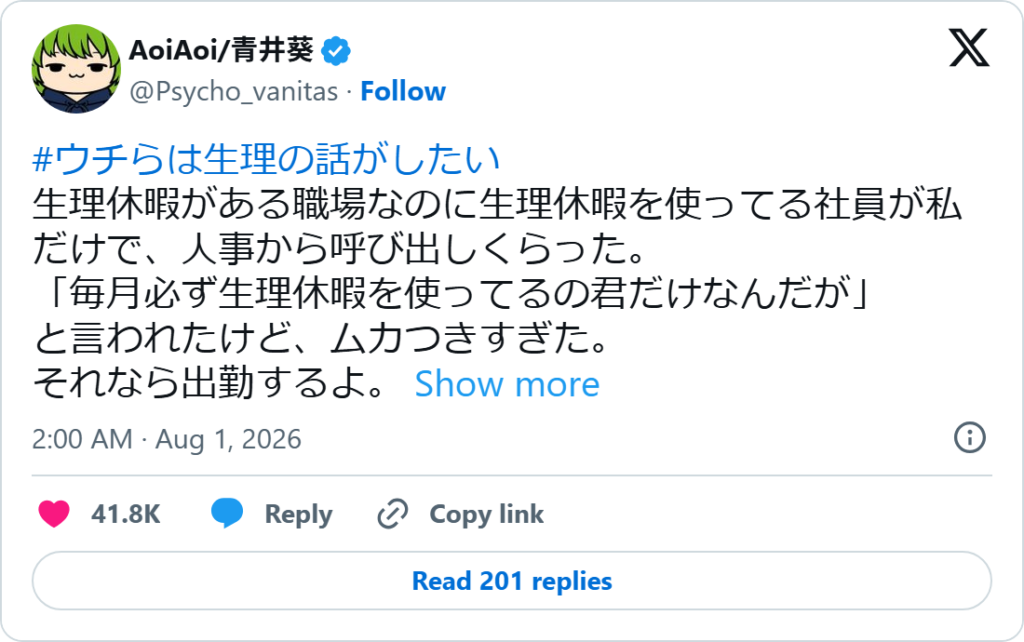
On August 1, 2026, this oft-unspoken contradiction exploded into public view after a post from a Japanese office worker went viral. X user @Psycho_vanitas said that HR brought her in for a talking-to simply because she was the only employee taking menstrual leave every single month.
She explained to HR that every month, her period causes such severe diarrhea that she ends up lying on a futon beside the toilet. So, if they want her to come to work during her period, that’s what she’ll have to do at the office, too.
She hashtagged the post “We want to talk about our periods” (ウチらは生理の話がしたい, uchira wa seiri no hanashi ga shitai). It rang true for a lot of people, earning more than 45,000 likes and over 5 million views despite coming from an account with only about 365 followers.
Righteous outrage in the face of ignorance
For many readers, the issue wasn’t simply menstrual leave. Responses ranged from frustration at the ignorance regarding the symptoms that can come along with periods (cramps, diarrhea, migraines, nausea, and more) to people sharing their own experiences with HR harassing them over menstrual leave.
One of the most-liked responses, at 3,500 likes, bashed HR’s logic and sympathized with the unfairness of the treatment. The commenter said, “If you’re going to say that, then we shouldn’t have created menstrual leave in the first place. It makes you want to ask, ‘What was the point of creating it?'”
Some also pointed out that menstrual leave is a legal right, and suggested going to the Labor Standards Office to report the company. The company isn’t allowed to refuse it or disadvantage someone who decides to use it, and calling an employee into HR like that could be power harassment.
Menstrual leave in Japan: how it works
Japan’s menstrual leave system isn’t new. It’s one of the oldest legal workplace protections of its kind in the world. It’s Article 68 of Japan’s Labor Standards Act, and it has guaranteed menstrual leave since 1947. If a woman finds it significantly difficult to work because of menstruation and requests leave, her employer cannot refuse. There is no limit on the number of days or when the request has to be made. Requests can be made on the same day, and leave can even be taken by the hour.
However, the law does not require employers to pay for it. According to the Ministry of Health, Labour and Welfare (MHLW), menstrual leave is unpaid in roughly 67% of companies. And because it’s often unpaid, taking menstrual leave means losing income. It doesn’t help that menstrual product prices themselves are going up.
For that, many women use their regular paid vacation days instead. That way, they can stay home without losing income and without having to explain the reason to supervisors or coworkers.
That’s not the only issue, though. Many workplaces are understaffed, making it difficult for employees to take additional time off. On top of that, asking for menstrual leave often requires disclosing personal medical information, frequently to male supervisors. According to Forbes Japan, many women don’t feel comfortable with that and may avoid taking leave for that reason.
Question: do you like UJ's independent coverage of Japan? Our writers are supported by our members. Join Unseen Japan Insider to get bonus content every week, an ad-free website, and access to our large and growing Insider archive.If you love what we do, help us pay our writers to do more of it by joining Insider. You'll get bonus content every week, an ad-free website, and access to our large and growing Insider archive.
Who is using menstrual leave? Some stats over time
The numbers show just how rarely menstrual leave is used today. A 2022 survey of more than 9,000 healthcare and caregiving workers found that 82.7% had never taken menstrual leave.
Another survey by Job Research Institute, reported by Forbes Japan, found only 12.8% of the women surveyed had ever used it. Meanwhile, a ministry survey found that only 0.9% of eligible women used menstrual leave during fiscal 2020. That’s a huge drop from its high point of 26.3% in 1963.
So, why the decline? There are two things to keep in mind. One is that, as mentioned above, not every woman who is taking time off for their period is actually claiming menstrual leave. However, it’s impossible to know the exact stats on that.
Historical sociologist Tanaka Hikaru, author of A Social History of Menstrual Products, meanwhile, argues that medical progress explains much of the decline. Disposable pads became widespread beginning in the early 1960s, while modern painkillers and low-dose birth control pills have made symptoms easier for many women to manage.
But that doesn’t mean menstrual conditions stopped existing. Not by a long shot. Even with medical advances, some people experience debilitating cramps, unusually heavy bleeding, endometriosis, polycystic ovary syndrome (PCOS), or digestive problems triggered by menstruation. For them, working through those days isn’t simply uncomfortable. It can be impossible.
Efforts to make taking menstrual leave easier
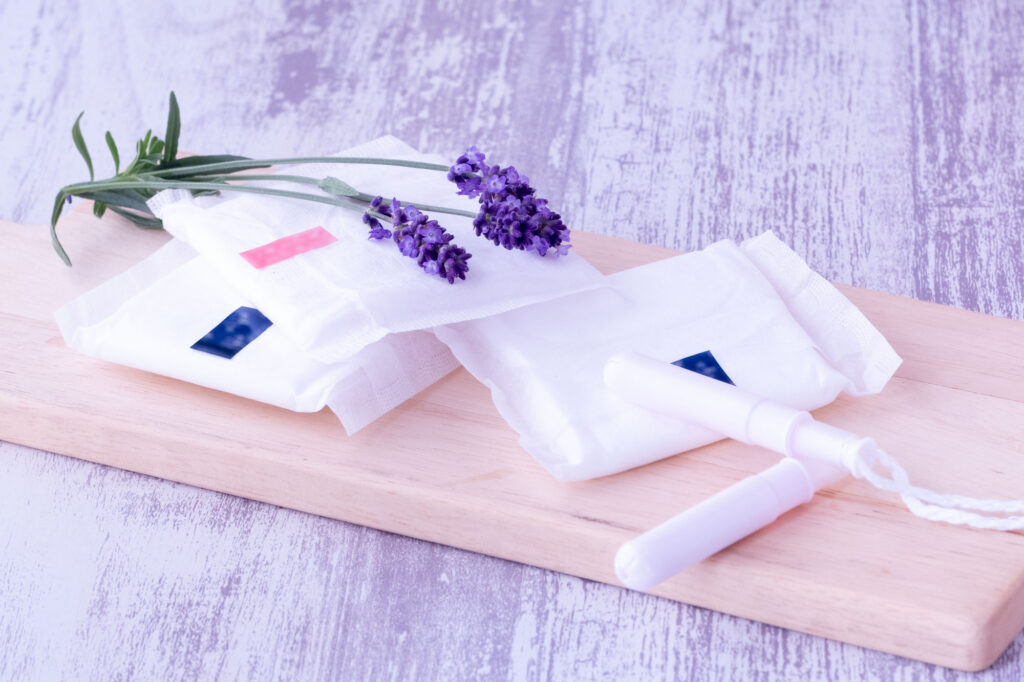
While there isn’t much companies can do on the medical side of things, some are experimenting with ways to reduce the stigma of taking menstrual leave.
IT company AIRU introduced one day of paid menstrual leave each month, and says the taboo has faded since it paired the change with company-wide menstrual-health training.
Meanwhile, Osaka-based systems company Cleaveware renamed the benefit “Life Support Leave,” a gender-neutral category covering menstrual symptoms, fertility treatment, childcare responsibilities, and other life events. Around 30% of employees reportedly use the leave.
Management scholar Morinaga Yūta, then at Musashi University, argues that this approach also makes financial sense. Employees who struggle through work while sick often produce less than workers who simply take the time they need to recover.
While it is heartening that some companies are taking steps to improve things, there’s still a long way to go in reducing the stigma around taking menstrual leave.
Keep reading

Sources
わずか0.9%とは…「生理休暇」なぜ取らない?有休化、性別問わない新制度も登場 時事ドットコム (Jiji Press)
労働基準法のあらまし(生理休暇) 厚生労働省 (MHLW)
労働基準法第68条とは?生理休暇の取得方法や企業が配慮すべきポイントを解説 マネーフォワード クラウド給与
生理休暇を取得していない割合が8割超に 労働政策研究・研修機構(JILPT)ビジネス・レーバー・トレンド
生理休暇の取得率は1割にとどまる 背景に名称と申請先か Forbes JAPAN
8月から生理用ナプキン15%値上げ 女性の悲鳴が止まらない 深刻な生理の貧困と世界の無料配布との差 coki(公器)
Menstrual leave: stigma and uncertainty mean these progressive measures are being underused around the world The Conversation
誕生からまだ60年!?日本の生理用ナプキンの歴史と進化を学ぶ HELiCO(アイセイ薬局)