
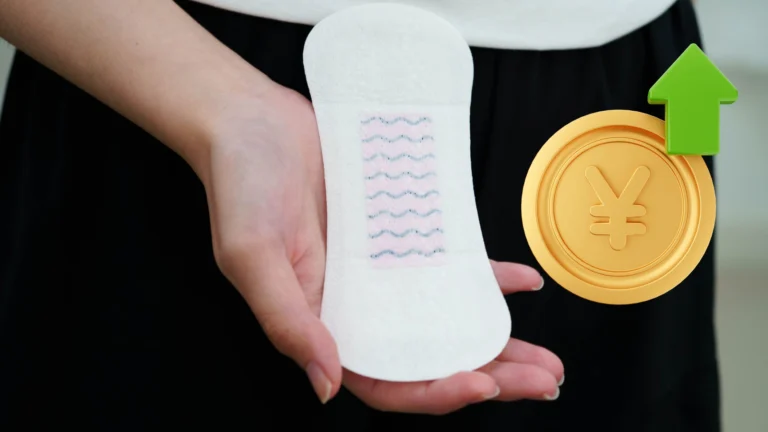
A viral social media post claimed sanitary pad prices in Japan are going to jump 15% in August, all while the country’s closest neighbor, South Korea, has started handing them out for free. Were people upset? You better believe it.
The post blamed one person above all: Japan’s first female prime minister, Takaichi Sanae. But while the anger stemmed from real problems, it had people pointing in the wrong direction.
Hiking prices and accusations: a perfect viral storm
The now-viral post on X, published on July 25 by user @marieeelse, talked about the coming price increase. She contrasted it with South Korea’s new free menstrual product initiative and ended with a pointed question. “Takaichi Sanae, what are you even being Japan’s first female PM for?”
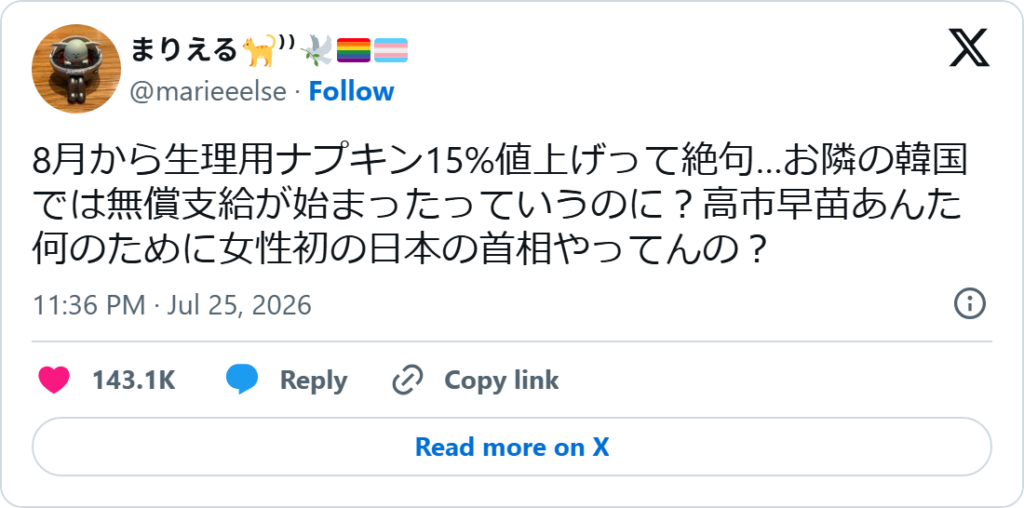
Despite coming from an account with just 746 followers, the post exploded, collecting around 143,000 likes, 22,000 reposts, and 4.9 million views. The replies were locked, so nearly all of the debate played out through quote-posts instead.
About a third of replies latched onto the last part of the post, with people expressing their disappointment at Prime Minister Takaichi. Some even went so far as to call her the enemy of women.
Another notable chunk of likes went to posts that said this was about more than just pads. User @nikamoto08 said, “To everyone who saw this and thought ‘Takaichi, screw you!’, it’s not just pads. These past few months, law after law that grinds away at our rights has been passed. It’s really dire! Please keep an eye on politics.”
However, only about a quarter of replies (and a mere 8% of likes) actually talked about possible solutions instead of just venting. These suggested waiving the 10% sales tax for pads and making free pads available in schools and public restrooms.
The true culprit behind the cost increase
However, the problem is that the 15% increase isn’t a government decision. It doesn’t affect only menstrual pads, either. It comes from manufacturers responding to rising production costs.
Daio Paper, which makes the Elleair brand, announced that deliveries from August 1, 2026, would see prices rise by at least 15% across household paper products. This includes toilet paper, sanitary pads, and infant diapers. Unicharm had already begun increasing prices by roughly 5% on diapers and menstrual products in July. Meanwhile, Kao plans to raise prices on its Laurier pads beginning in September.
The reason is painfully simple: naphtha. Companies use this petroleum-based feedstock to produce the nonwoven fabrics and superabsorbent polymers found in products like sanitary pads and diapers. Supply disruptions in the Middle East (like the temporary closure of the Strait of Hormuz) combined with the weak yen have driven raw material costs way up.
This is the same chain reaction that recently affected other everyday products, like Calbee being forced to temporarily switch some potato chip bags to simple black-and-white packaging. Natto manufacturers have also announced price increases because packaging materials became more expensive. Sanitary products are simply another casualty of the same petrochemical shock.
How government policy can make hard situations harder
But while lobbing all the blame for the pad price hike onto Prime Minister Takaichi misses the true cause, the frustration exists for a reason. The government might not be able to dictate the price tags companies put on their products, but it’s not powerless.
Japan applies the full 10% consumption tax to menstrual products. Although food, non-alcoholic drinks, and newspaper subscriptions qualify for a reduced 8% tax rate, sanitary products do not. There is also no nationwide program providing free menstrual products.
That matters because period poverty is a documented issue. According to a 2022 government survey, about 8.1% of Japanese women aged 18 to 49 struggle to afford menstrual products. For many people, the debate is less about one manufacturer’s price increase and more about years of feeling that menstrual necessities have been treated as optional rather than essential.
Question: do you like UJ's independent coverage of Japan? Our writers are supported by our members. Join Unseen Japan Insider to get bonus content every week, an ad-free website, and access to our large and growing Insider archive.If you love UJ's independent coverage of Japan, join Unseen Japan Insider to get content every week, an ad-free website, and access to our large and growing Insider archive.
If Korea can do it, why not Japan?
This is where comparisons with South Korea entered the conversation. South Korea’s Ministry of Gender Equality and Family launched its “Pads for Everyone” pilot program. Running from July through December 2026, the project installs more than 700 free menstrual product dispensers across 12 local governments, with the goal of expanding nationwide in 2027.
It builds on an existing voucher program that already provides vulnerable young people aged 9 to 24 with 14,000 won (USD $10) each month to purchase menstrual products. The pilot program carries a budget of 3.2 billion won (USD $2.3 million).
That contrast helped fuel the viral outrage.
At the same time, some Korean users pointed out important context. The program is not nationwide, and menstrual products in South Korea are generally more expensive than those sold in Japan. Those details don’t erase the contrast, but they do make the issue more nuanced than most online debate suggested.
There’s another reason why this isn’t happening in Japan: people have tried, and been shot down.
In 2025, Mie Prefectural Assembly member Yoshida Ayaka, then just 27 years old, became the target of roughly 8,000 death threats after advocating for free menstrual products in public facilities. The harassment followed criticism from conservative lawmaker Sugita Mio. Eventually, Tsu City declined to provide free products, citing concerns over theft and costs.
No satisfying conclusion anytime soon
In other words, it is a very controversial topic. It’s also one reason why many people discussing the latest controversy have limited replies or avoided direct debate online.
But the outrage itself reflects concerns that many Japanese women have been raising for years: menstrual products remain taxed as ordinary consumer goods, there is no national free provision system, and period poverty continues to affect thousands of people. Naphtha might have triggered the price increase, but much deeper issues have fueled the public reaction.
Keep reading


Sources
中東影響、原材料高で紙おむつ値上げへ 大王製紙やユニ・チャーム 時事通信
ユニ・チャームや大王製紙、紙おむつ値上げ 材料高騰で2026年夏から 日本経済新聞
おむつ・生理用品・洗剤…生活必需品値上げ、ナフサ高騰の影響広がる 読売新聞 (archived)
8月から生理用ナプキン15%値上げ 女性の悲鳴が止まらない 深刻な生理の貧困と世界の無料配布との差 coki(公器)
Korea to roll out free public menstrual products in 12 regions from July The Korea Times
Free menstrual products, 24-hour FX trading and more: Gov’t announces policies for second half of 2026 Korea JoongAng Daily