

Japan’s culture is lauded the world over for its unique aesthetics, centuries-old traditions, and well-preserved temples and shrines. It’s why record levels of tourists are flocking here yearly.
The one aspect of Japanese culture that’s not lauded? Its work culture. The consequences of overwork can be seen in all facets of life. Statistics show they even haunt Japan in its sleep.
Unfortunately, under its current leadership, it doesn’t look like Japan will get a chance to rest any time soon.
Japan: The world’s worst sleepers since 2017
If there’s one thing health experts agree on, it’s the importance of sleep for good health. A bad night’s sleep opens you up to higher risk of heart disease, obesity, and stroke. A lack of sleep also leads to decreased physical activity and reduced mental acuity.
As a result, various world agencies and private companies have conducted studies over the past several years as a way of tracking national health. The results are pretty consistent year over year. Some of the best sleepers in the world are in New Zealand, Finland, Australia, and the Netherlands. Most of these countries average over 7 hours and 30 minutes of sleep nightly.
The worst sleepers? Bar none, it’s Japan, followed by South Korea. Japanese citizens average less than 6 hours and 30 minutes of sleep nightly.
Japan’s sleep deprivation issues go back to at least 2017, when the Japanese word for “sleep debt” (睡眠負債; suimin fusai) was nominated as one of the year’s top buzzwords. Nothing’s gotten better since then, unfortunately. A survey by the country’s Ministry of Health, Labour & Welfare in 2023 found that 38.5% of men and 43.6% of women reported sleeping less than 6 hours nightly.
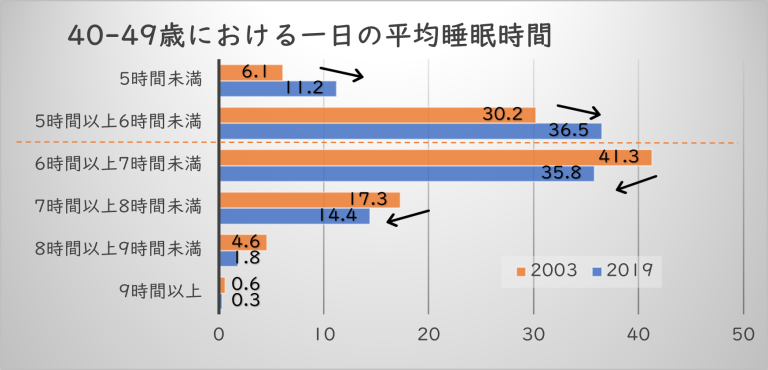
These numbers appear to have gotten worse over time. Numbers from the Organization for Economic Co-operation and Development (OECD) show that the number of people 40-49 years old getting between 6 and 7 hours of sleep a night or between 7 and 8 hours of sleep a night plummeted between 2003 and 2019.
Sleep deprivation may hit Japanese women the most
What’s causing the lack of sleep?
Not surprisingly from the country that has a word for working to death (過労死; karōshi), a primary cause is work. Workers in Japan are expected to put in overtime, with many working on the weekends. It’s no surprise, given what we know about the impact of sleep on mental health, that this leads to some workers taking their own lives out of exhaustion and desperation.
On the plus side, according to OECD data, a growing awareness of the dangers of overwork has led to a decrease in overall work hours. The average worker put in 1,607 hours annually, down from a high of 1,745 hours in 2012. However, that hasn’t led to a concomitant rise in sleep time.
A 2018 article from Toyo Keizai cites another factor in lack of sleep: long commute times. On average, Japanese workers spend 1 hour and 15 minutes commuting round-trip. Those who live in Kanagawa Prefecture spend a full 1 hour and 45 minutes going to and from their workplaces. (Tokyo workers clock in at 1 hour and 30 minutes.)
Planning a trip to Japan? Get an authentic, interpreted experience from Unseen Japan Tours and see a side of the country others miss!

Not surprisingly, sleep deprivation hits women in Japan harder than men. We’ve documented the uneven burden of housework on Japanese women, who bear 4.76 hours more housework and child-rearing duties than their husbands. That’s one of the largest gender gaps for any developed nation.
A Prime Minister running on two hours of sleep

It’s 2026, and Japan is still debating how it can catch up on a decade or more of sleep deprivation.
Experts such as Professor Yanagisawa Masashi, a sleep researcher at Tsukuba University, argue that the one-hour sleep gap between Japan and Western nations is a threat to the country’s economic growth.
“Sleep deprivation isn’t just a threat to your future health,” he argued. “It leads to lower work performance tomorrow. If you want to take your health into your own hands, sleep is the first place to start.”
Yanagisawa wishes that Japan’s government would address the issue of sleep deprivation. However, there seems little chance of that under Prime Minister Takaichi Sanae’s government. Takaichi has famously bragged that she never rests, claiming she gets by on a mere two to four hours of sleep.
Takaichi seems poised to push her personal work style onto the nation. The PM has announced that the government will put off revising the country’s labor standards, which it hasn’t done in 40 years. The government even says it may relax work hour regulations.
Yanagisawa hints that the attitude that “less sleep = higher commitment” in Japan starts in school. Between after-school activities and cram school attendance, Japan’s kids learn to live on less sleep at an early age.
“We have to address sleep deprivation with middle and high school kids especially,” argues Yanagisawa. “Education is crucial.”
If you or someone you love is in crisis, please reach out for help. Those in Japan you can call the following numbers:
0570-064-556 for kokoro-no-kenkou-soudan (こころの健康相談) operated by prefectorial and city organizations
0570-783-556 for inochi-no-denwa (いのちの電話) operated by Federation of Inochi No Denwa.
See a side of Tokyo that other tourists can't. Book a tour with Unseen Japan Tours - we'll tailor your trip to your interests and guide you through experiences usually closed off to non-Japanese speakers.

For English language help in Japan, reach out to TELL.
If you are in the US, call 911 for emergencies and 988 for the suicide hotline.

The library, reopened to fanfare in 2022, continues to bring in more visitors every year than people who live in the prefecture.
If you have one of these cards and don’t want to lose the balance – and the card – then you have only a few days left to use it.

Demons out, luck in! How the festival of Setsubun evolved into a tradition enjoyed by kids across Japan every year.
Sources
日本人は睡眠不足、職場も子どもも 筑波大学の柳沢正史教授の警鐘. Nikkei
Japanese women sleep the least in OECD survey of 33 countries. Asahi Shimbun English
第34回 2017年 授賞語. Jiyu Kokuminsha
Why Is Sleep Important? National Institutes of Health
日本が「睡眠不足大国」に転落した3つの事情. Toyo Keizai
日本人の通勤時間は平均1時間19分!世界の通勤時間と比較も!Canary
【2026年の働き方】「働いて働いて」の高市首相が方針転換、労働基準法改正先送り、時間規制「強化」から「緩和」へ. JBPress
高市総理の「働き方」のリアル 実質“休みゼロ”、睡眠は2時間、会食ゼロ…「溜まった洗濯をしながら党首討論の準備をしていたという話も」記者が明かした“裏話”. Abema Times
