
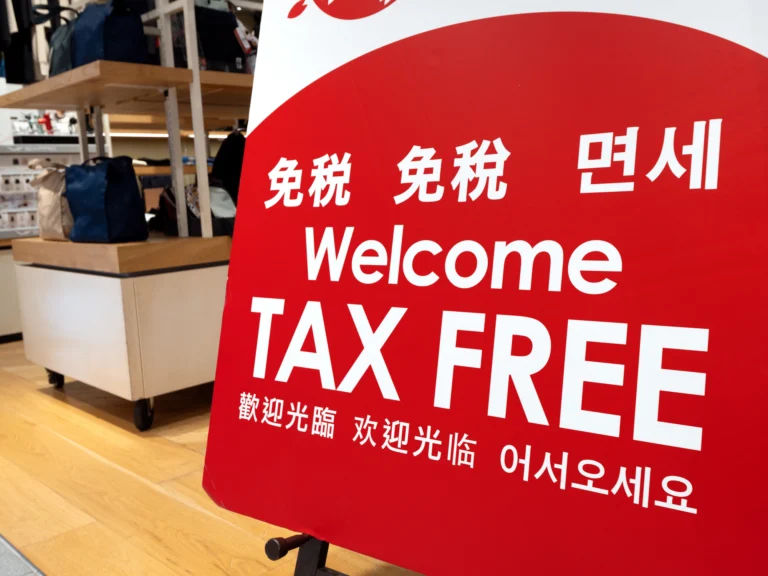
As we’ve brought up before, Japan is about to make tax-free shopping considerably more complicated for foreign visitors.
From November 1, 2026, tourists will no longer get Japan’s 10% consumption tax removed at the register. Instead, they’ll pay the full price, take their purchases through customs when leaving Japan, and then wait for a refund. And while this may sound like a simple shift in timing, it’s not so simple.
The new middleman in tax-free refunds

The new system, officially called the “refund method” (リファンド方式, rifando hōshiki), creates an entirely new middleman between shoppers and their tax refund.
You might ask, middleman? Where? But it’s very simple. To get a refund, someone has to process and issue it. It’s not done automatically. And if something costs time and manpower, it obviously won’t come free.
What this means is that the middleman will almost certainly charge something. And even more alarming: the government hasn’t set a cap on that charge.
The Tourism Agency’s own FAQ says the consumption tax law contains no rules governing how refunds must be carried out or who must pay the refund operator’s commission. It explicitly notes that in other countries, travelers commonly bear the cost.
Most likely, the private operator will deduct a commission from the refund. The government itself collects none of that fee. And the law doesn’t require the refund to arrive as cash. Tourism Agency guidance says shops can use coupons or points redeemable at particular facilities (useless if you never go back to Japan!).
So a visitor who thinks, “I’ll get my 10% consumption tax back at the airport,” may discover that the actual refund is smaller and potentially not even useful.
The middleman can be trusted (probably)
Not only has the government not set any real rules about how refunds should be processed or how much a refund operator can charge, but it also doesn’t yet have a system to properly review operators.
The National Tax-Free Shop Association publishes an operator list. However, the association built that list from the operators’ own declarations, and the tax agency says outright that appearing on it carries no official authorization or guarantee where refunds are concerned. These firms do hold a government approval, but it covers transmitting your purchase data to the tax agency, not handling your money.
And there are no current laws requiring that whoever processes the refund be on that list at all. Theoretically, all they really need to do is register as a funds-transfer business and go through some government checks and screening.
In all fairness, that’s not nothing since it means they have to get state approval as a legitimate business. However, that doesn’t mean they’ll have the experience or logistical capability to handle refunds in a quick or efficient manner. This refund method is all-new, after all, and its complicated nature means that it will be prone to mishaps.
Consumable caps, 90-day windows, and more

That’s not the only notable change in this new method.
The old distinction between general goods and consumables will disappear, as will the ¥500,000 (~$3,150) cap on consumables and the special sealed packaging requirement. The ¥5,000 (~$32) minimum purchase will remain, so shoppers should make sure to get their money’s worth. Travelers will also get 90 days from the date of purchase to clear customs.
However, Japan’s Tourism Agency says travelers have to have their purchases with them at the customs terminal before checking baggage in. At a minimum, this can lead to some hassle, as you have to pull your shopping out of your luggage.
It can be even worse if you’ve decided to use a hands-free luggage service that sends shopping and/or suitcases ahead to airports or hotels. If you can’t arrange the pick-up of said luggage before going through customs, you’ll go through empty-handed and lose any chance of a refund. (These are the kind of details about traveling to Japan we cover in our free five-day trip planner.)
Customs verification is also unforgiving. They perform checks based on purchase records rather than individual items. If one item on a record is missing, they might mark the entire record as 免税不可 (menzei fuka; tax exemption unavailable). Meaning, the refund for the whole purchase will go straight down the drain. (This is on top of increased taxes and fees.)
Opened consumables create another issue. If you eat, drink, use, or otherwise consume part of food, medicine, cosmetics, or another consumable before leaving Japan, you might run into a problem.
Large purchases receive additional scrutiny. Purchases of ¥1 million (~$6,300) or more before tax will require identifying information. Think serial numbers, brand, and model details to be filed with the National Tax Agency. The idea is to prevent someone from buying an expensive watch tax-free and then swapping it for a cheaper one before departure.
What happens to unclaimed refunds?
Even if you clear customs, the refund process might be incomplete due to an incorrect bank account number or a misapplied refund method. And if that happens, the refund goes unclaimed.
The shop would have already claimed the item as tax-free, assuming the refund went through. So, if the refund is unclaimed, the retailer can keep the amount and book it as miscellaneous income. There is also no deadline for making a refund claim. Individual shops can establish their own expiration periods.
To understand why this is important, you need to know that the Japan Department Stores Association surveyed 87 department stores and found that tax-free sales totaled about ¥53.8 billion (~$339M) in February 2025 alone. At some major retailers, tax-free purchases account for roughly 10% to 12.6% of revenue.
The government has said that its aim isn’t to collect more money from tourists. Rather, they’re trying to combat fraud, especially the resale of tax-free goods inside Japan. For shoppers, it’s best to brace yourself for the likely reality that you won’t get that 10% tax back at the airport. Instead, you apply for a privately operated refund after some tedious customs confirmations.
Keep reading



Sources
免税店向け よくある質問(リファンド方式) 観光庁 消費税免税店サイト
輸出物品販売場制度に関するQ&A(リファンド方式・概要編) 国税庁
輸出物品販売場制度に関するQ&A(リファンド方式) 国税庁消費税室
輸出物品販売場制度のリファンド方式への見直し 国税庁
外国人旅行者向け免税制度の見直し(案)について 財務省・国税庁・経済産業省・観光庁
旅行者向け特設ページ 多言語リーフレット追加 観光庁 消費税免税店サイト
「リファンド方式」特設サイト 全国免税店協会
インバウンド免税「リファンド方式」開始まで約3ヶ月、免税店が準備すべき4ステップ トラベルボイス
2025年度税制改正大綱が閣議決定、免税制度は「リファンド方式」へ、2026年11月1日から特殊包装や上限額を廃止 トラベルボイス
春節期間中の免税店実態調査、6割が売上10%以上増。2026年免税制度改正の認知率は? やまとごころ.jp
百貨店免税売上“急ブレーキ”の背景は?各社の決算書から読み解く 訪日ラボ
「訪日外国人向け消費免税廃止を」 自民有志が提言、不正指摘 日本経済新聞
Tax-free Shopping in Japan: 2026 Changes Japan Travel