

For Japanese language learners, the Japanese Language Proficiency Test (JLPT) is often their white whale. Many learners need to pass level N2 for work purposes. Some take it just to prove their level.
Many foreign speakers of Japanese find the test difficult at the top two levels. Native speakers, by contrast, would generally have no problem passing N1, the top level.
But there is a test whose hardest levels bedevil even the most dedicated native speaker. That’s the Kanji Kentei (漢字検定), or Kanken, a test of how well you know the Chinese characters at the center of Japan’s tripartite writing system.
The easier levels, mostly aimed at schoolchildren, aren’t that bedeviling. The highest level, however, requires an almost scholarly level of kanji to pass. Here’s what makes the test so bedeviling, and what you should know if you want to try your hand at the levels that make even Japanese people cry.
No, the JLPT isn’t hard for Japanese people
First, time to dispel a myth.
The JLPT, which is run by the Japan Foundation and Japan Educational Exchanges and Services (JEES), was created in 1984 to test Japanese knowledge among non-native speakers specifically. The test is given twice a year in both Japan and abroad, once in July and once in December.
The JLPT runs from levels N5 (easiest) to N1 (hardest), with N1 requiring knowledge of most of the Jōyō Kanji (the Kanji for Regular Use) and most grammatical forms. The test covers reading, kanji use and pronunciation, grammar, and listening.
Pass rates are tough. Across all takers, only 36.3% passed in July 2025. 33.4% passed N2 across both sittings of the exam. Only 28.9% managed to conquer N1.
Ironically, living in Japan doesn’t help you. Only 24.4% passed N1 in Japan compared to 32.2% of overseas takers. A whopping 40% of overseas test takers passed N2 in 2025, while only 26.4% in Japan made the mark.
What accounts for the gap? Likely kanji knowledge. In December 2025, 84% of overseas N1 examinees sat the test in China, Taiwan, or South Korea, more than half in China alone, which is where Japan got kanji from in the first place. Exam cheating is documented, but the reported schemes target test-takers in Japan, so it doesn’t explain the gap.
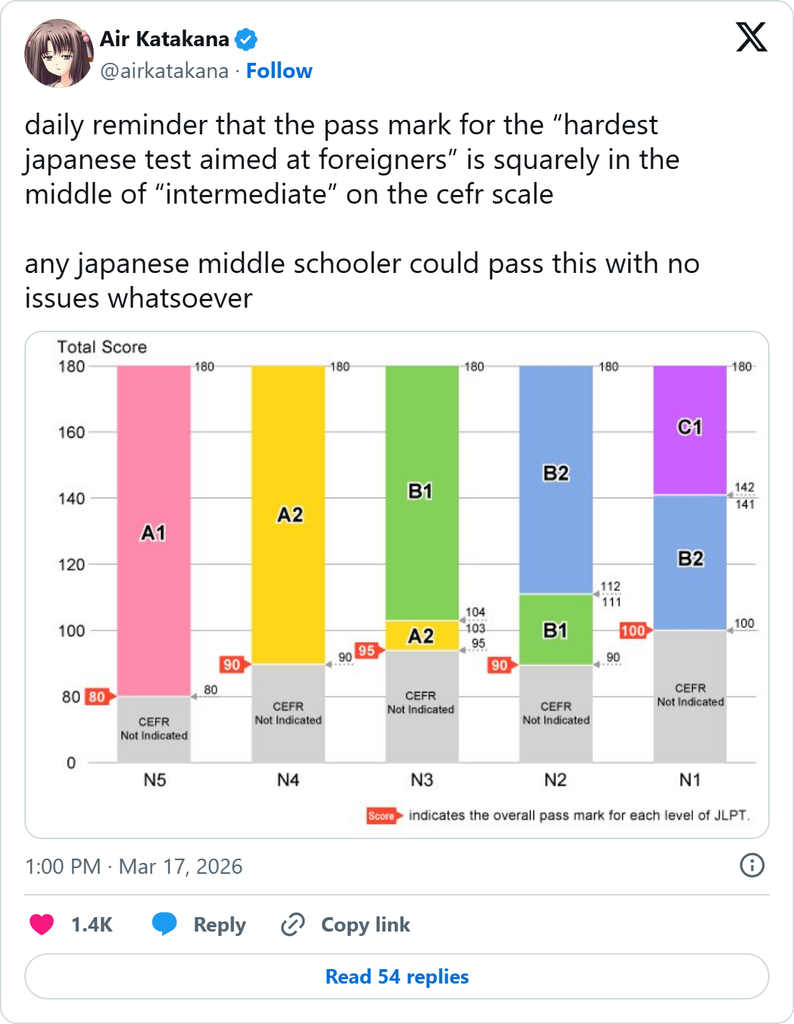
What is clear is that the JLPT is a test for non-native speakers. It doesn’t contain anything esoteric; even the “hard” parts of N1, which contain a large number of primarily written grammar forms, are forms you’ll find in any government document, newspaper op-ed, or Japanese novel. As one X user put it, “any japanese middle schooler could pass [the JLPT] with no issues whatsoever.”
…but the Kanji Kentei can be
Which brings us to Kanken.
The Kanken is administered by the Japan Kanji Aptitude Testing Foundation (日本漢字能力検定協会; Nihon Kanji Nōryoku Kentei Kyōkai). This is, incidentally, the same public-interest foundation that declares the kanji of the year with a live writing at Kiyomizudera every December.
The test was created by a businessman, Ōkubo Noboru (大久保昇), then a Matsushita Electric Works employee. He created the association as a voluntary body in 1975 after seeing a kanji cram school. Ōkubo is no longer associated with the exam, though; he was sentenced to prison in 2012 over fishy contracts that benefited his and his family’s companies.
The test primarily tests something the JLPT never touches: writing kanji by hand (書き取り; kakitori). But it goes well beyond that. Besides being able to write characters “correctly and with clear strokes,” participants at the higher levels are tested on:
- Kanji readings (漢字の読み; kanji no yomi)
- Classical allusions and famous proverbs (故事・諺; koji/kotowaza).
- Antonyms and synonyms (対義語・類義語; taigigo/ruigigo), being able to produce an antonym or synonym in kanji given a base word and a reading.
- Compound structure (熟語の構成; jukugo no kōsei). In Japanese words composed of two characters, the first and second kanji have a relationship to one another. For example, in 岩石 (ganseki, rock), the characters are synonyms. In 洋画 (yōga, Western painting), the first character modifies the second.
- Four-character compounds (四字熟語; yoji jukugo), words such as 天衣無縫 (ten’i muhō, flawless and natural).
- Homophones (同音・同訓異字; dōon/dōkun iji), distinguishing kanji words that have the same sounds.
- Miswritten characters (誤字訂正; goji teisei), identifying incorrectly used characters by writing the correct one.
More than testing a general knowledge of Japanese, then, the Kanken is a kanji deep dive.
Kanken has 12 levels, starting from 10級 (Level 10) to 1級 (Level 1), with two intermediate levels: 準2級 (Pre-Level 2) and 準1級 (Pre-Level 1). Not every level tests every aspect of kanji knowledge. Level 10, for example, is limited to reading, writing, and stroke order of the 80 characters every first grader needs to know. 94% of all takers pass this level.
Can you memorize 6,000 kanji?
As you’d guess, the test gets harder as you increase levels. By Level 2, you’re being tested on the 2,136 characters everyone who attends high school and college is expected to know. This is, in other words, standard adult literacy, but coupled with an in-depth knowledge of pronunciation, writing, and word constructions.
At this level, the going gets tough. Only 30.7% of the 95,968 test takers in 2025 passed, which requires getting 80% of all questions right.
At Pre-Level 1, shit gets hard. The test covers around 3,000 kanji, over 800 more kanji than those defined as common by the government. Only 21.6% of the test’s 13,372 takers managed to pass by answering 80% of the questions right.
Level 1 is a dramatic jump. The test expects you to know a mind-boggling 6,000 kanji. Of the test’s 2,535 certifiably insane test takers, a mere 12.5%, or 316, earned their Level 1 certificate.
Question: do you like UJ's independent coverage of Japan? Our writers are supported by our members. Join Unseen Japan Insider to get bonus content every week, an ad-free website, and access to our large and growing Insider archive.If you love what we do, help us pay our writers to do more of it by joining Insider. You'll get bonus content every week, an ad-free website, and access to our large and growing Insider archive.
Who takes the Kanji Kentei?

Who would take such an insane test?
There were 1,294,214 applicants in FY2025. The test is primarily run at schools, universities, and by some companies looking to boost their workers’ written Japanese skills.
Private test-taking by hobbyists is a lot smaller. There were only 428 public sittings in FY2024 versus 31,374 group sittings at schools, cram schools, and companies. Online testing is small: there were only 61,173 applicants for Computer-Based Testing (CBT) in FY2024, and only 2,726 test takers who used Kanken Online. Both groups represented under 5% of total test takers.
In Japan, some schools and universities reward taking Kanken. Some 2,764 out of 5,429 high schools and technical colleges count the Kanji Kentei when weighing submissions, whereas 672 out of 1,079 colleges do the same. Having Kanken on your resume can help you get hired by a Japanese firm, but only if it’s Level 2 or higher.
In recent years, the number of people taking Kanken has dropped significantly. Participation peaked in 2008, when 2,893,071 people applied to sit the exam. After a scandal involving the exam’s founder, Ōkubo Noboru (大久保昇), in 2009, participation fell by 26.6%. In FY2025, it was down to 1,294,214 applicants, a 32% drop from 2019.
One group taking it more than they used to is seniors. In FY2023, the number of applicants in their 80s rose 10.3% over the previous year, and passers in their 80s rose 17%. The oldest person who passed was 96. Some elder-care facilities now run group sittings of the test as recreation, seeing it as a way to help stave off the effects of dementia by keeping residents’ brains active.
Very few people take the two hardest levels. In FY2025, only 1.37% of participants sat Pre-Level 1 and Level 1 combined.
Should YOU take the Kanji Kentei?

First, let me be clear. There is little practical reason for taking the Kanken outside of making Japanese people exclaim すごい! at parties. It may help on a resume or with entry to a Japanese college. It may also help as proof of Japanese ability in a permanent residency application, given that the Japanese government is considering requiring proof of language ability for PR.
Learning to write kanji may help you with memorizing them. Literature reviews such as one from MacLeod and Bodner in 2017 found that the production effect – saying, writing, or typing an item – improves memorization. Notably, however, studies on whether handwriting beats typing for memory in general are inconclusive.
If you want to take it, your best bet is taking it in Japan. The association only lists 10 official locations worldwide that give the test regularly. However, any overseas organization can give it if it has 10 or more willing test-takers signed up. In practice, it’s usually given at Saturday schools for Japanese children abroad. Pre-Level 1 and Level 1 tests are only given in Japan, so the highest you can take abroad is Level 2.
If you passed one of the hardest levels as a foreigner, you’d be part of an elite crowd. The association doesn’t publish numbers on how many non-Japanese takers sit the exam. It’s rumored that only around six non-native speakers from outside the kanji-using world have conquered Level 1. One of them is Bret Mayer, an American translator and kanji instructor in Hamamatsu who got hooked on Japanese after watching Dragon Ball.
The only question left is: are you up for the challenge?
Keep reading


Sources
年度・回ごとの級別志願者数・合格者数 日本漢字能力検定協会
年間志願者数および合格者数の推移 日本漢字能力検定協会
数字で見る漢検 日本漢字能力検定協会
各級の概要(出題内容・審査基準・合格基準・採点基準) 日本漢字能力検定協会
事業報告書 【第12期】2024年度 日本漢字能力検定協会
海外の会場のご案内(準会場) 日本漢字能力検定協会
海外での団体受検について 日本漢字能力検定協会
「今年の漢字®」 日本漢字能力検定協会
“アクティブシニア”は80代?! 志願者・合格者ともに増加~「漢検」受検データ年齢別集計で判明〜 共同通信PRワイヤー
2025年 第1回(7月)データ 日本語能力試験 JLPT
2025年 第2回(12月)データ 日本語能力試験 JLPT
2025年 第2回 日本語能力試験 結果の概要 日本語能力試験 JLPT
Guaranteed to pass the JLPT for 300,000 yen… “Astonishing trick” image of cheating support by a Chinese crook. FRIDAY DIGITAL
日本語能力試験の目的と沿革 日本語能力試験 JLPT
Typed Versus Handwritten Lecture Notes and College Student Achievement: A Meta-Analysis Educational Psychology Review
The Production Effect in Memory Current Directions in Psychological Science
漢検元理事長親子に実刑判決 背任事件で京都地裁 日本経済新聞
英語学習につまずく人には特徴が?漢検1級合格者ブレット・メイヤーさんに聞く語学習得のコツ DMM英会話ブログ
漢検1級に受かった外国人 漢検1級・日本語検定1級に合格したロシア人
漢検は履歴書に何級から書ける?正しい書き方や就活の評価を解説 キャリアチケット
日本漢字能力検定協会 Wikipedia
漢検協会事件 Wikipedia