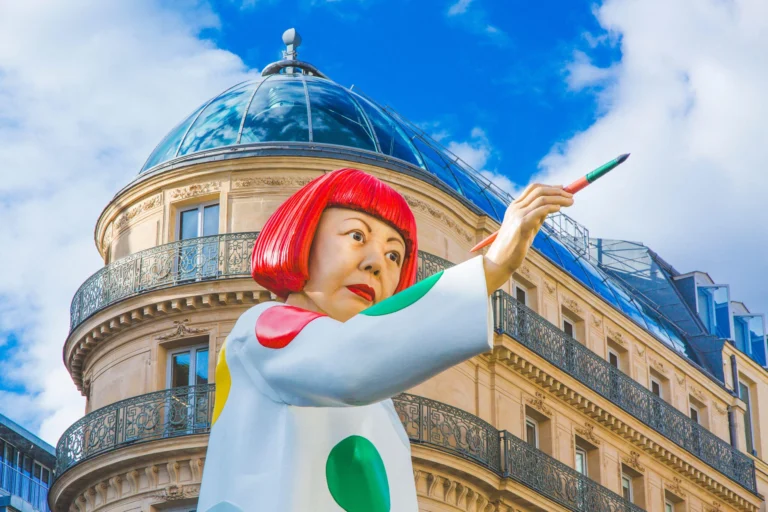
As the world reeled from the deaths of both Dolly Parton and Tim Curry in the same week, news came of another big loss. Artist Kusama Yayoi’s office announced last week that she had died of multiple organ failure on August 14.
Born to a wealthy family in Matsumoto, Nagano Prefecture, in 1929, Kusama moved to New York in 1958. There, she first developed her avant-garde art projects that played with dots and mirrors, such as her Infinity Net paintings and Infinity Mirrored Room in the late 1950s and 60s. While not officially invited to the 1966 Venice Biennale, she received permission from its chair and support from a financial backer to attend and install her mirror project, Narcissus Garden.
Kusama struggled most of her life with hallucinations, obsessional states, and suicidal ideation. For the last 49 years of her life, she commuted between her studio in Shinjuku by day and a nearby mental hospital at night, having voluntarily admitted herself in 1977. During that time, she wrote several novels, including The Hustler’s Grotto of Christopher Street (クリストファー男娼窟; Kurisutofā Danshōkutsu) and her autobiography, Infinity Net (無限の網; Mugen no Ami).
Kusama’s impact on the art world was enormous. Some credit her with popularizing and “democratizing” art through commercialization. Others celebrate her struggle against sexism and racism in the art world, arguing she was a “banner artist for the transnational and transhistorical, and for improving gender balance.”
But her writings present a different Kusama: a woman who casually inserted virulently racist, anti-Black statements in her work. English speakers, particularly Black people, were quick to remind the world about this long, dark history.
The conversation about her death, however, was quite different in Japan. Japanese commenters didn’t ignore her racism. They just put it in a very small box. Her death ties into what one UJ author has previously called “Japan’s whiteness problem,” and opens a transnational debate about forgiveness for someone whose racism was vicious and deliberate.
“A profoundly, specifically Anti-Black racist”
The single highest-engagement X post about Kusama’s death came from the art account La Mode Unknown, which heralded the artist as the “Queen of COLOR.”
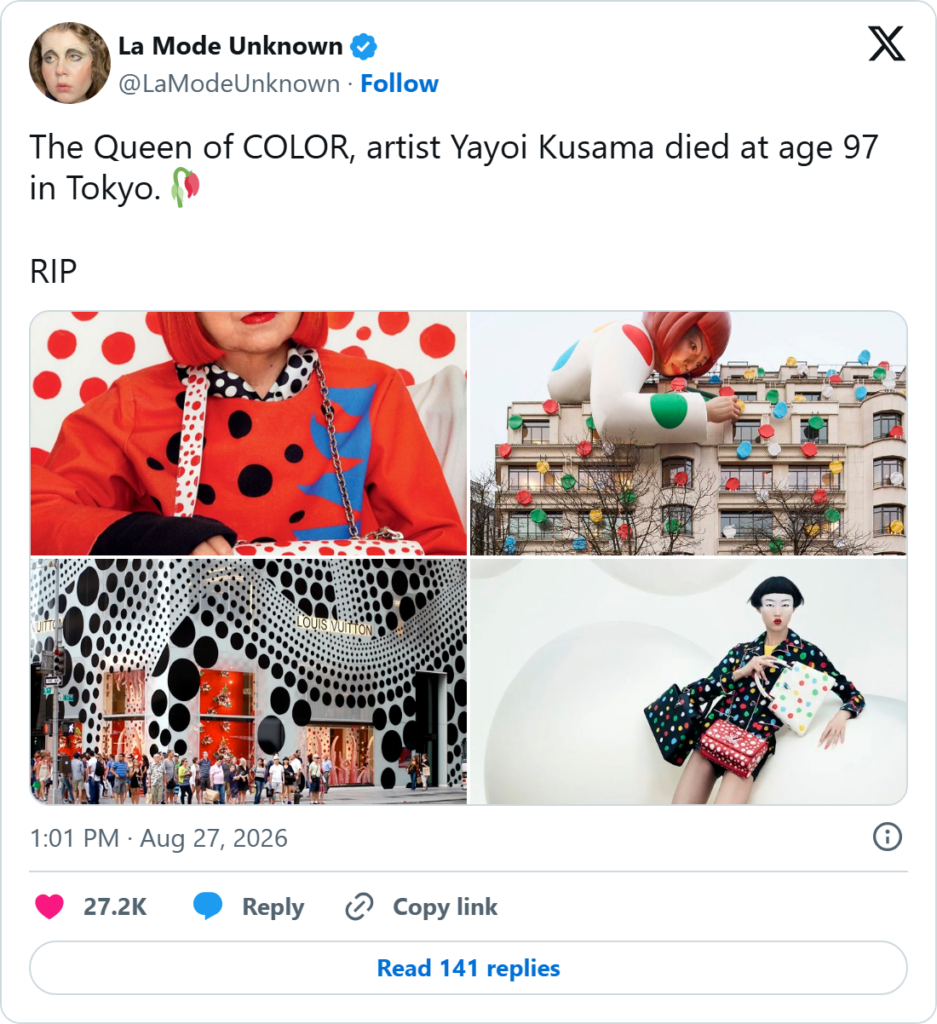
A majority of the English-language sentiment in this and other threads was straight mourning and tributes from art institutions worldwide.
Within those posts, however, many were quick to remind the world of the troubled artist’s most vile statements.