
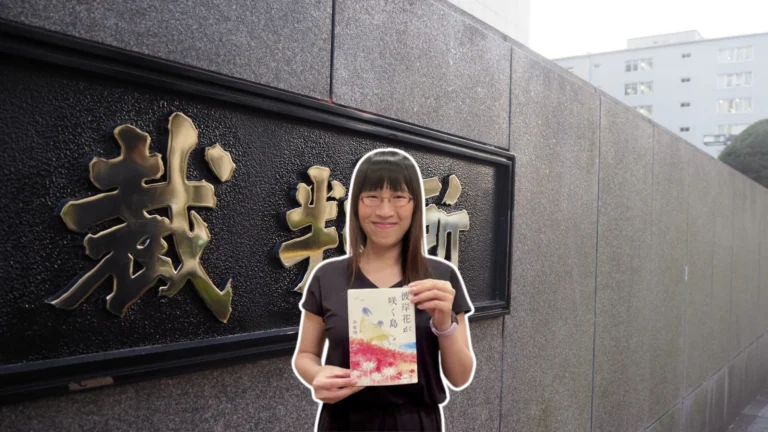
On May 27, 2026, the Tokyo District Court handed down a small but significant ruling. The court ordered Takimoto Tarō, a Kanagawa-based lawyer, to pay ¥220,000 (USD $1,400) in damages to Li Kotomi, an Akutagawa Prize-winning author, for outing her as transgender on X.
Though the amount seems small, this case marks the first time a Tokyo court awarded compensation to a sexual minority for being outed. For a country that doesn’t have any laws criminalizing outing, that’s huge.
Li, Takimoto, and a tweet that started a lawsuit

To understand what the deal is, you have to know a little bit about the people involved, first. Li Kotomi was born in Taiwan in 1989 and moved to Japan in 2013. She won the Akutagawa Prize in 2021 for her novel, Higanbana ga Saku Shima, which imagines a society without fixed gender roles.
She publicly identified as a lesbian before revealing in November 2024 that she is transgender. However, this wasn’t exactly her choice, and only came after various figures and even a magazine outed her. Takimoto Tarō is one of those.
In 2024, Takimoto posted on X, describing Li as a “woman-identifying person with a male body,” adding that she did not appear to be legally female. The post was viewed around 8,000 times before being deleted a few days later. Li filed suit two months after (not the first author to push back against a clear wrong), and the court case recently concluded.
In its decision, the court recognized that information about a person’s sex or gender history is sensitive information tied to personal rights and dignity. Sharing it without consent, the court said, is an unlawful act. That language is important because it moves outing from something socially condemned into something legally actionable.
Importantly, Takimoto is not an obscure figure. He’s been a high-profile public-interest lawyer ever since the Aum Shinrikyo trials; the group even attempted to kill him numerous times. More recently, however, he’s been doing far less heroic work with a “gender-critical” advocacy group. His being such a public figure amplified the impact of his statements and helped frame the case as more than a private dispute.
Precedent for the case
Japanese courts had already acknowledged the harm of outing back in 2020, in the aftermath of the Hitotsubashi University case. In that incident, a law student died after being outed in a group chat. The Tokyo High Court noted that outing violates privacy and personal rights, but ultimately did not award damages to the family.
So, the fact that the court is awarding damages this time is important.
It’s not the first time that a Tokyo court awarded damages to someone who is transgender. That case ran from 2019 to 2023, flip-flopping between whether it was illegal to restrict a transgender woman’s access to the women’s bathroom. Japan’s Supreme Court ultimately stepped in and said that it was illegal. This marked another nudge in Japan’s gradual shift toward accepting those who identify as LGBTQ+.
Consequently, even though this case marks the first time Tokyo awarded damages for an outing case, other places in Japan have awarded damages for outing. Notably, in 2024, Li Kotomi won a case against former sci-fi writer Itō Maki. Itō, like Takimoto, was another person who outed Li over X.
Even so, the legalities (or illegalities, as it were) around outing are still shaky. While there are some municipalities like Kunitachi that have passed local ordinances that prohibit outing, no national laws explicitly ban it.
Question: do you like UJ's independent coverage of Japan? Our writers are supported by our members. Join Unseen Japan Insider to get bonus content every week, an ad-free website, and access to our large and growing Insider archive.We manage to keep most of our content free thanks to the generosity of our members. Join Unseen Japan Insider and you'll get access to new, exclusive UJ member content weekly, an ad-free website, and access to our large and growing Insider archive.
Li’s other outing lawsuits

So, remember how Takimoto wasn’t the only one outing Li? With this case against the lawyer and the aforementioned case against the sci-fi writer already won, Li currently has two other ongoing cases.
One is against Kofu City Council Member Muramatsu Hiromi, who outed Li on a social media site. It’s not the first time a local politician has been, let’s say, insensitive toward transgender people. Muramatsu also took things further than Takimoto by posting Li’s previous legal name and pictures of her as a child. Li filed the suit in 2025, seeking ¥5 million (USD $31,000) in damages.
The other case is against Reduxx Magazine, also filed in 2025. This one might prove to be a bit trickier since Reduxx is an overseas English-language publisher.
It will be interesting to see how a Japanese court will apply the country’s privacy and defamation laws in this case. After all, the standards for defamation are different in Japan compared with other parts of the world. In the U.S., for example, truth is an absolute defense. However, in Japan, a person or business’s damages count for a lot more.
What this case signals for the future
While the ¥220,000 awarded in this latest case may seem small by U.S. standards, it’s typical for Japanese privacy cases. More importantly, this win sets a precedent that future outing victims can point to and say, “The damages for violating my privacy in this way are real. I’m not the only one.”
Following her win in court, Li held a press conference on June 1, 2026, to talk about how harmful outing is. When you consider that June 1st is also the day the Japanese government presented its first LGBT understanding basic plan (under the 2023 LGBT Understanding-Promotion Act), and the first day of Pride Month, the timing feels impactful. Li didn’t just make a statement about how she was personally harmed, but about the mistreatment of sexual minorities as a whole.
And rather than dismiss the issue out of hand, many people are taking it seriously.
Keep reading



Sources
芥川賞作家の李琴峰さん 性別めぐる投稿で弁護士に賠償命令 NHKニュース
李琴峰さんのアウティング被害 投稿した弁護士に22万円の賠償命令 朝日新聞(Yahoo!ニュース配信)
李琴峰 Wikipedia日本語版
滝本太郎 Wikipedia日本語版
「女性として生きてきた生活の破壊」 芥川賞作家が甲府市議の”アウティング”に対し損害賠償を請求 弁護士JPニュース
東京都国立市が「アウティングの禁止」を盛り込んだ新条例を制定、本邦初 PRIDE JAPAN(Out Japan)
ゲイだと暴露「許されない行為なのは明らか」 一橋大学アウティング事件、遺族の控訴は棄却 BuzzFeed Japan
「ヘイトスピーチを加速させる恐れ」 芥川賞作家・李琴峰さんが猛反対する「永住資格取り消し制度」の問題点は 東京新聞デジタル
【勝訴】誹謗中傷者・ツイ廃伊東麻紀は16万5千円支払え Note