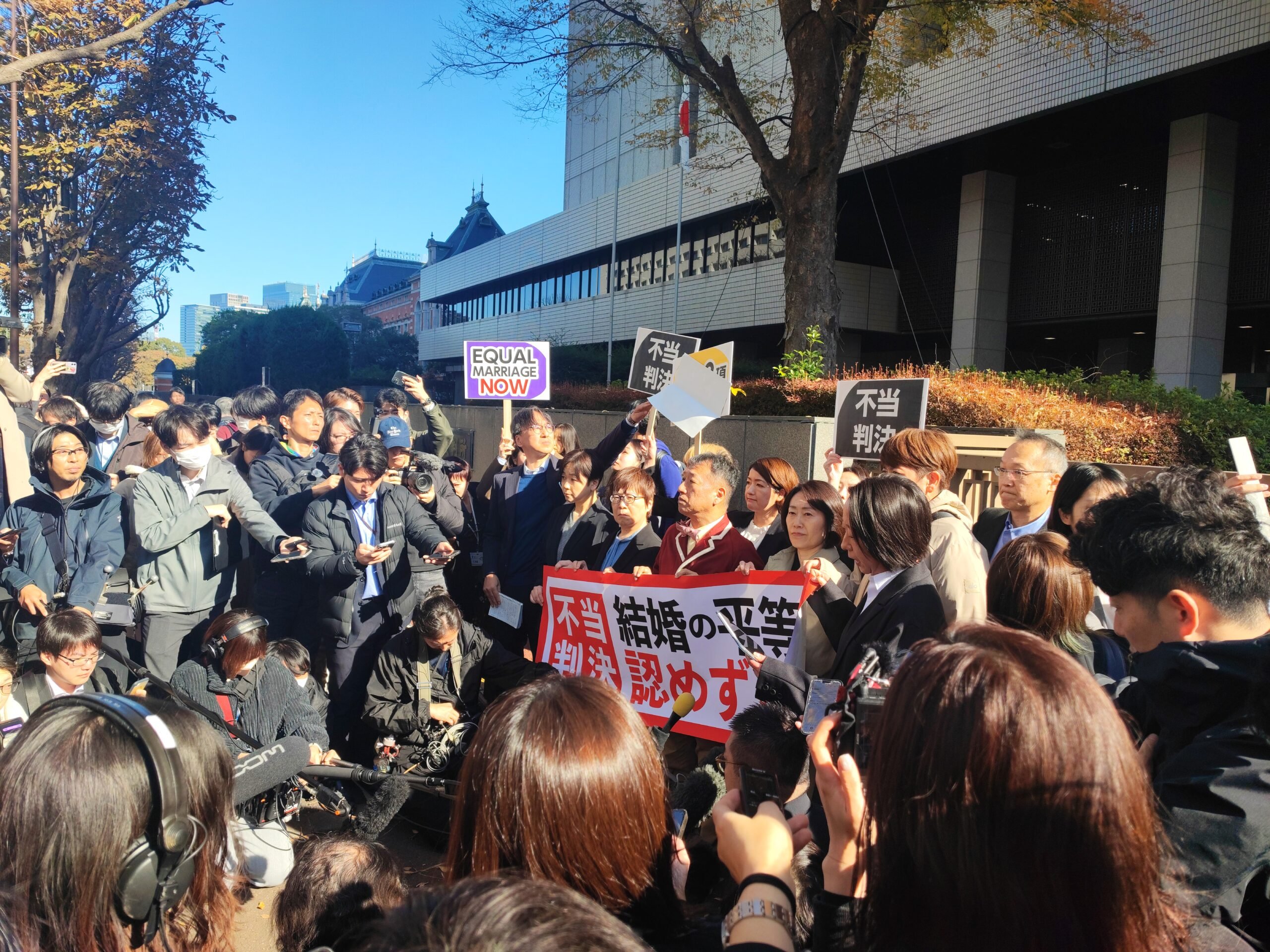


Supporters of marriage equality in Japan faced a setback on November 28th that surprised many. After a series of court rulings across the country that deemed the lack of adequate recognition for couples of the same legal gender unconstitutional, the Tokyo High Court ruled against it.
Excitement before the ruling
It’s 9:30 AM. The mood is optimistic and cheerful as supporters gather in front of the court building in Tokyo on a sunny Friday morning. Everyone seems to expect yet another ruling in favor of marriage equality.
Who can blame them? Eleven rulings have so far been issued in the Marriage For All Japan court cases. Although plaintiffs’ claims for compensation have been dismissed in every ruling, most verdicts nevertheless contained wins for the marriage equality movement.
Only the Osaka District Court found no issue with the present situation, in which couples of the same legal sex are deprived of the benefits of marriage. The other courts, such as Nagoya, either declared it “a state of unconstitutionality” or straightforwardly declared it unconstitutional.
After greeting the plaintiffs and their legal team with banners and pride flags around 10:30 AM, the crowd makes its way to the court building entrance. The courtroom has a limited number of seats, so a raffle is used to decide who gets to spectate.
A man standing in line next to me speaks excitedly about just how exceptional it is that five high courts have so far deemed the government’s de facto same-sex marriage ban unconstitutional. People have come here not just to support the plaintiffs and their legal team, but to witness and be part of history. Today’s ruling is set to be the last one before the country’s Supreme Court releases its verdict.
Tears turn into anger and frustration

Once inside the courtroom, murmuring turns into silence, but excitement initially continues to linger in the air. Use of phones is forbidden, so spectators pull out their own little notebooks and pens to scribble along as the verdict is delivered.
The judgment starts off by acknowledging gender identity and sexual orientation as important personal characteristics that should be accounted for in legal matters. Soon, however, the mood changes gradually, as it becomes seemingly clear that the court refrains from declaring the government’s inaction unconstitutional. A woman bursts into tears.

Want more news and views from Japan? Donate $5/month ($60 one-time donation) to the Unseen Japan Journalism Fund to join Unseen Japan Insider. You'll get our Insider newsletter with more news and deep dives, a chance to get your burning Japan questions answered, and a voice in our future editorial direction.
Afterwards, people look at each other for answers as they leave the courtroom in a daze. Waiting for the plaintiffs’ lawyers to come explain the ruling, people around me hold out hope that they may have simply misunderstood the ruling in one way or another. Even when the first few news articles come out, stating that the court ruled against marriage equality, people continue to find it hard to believe.
When the plaintiffs and their lawyers come outside, they carry a big banner that takes away any remaining doubt. In a big, bold font, it reads: “不当判決 結婚の平等を認めず” (Unjust ruling: no recognition for marriage equality). As lawyers explain the ruling, uncertainty turns into anger and frustration.
Families left behind by the ruling
Kikumi, one of the people who came to the court to support the plaintiffs, has been in a relationship with her female partner for over 17 years. Asked how she feels, she responded:
“I feel really angry. The court’s judgment seems to suggest that a common-law marriage should be enough. It feels like they’re telling us we shouldn’t expect the same rights as opposite-sex couples.”
Ishikawa Taiga, an openly gay politician who has served in the upper house of Japan’s national parliament from 2019 to 2025 as a member of the Constitutional Democratic Party, was similarly frustrated with the ruling. In its judgment, the court notes that the Diet has been engaging with the topic – questions are being asked by lawmakers, and marriage equality bills have been submitted several times. What the court seeks to suggest here, it appears, is that the Diet can be trusted to take action by itself.
“I am extremely angry that the opposition’s efforts to introduce same-sex marriage are being used to justify the present situation as constitutional”, Ishikawa said. “The LDP-led government has so far consistently refrained from engaging in deliberations on the bills we have submitted.”
Another part of the judgment that sparked much anger is its emphasis on marriage in relation to child-rearing. At one point, it states that almost 100% of children are born and raised as children of a married husband and wife. It appears to use this as justification for the constitutionality of denying marriage to couples of the same legal sex.
See a side of Tokyo that other tourists can't. Book a tour with Unseen Japan Tours - we'll tailor your trip to your interests and guide you through experiences usually closed off to non-Japanese speakers.

The plaintiffs’ lawyers point out in a statement that this point from the court “completely disregards the existence of children raised outside of wedlock, children raised by couples of the same legal sex, and children raised through adoption or foster care.”
Take, for example, the situation of Canadian national Connie Sim and her family.
“I’ve been here for thirty years with my Japanese partner. We have an 8-year-old son, and this is critical for us”, Sim said. “Under Canadian law, we are married, but here our marriage is not recognized.
“I do everything for my kid as a parent, but from the perspective of Japanese law, I am just a roommate. Tax benefits, welfare—we’re excluded from all of that. If I die, my wife and kid don’t get to inherit anything. And if she dies, I might not even get him, because I am not recognized as one of his parents.”
Not giving up
At the subsequent press conference, the plaintiffs and lawyers emphasized that they are not giving up.
One of the plaintiffs, Yamagata Shinya, addresses the audience: “Yesterday, I could not have imagined we would face a situation like this today. I imagine many of you, too, feel angry. Today, I would like you to convey this anger to everyone, spread it further, and together, make sure this fire doesn’t go out, and let it grow, as we move on towards the Supreme Court case and future lawmaking efforts.”

The parade in Hitachi, Ibaraki Prefecture, shows how Japan’s LGBTQ+ citizens are committed to raising awareness in smaller cities and towns.
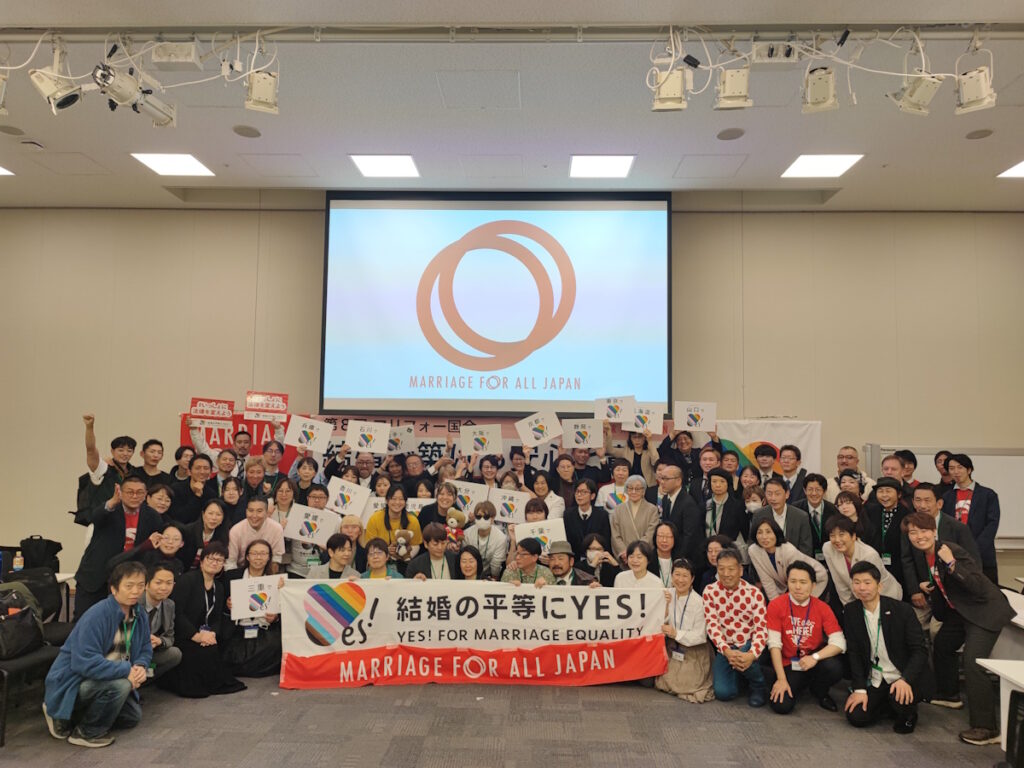
After a bitter court loss, LGBTQ people in Japan continue pressing politicians for fast action.

Wada Keiko further stated she believed transgender people needed medical treatment instead of accommodation and understanding.
