
I’m not generally a fan of department stores. They’re proliferating in Tokyo, knocking down local history and flavor to replace it with big-box sameness.
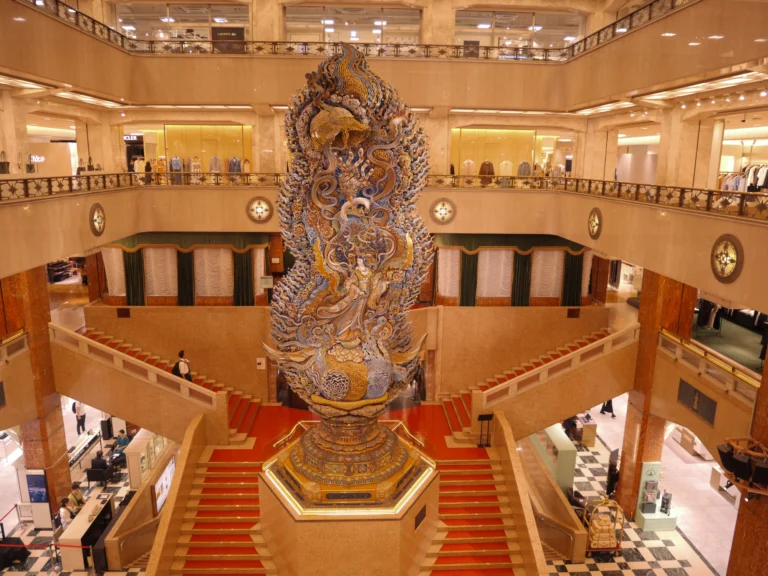
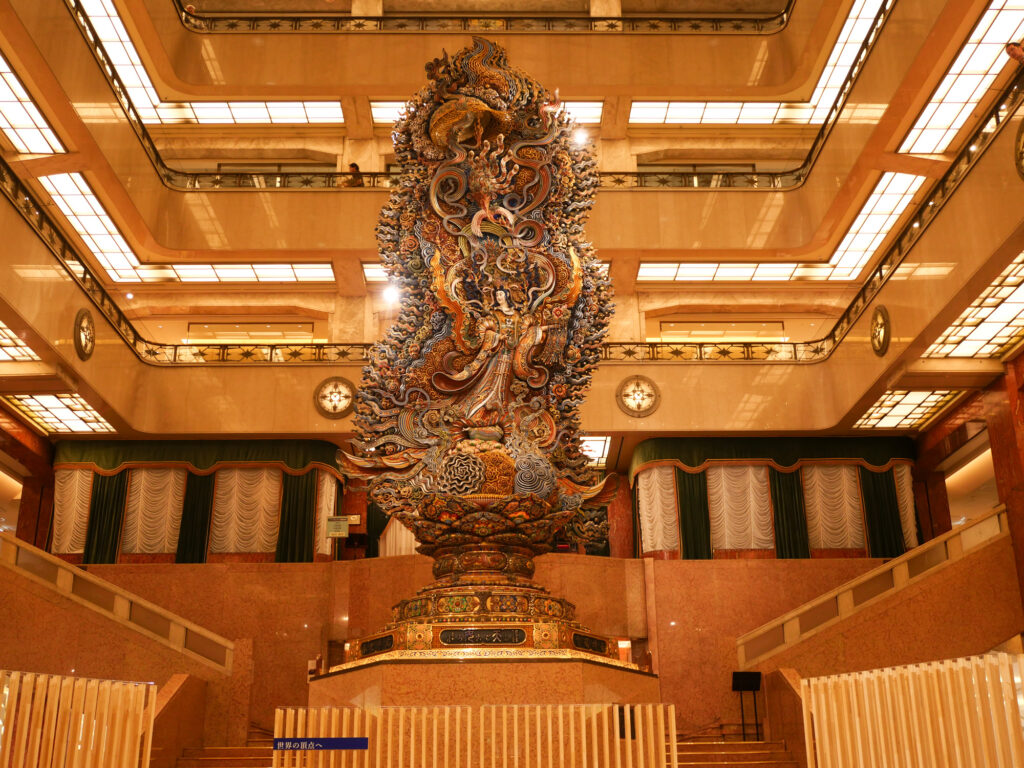
I’ll make an exception, however, for a department store that bears its own distinct history and style. Mitsukoshi, in Tokyo’s Nihonbashi neighborhood, fits this bill. Mitsukoshi is more than just a snapshot of Meiji-era modernization. It’s also the home of an 11-meter-tall unnamed goddess who looks out kindly over shoppers as they peruse necklaces and facial cream.
Just who (or what) is this figure? And who’s the beautiful madman who created her?
An unnamed goddess carved from a 500-year-old tree
Mitsukoshi’s history dates back far before the Meiji period. The iconic shopping mall began in 1673 as Echigoya (越後屋), a dry-goods store opened in Edo’s Nihonbashi by the merchant Mitsui Takatoshi (三井高利). Its big innovation? It sold everything at fixed prices, doing away with haggling. It also cut cloth to order rather than selling it by the bolt. For the first time, Echigoya made fashion accessible to the common person.
Echigoya would grow from these humble beginnings to become the Mitsui banking and real estate empire. In 1904, the company reorganized as Mitsukoshi Gofukuten and sent customers its “Department Store Declaration.” From that year on, the newly-christened Mitsukoshi would be a department store on the American and European model. It was the first (but hardly the last) Western department store in Japan.
The declaration fit the times. After the fall of the shogunate, Japan embarked on a rapid push for modernization modeled largely after Western norms. Neighboring Ginza would become the economic centerpiece of this push, serving as the home of the metropolis’ newspapers and modern cafes.
Goddess, delayed
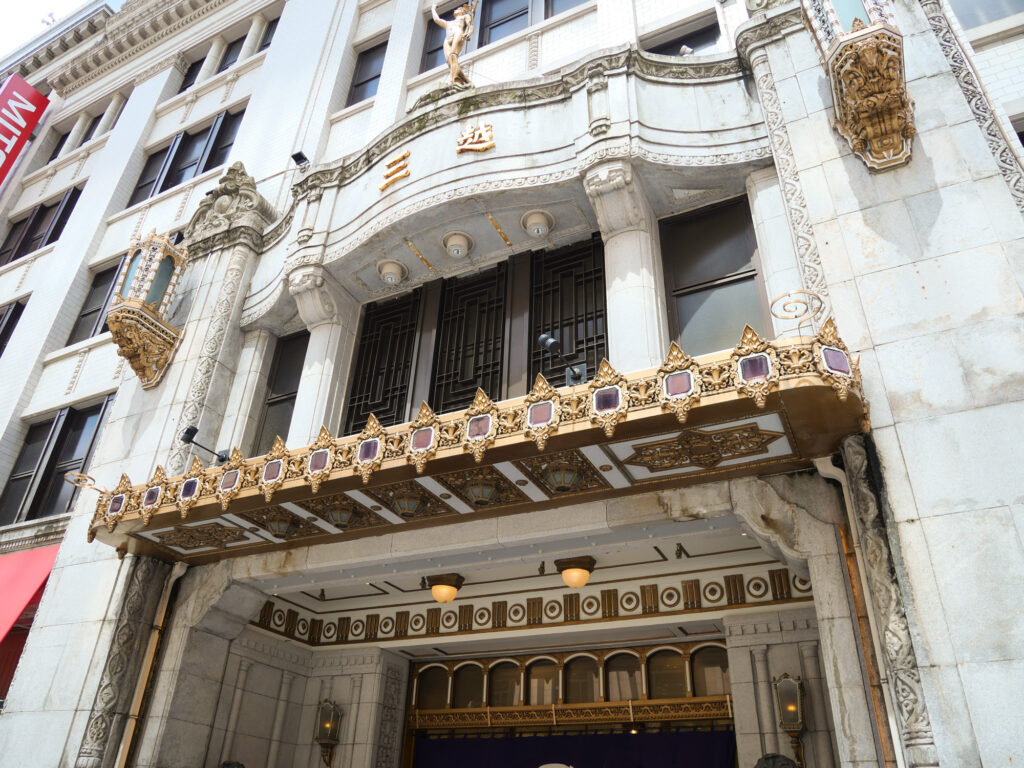
Mitsukoshi opened its flagship Nihonbashi store on September 15, 1914. It announced luxury through architecture: a five-story central hall ringed by Corinthian marble columns under a skylight.
46 years later, this atrium would become the home of the goddess who overlooks it today. Mitsukoshi commissioned it from woodcarver Satō Gengen (佐藤玄々) in 1951, giving him two years to finish it.
Born into a family of shrine carvers in Fukushima, Satō came to Tokyo in 1906 to study under the woodcarver Yamazaki Chōun. He joined the revived Japan Art Institute’s sculpture section and had his first major show in 1914. He studied under Antoine Bourdelle, a former assistant to Rodin, in France from 1922 to 1924 under a government scholarship.
Satō would go on to join the Imperial Art Academy and the Japan Art Academy. His bronze statue of Wake no Kiyomaro (和気清麻呂像, 1940) stands near the Imperial Palace moat by Takebashi.
The statue was intended to commemorate the department store’s 50th anniversary in 1954, and serve as a symbol of the store’s philosophy of magokoro (真心), or sincerity. Satō, however, wouldn’t complete the project until 1960. By then, the cost had ballooned to somewhere between hundreds of thousands to the low millions USD.
The project was an expensive labor of love. Satō worked on it in a dedicated studio in Myōshin-ji in Kyoto, working slowly through concepts, designs, and trial carvings. The project ultimately consumed over 100,000 craftsperson-days of time to complete.
Question: do you like UJ's independent coverage of Japan? Our writers are supported by our members. Join Unseen Japan Insider to get bonus content every week, an ad-free website, and access to our large and growing Insider archive.If you love UJ's independent coverage of Japan, join Unseen Japan Insider to get content every week, an ad-free website, and access to our large and growing Insider archive.
Who is she?
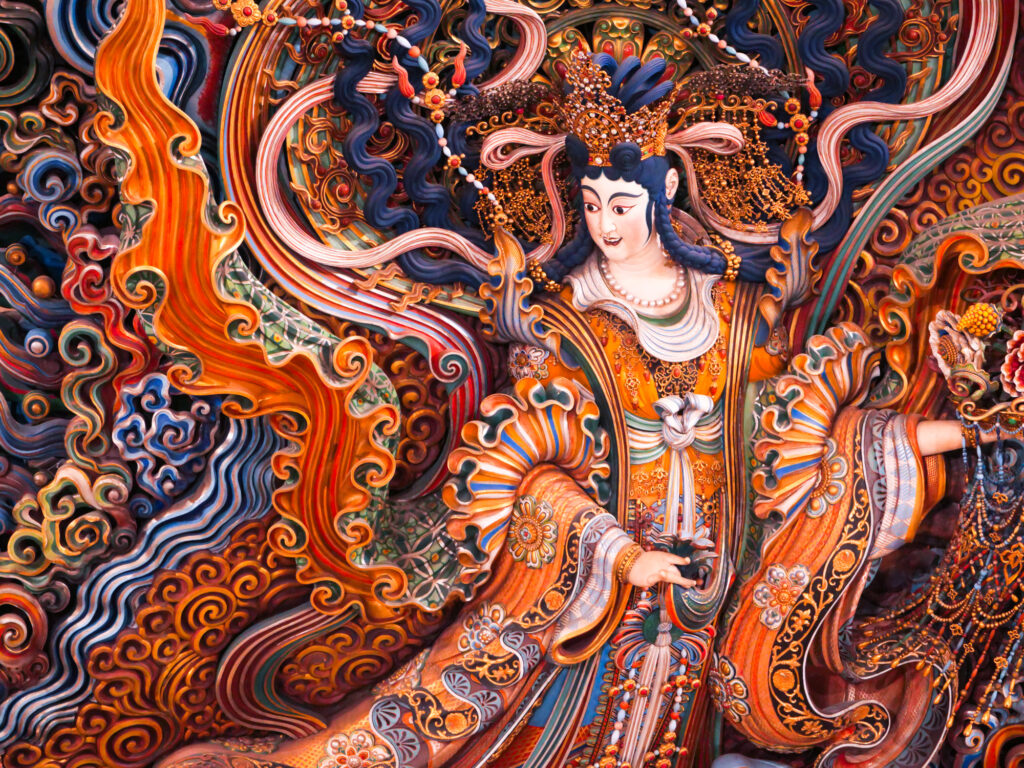
Carved from a single 500-year-old block of wood, the goddess is stunning in both detail and scale. She’s as elegant and awe-inspiring as she is mysterious.
For his part, the enigmatic artist didn’t deign to explain his work. At her unveiling, Satō Gengen rose to the podium, said, “I am Satō,” and promptly sat back down.
In broader terms, the statue represents a tennyo (天女), a class of goddesses inhabiting the highest of the six realms of Buddhism, the tennin (天人), or Realm of Heavenly Beings. These figures aren’t permanent; in Buddhism, even the heavenly beings age and die. Their realm, while at the top of creation, is still subject to the samsaric wheel of life and death.
Many visitors assume the statue represents Kannon (観音), the Buddhist bodhisattva of compassion. In fact, she doesn’t represent any specific goddess. Neither Satō nor Mitsukoshi ever gave her a firm identity. Her status as a tennyo makes her more akin to Kichijōten (吉祥天, goddess of fortune and beauty, descended from the Indian Lakshmi) or Gigeiten (伎芸天, goddess of the arts).
From Mitsukoshi’s standpoint, the figure represents sincerity. The store glosses it as 大和心 (Yamato-gokoro), the native Japanese spirit. Her “backstory,” in Mitsukoshi’s view, is corporate and philosophical, not mythological.
Satō was aiming, however, for something higher. His teacher Antoine Bourdelle reportedly sent him home from France with a singular charge: “With your own blood, create the soul of your homeland.”
What Satō carved is an instant rather than a named goddess’s tale. It depicts a heavenly maiden wrapped in auspicious clouds (瑞雲, zuiun) at the moment she alights on the pistil of a flower, with 48 birds worked into the clouds behind her. It’s Satō’s attempt at reviving mythological sculpture in the modern, postwar era.
Serious “Final Boss” energy
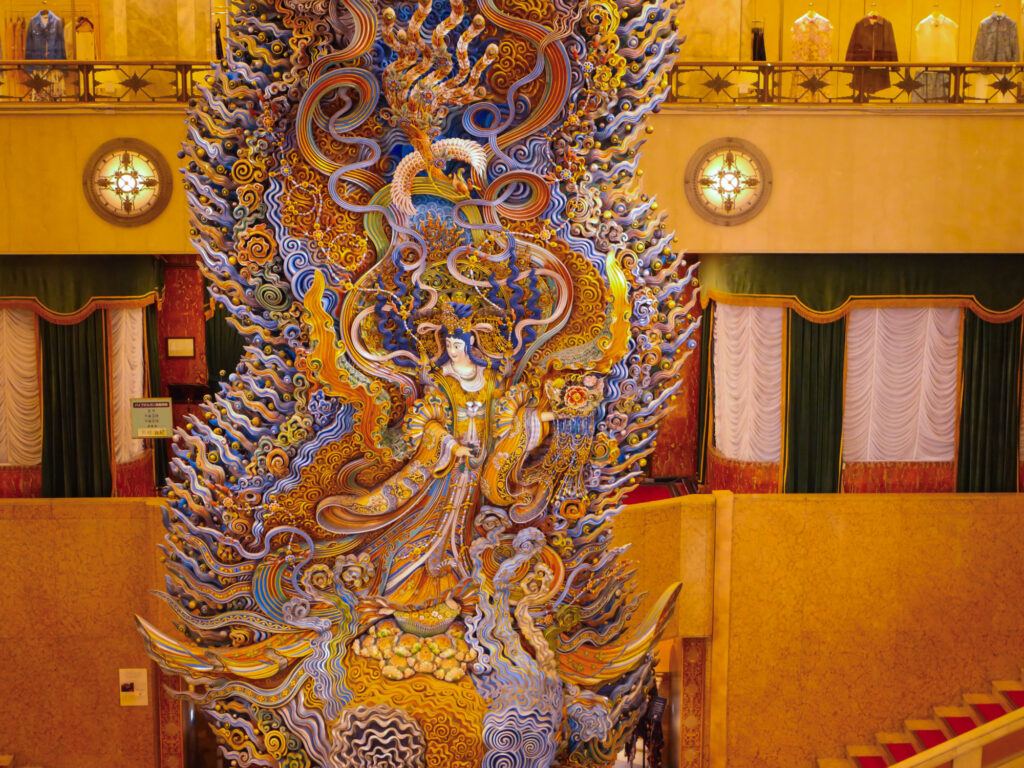
The lack of a definitive mythology means that the statue has become a vessel for people’s hopes and desires. During the COVID-19 pandemic, staffers at Mitsukoshi reported people coming to pray for a swift end to the pandemic. (Well done, Holy Mother.)
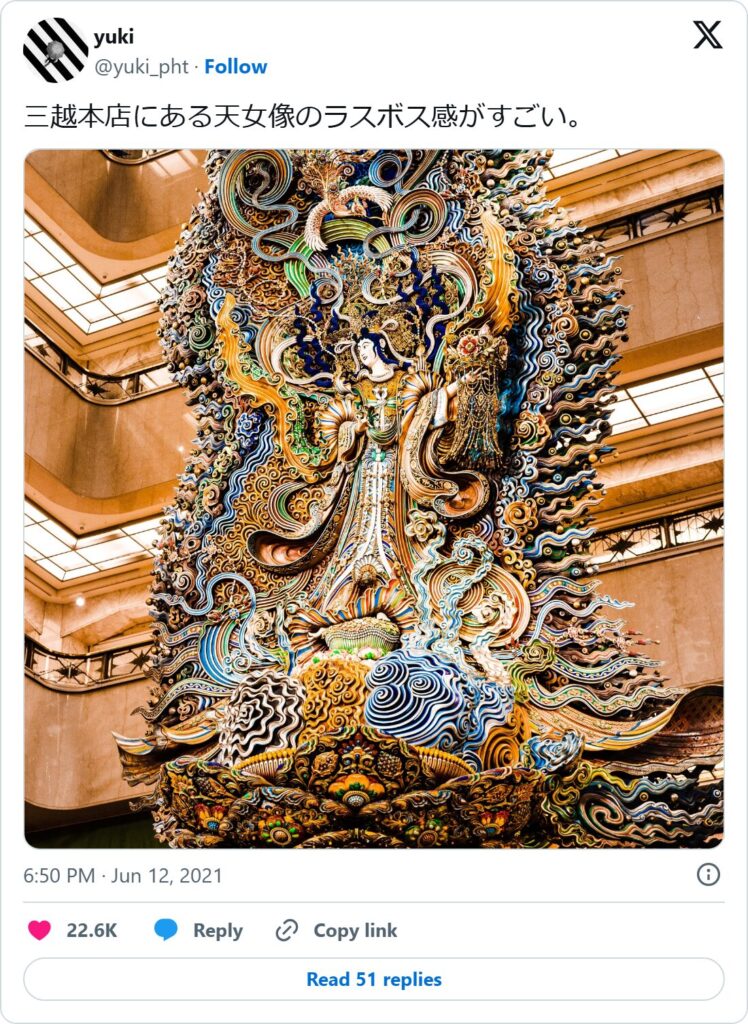
She’s also had her moments of virality in the Internet age. In 2021, gamers stood in awe of her “final boss” energy, likening her to the god-like beings one fights at the end of popular games such as Final Fantasy or Bayonetta.
The goddess isn’t the only vaunted figure at Mitsukoshi, either. The pair of bronze lions installed at the entrance in 1914 were modeled on the lions at the foot of Nelson’s Column in London’s Trafalgar Square.
They became a Tokyo landmark and a favorite meeting spot, and they carry a piece of folklore of their own. Straddle a lion’s back without anyone seeing you, the saying goes, and your wish will come true. The lions are very popular at exam time, when students hope a little light tomfoolery will offset their lack of test prep. (Tourists: please don’t get any ideas.)
It might seem silly to some to pray to a department store goddess. Maybe it is. But I find a strange sort of solace in knowing that, even in the age of AI, a monument to sincerity can still inspire devotion.
Keep reading

Sources
知っていますか? 日本橋三越本店本館のホールにある「天女像」と、彫刻家・佐藤玄々のこと。 さんたつ by 散歩の達人
天女(まごころ)像 三越日本橋本店
日本橋三越本店 天女像 三井広報委員会
佐藤玄々 ウィキペディア(日本語版)
佐藤玄々(朝山) 東京国立近代美術館 (MOMAT)
天女(まごころ)像 佐藤玄々作(東京都中央区) 朝日マリオン・コム
[vol.15] 極彩色の到達点 日本橋三越に降り立った天女像 ディスカバーふくしま in TOKYO(福島県東京事務所)/ note
佐藤玄々遺作品 相馬市公式ホームページ
日本橋三越に「ラスボス感」半端ない天女像 改めて見ると、精巧すぎて「鳥肌」 Jタウンネット
日本橋三越の天女像の裏側にはデパートの中とは思えない神業が広がっている Togetter
三越本店の天女像の意味するもの 雀のお宿
まごころ(天女)像プロジェクションマッピング 三越 日本橋本店
日本橋三越本店 まごころ天女プロジェクションマッピング 初公開! 三越伊勢丹ホールディングス / PR TIMES
Celestial Beings in Japanese Buddhism: Apsaras, Tennin, Tennyo, Hiten and Karyobinga onmarkproductions.com (Mark Schumacher)
鳳凰堂 雲中供養菩薩像 平等院
薬師寺吉祥天像 ウィキペディア(日本語版)
維摩経 ウィキペディア(日本語版)
三保松原の羽衣伝説 静岡市(三保松原)
天人五衰 ウィキペディア(日本語版)
三越のあゆみ(百貨店事業のあゆみ) 三越伊勢丹ホールディングス
日本初の百貨店、三越のはじまり / 越後屋誕生と高利の新商法 三井広報委員会
三越日本橋本店 ウィキペディア(日本語版)
三越のライオン像 ウィキペディア(日本語版)
パイプオルガン 三越日本橋本店
Ginza history: the Bricktown, the 1872 fire, Thomas Waters GINZA OFFICIAL
中央区の歴史 / 商業発展史 中央区観光協会
近代の日本橋 ~成長と衰退~ まち日本橋
How Tokyo’s department stores got their big start Japan Today
Bank of Japan Headquarters (Tatsuno Kingo, 1896) Wikipedia
Ginza Bricktown and the Myth of Meiji Modernization (Tristan R. Grunow) Meiji at 150 (UBC)