
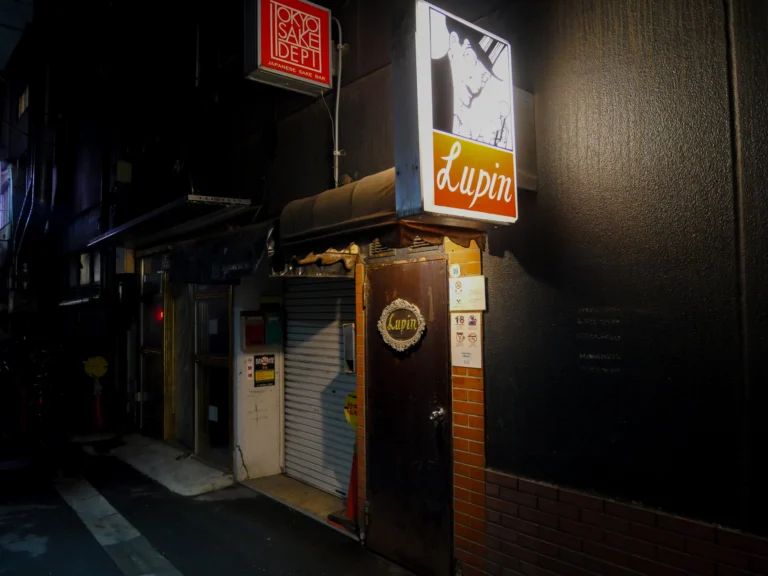
As I approached Bar Lupin in Ginza, a group of three American tourists approached at the same time. “Are you a Bungo fan?” one asked excitedly.
It took me a minute to realize she wasn’t referring to Japan’s great literary masters (文豪). Well, she was, after a fashion: she was referencing their fictitious counterparts in the popular anime Bungo Stray Dogs, in which characters bear the names of literary giants such as Dazai Osamu and mystery writer Edogawa Ranpo.
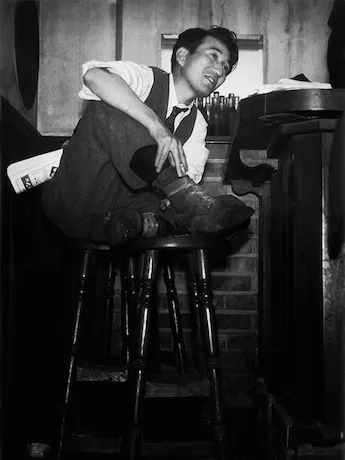
It’s no mystery why the bar attracts Bungo fans. It used to be the favorite watering-hole of Dazai himself. Indeed, Japan’s most famous literary world photo – a picture of Dazai Osamu with his legs perched up on a second barstool – was taken in this very location.
If you’re lucky, you may even get to drink where the man himself did, almost 100 years ago. Bar Lupin continues operating in the same basement location today, as do several other locations that Japan’s literary mavens, feminists, and radical thinkers of the Meiji, Taisho, and Showa eras made famous.
The birth of Ginza
Before we enter Lupin, let’s go back in time to see how and why Ginza drew in so many among Japan’s intelligentsia.
Ginza’s name is as rich as the neighborhood itself. Literally “silver mint” (銀座), the area takes its name from the Tokugawa-era silver coin office that existed there. However, “Ginza” was just a nickname, officially, the town was known as Shin-ryōgaechō (新両替町), “the new money-changer’s town.”
In early 1872 (Meiji 5), a fire tore across 95 hectares of Ginza and Tsukiji. The government hired Irish architect Thomas James Waters to rebuild the area in brick. Waters reportedly based his designs on London’s Regent Street, giving Ginza a modern feel.
At first, the new Ginza was a big flop. Rumors had it that living in a brick house would make you ill. Tons of houses and storefronts stood empty for years.
That didn’t stop Ginza from becoming a cultural hub, though. Its Western-style storefronts made it the perfect place to nurture the culinary scene of Meiji-era Tokyo, which blended traditional Japanese cooking and confectionaries with Western-style food (洋食; yōshoku). Cafes such as Rengatei (煉瓦亭) helped craft many dishes that remain popular in Japan today, such as tonkatsu (fried pork cutlet) and omurice.
Ginza would also become known as Tokyo’s high-end shopping district. The watchmaker Hattori Kintarō opened his famous clock tower there in 1894. During the Taisho era, ginbura (銀ブラ), walking around and window-shopping in Ginza, became a popular pastime.
The first department stores arrived in the 1920s, with the famous Mitsukoshi opening in 1930. 1934 saw the finalization of the Ginza Line, which brought more foot traffic to the neighborhood. The area became a hotspot for working women in the 1920s and 30s; so-called “modern girls” (moga) could be spotted daily shopping and dining at local cafes.
Ginza retains its reputation for high-end shopping today. In fact, it’s so successful that other shopping districts, such as Togoshi-Ginza in Shinagawa, baldly steal the “Ginza” name to give themselves a dash of glamour. At ¥60.5 million per m² as of January 2025, Ginza has the highest land price of any area in Japan.
Ginza lies near Yūrakucho, another high-end neighborhood with a deep history and lots of great modern dining. If you want to experience this yourself while you’re in Tokyo, book my Yūrakocho nighttime food tour. It’s one fixed price per person, all-inclusive, and gives you an in-depth introduction to Japanese dining and sake (veg/vegan and nonalcoholic options also available).
Ginza’s literary history
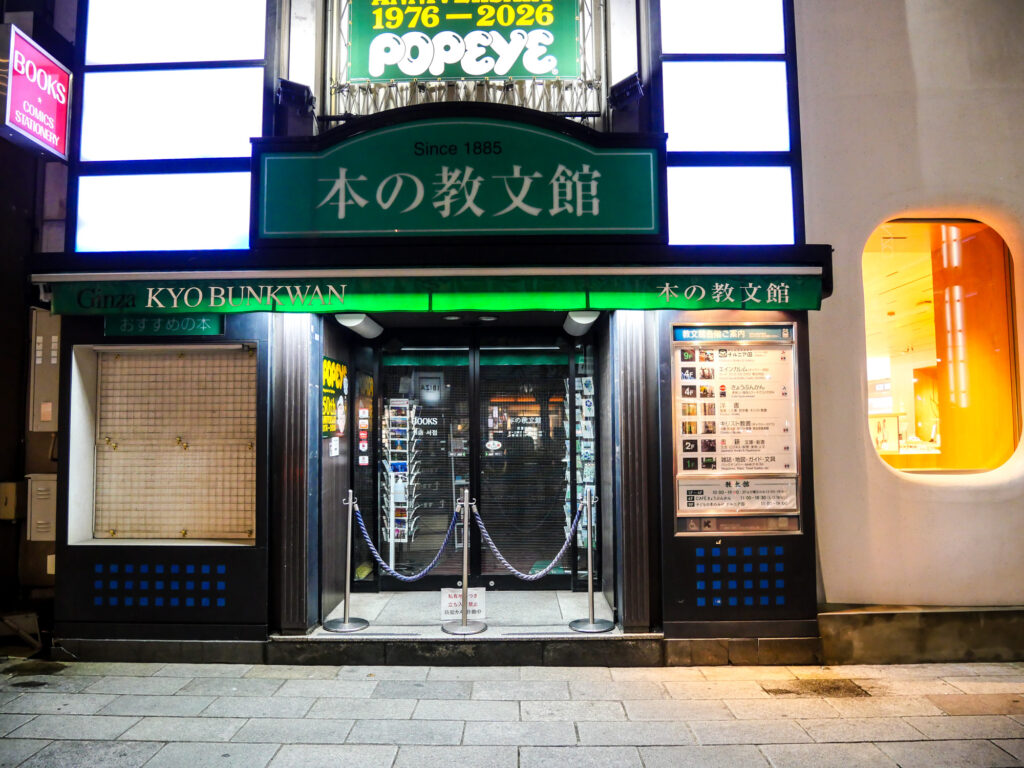
Ginza also attracted Tokyo’s growing literati starting from the Meiji era. American Methodist missionaries founded the bookstore Kyōbunkan (教文館) in 1885 (Meiji 18) moving it to Ginza in 1891. It still operates today in the 1933 Antonin Raymond-designed Kyōbunkan Building on Ginza 4-chōme.
The area also attracted Tokyo’s fledgling newspapers. Tokyo Nichinichi (the modern Mainichi Shimbun) relocated there in 1877, with Asahi and Yomiuri soon following them.
The presence of booksellers and journalists made Ginza an obvious draw for Japan’s writers, poets, and activists. And Ginza had plenty of space to host them. Shiseido Parlour (資生堂パーラー) opened in 1902, becoming a full-fledged Western restaurant in 1928.
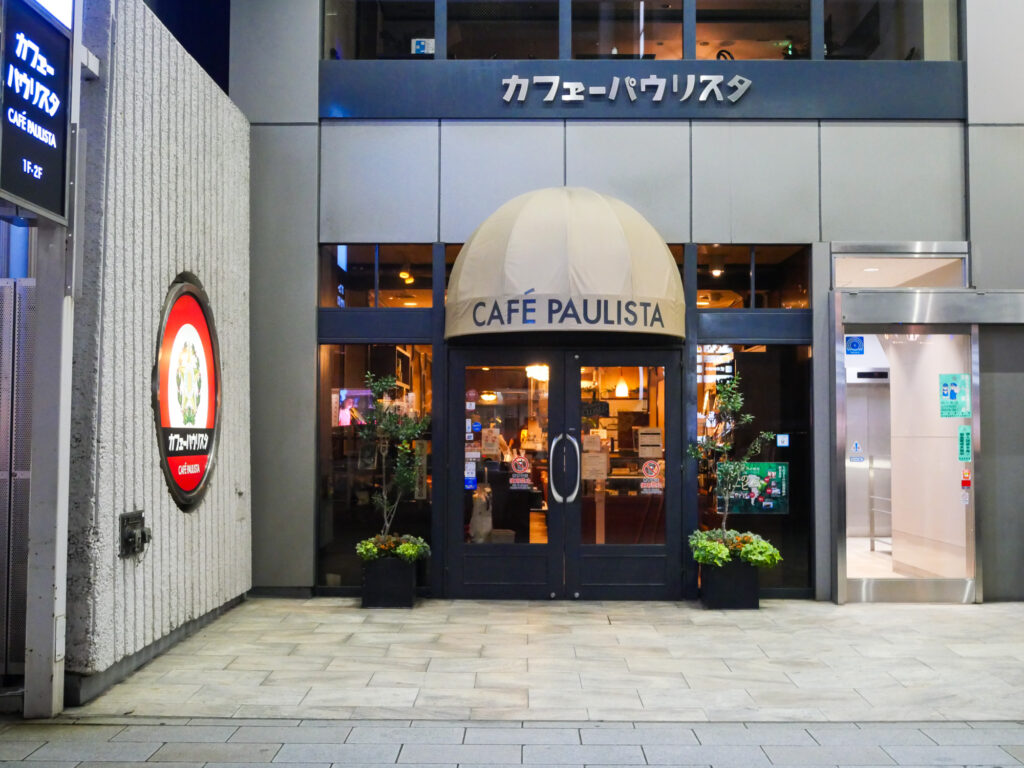
Ginza also birthed multiple models of cafe, with locations such as Café Lion (August 1911) and Café Paulista (December 1911) serving coffee, an increasingly popular beverage, to the masses. This would eventually give birth to both junkissa as as well snack bars and host/hostess clubs.
Several of these locations drew working and aspiring writers and intellectuals. Akutagawa Ryūnosuke (芥川龍之介), after whom the esteemed Akutagawa Prize is named, would meet his editor at Café Paulista to hand off manuscripts. Feminist Hiratsuka Raichō (平塚らいてう) was also a regular. Painter Matsuyama Shōzō ran Café Printemps (also founded in 1911), which was named by playwright Osanai Kaoru. Locations like Shiseido Parlour frequently appeared in the works of authors of this period.
Question: do you like UJ's independent coverage of Japan? Our writers are supported by our members. Join Unseen Japan Insider to get bonus content every week, an ad-free website, and access to our large and growing Insider archive.We manage to keep most of our content free thanks to the generosity of our members. Join Unseen Japan Insider and you'll get access to new, exclusive UJ member content weekly, an ad-free website, and access to our large and growing Insider archive.
Bar Lupin: The hangout of the buraiha
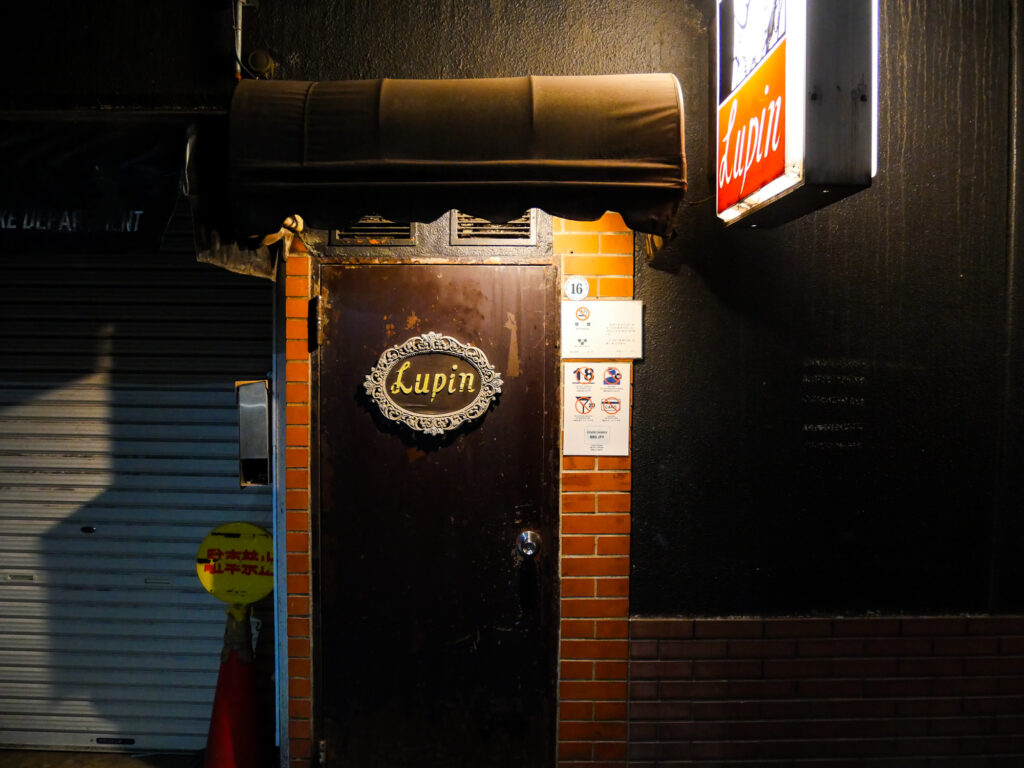
Amidst all this rose Bar Lupin, founded in 1928 and named after the famous gentleman thief created by author Maurice Leblanc, Arsène Lupin. (Japan’s fascination with Lupin continues to this day, as the popular anime character attests.) It launched thanks to the financial backing of a trio of writers, Satomi Ton (里見弴), Izumi Kyōka (泉鏡花 ), and Kikuchi Kan (菊池寛). The 90-year-old ash countertop installed several years later is the countertop still in service today.
The bar ran even through most of the war, though it renamed itself to Pantei (麺包亭) after the Imperial government banned foreign words. It closed in 1944. Lupin somehow miraculously escaped significant damage from the firebombing of Ginza on January 27, 1945.
Lupin re-opened after the war. However, due to postwar shortages, there was no alcohol to sell. Production had collapsed. Air raids had decimated 223 sake breweries, reducing national output by 17%. Black market dealers in areas like Shinjuku sold alcohol, but it was often a dangerous substance called bakudan (バクダン, Japanese for “bomb”), industrial fuel alcohol cut with methanol.
Lupin reopened as a tea room (喫茶店; kissaten) before eventually resuming alcohol sales after staff managed to scrounge up enough legitimate booze to justify serving again. The bar advertised itself with the slogan “At Lupin, you’re safe” (ルパンなら安心; rupan nara anshin) – a signal to its literary clientele that Lupin served legitimate drinks and that they wouldn’t go blind drinking there.
After its re-opening, the bar soon became the primary haunt for the members of Japan’s “Decadent School” (無頼派; burai-ha) of literature. The Decadent School boomed in these postwar years from 1946 to 1949. It railed against the literary establishment – both the inward, confessional realism popular at the time and the explicitly ideological, proletarian literature.
In his Discourse on Decadence (堕落論; daraku-ron), Sakaguchi Ango defined the central tenet of the school as 堕落 (daraku) – decadence or falling. Sakaguchi argued that only by falling into degradation can one shed imposed morality and find one’s authentic human self.
Dazai and friends flocked to Lupin, christening it their home away from home. In 1946, photographer Hayashi Tadahiko was at Lupin shooting Oda Sakunosuke when Dazai, slouched nearby, demanded a shot too. The result made literary history.
Sadly, the debauchery and decadence of the Decadent School proved its own undoing. Dazai, the most notable example, killed himself in 1948. While the school burned out quickly, it burned bright. Dazai’s No Longer Human (人間失格; ningen shikkaku) is regarded as a masterpiece of world literature. His book Setting Sun (斜陽; shayō) and Sakaguchi’s In the Forest, Under the Cherry Blossoms in Full Bloom are other examples of great works from this period.
A literary walk through Ginza: Bar Lupin and beyond
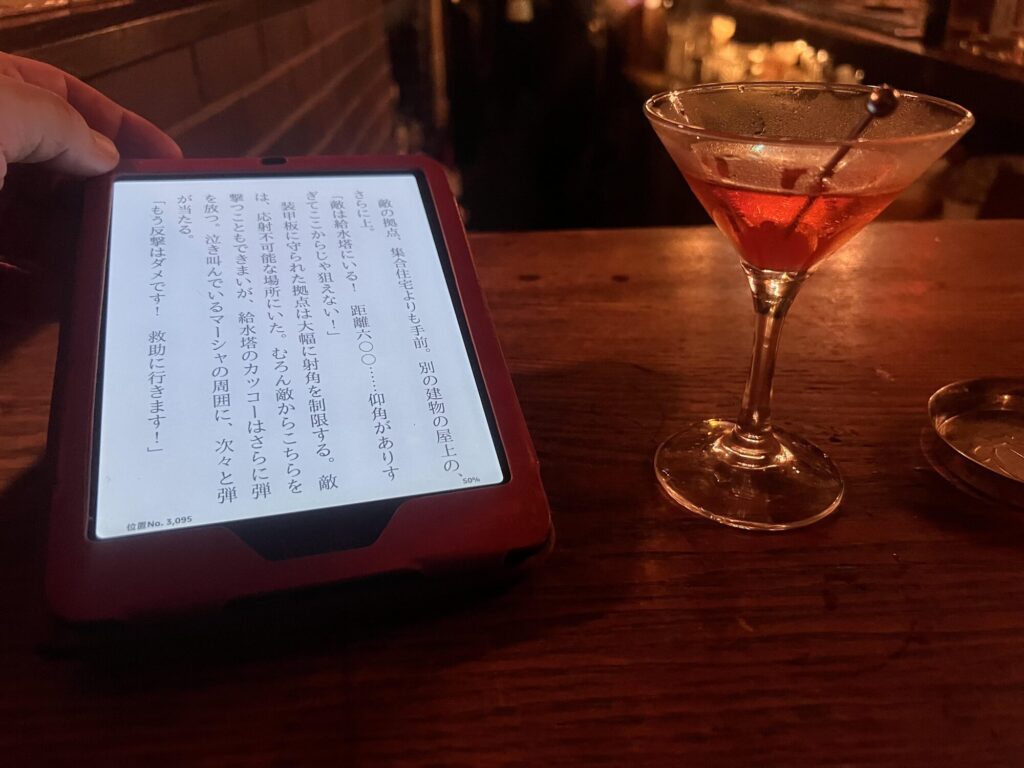
Some tourists avoid Ginza because they associate it with excessive commercialization. That’s a shame. As I’ve discussed above, Ginza is also a hotbed of cultural innovation – from food to cafes to literature.
You can give yourself a nice, literary afternoon in Ginza by first grabbing lunch from Shiseido Parlour. (Warning: They don’t accept reservations – you just have to show up and wait!) From there, you can check out Kyōbunkan, followed by the newer Morioka Shoten (森岡書店), whose concept is that they only sell a single book at a time.
From there, you can enjoy coffee at Café Paulista, followed by shopping at Mitsukoshi or perhaps a leisurely stroll through Art Aquarium Ginza. Then, enjoy dinner at one of the area’s historic restaurants, such as high-end tempura restaurant Tenichi, a shinise shop that’s been running since 1930.
Then, of course, you can wind down your evening with cocktails at Lupin. (Alternatively, book my nightlife food tour of Yūrakucho/Ginza. I’ll walk you through this personally and give you an in-depth introduction to the local cuisine.)
Getting to Lupin requires a little attention to detail. It’s in the basement of the Tsukamoto Fudōsan Building at 5-chōme 5-11 in Ginza. The entrance is situated in an alley between buildings; if you’re not careful, you’ll walk right past it.
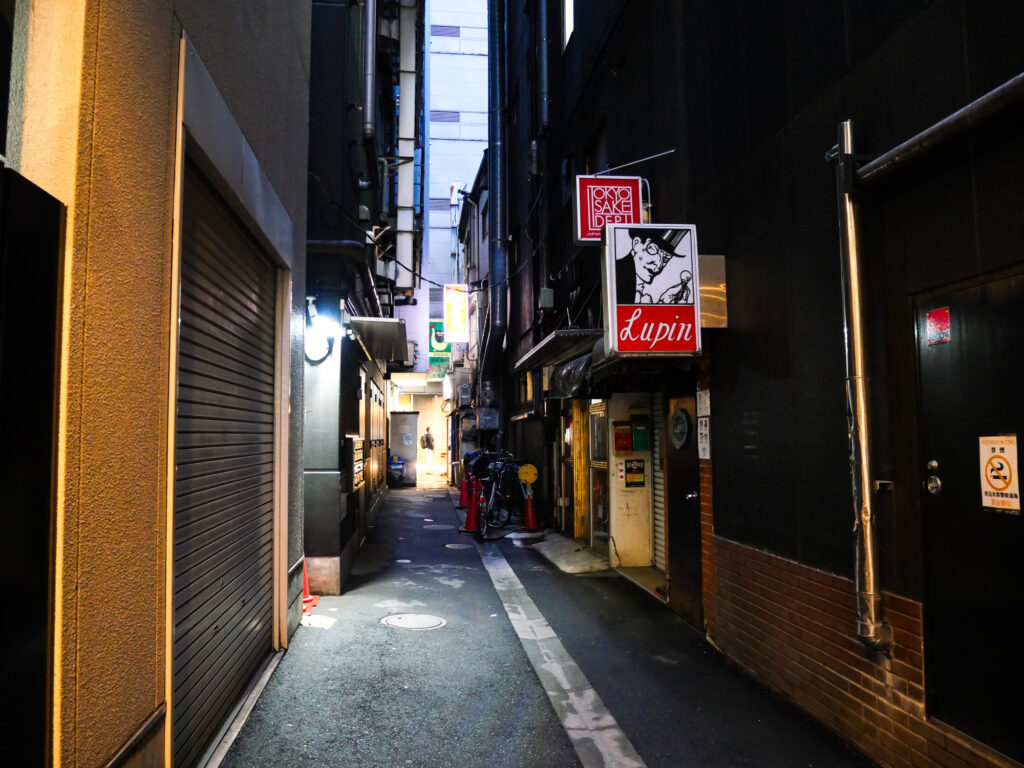
Additionally, note that the bar might look closed even if it’s open. They don’t light up the sign until it becomes well and truly dark. The tourists who showed up when I did left because they thought it looked shuttered.
Thanks to its literary history, Lupin attracts a lot of educated locals as well as tourists who are into Japanese literature. Bungo Stray Dogs has opened it up to another kind of fan, prompting the store to put up signs in Japanese and English laying down some rules.
First, there’s a 880 yen ($5.55) cover charge (by no means unheard of for bars and izakaya). The store also bans entry for anyone looking just to take pictures. Any pictures need to be taken with permission and can’t include other patrons. Bar Lupin is also a no smoking establishment.
Finally, Bar Lupin is cash only. So stop at the nearest 7-Eleven and pull some yen first.
If you’re lucky, you may be able to sit in the “Dazai Osamu seat” – the area at the end corner of the bar that was Dazai’s favored location. I went on a Tuesday night and got to sit here, which felt like quite the privilege.
The bar has a rich cocktail menu and can concoct anything you like. The house specialty is the Golden Fizz, a gin fizz with an egg yolk whipped and floated on top. The staff are warm and friendly, and were very welcoming even to guests who couldn’t speak Japanese. Just be sure to follow the rules, and you’re sure to have a nice, warm time at one of Japan’s most famous literary haunts.
Keep reading

Sources
一世紀近い歴史を持つ、文豪に愛されたバーでゴールデンフィズを。銀座『ルパン』<前編>【街の昭和を食べ歩く】 さんたつ by 散歩の達人
大きな転機でも途切れなかった老舗バーの歴史。銀座『ルパン』<後編>【街の昭和を食べ歩く】 さんたつ by 散歩の達人
銀座の老舗バーに女性が集う --文壇、画壇、映画演劇界に愛されたバー・ルパン 中央区観光協会特派員ブログ
あの太宰の写真には”秘密”があった! 昭和を生きた写真家・林忠彦の展覧会が静かに話題を呼んでいます。 Pen Online
日本で最も古いとされる喫茶店、銀座「カフェーパウリスタ」で文豪たちが愛したコーヒーを味わう ことりっぷ
銀座【中央区】文豪ゆかりの名店⑤銀ブラのルーツをたどるカフェ・バー巡り〜ぐるり東京 街さんぽ〜 東京新聞デジタル
教文館物語 教文館
築86年の古いビルに森岡書店銀座店が誕生。 Casa BRUTUS