
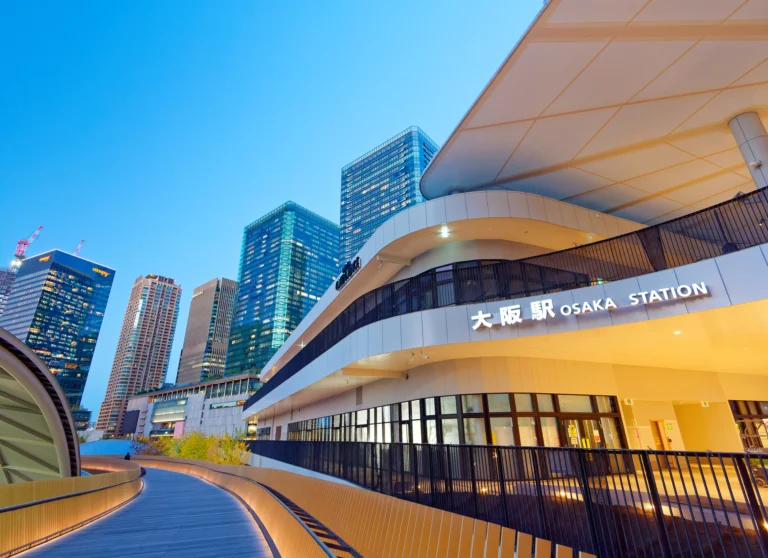
In July 2026, a patch of concrete outside one of Japan’s busiest train stations became the center of a surprisingly heated national debate. The issue? Roughly 150 small concrete blocks embedded into the ground outside JR Osaka Station.
To some, they were a textbook example of “exclusion art” (排除アート, haijo āto), Japan’s term for hostile architecture. To others, they were simply a practical solution to a space that had become difficult to manage.
A concrete installation under an overpass
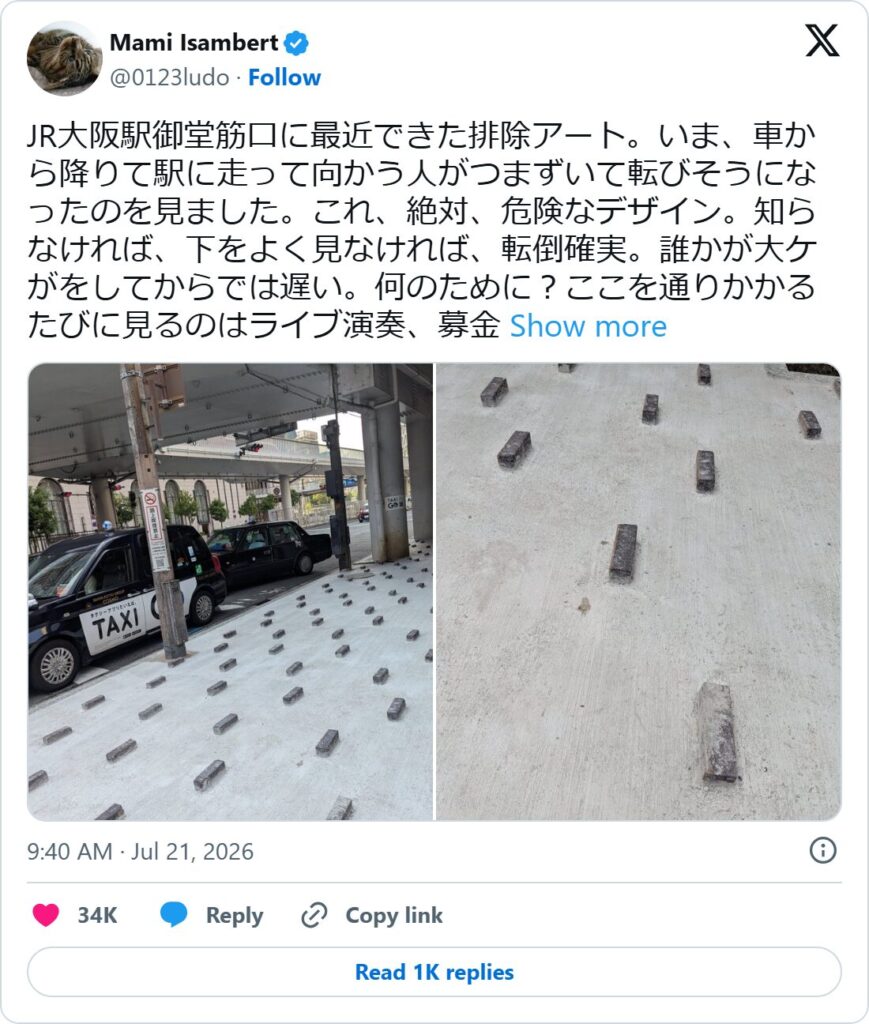
The work took place over several days, roughly between July 9 and 13. Osaka City’s Construction Bureau installed rows of low, irregularly spaced, brick-shaped concrete blocks across a swath of ground measuring about 58 square meters (625 sqft). The protrusions rise only a few centimeters above the surface, but there are a lot of them. Yomiuri TV counted around 150. Afterward, workers surrounded the area with yellow “No Entry” barriers.
The location is impossible to miss. It sits beneath the pedestrian overpass connecting JR Osaka Station’s Midōsuji South Exit with Hankyu Umeda’s flagship department store, an area crossed by thousands of commuters every day.
Ironically, the city didn’t originally plan the space to stand empty. Years ago, it served as a planting bed, but the overpass blocked so much sunlight that trees struggled to survive. Eventually, the city removed the landscaping, leaving behind an open strip of pavement.
Over the years, people used that space for many things: demonstrations, charity fundraising events, musical performances, and illegal dumping of garbage. Most notably, homeless people also used it as a shelter.
Outrage against the loss of a public space
The controversy exploded on July 21 when X user @0123ludo posted photos describing the installation as dangerous “exclusion art.” She wrote that she had watched a rushing commuter nearly trip over the blocks and argued that she had only ever seen live performances, protests, and charitable street campaigns occupy the space.
The post quickly went viral, collecting around 34,000 likes and more than 26.5 million views.
One of the most popular replies on X, gathering over 3,800 likes, said, “Restoration can’t even fix the waterworks or the roads, yet they go and whip up some useless, ugly thing – what a hopeless bunch.”
Other replies carried a similar sentiment, going so far as to say the new installation posed a danger, especially for those with disabilities. One commenter on Yahoo! News said that it was a waste; they could have converted the space into a bicycle parking lot or other useful space, but instead they just blocked it off.
Exclusion art and hostile architecture in Japan
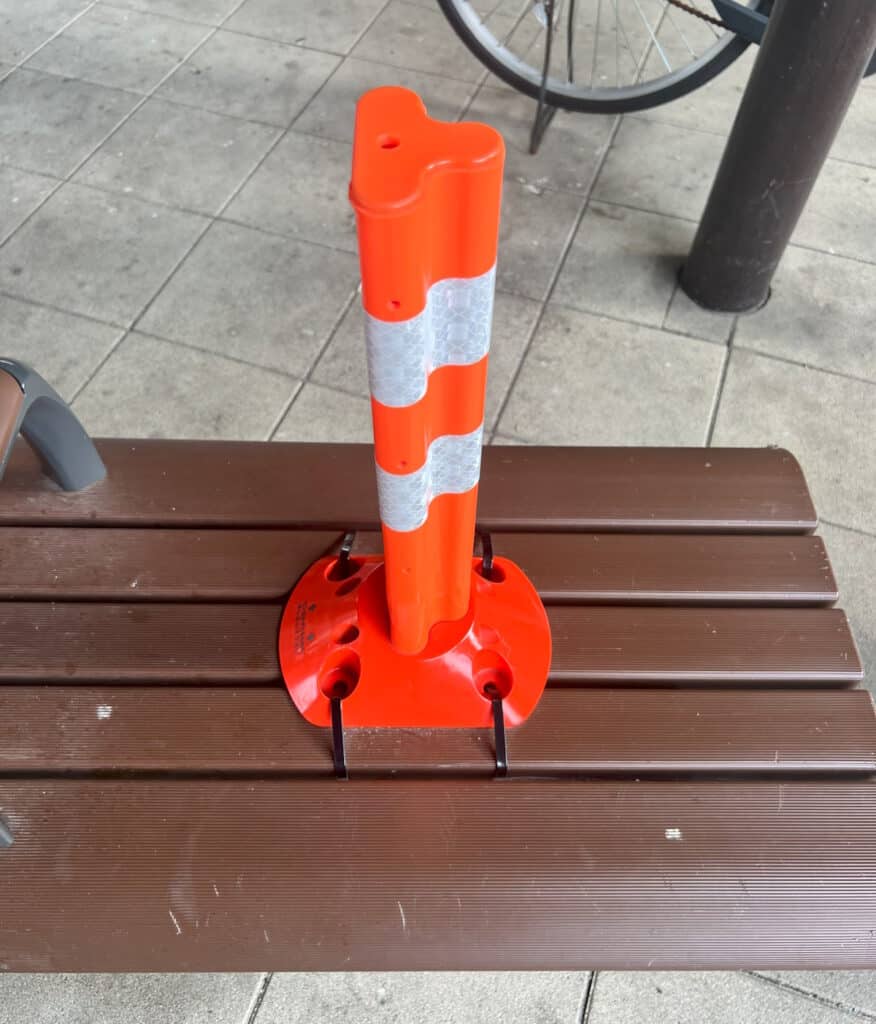
But what exactly is exclusion art? In Japan, it refers to architectural design intended to discourage certain behaviors without outright banning them. Instead of signs or police enforcement, the way it’s built makes unwanted activities uncomfortable or impossible.
This isn’t the first example. Public spaces have been redesigned and park benches removed to discourage people from sleeping or taking up residence there.
Architecture critic Igarashi Tarō said this style of urban design spread in Japan during the late 1990s and 2000s. He links its rise to growing public concern about safety following events such as the 1995 Aum Shinrikyō subway sarin attack and the 2001 Ikeda elementary school stabbing.
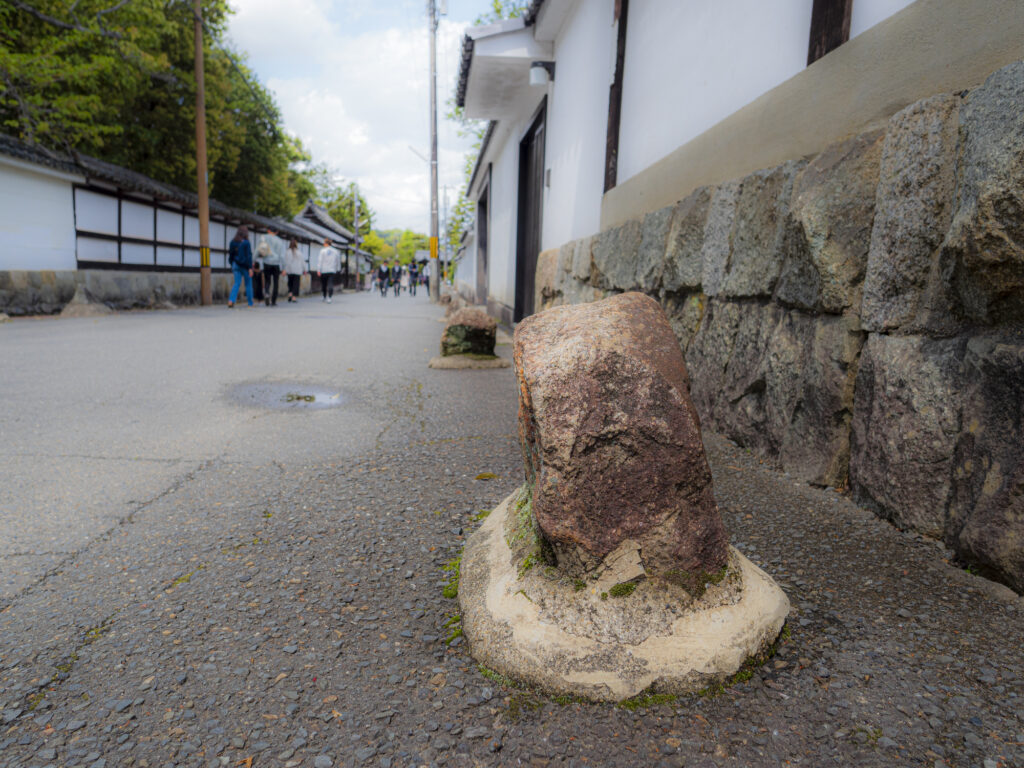
Of course, a form of exclusion art has existed in Japan for centuries: ikezu-ishi (いけず石). Starting around the Heian period (8th-12th centuries), people placed these “rude rocks” at building corners or in narrow streets in Kansai, especially Kyoto. These stones discouraged drivers from cutting corners and prevented loitering.
Question: do you like UJ's independent coverage of Japan? Our writers are supported by our members. Join Unseen Japan Insider to get bonus content every week, an ad-free website, and access to our large and growing Insider archive.We manage to keep most of our content free thanks to the generosity of our members. Join Unseen Japan Insider and you'll get access to new, exclusive UJ member content weekly, an ad-free website, and access to our large and growing Insider archive.
The city’s take: a necessary step in keeping the space orderly?
Officials said that ever since the lot became empty, they’d had never-ending problems with illegal dumping, abandoned bicycles, and homeless people taking up camp. They described the new installation as an “access-prevention measure” to keep everyone out of the lot, not just the homeless.
As it turns out, a decent chunk of people agree. One Yahoo! News reader said, “This spot was a problem, homeless people sleeping here even in the daytime, leftover food dumped, drinking at night, garbage put out, crushed bikes abandoned, a rotting smell. Compared to that, isn’t this better? It’s a stopgap.”
There were other justifications, too. Some pointed out that the strip is legally part of an intersection rather than a sidewalk. Cars are prohibited from stopping within five meters (16 feet) of a crosswalk under Japan’s traffic laws, yet taxis reportedly used the area for passenger drop-offs anyway. From this perspective, the concrete blocks are just enforcing an existing rule.
On July 24, Osaka Mayor Yokoyama Hideyuki responded to the growing controversy. He explained that installing traditional fencing would require foundation work that is difficult beneath the overpass. However, since the site had attracted so much attention, he said he had instructed city staff to study the possibility of installing public art there instead.
A noted split in responses: social media vs. the news
Interestingly, while most people on X agreed with the original post, calling the installation dangerous or heartless, most who commented on Yahoo! News offered support.
One of these, receiving over 1,100 likes, said, “People criticize it as ‘exclusion art,’ but I wish they understood what actually happens when the homeless settle in. One person you let stay becomes tents, then laundry and belongings, until children can’t use the park at all…You chase them off, you call the police, and they come back every time. Once a spot is sheltered and comfortable, they won’t leave.”
To put it another way, social media framed the blocks as symbols of exclusion, while many news readers saw them as overdue maintenance.
Whether viewed as discrimination, practical urban management, or simply the modern version of Kansai’s old “rude rocks”, it’s a reminder that even the tiniest changes to a city can expose much larger disagreements about who public spaces are really for.
Keep reading


Sources
大阪駅前の地面に現れた無数のブロック、「排除アート」と波紋呼ぶが… 市は「迷惑行為への対策」と説明 モデルプレス
【物議】JR大阪駅前に突如現れた約150個の突起物「排除アートだ」批判も…大阪市「全ての人が立ち入らないようにするため」市長は新たな活用も検討 読売テレビ(Yahoo!ニュース)
大阪駅前に現れた突起物、SNSで賛否 「排除アート」との指摘も 朝日新聞(Yahoo!ニュース)
JR大阪駅前の“謎の突起”が物議醸す 「排除アート」との声も… ABCニュース(Yahoo!ニュース)
【大阪市、動く】JR大阪駅前にできた「排除アート」に危険では?と批判集まる→たしかに「いけず石」っぽいデザインだが、Xの反論から違法乗降や不法占拠の多い別の面が見えてきた Togetter
JR大阪駅前の“排除アート”の件に大阪市長が触れ、侵入防止の柵等を設置するには課題があると説明… パブリックアート設置等の活用案も検討するよう指示 Togetter
JR大阪駅前の“排除アート”について、大阪市議会議員が現地確認&工営所へ確認… 「放置自転車や水溜り等の課題があったため、対策を講じたもの」と説明 Togetter
誰のための排除アート? 不寛容と自己責任論(岩波ブックレット) 岩波書店
排除アートと過防備都市の誕生。不寛容をめぐるアートとデザイン 美術手帖
排除アート ウィキペディア
いけず石 ウィキペディア