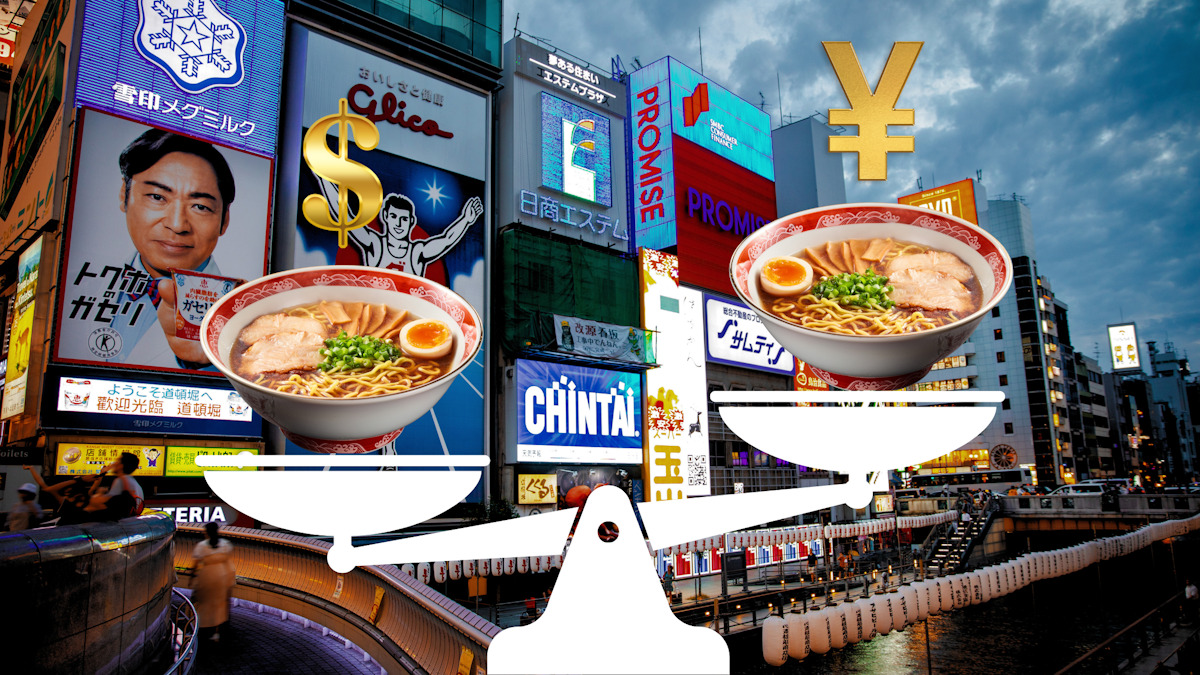


A popular ramen shop in Osaka has sparked debate after a dispute with a foreign tourist led the shop to declare it would ban Chinese customers outright. The announcement led to a dispute over “two-tier pricing,” which saw the store charging non-Japanese speakers nearly double what Japanese speakers are charged.
A dispute over the bill ends in racist declaration
The shop, IEKEI OSAKA near Namba Station, uses a multilingual ticket vending machine. Customers who select Japanese see ramen priced at around 1,000 yen, or about 6.70 US dollars. Customers who select a foreign language such as English, Korean, or Chinese are shown prices closer to 2,000 yen, or roughly 13.30 US dollars. The shop states that the higher-priced ramen is a different product, with adjusted seasoning and additional toppings aimed at foreign tastes.
On January 4, a Chinese tourist who ordered the foreign-language menu ramen demanded a refund after finishing the meal, claiming the menu differed from what was expected. According to the shop, the disagreement escalated to the point where police intervention was considered.
The situation ultimately ended without officers arriving. However, afterwards, the shop posted on its X account that, because “90%” of the trouble at the store is caused by Chinese customers, it would ban all Chinese people from entering.
A premium ramen only for foreigners?
Shop owner Arai Yusuke defended the pricing system in media interviews. He said the shop introduced double pricing while accepting the risks. Arai explained that the system separates customers by language ability, with the ticket machine asking users to select a language first.
According to Arai, the foreign-language menu offers a premium ramen that uses a milder seasoning and blended soy sauce. It also includes more meat than the standard version. Arai said preparing these bowls requires double the workload.
The shop also cited operational concerns. Family-style ramen orders involve many customization choices. Explaining these options in foreign languages slows service. Arai said slower service harms table turnover and staff efficiency.
Online backlash causes store to backtrack on ban
Once photos of the ticket vending machine began circulating online, the controversy spread rapidly. The images showed stark price differences between Japanese and foreign-language menus, with some items costing up to 2.2 times more depending on the language selected.
For example, ramen priced at 950 yen, or about 6.30 US dollars, on the Japanese menu appeared as 1,500 yen, or 10 US dollars, on foreign-language menus, while higher-end items rose from 1,350 yen, or 9 US dollars, to as much as 2,200 yen, or about 14.70 US dollars.
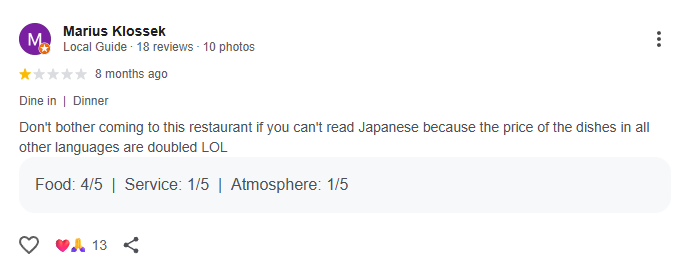
Customers posted critical reviews on Google. Several foreign customers said staff directed them away from the Japanese menu. Some said staff told them to order only in their native language. Korean reviewers claimed staff blocked them from viewing the cheaper options.
Japanese customers also weighed in, with some calling the practice discriminatory and damaging to Japan’s reputation. Phrases such as “embarrassing as a Japanese person” and “never support a shop like this” appeared repeatedly.
Planning a trip to Japan? Get an authentic, interpreted experience from Unseen Japan Tours and see a side of the country others miss!

Arai responded by uploading a YouTube video explaining his stance, stressing that it was not an apology video. Rather than calming the situation, the explanation further polarized public opinion and led to review bombing and calls for boycotts.
Arai also clarified his post on banning Chinese customers, saying it reflected frustration rather than policy. He stated that no formal ban exists. According to legal experts, such blanket bans based on nationality are illegal under Japan’s Constitution and could expose the store to lawsuits. Discrimination is an especially sensitive subject right now, as Japan’s government is currently cracking down on immigrants who it claims “take advantage” of Japan’s public benefits, such as its health care system.
How the Japanese government is responding
Amid rising disputes, the Consumer Affairs Agency has released guidance on two-tier pricing. The agency publishes rules on price displays, which fall under the Act against Unjustifiable Premiums and Misleading Representations.
The guidelines warn businesses against misleading price displays. Problems occur when businesses compare different products without clarity. Issues also arise when reference prices lack accuracy, which is why the agency emphasizes clear explanations and accurate information.
Although the guidance mainly addresses discount pricing, it applies broadly. Businesses must clearly explain why prices differ, and consumers must understand what they’re purchasing.
In this case, the shop says it displayed a warning on the ticket machine. The notice stated that product specifications and prices change depending on the language.
Critics argue the notice does nothing to avoid confusion, as language choices shouldn’t result in higher prices. Legal experts say that, while the system may follow the law, it can easily cause problems (as we’ve seen).
Double pricing and Japan’s growing inbound tourism challenge
The ramen shop dispute also reflects broader tensions surrounding inbound tourism in Japan.
According to projections released by JTB, Japan is expected to welcome 41.4 million foreign visitors in 2026. While visitors from China are expected to decline, visitors from Europe, the United States, and Australia are expected to continue increasing. These travelers tend to stay longer and spend more, pushing total inbound consumption to an estimated 9.64 trillion yen, or about 64.3 billion US dollars, even as overall visitor numbers decline slightly.
Two-tier pricing has already appeared in theme parks, museums, and historic sites, often framed as discounts for residents rather than surcharges for foreigners. Experts argue that this framing reduces friction by placing the burden of identification on those receiving the benefit.
The Osaka ramen shop case demonstrates how easily pricing strategies can backfire when customers feel their choices are constrained. As Japan continues to rely on inbound tourism while managing social tension and consumer trust, the incident may serve as a warning about how pricing policies can shape perceptions far beyond a single bowl of ramen.
See a side of Tokyo that other tourists can't. Book a tour with Unseen Japan Tours - we'll tailor your trip to your interests and guide you through experiences usually closed off to non-Japanese speakers.

Japan’s Best Seaside Towns: Our Ranking of the Most Idyllic
Our top-scoring towns feature beautiful, swimmable waters, a balance of attraction and solitude, and authentic marine culture.
Kyoto Plans Two-Tier Bus Pricing Amid Overtourism
The city hopes that charging tourists more will make it easier for residents to get around and fund new transportation initiatives.
Anime Pilgrimage in Japan: From Fandom to Infrastructure
How anime pilgrimage in Japan has evolved from a fan ritual into a coordinated regional strategy to boost tourism.
Sources
二重価格でトラブル 「メニュー違う」と訪日客が不満訴え返金要求 テレ朝NEWS
「外国人は高く取る」…日本の有名ラーメン店で“二重価格”論争 中央日報
外国人客が「返金しろ」“二重価格”めぐり人気ラーメン店でトラブル…世界や国内でも広がり見せる“外国人客料金” FNNプライムオンライン
大阪難波のラーメン店「二重価格」で中国人客とトラブル 英語表記はトッピング付きで高額 産経新聞
訪日外国人の見通し、中国・香港からの来日減り5年ぶり減少…欧米豪の伸びは続き消費額は増加 読売新聞
二重価格表示 消費者庁
